
#FactCheck- AI-Generated Image Falsely Shows SRH Team Seeking Blessings
Executive Summary
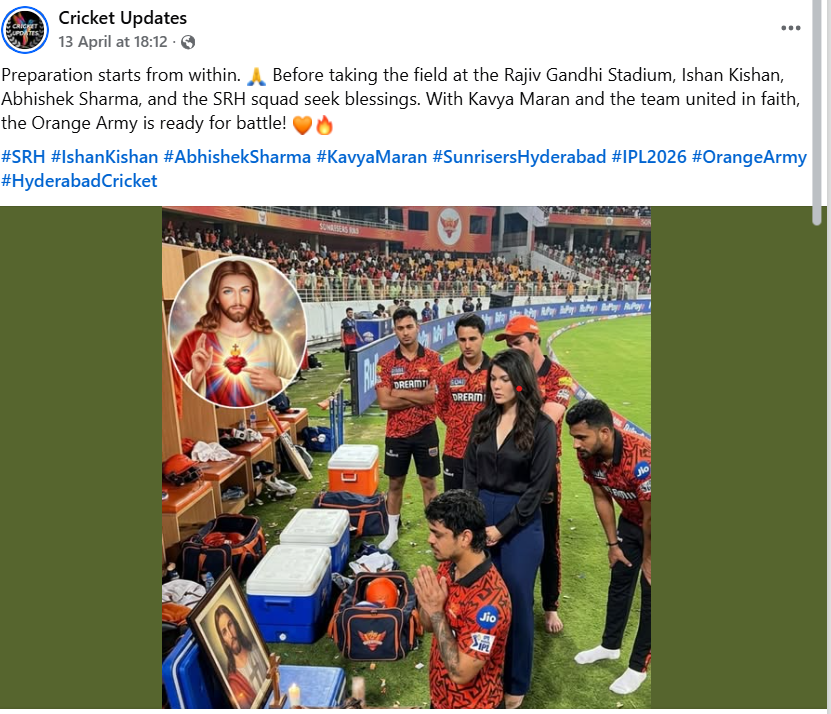
A post is rapidly going viral on social media claiming to show Sunrisers Hyderabad (SRH) captain Ishan Kishan, CEO Kavya Maran, and the team seeking blessings in front of a portrait of Jesus Christ at the Rajiv Gandhi International Cricket Stadium before a match. The image is being shared as a genuine pre-match moment. However, research by the CyberPeace found that the viral image is not real but generated using artificial intelligence (AI). There are no credible media reports or official updates from Sunrisers Hyderabad confirming any such pre-match activity. Further analysis using multiple AI detection tools also indicated that the image is likely synthetic. Therefore, the claim made in the viral post is false.
Claim
A Facebook user shared the image with the caption:“Preparation starts from within. Before taking the field at the Rajiv Gandhi Stadium, Ishan Kishan, Abhishek Sharma, and the SRH squad seek blessings. With Kavya Maran and the team united in faith, the Orange Army is ready for battle!”
- https://archive.ph/wip/dtbZ0
- https://www.facebook.com/13CricketNews/posts/preparation-starts-from-within-before-taking-the-field-at-the-rajiv-gandhi-stadi/1790225659038036/
Fact Check
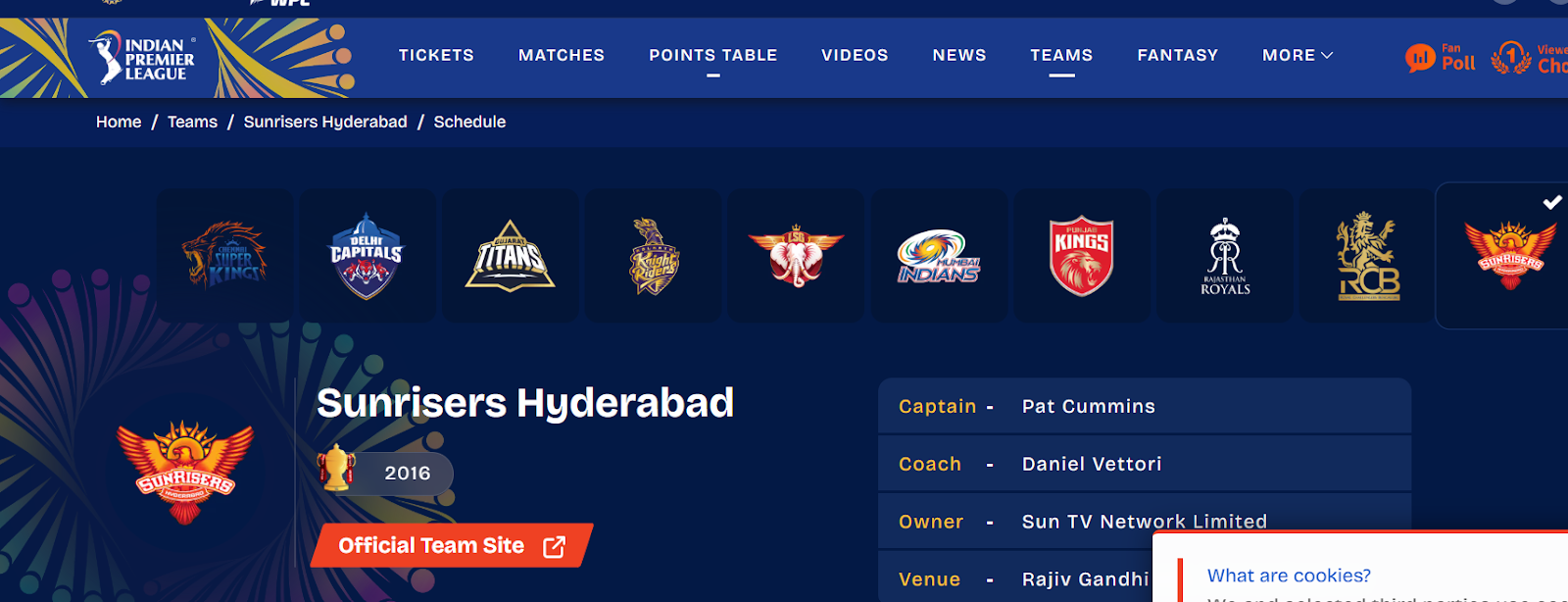
A close inspection of the viral image revealed several inconsistencies. A cooler box in the image bears a sticker of Mumbai Indians, even though Mumbai Indians and Sunrisers Hyderabad had not played each other in IPL 2026 at the time implied by the claim. Their scheduled match is set for April 29, 2026, at Wankhede Stadium, not at the Hyderabad venue shown in the image.
- https://www.iplt20.com/teams/sunrisers-hyderabad/schedule
Additionally, the image incorrectly displays Dream11 as the title sponsor for SRH, whereas Shree Cement is the official title sponsor for the IPL 2026 season.

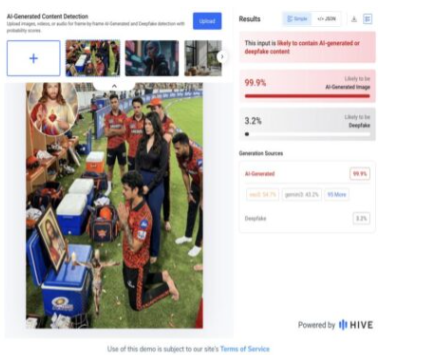
To further verify authenticity, the image was analysed using AI detection tools. Hive Moderation assigned it a 99.9% probability of being AI-generated, strongly indicating that it is not genuine.
Conclusion
The viral claim is false. The image showing Sunrisers Hyderabad players and their CEO praying before a match is AI-generated and does not depict a real event. It has been circulated with a misleading narrative and lacks any factual basis.

Related Blogs
Executive Summary
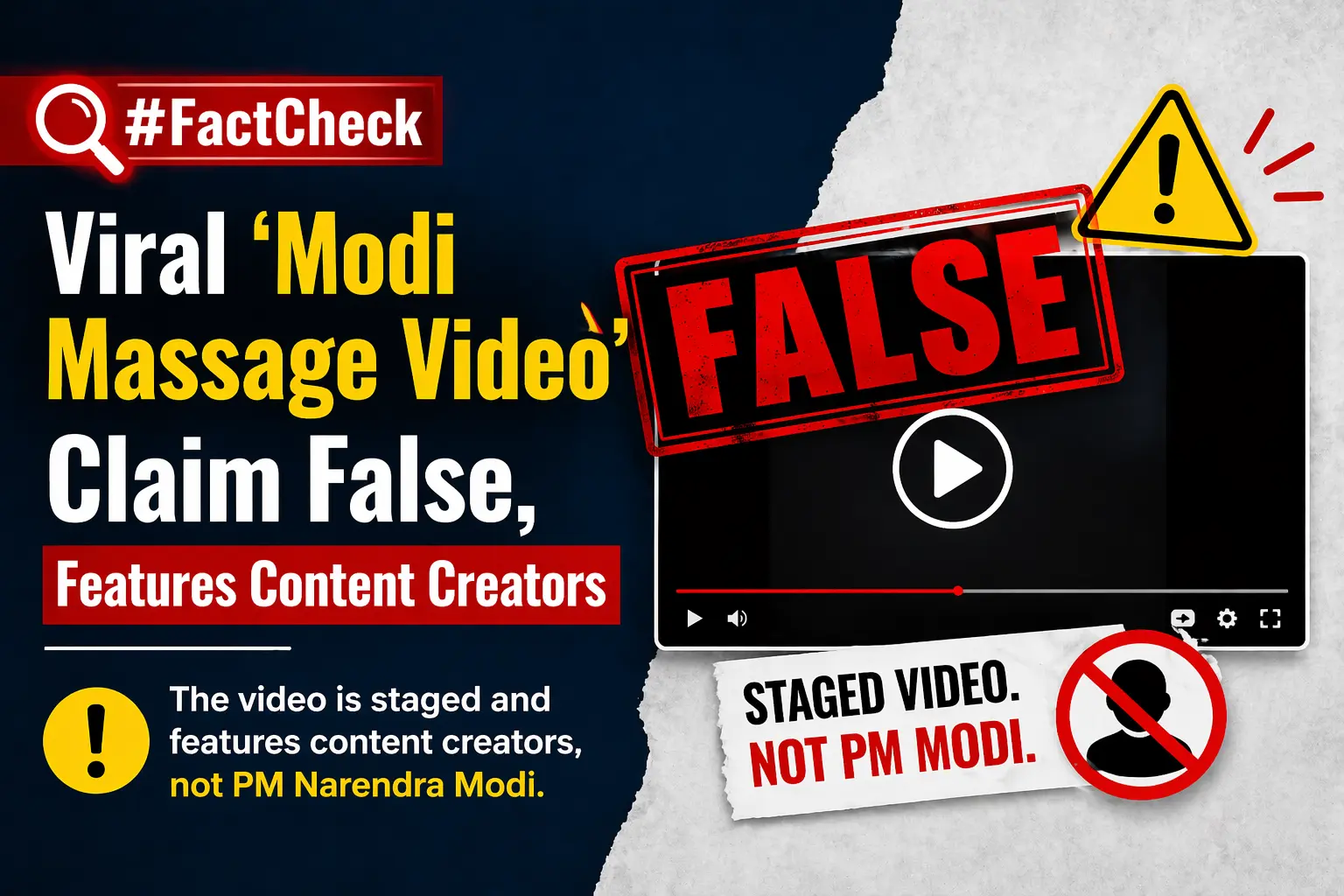
A video showing a woman giving a facial massage to an elderly man with a white beard is going viral on social media, with users claiming that the man is Prime Minister Narendra Modi. Some posts describe it as a “leaked massage video” of the Prime Minister, while others sarcastically link it to the glow on his face. However, research by the CyberPeace Research Wing found that the claim is false. The viral video has no connection to Narendra Modi and is being shared with a misleading narrative.
Claim
An X user named Sonu Singh shared the video with the caption: “Narendra Modi video leaked.”
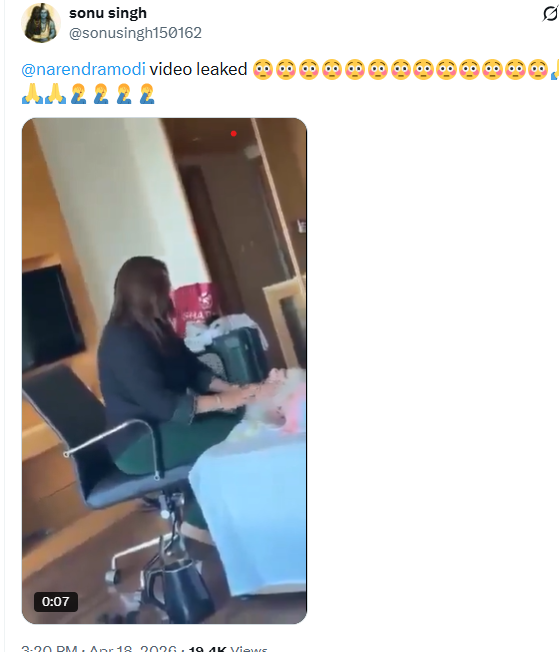
Fact Check
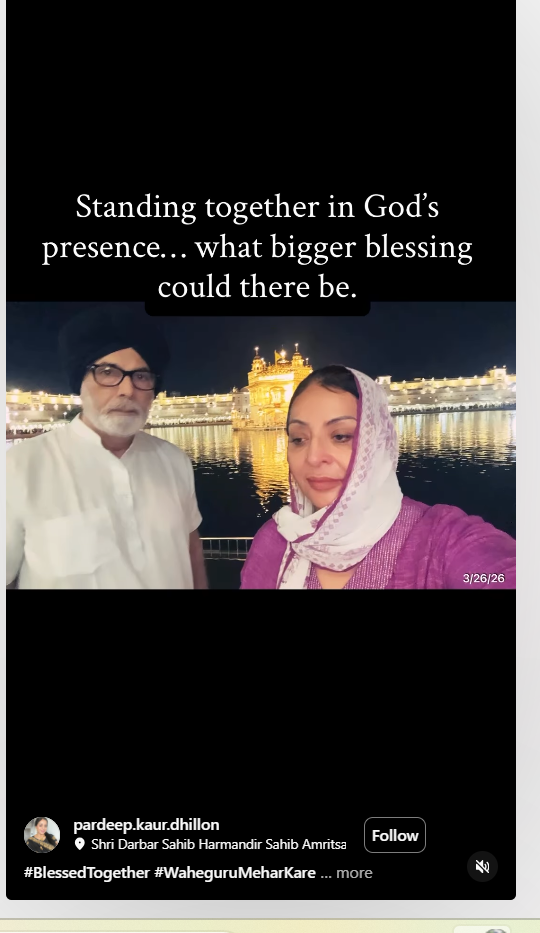
To verify the claim, we extracted keyframes from the viral video and conducted a reverse image search. This led us to the same video uploaded on April 12, 2026, on the Instagram and Facebook pages of content creator Pradeep Kaur Dhillon, where it was captioned “Massage time.”
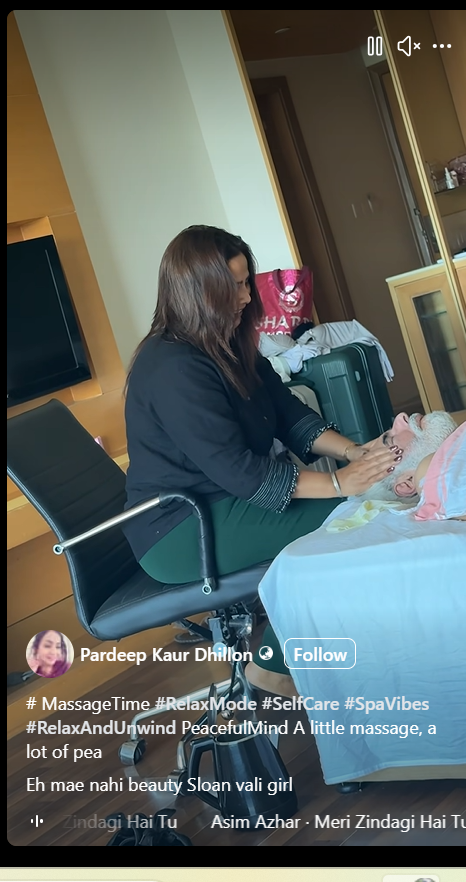
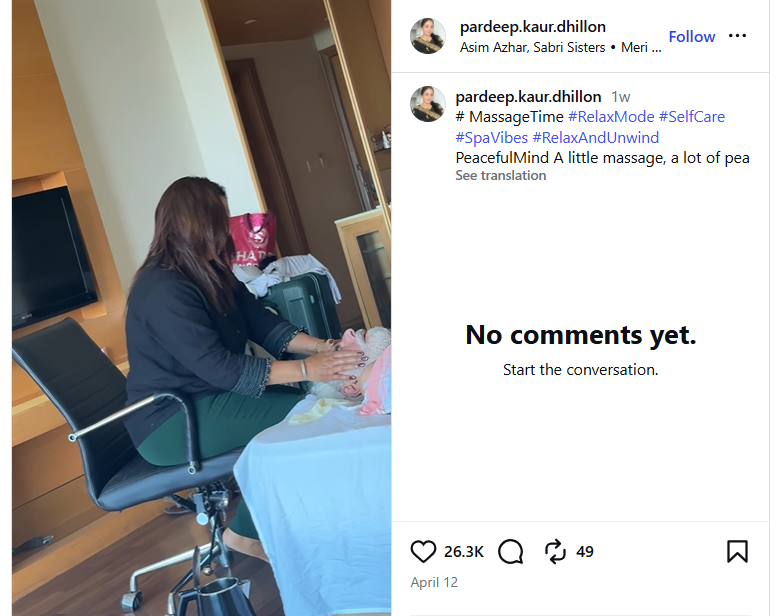
Further checks revealed another similar video posted on March 28, 2026, on the same social media accounts, with the caption: “Stylish, Spa day for him… kyunki self-care sirf ladies layi nahi.”
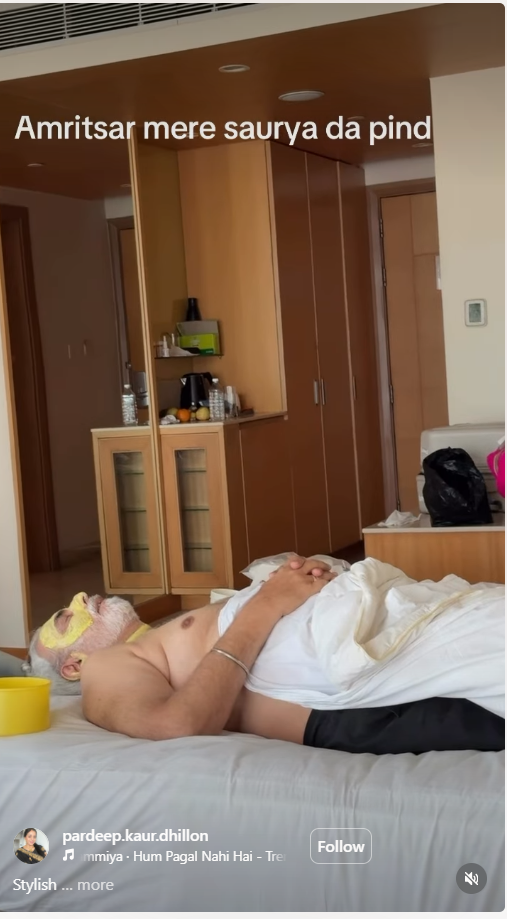
During the research, we also found that the man seen in the video is Jaspal Singh, Dhillon’s partner, who frequently appears in her social media posts. According to publicly available profile details, the duo resides in New Jersey, USA, and originally belongs to Amritsar, Punjab, India.
Conclusion
The viral claim is false. The video does not show Prime Minister Narendra Modi. It features content creators Pradeep Kaur Dhillon and Jaspal Singh and is being circulated online with a false and misleading claim.

Introduction
The Telecom Regulatory Authority of India (TRAI) has directed all telcos to set up detection systems based on Artificial Intelligence and Machine Learning (AI/ML) technologies in order to identify and control spam calls and text messages from unregistered telemarketers (UTMs).
The TRAI Directed telcos
The telecom regulator, TRAI, has directed all Access Providers to detect Unsolicited commercial communication (UCC)by systems, which is based on Artificial Intelligence and Machine Learning to detect, identify, and act against senders of Commercial Communication who are not registered in accordance with the provisions of the Telecom Commercial Communication Customer Preference Regulations, 2018 (TCCCPR-2018). Unregistered Telemarketers (UTMs) are entities that do not register with Access Providers and use 10-digit mobile numbers to send commercial communications via SMS or calls.
TRAI steps to curb Unsolicited commercial communication
TRAI has taken several initiatives to reduce Unsolicited Commercial Communication (UCC), which is a major source of annoyance for the public. It has resulted in fewer complaints filed against Registered Telemarketers (RTMs). Despite the TSPs’ efforts, UCC from Unregistered Telemarketers (UTMs) continues. Sometimes, these UTMs use messages with bogus URLs and phone numbers to trick clients into revealing crucial information, leading to financial loss.
To detect, identify, and prosecute all Unregistered Telemarketers (UTMs), the TRAI has mandated that Access Service Providers implement the UCC.
Detect the System with the necessary functionalities within the TRAI’s Telecom Commercial Communication Customer Preference Regulations, 2018 framework.
Access service providers have implemented such detection systems based on their applicability and practicality. However, because UTMs are constantly creating new strategies for sending unwanted communications, the present UCC detection systems provided by Access Service providers cannot detect such UCC.
TRAI also Directs Telecom Providers to Set Up Digital Platform for Customer Consent to Curb Promotional Calls and Messages.
Unregistered Telemarketers (UTMs) sometimes use messages with fake URLs and phone numbers to trick customers into revealing essential information, resulting in financial loss.
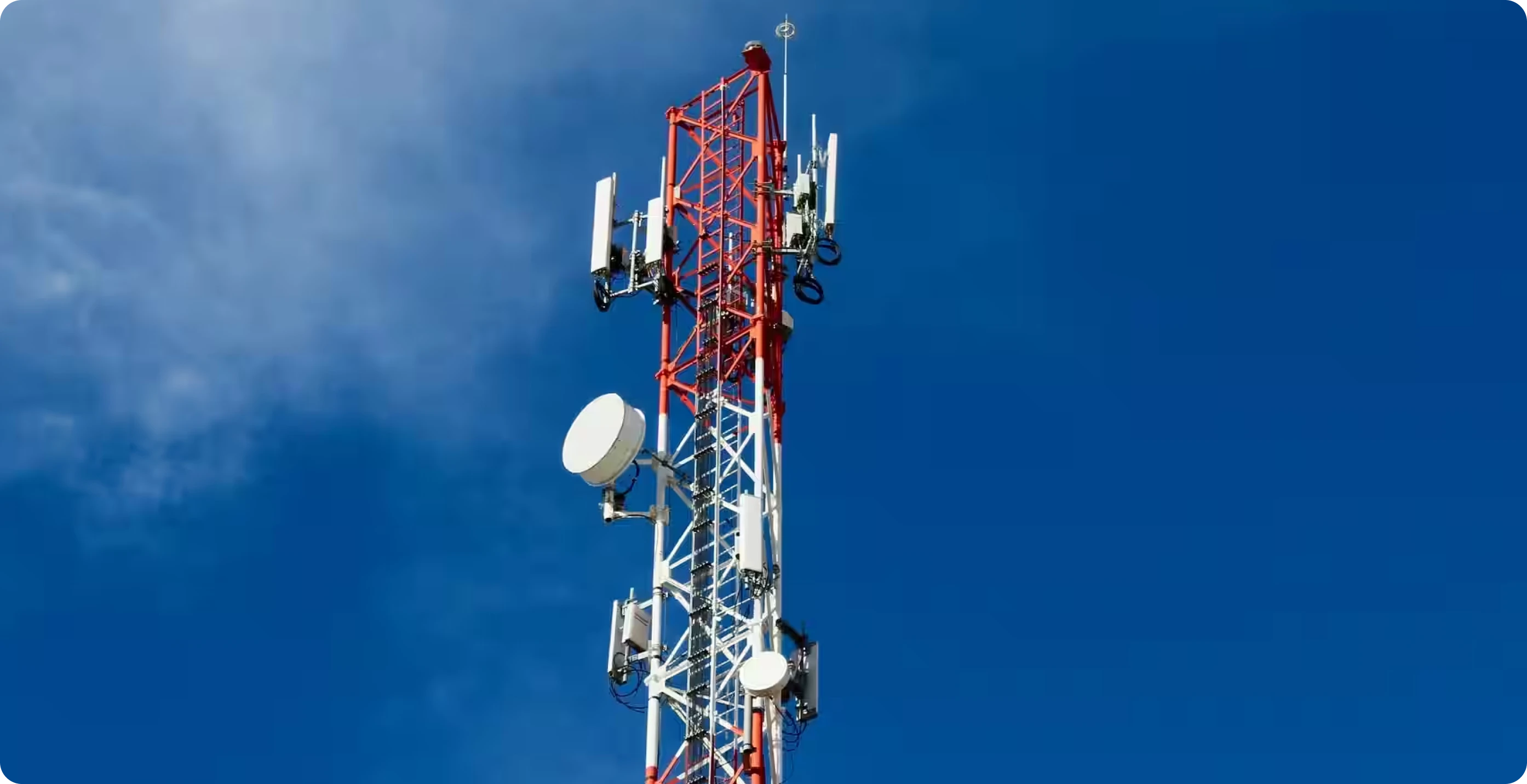
TRAI has urged businesses like banks, insurance companies, financial institutions, and others to re-verify their SMS content templates with telcos within two weeks. It also directed telecom companies to stop misusing commercial messaging templates within the next 45 days.
The telecom regulator has also instructed operators to limit the number of variables in a content template to three. However, if any business intends to utilise more than three variables in a content template for communicating with their users, this should be permitted only after examining the example message, as well as adequate justifications and justification.
In order to ensure consistency in UCC Detect System implementations, TRAI has directed all Access Providers to deploy UCC and detect systems based on artificial intelligence and Machine Learning that are capable of constantly evolving to deal with new signatures, patterns, and techniques used by UTMs.
Access Providers have also been directed to use the DLT platform to share intelligence with others. Access Providers have also been asked to ensure that such UCC Detect System detects senders that send unsolicited commercial communications in bulk and do not comply with the requirements. All Access Providers are directed to follow the instructions and provide an update on actions done within thirty days.
The move by TRAI is to curb the menacing calls as due to this, the number of scam cases is increasing, and now a new trend of scams started as recently, a Twitter user reported receiving an automated call from +91 96681 9555 with the message “This call is from Delhi Police.” It then asked her to stay in the queue since some of her documents needed to be picked up. Then he said he works as a sub-inspector at the Kirti Nagar police station in New Delhi. He then inquired whether she had recently misplaced her Aadhaar card, PAN card, or ATM card, to which she replied ‘no’. The scammer then poses as a cop and requests that she authenticate the last four digits of her card because they have found a card with her name on it. And a lot of other people tweeted about it.

Conclusion
TRAI directed the telcos to check the calls and messages from Unregistered numbers. This step of TRAI will curb the pesky calls and messages and catch the Frauds who are not registered with the regulation. Sometimes the unregistered sender sends fraudulent links, and through these fraudulent calls and messages, the sender tries to take the personal information of the customers, which results in financial losses.
.webp)
Introduction
We were all stunned and taken aback when multiple photos of streets in the U.S. surfaced with heavily drugged individuals loosely sitting on the streets, victims of a systematically led drug operation that has recently become a target of the Trump-led “tariff” war, which he terms as a war on drug cartels. The drug is a synthetic opioid, fentanyl, which is highly powerful and addictive. The menace of this drug is found in a country that has Wall Street and the largest and most powerful economy globally. The serious implications of drug abuse are not about a certain economy; instead, it has huge costs to society in general. The estimated cost of substance misuse to society is more than $820 billion each year and is expected to continue rising.
On June 26, the International Day against Drug Abuse and Illicit Trafficking is observed globally. However, this war is waged daily for millions of people, not on streets or borders, but in bloodstreams, behind locked doors, and inside broken homes. Drug abuse is no longer a health crisis; it is a developmental crisis. The United Nations Office on Drugs and Crime has launched a campaign against this organised crime that says, “Break the Cycle’ attributing to the fact that de-addiction is hard for individuals.
The Evolving Drug Crisis: From Alleyways to Algorithms
The menace of Drug abuse and illicit trafficking has also taken strides in advancement, and what was once considered a street-side vice has made its way online in a faceless, encrypted, and algorithmically optimised sense. The online drug cartels operate in the shadows and often hide in plain sight, taking advantage of the privacy designed to benefit individuals. With the help of darknet markets, cryptocurrency, and anonymised logistics, the drug trade has transformed into a transnational, tech-enabled industry on a global scale. In an operation led by the U.S. Department of Justice’s Joint Criminal Opiod and Darknet Enforcement (JCODE) and related to Operation RapTor, an LA apartment was only to find an organised business centre that operated as a hub of one of the most prolific methamphetamine and cocaine distributors in the market. Aaron Pinder, Unit Chief of the FBI Hi-Tech Organised Crime Unit, said in his interview, “The darknet vendors that we investigate, they truly operate on a global scale.” On January 11, 2025, during the Regional Conference on “Drug Trafficking and National Security,” it was acknowledged how cryptocurrency, the dark web, online marketplaces, and drones have made drug trafficking a faceless crime. Reportedly, there has been a seven-fold increase in the drugs seized from 2004-14 to 2014-24.
India’s Response: Bridging Borders, Policing Bytes
India has been historically vulnerable due to its geostrategic placement between the Golden Crescent (Afghanistan-Iran-Pakistan) and Golden Triangle (Myanmar-Laos-Thailand), and confronts a fresh danger from “click-to-consume’ narcotics. Although India has always adopted a highly sensitised approach, it holds an optimistic future outlook for the youth. Last year, to commemorate the occasion of International Day against Drug Abuse and Illicit Trafficking, the Department of Social Justice & Empowerment organised a programme to engage individuals for the cause. The Indian authorities are often seen coming down heavily on the drug peddlers and cartels, and to aid the cause, the Home Minister Amit Shah inaugurated the new office complex of the NCB’s Bhopal zonal unit and extension of the MANAS-2 helpline to all 36 states and UTs. The primary objectives of this step are to evaluate the effectiveness of the Narcotics Coordination Mechanism (NCORD), assess the progress of states in fighting drug trafficking, and share real-time information from the National Narcotics Helpline ‘MANAS’ portal with the Anti-Narcotics Task Force (ANTF) of states and UTs.
The United Nation’s War on Narcotics: From Treaties to Technology
The United Nations Office on Drugs and Crime (UNODC) is leading the international response. It offers vital data, early warning systems, and technical support to the states fighting the drug problem. The UNODC incorporates cooperation in cross-border intelligence, overseeing the darknet activities, encouraging the treatment and harm reduction, and using anti-money laundering mechanisms to stop financial flows. India has always pledged its support to the UN led activities, and as per reports dated 26th March, 2025, India chaired the prestigious UN-backed Commission on Narcotic Drugs (CND) meeting held in vienna, wherein India highlighted the importance of opioids for medical purposes as well as the nation’s notable advancements in the field.
Resolution on June 26: From Commemoration to Commitment
Let June 26 be more than a date on the calendar- let it echo as a call to action, a day when awareness transforms into action, and resolve becomes resistance. On this day, CyberPeace resolves the following:
- To treat addicts as victims rather than criminals and to pitch for reforms to provide access to reasonably priced, stigma-free rehabilitation.
- To integrate anti-drug awareness into digital literacy initiatives and school curricula in order to teach frequently and early.
- To demand responsibility and accountability from online marketplaces and delivery services that unwittingly aid traffickers
- To tackle the demand side through employment, mental health services, and social protection, particularly for at-risk youth.
References
- https://www.gatewayfoundation.org/blog/cost-of-drug-addiction/#:~:text=The%20estimated%20cost%20for%20substance,Alcohol%3A%20%24249%20billion
- https://www.unodc.org/unodc/en/drugs/index-new.html
- https://www.fbi.gov/news/stories/global-operation-targets-darknet-drug-trafficking
- https://www.thehindu.com/news/national/dark-web-crypto-drones-emerge-as-challenges-in-fight-against-drug-trafficking-amit-shah/article69088383.ece
- https://www.pib.gov.in/PressReleaseIframePage.aspx?PRID=2028704
- https://www.newindianexpress.com/nation/2025/Mar/26/in-a-first-india-chairs-un-forum-on-narcotics-pledges-to-improve-access-to-pain-relief-and-palliative-care
