
#FactCheck- AI-Generated Flyover Video Falsely Shared as Patna Infrastructure
Executive Summary
A video showing a modern highway flyover illuminated at night is being widely shared on social media. The bridge features bright white light poles and illuminated barriers. The video is being falsely claimed to be from Patna, Bihar. A CyberPeace Research Wing research has found the claim to be false. Our verification shows that the viral video is not real but AI-generated and is being circulated with misleading claims.
Claim:
A user on YouTube shared the viral video, claiming it shows a flyover in Patna. The post, along with its archive link and screenshots, can be seen below:
https://www.youtube.com/shorts/j9jU-QVKcrw

Meanwhile, the BJP also shared the same video on its official Facebook page, writing: “Don’t be surprised, this is Patna, the capital of Bihar! Where there is BJP-NDA government, development moves at a fast pace.” The post link, archive link, and screenshots are available below:
https://www.facebook.com/bjp4bihar

Fact Check
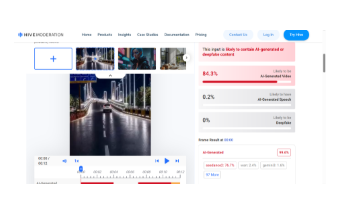
A careful review of the viral video raised suspicions that it may be AI-generated. The footage was analysed using the AI detection tool HIVE MODERATION, which indicated that the video is approximately 84% likely to be AI-generated.
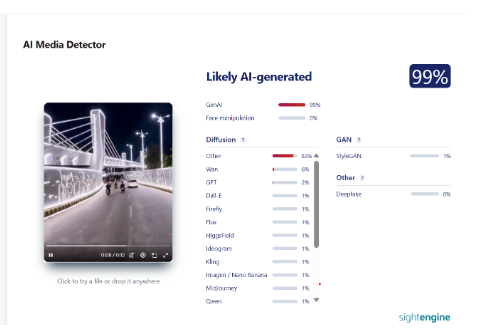
We also analysed the video using another AI detection tool, SIGHTENGINE, which produced an even stronger result, indicating a 99% likelihood of AI generation.
Conclusion:
The viral video being circulated as a flyover from Patna is not real. It is AI-generated and is being shared with misleading claims.

Related Blogs

Executive Summary
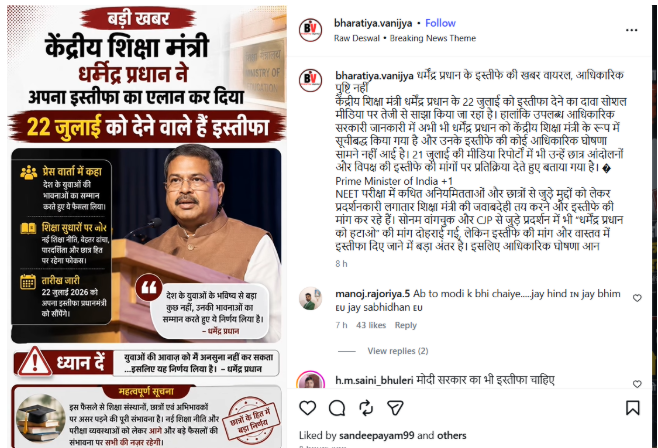
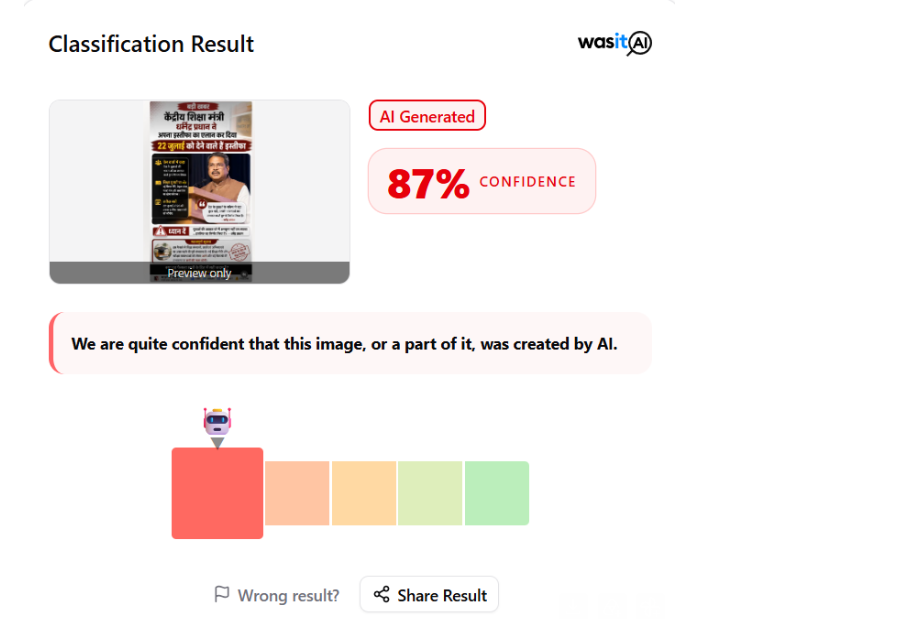
A news graphic is being widely shared on social media claiming that Union Education Minister Dharmendra Pradhan will resign on July 22. The graphic quotes him as saying, "Respecting the sentiments of the country's youth, I have taken this decision." CyberPeace Research Wing ’s research found the claim to be false. The probe revealed that no official announcement has been made regarding Dharmendra Pradhan’s resignation as Union Education Minister. However, demands for his resignation have intensified from opposition parties and student groups over alleged irregularities in NEET and other examinations, leading to protests in Delhi and other places. The research also found that the viral news graphic circulating on social media was likely created using Artificial Intelligence (AI).
Claim:
A social media user on Instagram shared the viral news graphic on July 21, 2026, claiming that Union Education Minister Dharmendra Pradhan is set to resign on July 22. The post also claimed that Pradhan said during a press conference, "Respecting the sentiments of the country's youth, I have taken this decision."
https://www.instagram.com/reel/DbEMoRtgLfT/?igsh=c3g3dzZxZ2U3YW01
Fact Check:
To verify the authenticity of the viral claim, we conducted a Google search using relevant keywords. However, we did not find any credible media reports confirming that Union Education Minister Dharmendra Pradhan is resigning on July 22.Further, we examined the official X (formerly Twitter) account of Union Education Minister Dharmendra Pradhan. No official announcement or post related to his resignation was found on his account.
https://x.com/dpradhanbjp?lang=en

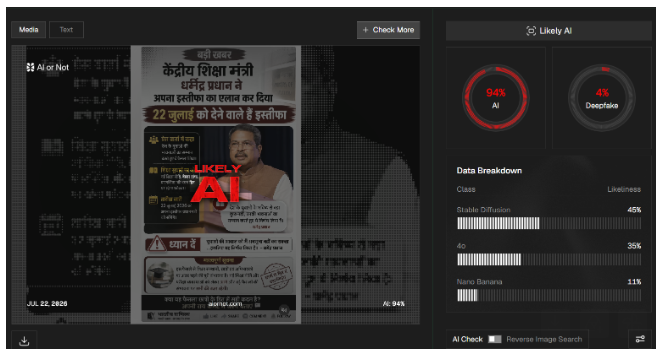
Upon examining the viral news graphic, we noticed several indicators suggesting that it could be AI-generated. To verify this, we analysed the graphic using the AI detection tool AI or Not. The tool’s analysis indicated a 94% probability that the graphic was generated using AI.
We also scanned the viral graphic through another AI detection tool, WasIt AI. According to the tool’s results, the probability of the graphic being AI-generated was found to be 87%.
Conclusion:
CyberPeace Research Wing ’s fact check found the viral claim to be false. No official announcement has been made regarding Union Education Minister Dharmendra Pradhan’s resignation, and reports claiming that he will resign on July 22 are incorrect. The research further revealed that the viral news graphic circulating on social media was created using Artificial Intelligence (AI).

Executive Summary
A video has recently gone viral on social media, with claims that it shows Iranian air defence systems intercepting attacks by US fighter jets. The video is being widely shared across various social media platforms, linking it to the ongoing military tensions between Iran and the United States. CyberPeace’s research found the viral claim to be misleading. The research revealed that the video is old and has no connection with the ongoing war between Iran and the US or any recent military action.
Claim:
A video shared on the social media platform X claims that Iranian air defence systems are responding to an attack by US aircraft.
https://x.com/tvir_X/status/2095185048567968013?s=20

Factcheck
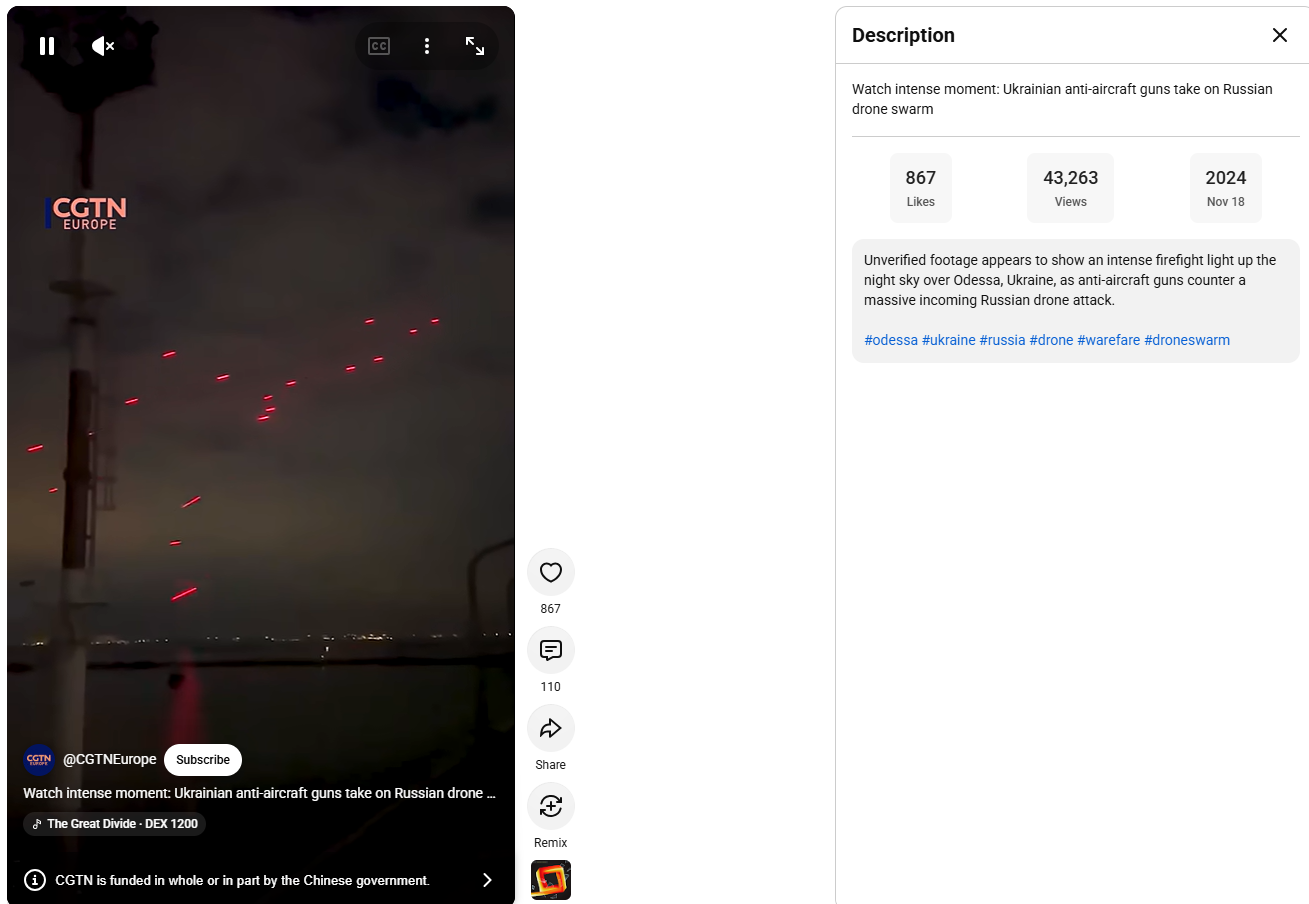
As part of our research, we conducted a reverse image search of the keyframes from the viral video. During the search, we found the same video on The Sun’s YouTube channel, where it was published on November 16, 2024. According to the video’s description, the incident took place in Odesa, Ukraine, where Ukrainian air defence systems engaged in a heavy confrontation with Russian drones. The descr
https://www.youtube.com/watch?v=TxECQr27wng

As part of our research, we found the video on the CGTN Europe YouTube channel, where it was published on November 18, 2024.The unverified footage appears to show heavy gunfire lighting up the night sky over Odesa, Ukraine. It is claimed that anti-aircraft guns were fired in response to a Russian drone attack.
https://www.youtube.com/shorts/Hq5P-UoPNHc
Conclusion:
The evidence gathered during our research makes it clear that the video circulating on social media is not related to the ongoing military tensions or any recent military action between Iran and the United States. A reverse image search revealed that the same video was published in November 2024. According to the video’s description, it shows Ukrainian air defence systems responding to a Russian drone attack in Odesa, Ukraine. Therefore, the claim that the viral video shows Iranian air defence systems intercepting attacks by US fighter jets is misleading.
.jpeg)
Introduction and Brief Analysis
A movie named “The Artifice Girl” portrayed A law enforcement agency developing an AI-based personification of a 12-year-old girl who appears to be exactly like a real person. Believing her to be an actual girl, perpetrators of child sexual exploitation were caught attempting to seek sexual favours. The movie showed how AI aided law enforcement, but the reality is that the emergence of Artificial Intelligence has posed numerous challenges in multiple directions. This example illustrates both the promise and the complexity of using AI in sensitive areas like law enforcement, where technological innovation must be carefully balanced with ethical and legal considerations.
Detection and Protection tools are constantly competing with technologies that generate content, automate grooming and challenge legal boundaries. Such technological advancements have provided enough ground for the proliferation of Child Sexual Exploitation and Abuse Material (CSEAM). Also known as child pornography under Section 2 (da) of Protection of Children from Sexual Offences Act, 2012, it defined it as - “means any visual depiction of sexually explicit conduct involving a child which includes a photograph, video, digital or computer-generated image indistinguishable from an actual child and image created, adapted, or modified, but appears to depict a child.”
Artificial Intelligence is a category of technologies that attempt to shape human thoughts and behaviours using input algorithms and datasets. Two Primary applications can be considered in the context of CSEAM: classifiers and content generators. Classifiers are programs that learn from large data sets, which may be labelled or unlabelled and further classify what is restricted or illegal. Whereas generative AI is also trained on large datasets, it uses that knowledge to create new things. Majority of current AI research related to AI for CSEAM is done by the use of Artificial neural networks (ANNs), a type of AI that can be trained to identify unusual connections between items (classification) and to generate unique combinations of items (e.g., elements of a picture) based on the training data used.
Current Legal Landscape
The legal Landscape in terms of AI is yet unclear and evolving, with different nations trying to track the evolution of AI and develop laws. However, some laws directly address CSEAM. The International Centre for Missing and Exploited Children (ICMEC) combats Illegal sexual content involving children. They have a “Model Legislation” for setting recommended sanctions/sentencing. According to research performed in 2018, Illegal sexual content involving children is illegal in 118 of the 196 Interpol member states. This figure represents countries that have sufficient legislation in place to meet 4 or 5 of the 5 criteria defined by the ICMEC.
CSEAM in India can be reported on various portals like the ‘National Cyber Crime Reporting Portal’. Online crimes related to children, including CSEAM, can be reported to this portal by visiting cybercrime.gov.in. This portal allows anonymous reporting, automatic FIR registration and tracking of your complaint. ‘I4C Sahyog Portal’ is another platform managed by the Indian Cyber Crime Coordination Centre (I4C). This portal integrates with social media platforms.
The Indian legal front for AI is evolving and CSEAM is well addressed in Indian laws and through judicial pronouncements. The Supreme Court judgement on Alliance and Anr v S Harish and ors is a landmark in this regard. The following principles were highlighted in this judgment.
- The term “child pornography” should be substituted by “Child Sexual Exploitation and Abuse Material” (CSEAM) and shall not be used for any further judicial proceeding, order, or judgment. Also, parliament should amend the same in POCSO and instead, the term CSEAM should be endorsed.
- Parliament to consider amending Section 15 (1) of POCSO to make it more convenient for the general public to report by way of an online portal.
- Implementing sex education programs to give young people a clear understanding of consent and the consequences of exploitation. To help prevent Problematic sexual behaviour (PSB), schools should teach students about consent, healthy relationships and appropriate behaviour.
- Support services to the victims and rehabilitation programs for the offenders are essential.
- Early identification of at-risk individuals and implementation of intervention strategies for youth.
Distinctive Challenges
According to a report by the National Centre for Missing and Exploited Children (NCMEC), a significant number of reports about child sexual exploitation and abuse material (CSEAM) are linked to perpetrators based outside the country. This highlights major challenges related to jurisdiction and anonymity in addressing such crimes. Since the issue concerns children and considering the cross-border nature of the internet and the emergence of AI, Nations across the globe need to come together to solve this matter. Delays in the extradition procedure and irregular legal processes across the jurisdictions hinder the apprehension of offenders and the delivery of justice to victims.
CyberPeace Recommendations
For effective regulation of AI-generated CSEAM, laws are required to be strengthened for AI developers and trainers to prevent misuse of their tools. AI should be designed with its ethical considerations, ensuring respect for privacy, consent and child rights. There can be a self-regulation mechanism for AI models to recognise and restrict red flags related to CSEAM and indicate grooming or potential abuse.
A distinct Indian CSEAM reporting portal is urgently needed, as cybercrimes are increasing throughout the nation. Depending on the integrated portal may lead to ignorance of AI-based CSEAM cases. This would result in faster response and focused tracking. Since AI-generated content is detectable. The portal should also include an automated AI-content detection system linked directly to law enforcement for swift action.
Furthermore, International cooperation is of utmost importance to win the battle of AI-enabled challenges and to fill the jurisdictional gaps. A united global effort is required. Using a common technology and unified international laws is essential to tackle AI-driven child sexual exploitation across borders and protect children everywhere. CSEAM is an extremely serious issue. Children are among the most vulnerable to such harmful content. This threat must be addressed without delay, through stronger policies, dedicated reporting mechanisms and swift action to protect children from exploitation.
References:
- https://www.sciencedirect.com/science/article/pii/S2950193824000433?ref=pdf_download&fr=RR-2&rr=94efffff09e95975
- https://aasc.assam.gov.in/sites/default/files/swf_utility_folder/departments/aasc_webcomindia_org_oi d_4/portlet/level_2/pocso_act.pdf
- https://www.manupatracademy.com/assets/pdf/legalpost/just-rights-for-children-alliance-and-anr-vs-sharish-and-ors.pdfhttps://www.icmec.orghttps://www.missingkids.org/theissues/generative-ai
