
#FactCheck - AI‑Manipulated Audio Used to Falsely Claim Trump Warned India Over Russia Ties
A video circulating widely on social media claims to show former US President Donald Trump issuing a threat to India over its relationship with Russia. In the clip, Trump is allegedly heard warning New Delhi that if it does not cut bilateral ties with Moscow, the United States would “treat India the same way Pakistan did during the May war.”
The reference to the “May war” appears to point to the India-Pakistan military escalation in May 2025, which followed the Pahalgam terror attack and India’s retaliatory strikes under Operation Sindoor targeting terror infrastructure.
However, research done by the Cyber Peace Foundation has found that the video is misleading and digitally manipulated.
The visuals used in the viral clip are genuine and were taken from a press briefing addressed by Donald Trump on January 3, 2026. However, the audio track accompanying the video has been fabricated and falsely superimposed to
misrepresent his remarks. In the original address, Trump was speaking about a US-led military operation in Caracas that reportedly resulted in the capture of Venezuelan President Nicolás Maduro and his wife. He made no reference to India, Russia, or any geopolitical warning involving New Delhi.
Claim:
On January 10, an X (formerly Twitter) user, Niki Chiri (@cutehunmee), shared a video claiming it showed Donald Trump threatening India over its ties with Russia.
In the clip, Trump is purportedly heard stating that unless India severed its relationship with Moscow, the United States would respond in a manner similar to Pakistan’s actions during the May conflict.
The post quickly gained traction, with several users amplifying the claim. Iink,archive link and screenshot
Research:
To verify the authenticity of the video, the Cyber Peace Foundation conducted a reverse image and video analysis. A Google Lens search led investigators to a longer version of the same footage uploaded on the official YouTube channel of The Wall Street Journal, a prominent US-based news outlet.
A comparison confirmed that both videos shared identical visuals, background elements, and camera angles, establishing that the viral clip was sourced from the same press address.
A review of the full speech, however, showed that Trump did not issue any warning to India, nor did he mention Russia or the May conflict. His remarks were strictly focused on developments in Venezuela.
This confirmed that the viral video had been digitally altered. Here is the link to the original video, along with a screenshot:
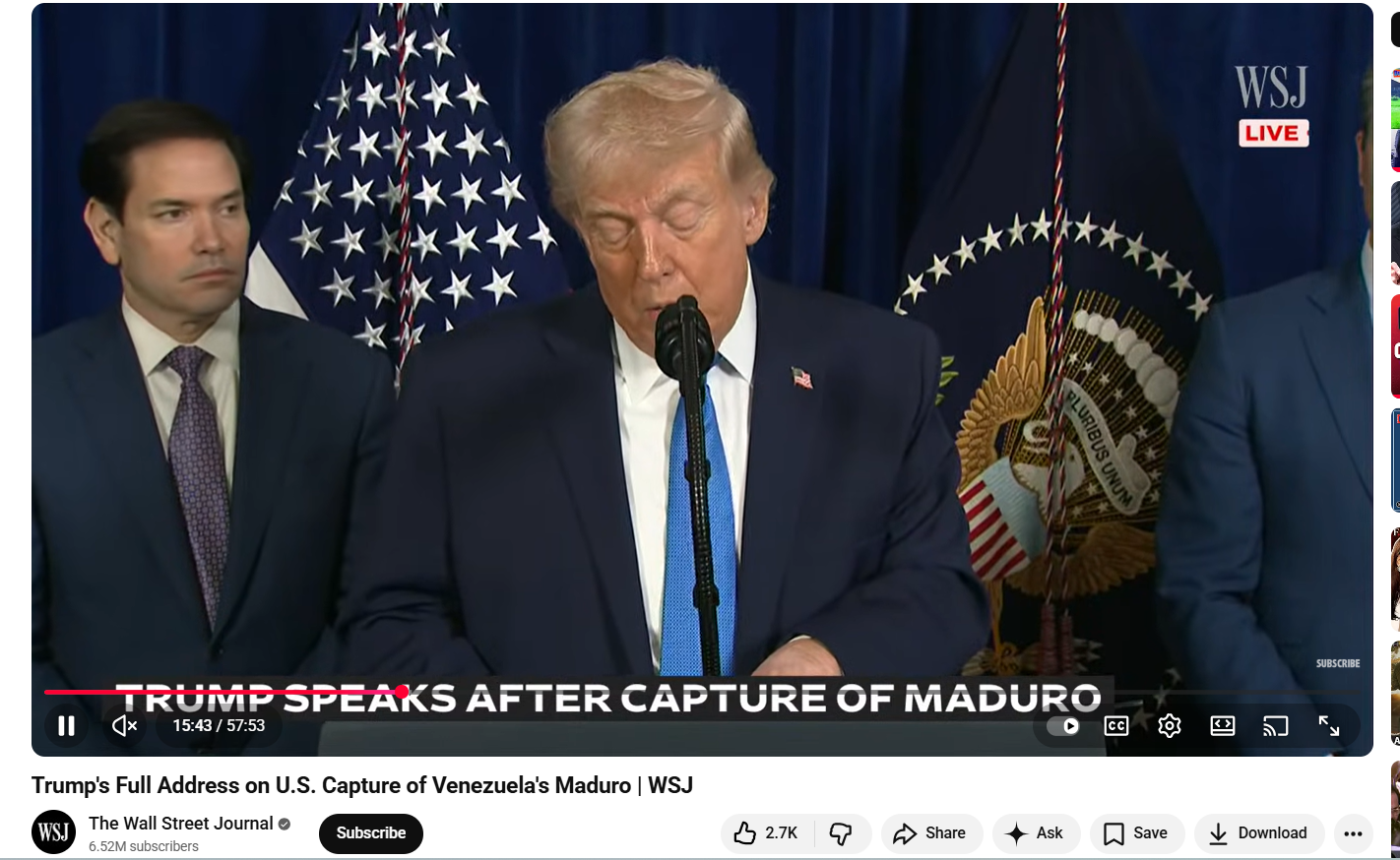
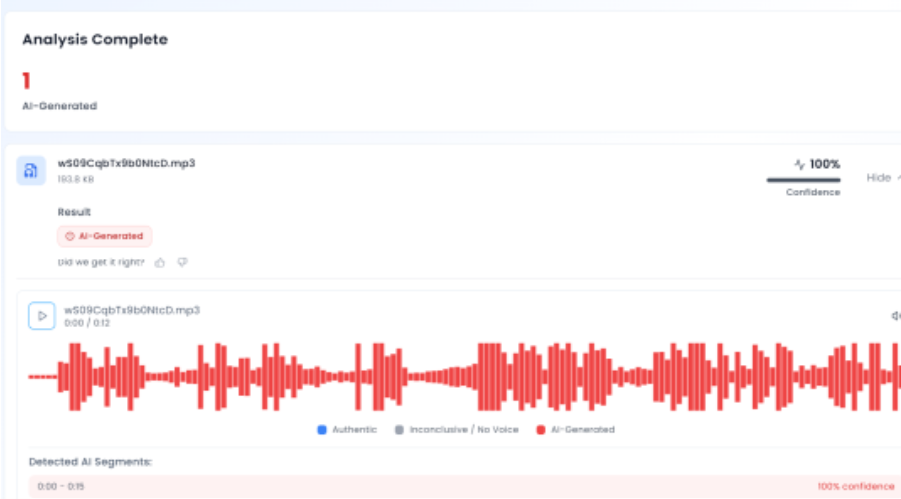
In the next phase of the research, the audio track from the viral clip was extracted and analysed using the AI-based voice detection tool Aurigin. The results indicated a high likelihood that the voice in the video was artificially generated, further confirming that the audio did not originate from Trump’s original speech. A screenshot of the result is provided below.
Conclusion
The claim that a video shows Donald Trump threatening India over its ties with Russia is false. The Cyber Peace Foundation found that while the visuals were taken from a real press address, the audio was fabricated and overlaid to falsely attribute threatening statements to Trump. The manipulated video was circulated online to mislead viewers and spread disinformation.

Related Blogs
Executive Summary
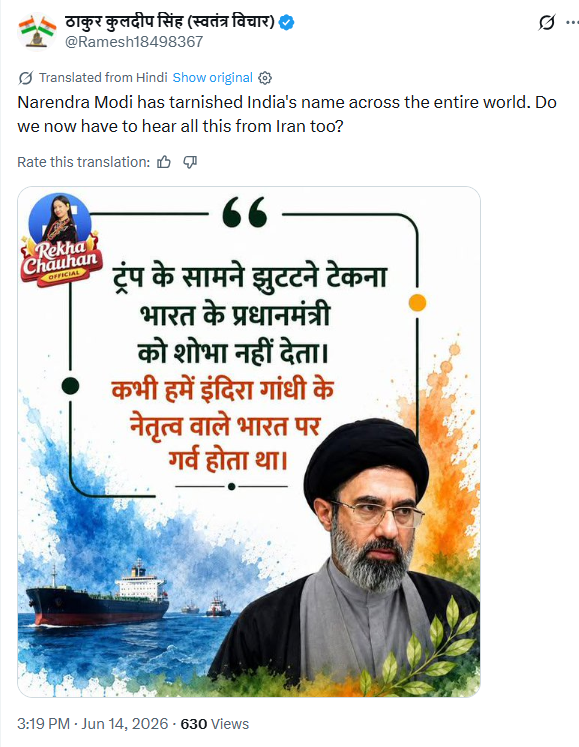
A graphic featuring a photograph of Mojtaba Khamenei, the son of Iran’s Supreme Leader Ayatollah Ali Khamenei, is being widely circulated on social media. The graphic carries a statement attributed to him: “It is not appropriate for the Prime Minister of India to bow before Trump, and India was a matter of pride under Indira Gandhi.” The graphic claims that Mojtaba Khamenei made this statement. CyberPeace Research Wing’s research found that Mojtaba Khamenei did not make any such statement. The research revealed that there is no credible evidence, official statement, interview, or verified social media post supporting the claim. Had such a statement been made by him, it would have been reported by credible media outlets.
Claim
Sharing the graphic, an X user named Thakur Kuldeep Singh wrote:“Narendra Modi has tarnished India’s name across the entire world. Do we now have to hear all this from Iran too?”
https://x.com/Ramesh18498367/status/2066095602954649607?s=20
Fact Check
As part of our fact-checking process, we conducted a keyword search on Google using terms such as “Mojtaba Khamenei criticized India’s Prime Minister for bowing before Trump” and “Mojtaba Khamenei praised India under Indira Gandhi.” However, we found no credible news reports, official statements, interviews, or verified social media posts supporting the claim that Mojtaba Khamenei made such remarks. During our research, we also found a report published by NDTV on March 12, 2026, which mentioned remarks made by a representative of Iran’s Supreme Leader regarding Iran-India relations.

According to the report, the representative stated that Mojtaba Khamenei “loves India” and values the long-standing civilizational ties between the two countries. He further said that Iran’s leadership has historically admired India’s culture, philosophy, and history and has consistently supported stronger relations between the two nations.
Conclusion
Our research found that the claim attributing a statement to Mojtaba Khamenei criticizing India’s Prime Minister for bowing before Trump and praising India during Indira Gandhi’s tenure is false. There is no credible news report, official statement, interview, or verified social media post confirming that Mojtaba Khamenei made such a statement. The viral graphic is being circulated with a false attribution.

Introduction
Recently, in April 2025, security researchers at Oligo Security exposed a substantial and wide-ranging threat impacting Apple's AirPlay protocol and its use via third-party Software Development Kit (SDK). According to the research, the recently discovered set of vulnerabilities titled "AirBorne" had the potential to enable remote code execution, escape permissions, and leak private data across many different Apple and third-party AirPlay-compatible devices. With well over 2.35 billion active Apple devices globally and tens of millions of third-party products that incorporate the AirPlay SDK, the scope of the problem is enormous. Those wireless-based vulnerabilities pose not only a technical threat but also increasingly an enterprise- and consumer-level security concern.
Understanding AirBorne: What’s at Stake?
AirBorne is the title given to a set of 23 vulnerabilities identified in the AirPlay communication protocol and its related SDK utilised by third-party vendors. Seventeen have been given official CVE designations. The most severe among them permit Remote Code Execution (RCE) with zero or limited user interaction. This provides hackers the ability to penetrate home networks, business environments, and even cars with CarPlay technology onboard.
Types of Vulnerabilities Identified
AirBorne vulnerabilities support a range of attack types, including:
- Zero-Click and One-Click RCE
- Access Control List (ACL) bypass
- User interaction bypass
- Local arbitrary file read
- Sensitive data disclosure
- Man-in-the-middle (MITM) attacks
- Denial of Service (DoS)
Each vulnerability can be used individually or chained together to escalate access and broaden the attack surface.
Remote Code Execution (RCE): Key Attack Scenarios
- MacOS – Zero-Click RCE (CVE-2025-24252 & CVE-2025-24206) These weaknesses enable attackers to run code on a MacOS system without any user action, as long as the AirPlay receiver is enabled and configured to accept connections from anyone on the same network. The threat of wormable malware propagating via corporate or public Wi-Fi networks is especially concerning.
- MacOS – One-Click RCE (CVE-2025-24271 & CVE-2025-24137) If AirPlay is set to "Current User," attackers can exploit these CVEs to deploy malicious code with one click by the user. This raises the level of threat in shared office or home networks.
- AirPlay SDK Devices – Zero-Click RCE (CVE-2025-24132) Third-party speakers and receivers through the AirPlay SDK are particularly susceptible, where exploitation requires no user intervention. Upon compromise, the attackers have the potential to play unauthorised media, turn microphones on, or monitor intimate spaces.
- CarPlay Devices – RCE Over Wi-Fi, Bluetooth, or USB CVE-2025-24132 also affects CarPlay-enabled systems. Under certain circumstances, the perpetrators around can take advantage of predictable Wi-Fi credentials, intercept Bluetooth PINs, or utilise USB connections to take over dashboard features, which may distract drivers or listen in on in-car conversations.
Other Exploits Beyond RCE
AirBorne also opens the door for:
- Sensitive Information Disclosure: Exposing private logs or user metadata over local networks (CVE-2025-24270).
- Local Arbitrary File Access: Letting attackers read restricted files on a device (CVE-2025-24270 group).
- DoS Attacks: Exploiting NULL pointer dereferences or misformatted data to crash processes like the AirPlay receiver or WindowServer, forcing user logouts or system instability (CVE-2025-24129, CVE-2025-24177, etc.).
How the Attack Works: A Technical Breakdown
AirPlay sends on port 7000 via HTTP and RTSP, typically encoded in Apple's own plist (property list) form. Exploits result from incorrect treatment of these plists, especially when skipping type checking or assuming invalid data will be valid. For instance, CVE-2025-24129 illustrates how a broken plist can produce type confusion to crash or execute code based on configuration.
A hacker must be within the same Wi-Fi network as the targeted device. This connection might be through a hacked laptop, public wireless with shared access, or an insecure corporate connection. Once in proximity, the hacker has the ability to use AirBorne bugs to hijack AirPlay-enabled devices. There, bad code can be released to spy, gain long-term network access, or spread control to other devices on the network, perhaps creating a botnet or stealing critical data.
The Espionage Angle
Most third-party AirPlay-compatible devices, including smart speakers, contain built-in microphones. In theory, that leaves the door open for such devices to become eavesdropping tools. While Oligo did not show a functional exploit for the purposes of espionage, the risk suggests the gravity of the situation.
The CarPlay Risk Factor
Besides smart home appliances, vulnerabilities in AirBorne have also been found for Apple CarPlay by Oligo. Those vulnerabilities, when exploited, may enable attackers to take over an automobile's entertainment system. Fortunately, the attacks would need pairing directly through USB or Bluetooth and are much less practical. Even so, it illustrates how networks of connected components remain at risk in various situations, ranging from residences to automobiles.
How to Protect Yourself and Your Organisation
- Immediate Actions:
- Update Devices: Ensure all Apple devices and third-party gadgets are upgraded to the latest software version.
- Disable AirPlay Receiver: If AirPlay is not in use, disable it in system settings.
- Restrict AirPlay Access: Use firewalls to block port 7000 from untrusted IPs.
- Set AirPlay to “Current User” to limit network-based attack.
- Organisational Recommendations:
- Communicate the patch urgency to employees and stakeholders.
- Inventory all AirPlay-enabled hardware, including in meeting rooms and vehicles.
- Isolate vulnerable devices on segmented networks until updated.
Conclusion
The AirBorne vulnerabilities illustrate that even mature systems such as Apple's are not immune from foundational security weaknesses. The extensive deployment of AirPlay across devices, industries, and ecosystems makes these vulnerabilities a systemic threat. Oligo's discovery has served to catalyse immediate response from Apple, but since third-party devices remain vulnerable, responsibility falls to users and organisations to install patches, implement robust configurations, and compartmentalise possible attack surfaces. Effective proactive cybersecurity hygiene, network segmentation, and timely patches are the strongest defences to avoid these kinds of wormable, scalable attacks from becoming large-scale breaches.
References
- https://www.oligo.security/blog/airborne
- https://www.wired.com/story/airborne-airplay-flaws/
- https://thehackernews.com/2025/05/wormable-airplay-flaws-enable-zero.html
- https://www.securityweek.com/airplay-vulnerabilities-expose-apple-devices-to-zero-click-takeover/
- https://www.pcmag.com/news/airborne-flaw-exposes-airplay-devices-to-hacking-how-to-protect-yourself
- https://cyberguy.com/security/hackers-breaking-into-apple-devices-through-airplay/
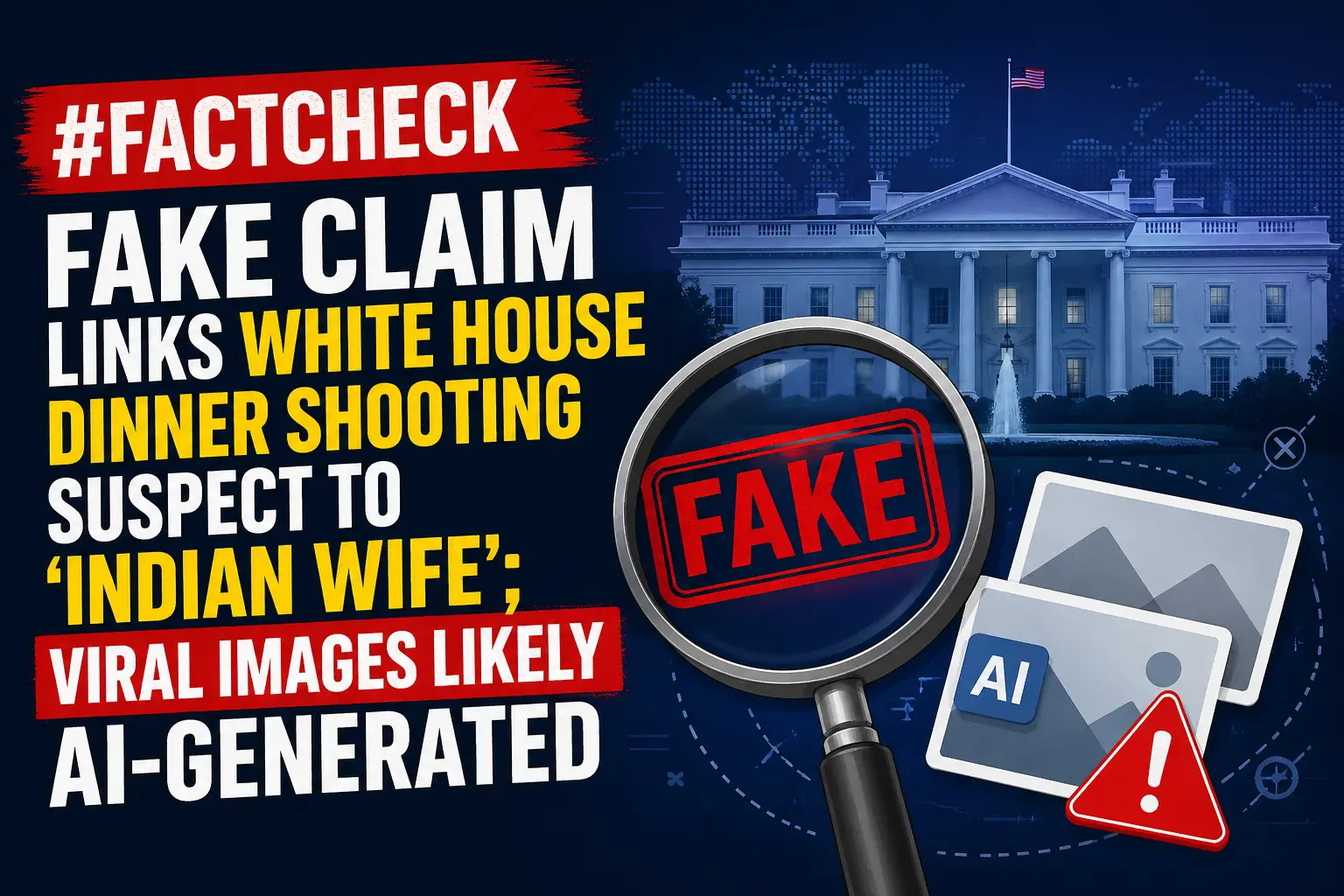
Executive Summary
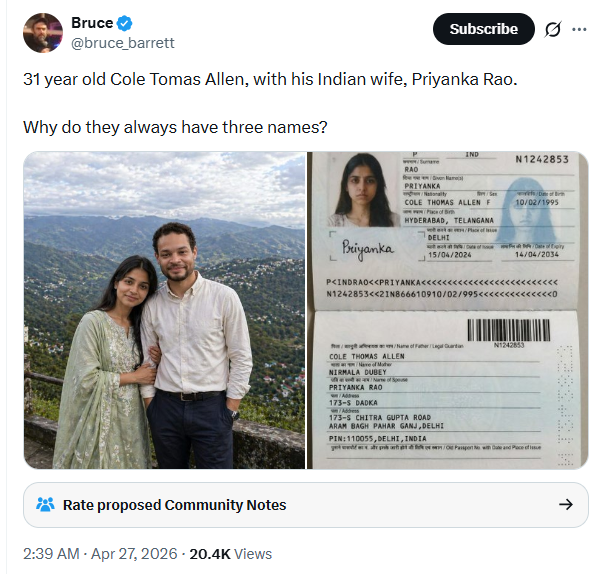
After reports identifying Cole Thomas Allen as the accused in the shooting incident at the White House Correspondents’ Association (WHCA) dinner, several Pakistani propaganda-linked social media accounts began circulating a new claim alleging that the suspect’s wife is an Indian woman named Priyanka Rao. Users shared a photo purportedly showing Cole Thomas Allen with Priyanka Rao, along with an alleged Indian passport in her name. One user posted the image with the caption: “31-year-old Cole Thomas Allen with his Indian wife Priyanka Rao. Why do they always have three names?”
However, research by the CyberPeace Research Wing found the claim to be fake. The viral passport and accompanying image appear to be AI-generated.
Claim:
Social media users claimed that Cole Thomas Allen, accused in the WHCA dinner shooting, is married to an Indian woman named Priyanka Rao.
Fact Check:
During the research, multiple inconsistencies were found in the viral passport image, strongly indicating it is fabricated. A close review of the document revealed several obvious errors commonly seen in AI-generated content. For instance, in the “Nationality” field, the name “Cole Thomas Allen” was written instead of a country name. Such a basic mistake would not appear in any genuine government-issued passport.
The Hindi text on the document was also highly inaccurate and unnatural. Examples included:
- “राष्ट्रीयता” misspelled as “राष्ट्रीयाय”
- “जन्मतिथि” replaced with meaningless text
- “जन्म स्थान” incorrectly written
- “Issue” mistranslated as unrelated wording
- “Date of Expiry” left untranslated in Hindi format
Further analysis using an AI detection tool indicated that the viral passport image had a 69 percent probability of being AI-generated.

Conclusion:
The claim that WHCA dinner shooting accused Cole Thomas Allen has an Indian wife named Priyanka Rao is fake. The viral passport and image being shared online are likely AI-generated and part of a misinformation campaign.
