
AI as a Cognitive Assistant or Cognitive Substitute? The Case for Human-Centred AI Use
Artificial intelligence tends to attract extreme opinions. Some commentators argue it is eroding our capacity to think. Others believe it is freeing our minds for more valuable work. Both views miss the more important point: the effect of AI depends on how a person chooses to use it. Whether a chatbot supports someone's thinking or replaces it altogether comes down to that choice, and that choice is what separates an assistant from a substitute. Not long ago, generative AI was a novelty. Now it shows up daily in classrooms, newsrooms and offices - almost everywhere people write, plan or make decisions. That kind of shift is exactly why researchers have started looking closely at something harder to see: what happens inside the brain once thinking gets outsourced to a machine. The findings are worth knowing.
What the Brain Scans Actually Showed
One of the clearest pieces of evidence comes out of MIT's Media Lab. The study by Nataliya Kosmyna was carried out for 4 months in 2025 with the participation of all in all, there were 54 participants The fifty four participants were divided into three groups and assigned each group one unique but identical writing task. Group one wrote with ChatGPT open in front of them. The second used a standard search engine. The third had access to nothing but their own knowledge. Throughout, an Electroencephalogram (EEG device) sat on every participant's head, feeding the research team a live picture of brain activity as the essays took shape. It did not take long for the ChatGPT group's readings to pull away from the other two. Activity in regions linked to memory and analytical reasoning dropped noticeably. Several participants struggled later to recall, or even accurately quote, essays they had written only minutes before. Kosmyna's team gave this effect a name: cognitive debt, borrowed from the language of personal finance. The convenience arrives immediately; the cost turns up afterwards, in this case as weakened memory and independent reasoning.
A less-reported result from the same study points the other way. Participants who started the task unaided, then moved on to using ChatGPT, showed higher brain activity than before, not lower. That detail matters. It indicates the tool itself is not the problem. What seems to matter more is the mental effort a person has already put in before turning to AI for help.
Assistant or Substitute? The Line Is Thinner Than You Think
A study published in Frontiers in Psychology in July 2026 offers a useful distinction that extends the MIT findings. The researchers differentiate between dependent offloading, where a task is handed over because a person doubts their own ability to complete it, and autonomous offloading, where a person chooses to delegate part of a task while remaining in control of the overall process.
Dependent offloading, according to the study, gradually undermines a person's sense of competence, since it signals, even quietly, that they cannot manage without help. Autonomous offloading works differently. Here, too, the scientists are relieved to discover that giving a wide birth to any 'hardest' decisions-just taking AI's assistance where it can make an honest contribution-boosts rather than damages the confidence. The same holds for creative output too. The tool does not change between these two scenarios. What changes is who remains in charge of the process.
The Cost Nobody Is Measuring at Work
This pattern is not confined to academic settings. Earlier, in August 2026 the Conversation collated workplace data which brings up similar issues. Around six out of 10 workers don’t receive formal training on using AI and the same number say they have used artificial intelligence irresponsibly (or covertly) as part of their work.
A separate finding, from a July 2026 study by the Centre for AI Safety, adds further weight to this concern. Even the most capable AI agents tested were unable to complete around 85 per cent of assigned projects to a standard fit for paid, professional work. Put next to the workplace training gap, these numbers point to something organisations cannot really ignore. Many employees are trusting output from tools they were never taught to question, built by systems that make more mistakes than most people give them credit for. That is not a case for banning AI at work. It does mean employees need a clearer sense of where these tools are likely to fail, and the training to recognise it when they do.
Building the Habit of Human-Centred AI Use
Translating this research into practice requires a few deliberate habits.
Think before you prompt:Structuring an argument or outline before opening an AI tool matters more than it might seem. Even five minutes of this kind of preparation involves exactly the mental effort that the MIT study found missing in its heaviest AI users.
Treat AI output as a starting point:Whatever output an AI tool provides should be treated as a rough sketch to work on and not a finished product. Facts need checking. Awkward sentences need rewriting in your own words. At the end of the day, the person whose name goes on the piece is the one who answers for what is in it — which by itself is enough reason to go through it carefully before it is sent out.
Preserve AI-free time:A few hours each week, kept free of AI tools entirely, gives planning and brainstorming room to happen without shortcuts. Teams that build this into their schedule, rather than compressing every stage of a project with AI, generally produce stronger work as a result.
Examine the motivation:Using AI to move through an idea faster is one thing. Using it to dodge thinking about a problem altogether is something else. The second habit tends to catch up with people later, often without their noticing at first.
Conclusion
Whether AI functions as a cognitive assistant or a cognitive substitute depends less on the technology itself and more upon the way it is used. Used to support one's own thinking, AI appears to strengthen cognitive engagement. Used as a substitute for effort, it appears to accumulate a quiet cost, one that eventually surfaces in memory, confidence and the overall quality of work produced. The relevant question, each time AI is used, is a straightforward one: is it being used to assist thinking, or to replace it?
References
2. Chow, A. (2025) 'ChatGPT's Impact On Our Brains According to an MIT Study', TIME

Related Blogs

Cyber, is the new weapon today! Cyber Violence is violence in cyber-space that has led to violation of cyber rights of individuals, especially those of children and women. Online violence and harassment have been overlooked laying more emphasis on offline or physical violence.
New Delhi [India], November 12 (ANI/NewsVoir): Cyber, is the new weapon today! Cyber Violence is violence in cyber-space that has led to violation of cyber rights of individuals, especially those of children and women. Online violence and harassment have been overlooked laying more emphasis on offline or physical violence. Cyber violence very often permanently, psychologically impacts the victims and their families. Various forms of threats ranging from morphing, stalking, solicitation of children for sexual purposes, online grooming, have grave consequences on the victims disturbing their mental well-being. Maintaining mental well-being in cyber space is a challenge we wish to promote and advocate for, in order to build responsible netizens.
Together, we stand against violation of cyber rights and strongly believe; it is critical to allow everyone to feel safe online. Netizen’s safety rights must be protected from all kinds of abuse and violence. Setting a mission of ‘Making India Cyber Safe for Children and Women’, Responsible Netism a social purpose organization in association with CyberPeace Foundation, an award-winning Cyber Security think tank working towards bringing CyberPeace in CyberSpace for more than two decades, host its 6th Annual National Conference on Cyber Psychology themed “India Fights Cyber Violence”, scheduled for Saturday, January 22, 2022. Ta advocate on the theme, the campaign #IndiaFightsCyberViolence was launched on November 11, 2021 by Vinay Sahasrabuddhe – President ICCR, Member of Parliament, Priyank Kanoongo – Chairperson, NCPCR and Rekha Sharma, Chairperson NCW at the ICCR Auditorium Delhi. The session was also attended by the CyberPeace Foundation team members.
Vinay Sahasrabuddhe has been a strong advocate of online safety of children, he shared his visionary words and focused on 3 R’s, Research, Reform and Reshape. He recommended extensive research was necessary to strongly voice concerns and remedies based on evidence-based research which would help us reform intervention strategies and the reshape the existing framework to best suit the needs to protect women and children in cyber space. The NCW Chairperson Rekha Sharma shared how critical it is to create awareness about online safety rights of women and reiterated the need for spreading awareness about online safety to reach the last mile in order to build collective action and bring change. She also mentioned the need to conducting nationwide trainings for the police personal to handle and report online distress.
Priyank Kanoongo, the Chairperson of NCPCR has been very proactively advocating for the cause of child online protection and has been instrumental in voicing critical in fiercely voicing his thoughts on protecting online safety rights of children across India. He shared the following thoughts at the launch. He said there is dire need to educate parents about online safety in order to let the information trickle down to their children. He said NCPCR does not hold any inhibitions in naming and shaming violators of child rights be it offline or online and will always raise a strong voice against platform ‘s inability to protect children in cyber space.
Vineet Kumar, Founder and Global President, CyberPeace Foundation, the partnering organization shared that this nationwide movement will build great momentum on the cause of online protection of children and women cross the country and urged organizations across India to pledge their support to the cause. The more people joining this movement would build collective pressure to formulate guidelines and policies the make cyber space safe for children and women. Sonali Patankar – Founder Responsible Netism shared the objective of the campaign was to let online safety reach the last mile and build on aggressive reporting of online content. The movement was an effort to make the campaign India Fights Cyber Violence to make India cyber safe for children.
She shared that the campaign launch would be followed by a nationwide research conducted to understand parents perspectives on cyber violence which would be handy in representing recommendations on women and child safety protocols through commoners. There would be a round table for organizations working with children chaired by Priyank Kanoongo on November 22 followed by a round table held for organizations working with Women chaired by Rekha Sharma Madam on December 22, 2021. The campaign would culminate in the Responsible Netism 6th National Cyber Psychology Conference scheduled for January 22, 2022 that would witness a compilation of the research and the work done throughout the campaign.
The launch was attended by Sujay Patki – Social Activist and Advisor Responsible Netism and Shilpa Chandolikar trustee Responsible Netism, Adv Khushbu Jain Advocate Supreme Court of India followed by the vote of thanks by Unmesh Joshi – Co-founder Responsible Netism. With the success of the launch and the support of NCPCR and NCW, we are sure to make this a nation-wide movement to protect cyber safety rights of netizens and strongly believe in collective action to make India Cyber Safe for Women and Children.
This story is provided by NewsVoir. ANI will not be responsible in any way for the content of this article. (ANI/NewsVoir)(This story has not been edited by Devdiscourse staff and is auto-generated from a syndicated feed.)

Executive Summary
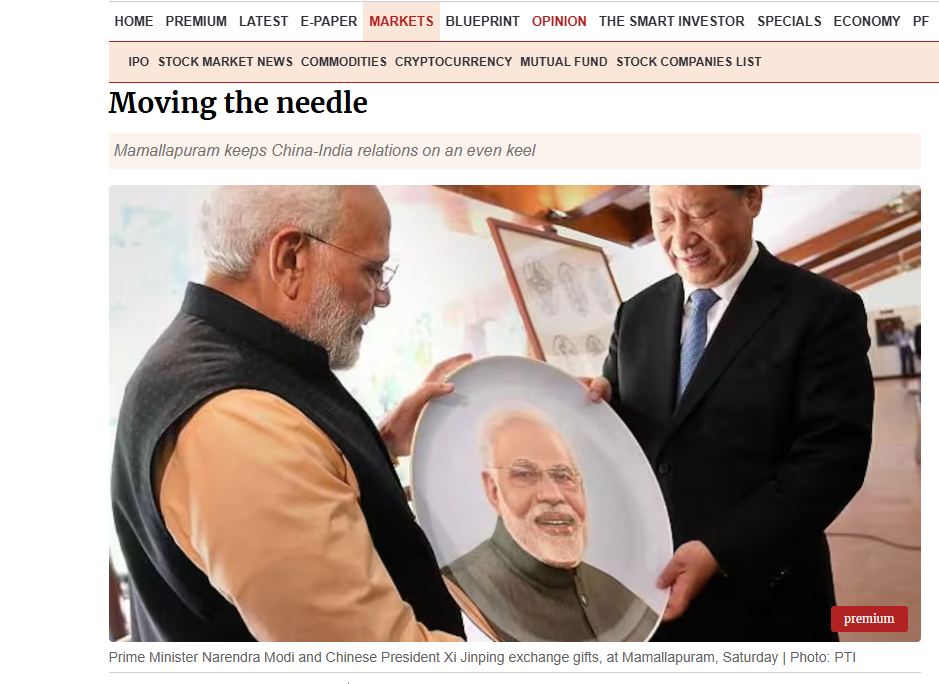
A video of Prime Minister Narendra Modi and Chinese President Xi Jinping is being shared on social media. The video is being shared with the claim that during the BRICS Summit, Prime Minister Modi gifted Xi Jinping a portrait featuring his own image. The post also takes aim at Prime Minister Modi based on this claim. Research by CyberPeace found that the video dates back to October 2019 and shows an exchange of gifts between Prime Minister Narendra Modi and Chinese President Xi Jinping. On the concluding day of the Mamallapuram Summit, Prime Minister Modi gifted Xi Jinping a large, handcrafted silk shawl. In return, Xi Jinping presented Prime Minister Modi with a porcelain souvenir bearing his portrait.
Claim:
A video of Prime Minister Narendra Modi and Chinese President Xi Jinping is being shared on Facebook with the claim that during the BRICS Summit, Prime Minister Modi gifted Xi Jinping a portrait of himself.
https://www.facebook.com/watch/?v=1109664078425193

Fact Check
To verify the authenticity of the viral claim, we conducted a Google search using relevant keywords. During the search, we found a report published by Navbharat Times on September 12, 2026. According to the report, Chinese President Xi Jinping has arrived in Delhi to attend the 18th BRICS Summit. His aircraft landed at Palam Airport at around noon on Saturday. This is his first visit to India in nearly seven years.The report further stated that Prime Minister Narendra Modi and Xi Jinping were scheduled to meet at around 5 pm on the same day. This made it clear during our research that the video being shared on social media is not from the current BRICS Summit and is an old video.
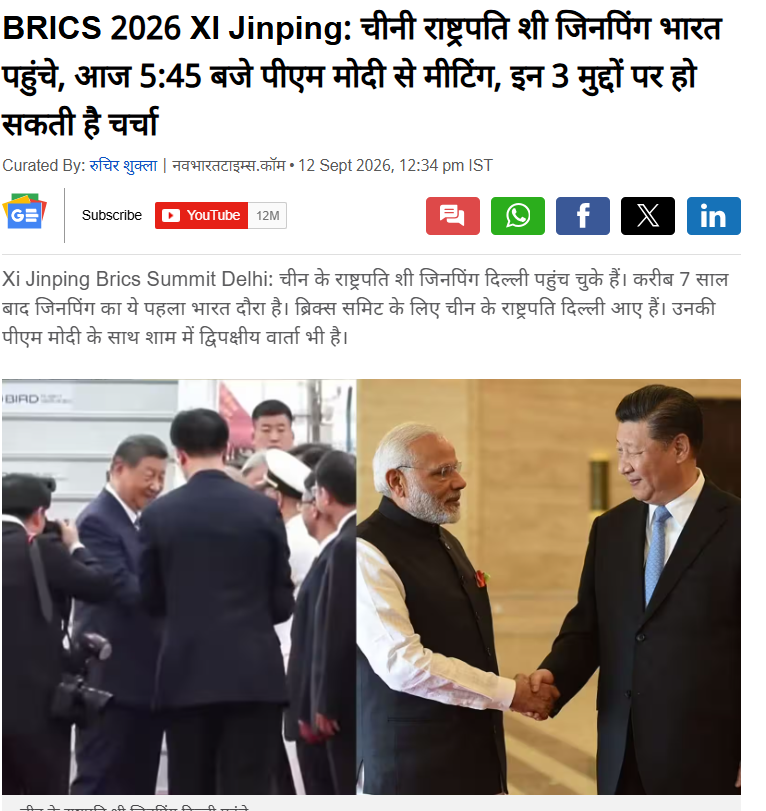
To verify the authenticity of the viral claim, we conducted a reverse image search of the keyframes from the video. During the search, we found a report published by Business Standard on October 13, 2019, which contained visuals from the viral video. According to the report, Chinese President Xi Jinping left for Nepal on Saturday aboard an Air China aircraft, concluding his second informal summit with Prime Minister Narendra Modi, which signalled a recalibration of bilateral ties. Xi spent around 24 hours in India.During his visit, he travelled to Mamallapuram near Chennai and held informal talks with Prime Minister Narendra Modi. Delegation-level talks between the two countries were also held.
https://www.business-standard.com/article/opinion/moving-the-needle-119101300820_1.html
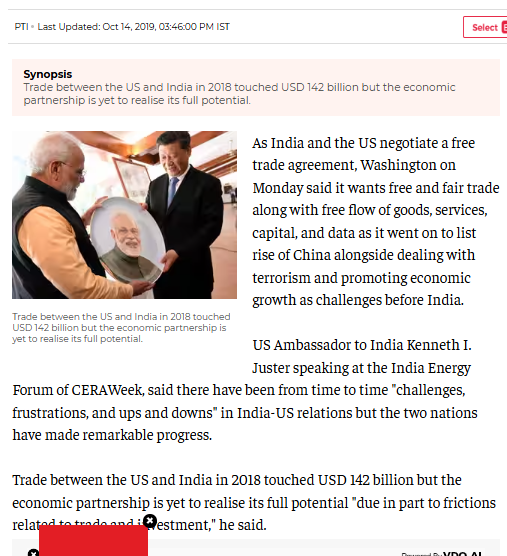
In the next step of our research, we found a report published by Economic Times on October 14, 2019. The report also contained the same visuals from the viral video and presented them in their original context.
Conclusion
The evidence gathered during our research makes it clear that the video being shared on social media is not from the BRICS Summit, but is an old video from 2019. This confirms that the video is being shared on social media by taking it out of its original context and falsely linking it to the BRICS Summit. Therefore, the claim that the viral video is from the BRICS Summit is misleading.

Executive Summary
A photograph circulating widely on social media has been falsely linked to the reported hantavirus outbreak on a cruise ship in May 2026. The image is being shared with claims that it shows a cameraman filming evacuation operations without wearing personal protective equipment (PPE), suggesting that the global health scare was staged. However, the claim is misleading. The viral image has no connection to the hantavirus outbreak or any real evacuation related to the incident. research found that the photograph actually originates from a Spanish military exercise conducted a year earlier.
Claim
A post on X dated May 13, 2026, shared the image with the caption, “Don’t be fooled! The #Hantavirus HOAX,” alleging that the evacuations were staged events filmed from a movie set. The image shows several individuals in full personal protective equipment (PPE) carrying a patient on a biocontainment stretcher across a dock in front of a large vessel. A cameraman, dressed in plain clothes, is seen descending a ramp connected to the ship while apparently recording the scene.

Fact Check
The image went viral across X, Threads and Instagram in multiple languages, with users claiming the hantavirus outbreak was a “hoax” or that evacuation operations were staged. These posts emerged as authorities were monitoring passengers aboard the Dutch-flagged MV Hondius and others potentially exposed to the virus following reports of an outbreak during its Atlantic voyage.

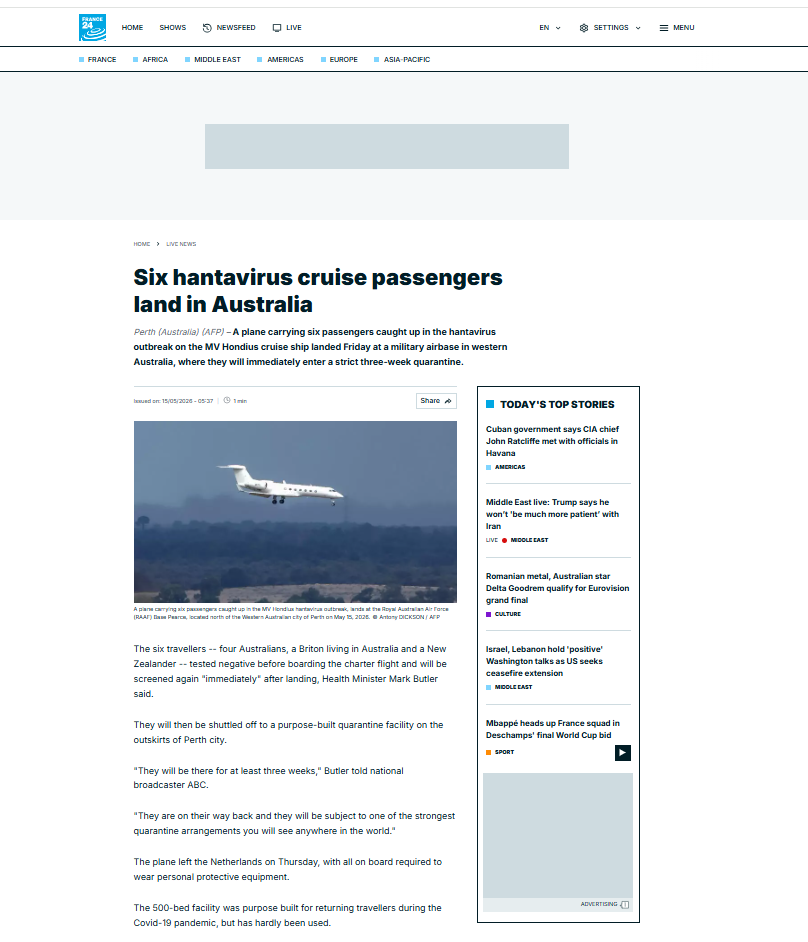
Health officials have repeatedly stressed that the overall public health risk from the Andes strain of hantavirus remains low. It is a rare rodent-borne virus and the only variant known to transmit between humans.
Reverse image search traced the photograph to the official website of the Port of Almería in Spain, where it was published in a May 7, 2025 article documenting an international maritime exercise involving the Spanish Navy and the health ministry.
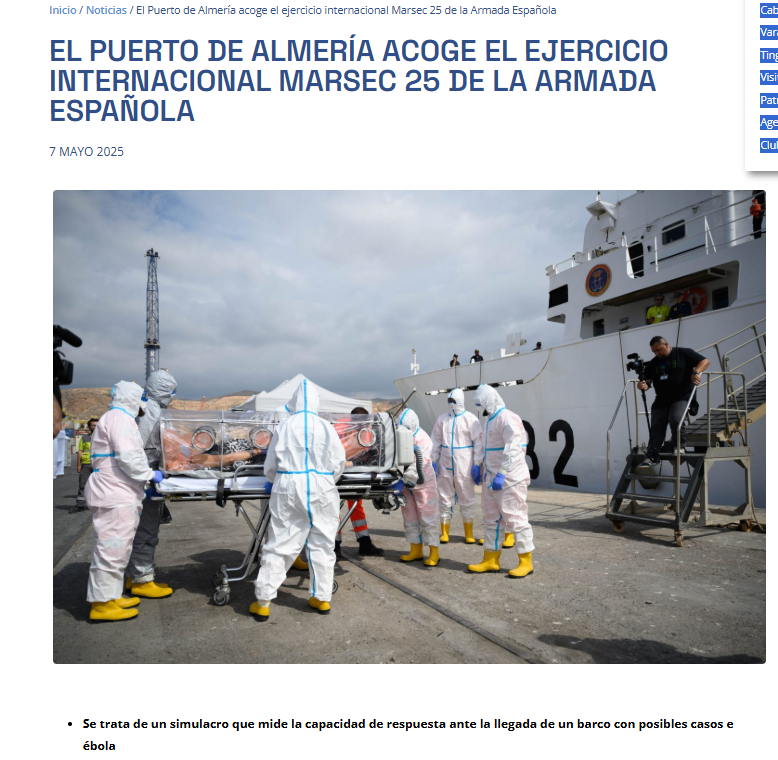
The exercise simulated the arrival of a vessel carrying suspected Ebola cases. Ebola is a rare but highly lethal disease that can cause fever, bleeding and organ failure.
Conclusion
The viral claim is false. The photograph has no connection to the reported hantavirus outbreak. It is from a Spanish military exercise conducted in 2025 and is being falsely shared out of context.
