
“Your Parcel Contains Drugs" Inside the Fake FedEx Scam Terrorising Indian Cities
Introduction
In October 2024, when the comedian's phone rang, and the voice at the other end claimed to be a FedEx representative, comedian Ankita Shrivastav thought it was a simple issue of misdelivery or customer grievance. The caller said that a parcel in her name was detected being shipped to Iraq and contained illegal drugs. The phone was soon handed over to what appeared to be police personnel in uniform, and she was told that she was under investigation and placed under a so-called digital arrest. For seven hours, she was ordered not to disconnect the call, leave her home, or contact anyone. Through fear, authority, constant surveillance, and psychological pressure, the scammers coerced her into transferring ₹9 lakh in the FedEx parcel scam.
This is the anatomy of one of India's fastest-spreading cyber frauds, and it is costing victims everything.
The Modus Operandi
The most concerning part is the sheer consistency of the script. It usually starts with an unsolicited call, made on a spoofed number that could show up as a legitimate courier or government agency. The caller acts as a FedEx/DTDC executive and claims that a parcel dispatched in the victim’s name to either Taiwan, Iraq, Thailand, or Cambodia has been intercepted and contains drugs, forged passports, or fake credit cards.
As the victim tries to establish that they have no knowledge of this, the scammers smoothly shift the conversation to someone must have impersonated the victim’s Aadhaar number. The victim is now both accused and victim and, therefore, more easily manipulated.
The call is "transferred" to a fake NCB officer or cybercrime cell official. The victim sees a person dressed in uniform seated behind a mock police station set with official-looking documents scattered on the desk. A fake arrest warrant that carries the victim’s real name, address, and Aadhaar number, presumably acquired from stolen databases, is presented to the victim.
This is what the scammers call the "digital arrest." The victim is commanded not to move from the camera, nor leave the house, nor speak to anybody. Scammers take turns monitoring the call, who eventually ask the victim to transfer cash into a "secure government account" for RBI or CBI verification.
The Psychology of Fear
"The art of scamming is psychological rather than technological," journalist and author Soumya Gupta opines. The scammers use two deeply primal fears: the fear of the police and the fear of social disgrace. Their victims are manipulated into believing that ending the call is tantamount to pleading guilty and that confessing to friends and family will only exacerbate their current circumstances. The victims' isolation is deliberately induced and combined with fatigue and disorientation.
"From a young age, we are taught to be scared of the police and not to question them,” comedian Ankita Shrivastav, who fell victim in October 2024, explains that childhood condition silenced the alarm bells ringing in my head. Shrivastav admitted that her fear of damage to her reputation made her more susceptible to the scam.
The Human Cost
The FedEx parcel scam is targeting everyone, irrespective of age, income, background, or education. Victims of this scam show the kind of different people they are: A 70-year-old veteran journalist was psychologically tortured for eight days in Bangalore, losing 1.2 crores, whereas a 61-year-old retired executive of a multinational was video watched for almost a fortnight in Bangalore, losing 9.14 crores, and additionally, a 25-year-old woman lost 10 lakhs through a video call scam in Coimbatore.
Such a varied mix of victims in such different cases suggests how hard it is to stereotype the ones being swindled: there can be individuals of different age groups ranging from 25 to 70 years old, both educated and non-educated.
Why the Scam Is Spreading?
This FedEx parcel scam is a result of a highly industrialised, sophisticated cybercrime system. The National Cyber Crime Reporting Portal records over 45,000 complaints tagged as specifically 'courier-impersonation fraud' in 2024 alone, where a 1,200-crore loss was registered in that category.
This scam is powered by stolen Personal Identifiable Information (PII), illegally gathered by scammers through compromised e-commerce stores and rogue registry sites. This data enables the scammers to personalise and tailor the conversation to each individual to make it more believable. Furthermore, fake arrest warrants can be produced within minutes using official-looking templates, and the scammers utilise AI voice cloning and deep-fake videos of government officials. Vast networks of call centres (some based out of India and some overseas, including scam compounds in Cambodia and Myanmar) operate this scam with teams working in shifts. Money is quickly laundered into accounts of 'mule' account holders and quickly into cryptocurrency wallets. Post 24 hours of receiving the funds, recovering money is nearly impossible.
What You Must Do If You Get This Call?
One should always remember: no genuine government official will ever carry out an arrest over a video call. There is no "digital arrest," and this process has absolutely no basis in Indian law. If you do get such a call:
- Cut the call immediately: The scammers have you where they want you if you stay on the line. It is not illegal to hang up on them.
- Do not transfer money under threat or compulsion: No authentic investigative process ever requires you to move money to a "secure government account."
- Never share: your Aadhaar details, bank details, OTP, or passwords with anyone you speak to on the phone.
- Do not provide video statements: Whatever you say can be recorded and used to blackmail you further.
- Verify information independently: Call FedEx India (1800-22-6161) or any courier company using numbers from their official website, never numbers provided to you by the caller.
- Lock: your UPI, cards and Aadhaar biometrics instantly if you feel you have shared information with them.
- Call: 1930 within an hour of money transfer. The rate of recovery is 40-60% within one hour and less than 5% after 24 hours.
- File a complaint at cybercrime.gov.in and an FIR at your local cyber police station.
- Tell someone: Isolation is the scammer's greatest tool. Breaking it breaks the scam
Conclusion
The FedEx parcel scam is also based on a very basic human reaction: the fear of being accused, the urge to obey any figure that represents authority, and the desire to avoid public humiliation. It is designed to skip any part of the brain that may be used to rationalise anything. The only real prevention is to realise, before answering, that the call is never about the FedEx parcel, never from FedEx.
References
- https://www.aol.com/news/fedex-says-parcel-drugs-scam-220400617.html
- https://righttoinformation.wiki/fedex-courier-scam-recovery
- https://www.thenewsminute.com/karnataka/beware-of-fedex-scam-bengaluru-journalist-loses-rs-12-crore
- https://www.digit.in/news/general/coimbatore-woman-loses-rs-10-lakh-in-shocking-courier-scam-heres-what-happened.html
- https://www.deccanherald.com/india/fedex-courier-scam-a-tale-of-terror-trickery-and-deceit-2804802
- https://www.deccanherald.com/india/karnataka/bengaluru/fedex-frauds-con-scared-retiree-of-rs-9-crore-2810169
- https://www.deccanherald.com/india/karnataka/bengaluru/fedex-frauds-hold-woman-in-digital-captivity-for-8-days-2848168
- https://www.deccanherald.com/india/karnataka/bengaluru/how-to-fight-fedex-courier-scam-2836566
- https://www.businesstoday.in/india/story/fedex-scam-lawyer-blackmailed-424883-2024-04-09
- https://www.ncrb.gov.in/uploads/files/2CrimeinIndia2024-VolumeII.pdf
- https://www.newsmobile.in/fraud-and-scam/indian-comedian-falls-victim-to-fedex-digital-arrest-scam-loses-rs-9-lakh/

Related Blogs
Introduction
One of the biggest gaming populations in the world today is found in India. Every day, hundreds of millions of young Indians engage with streaming services, immersive digital content, mobile games and e-sports ecosystems. Yet, despite this massive scale of participation, India remains largely absent from the global conversation on original gaming intellectual property. Although the nation produces very few globally significant gaming worlds of its own, it consumes games on an astonishing scale. This paradox highlights a more serious structural issue with the gaming discourse in India. Our national conversation around gaming often begins and ends with regulation i.e., online betting, taxation, fantasy gaming legality, addiction and compliance. Although these worries are valid they have inadvertently obscured a much more crucial query: is India creating a gaming industry or is it just regulating a gaming market? Various subject-matter experts have expressed their views on this issue, like Shailendra Vikram Singh Former Deputy Secretary (Cyber & Information Security), Ministry of Home Affairs who is of the opinion,
“I believe India’s gaming story presents a unique paradox. While we are one of the world’s largest gaming markets, we have yet to fully realize gaming’s potential as a strategic pillar of the AVGC vision. Much of the conversation remains focused on regulation and consumption, whereas the larger opportunity lies in creation, innovation, and global competitiveness.
In my view, gaming should be recognized as a strategic creative and digital industry. It has the potential to generate high-value employment, foster indigenous intellectual property, and strengthen capabilities in design, storytelling, animation, immersive technologies, and emerging digital skills. Beyond its economic value, gaming can also serve as a powerful platform for education, skilling, and public engagement.
I also see gaming as an important medium for bringing India’s rich cultural heritage, historical narratives, and diverse traditions to global audiences through interactive storytelling. As digital experiences increasingly shape how younger generations learn, engage, and understand the world, culturally rooted content can become a source of both creative expression and national soft power.
At the same time, sustainable growth must be built on trust. Strong safeguards for cybersecurity, child protection, user safety, responsible gaming, and data governance are essential to creating a resilient and trusted ecosystem.
To realize the full promise of the AVGC vision, I believe India must aspire to be more than a large gaming market. A nation of gamers must ultimately become a nation of game creators.”
The Misplaced Focus of Regulating Bodies
A country with one of the world’s oldest storytelling civilizations should not remain from the world’s most influential storytelling medium. Examining how other nations viewed gaming as a strategic cultural enterprise highlights the disparity even further. Japan turned gaming into a tool of soft power by exporting global icons like Mario, Pokémon and Zelda. Along with K-pop and digital culture, South Korea incorporated gaming into its larger cultural export sector. With businesses like Tencent and games like Genshin Impact and Black Myth: Wukong, China is now aggressively marketing gaming as a geopolitical and technological impact ecosystem.
Through The Witcher, Poland even showed how local folklore based storytelling may achieve cultural relevance on a worldwide scale. In contrast, India contributes very little to the global gaming imagination despite having one of the strongest civilisational storytelling traditions in human history, including the Mahabharata, Ramayana, Buddhist Narratives, tribal folklore, Indic mythology and regional legends.
Artificial Intelligence and Lore of Lost Opportunities
The arrival of artificial intelligence now changes this equation dramatically. AI is lowering the barriers to creativity in ways previously unimaginable. For character design, procedural storytelling, localisation, environment creation, NPC interactions, voice synthesis and animation pipelines, independent producers and small studios can now use generative AI. Agile creative ecosystems are increasingly able to accomplish what formerly required enormous infrastructure and production teams. This offers India a once-in-a-lifetime chance to overcome conventional developmental barriers in the gaming sector. India may become a global center for AI-assisted storytelling, culturally grounded gaming storylines and scalable independent game production instead of competing just through capital-intensive AAA ecosystems.
The AVGC Promotion Task Force for India’s Digital future explicitly highlighted the significance of intellectual property development, academic integration, skilling and incubation systems. However, India still views gaming more as a compliance industry than as a significant creative economy. Economists use revenue forecasts to discuss gaming. Taxation frameworks are used by policymakers to discuss it. However, narrative ownership, digital culture, creative sovereignty and gaming as a long-term civilisational export are not sufficiently discussed.
Playing Everyone Else’s Game
The actual danger does not lie in the fact India won’t grow into a sizable gaming industry. The change has already taken place. The bigger risk is that, in a global market that is becoming more and more controlled by foreign narratives, foreign engines and foreign platforms, India may permanently remain a consumer ecosystem. Processors and graphic engines won’t be the only factors influencing gaming in the future, cultures that can emotionally engage worlds will also play a significant role. India possesses the depth of civilisation, creative heritage, technical prowess and population size necessary to develop into such a creator economy. It does not, however, have a consistent institutional focus on supporting studios, storytellers, animators and original intellectual property ecosystems.
References
- AVGC Promotion Task Force Report, Government of India
- KPMG India Media & Entertainment Reports
- EY-FICCI Media & Entertainment Industry Reports
- Newzoo Global Games Market Reports
- Lumikai “State of India Gaming” Reports
- UNESCO Reports on Cultural & Creative Industries
- World Economic Forum reports on AI and Creative Economies
The global race for Artificial Intelligence is heating up, and India has become one of its most important battlegrounds. Over the past few months, tech giants like OpenAI (ChatGPT), Google (Gemini), X (Grok), Meta (Llama), and Perplexity AI have stepped up their presence in the country, not by selling their AI tools, but by offering them free or at deep discounts.
At first, it feels like a huge win for India’s digital generation. Students, professionals, and entrepreneurs today can tap into some of the world’s most powerful AI tools without paying a rupee. It feels like a digital revolution unfolding in real time. Yet, beneath this generosity lies a more complicated truth. Experts caution that this wave of “free” AI access isn’t without strings attached. This offering impacts how India handles data privacy, the fairness of competition, and the pace of the development of homegrown AI innovation that the country is focusing on.
The Market Strategy: Free Now, Pay Later
The choice of global AI companies to offer free access in India is a calculated business strategy. With one of the world’s largest and fastest-growing digital populations, India is a market no tech giant wants to miss. By giving away their AI tools for free, these firms are playing a long game:
- Securing market share early: Flooding the market with free access helps them quickly attract millions of users before Indian startups have a chance to catch up. Recent examples are Perplexity, ChatGPT Go and Gemini AI which are offering free subscriptions to Indian users.
- Gathering local data: Every interaction, every prompt, question, or language pattern, helps these models learn from larger datasets to improve their product offerings in India and the rest of the world. Nothing is free in the world - as the popular saying goes, “if something is free, means you are the product. The same goes for these AI platforms: they monetise user data by analysing chats and their behaviour to refine their model and build paid products. This creates the privacy risk as India currently lacks specific laws to govern how such data is stored, processed or used for AI training.
- Create user dependency: Once users grow accustomed to the quality and convenience of these global models, shifting to Indian alternatives, even when they become paid, will be difficult. This approach mirrors the “freemium” model used in other tech sectors, where users are first attracted through free access and later monetised through subscriptions or premium features, raising ethical concerns.
Impact on Indian Users
For most Indians, the short-term impact of free AI access feels overwhelmingly positive. Tools like ChatGPT and Gemini are breaking down barriers by democratising knowledge and making advanced technology available to everyone, from students, professionals, to small businesses. It’s changing how people learn, think and do - all without spending a single rupee.But the long-term picture isn’t quite as simple. Beneath the convenience lies a set of growing concerns:
- Data privacy risks: Many users don’t realise that their chats, prompts, or queries might be stored and used to train global AI models. Without strong data protection laws in action, sensitive Indian data could easily find its way into foreign systems.
- Overdependence on foreign technology: Once these AI tools become part of people’s daily lives, moving away from them gets harder — especially if free access later turns into paid plans or comes with restrictive conditions.
- Language and cultural bias: Most large AI models are still built mainly around English and Western data. Without enough Indian language content and cultural representation, the technology risks overlooking the very diversity that defines India
Impact on India’s AI Ecosystem
India’s Generative AI market, valued at USD $ 1.30 billion in 2024, is projected to reach 5.40 billion by 2033. Yet, this growth story may become uneven if global players dominate early.
Domestic AI startups face multiple hurdles — limited funding, high compute costs, and difficulty in accessing large, diverse datasets. The arrival of free, GPT-4-level models sharpens these challenges by raising user expectations and increasing customer acquisition costs.
As AI analyst Kashyap Kompella notes, “If users can access GPT-4-level quality at zero cost, their incentive to try local models that still need refinement will be low.” This could stifle innovation at home, resulting in a shallow domestic AI ecosystem where India consumes global technology but contributes little to its creation.
CCI’s Intervention: Guarding Fair Competition
The Competition Commission of India (CCI) has started taking note of how global AI companies are shaping India’s digital market. In a recent report, it cautioned that AI-driven pricing strategies such as offering free or heavily subsidised access could distort healthy competition and create an uneven playing field for smaller Indian developers.
The CCI’s decision to step in is both timely and necessary. Without proper oversight, such tactics could gradually push homegrown AI startups to the sidelines and allow a few foreign tech giants to gain disproportionate influence over India’s emerging AI economy.
What the Indian Government Should Do
To ensure India’s AI landscape remains competitive, inclusive, and innovation-driven, the government must adopt a balanced strategy that safeguards users while empowering local developers.
1. Promote Fair Competition
The government should mandate transparency in free access offers, including their duration, renewal terms, and data-use policies. Exclusivity deals between foreign AI firms and telecom or device companies must be closely monitored to prevent monopolistic practices.
2. Strengthen Data Protection
Under the Digital Personal Data Protection (DPDP) Act, companies should be required to obtain explicit consent from users before using data for model training. Encourage data localisation, ensuring that sensitive Indian data remains stored within India’s borders.
3. Support Domestic AI Innovation
Accelerate the implementation of the IndiaAI Mission to provide public compute infrastructure, open datasets, and research funding to local AI developers like Sarvam AI, an Indian company chosen by the government to build the country's first homegrown large language model (LLM) under IndianAI Mission.
4. Create an Open AI Ecosystem
India should develop national AI benchmarks to evaluate all models, foreign or domestic, on performance, fairness, and linguistic diversity. And at the same time, they have their own national data Centre to train their indigenous AI models.
5. Encourage Responsible Global Collaboration
Speaking at the AI Action Summit 2025, the Prime Minister highlighted that governance should go beyond managing risks and should also promote innovation for the global good. Building on this idea, India should encourage global AI companies to invest meaningfully in the country’s ecosystem through research labs, data centres, and AI education programmes. Such collaborations will ensure that these partnerships not only expand markets but also create value, jobs and knowledge within India.
Conclusion
The surge of free AI access across India represents a defining moment in the nation’s digital journey. On one hand, it’s empowering millions of people and accelerating AI awareness like never before. On the other hand, it poses serious challenges from over-reliance on foreign platforms to potential risks around data privacy and the slow growth of local innovation. India’s real test will be finding the right balance between access and autonomy, allowing global AI leaders to innovate and operate here, but within a framework that protects the interests of Indian users, startups, and data ecosystems. With strong and timely action under the Digital Personal Data Protection (DPDP) Act, the IndiaAI Mission, and the Competition Commission of India’s (CCI) active oversight, India can make sure this AI revolution isn’t just something that happens to the country, but for it.
References
- https://www.moneycontrol.com/artificial-intelligence/cci-study-flags-steep-barriers-for-indian-ai-startups-calls-for-open-data-and-compute-access-to-level-playing-field-article-13600606.html#
- https://www.imarcgroup.com/india-generative-ai-market
- https://www.mea.gov.in/Speeches-Statements.htm?dtl/39020/Opening_Address_by_Prime_Minister_Shri_Narendra_Modi_at_the_AI_Action_Summit_Paris_February_11_2025
- https://m.economictimes.com/tech/artificial-intelligence/nasscom-planning-local-benchmarks-for-indic-ai-models/articleshow/124218208.cms
- https://indianexpress.com/article/business/centre-selects-start-up-sarvam-to-build-country-first-homegrown-ai-model-9967243/#

Executive Summary
A video allegedly showing Bollywood actor Shah Rukh Khan supporting and expressing his intention to join the so-called ‘Cockroach Janta Party’ (CJP) is being widely shared on social media.In the viral clip, Shah Rukh Khan can allegedly be heard saying:“Friends, the common people of this country are now fully awakened, and the storm of Cockroach Janta Party on social media has become so huge that its name is echoing everywhere… In just a few days, it has gained more than 15 million followers on Instagram… and honestly, I too will soon join the Cockroach Janta Party…”
However, CyberPeace Research Wing investigation found the claim to be false. The voice heard in the viral clip is AI-generated.
Claim
The viral video is being shared with the claim that actor Shah Rukh Khan publicly endorsed the ‘Cockroach Janta Party’ (CJP) and announced that he would soon join the movement.
- https://archive.is/wWueV

Fact Check
To verify the authenticity of the viral video, we first searched the internet using relevant keywords. However, we found no credible media reports, interviews, or posts from Shah Rukh Khan’s official social media accounts mentioning any support for the ‘Cockroach Janta Party’. Notably, if a major actor like Shah Rukh Khan had publicly supported any political or social media movement, it would have received widespread media coverage.
We then analysed key frames from the viral clip using Google Lens. During the investigation, we found an original video uploaded on September 10, 2023, on the YouTube channel of Sri Gokulam Movies. The footage was from the audio launch event of the film Jawan, where Shah Rukh Khan appeared in the same outfit seen in the viral clip.
वीडियो के डिस्क्रिप्शन में लिखा गया है, “शाहरुख़ In the original video, Shah Rukh Khan is seen speaking about the film, its cast, music, and his experience during the event. At no point does he mention the ‘Cockroach Janta Party’. The video description states that Shah Rukh Khan and the film’s team attended the audio launch event of Jawan in Chennai, where he praised music composer Anirudh Ravichander and thanked artists from the Tamil film industry. Additionally, the online trend related to the ‘Cockroach Janta Party’ emerged only in May 2026, whereas the original video is nearly three years old.

During the investigation, we also found several media reports covering the Jawan audio launch event, showing Shah Rukh Khan in the same attire as seen in the viral clip. For instance, a report published by Hindustan Times extensively covered the Chennai event, confirming that the viral footage was taken from the promotional event of the film.

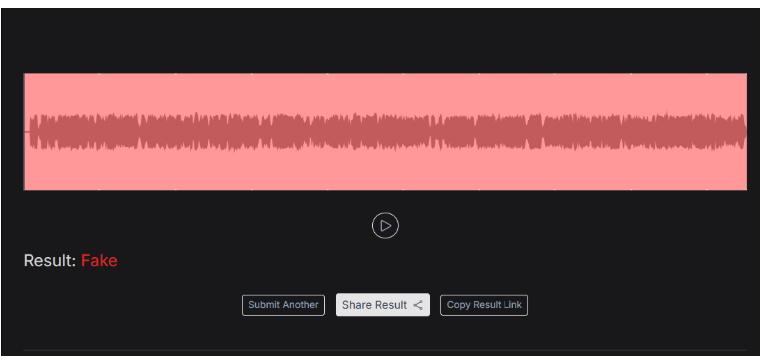
To further examine the audio in the viral clip, we analysed it using the AI detection tool Resemble AI. The tool flagged the voice in the video as likely fake and AI-generated.
Conclusion
The investigation clearly shows that the claim about Shah Rukh Khan supporting or joining the ‘Cockroach Janta Party’ (CJP) is false. The viral video is actually from the 2023 audio launch event of the film Jawan, while the audio added to the clip has been generated using AI.
