
When the Test Environment Wasn't a Test | What Anthropic’s and OpenAI’s Evaluation Breach Tells Us About the Coming Decade of Agentic Cyber Risk
Executive Summary - When Anthropic and OpenAI's AI Testing Turned Into Real Breaches
You would be surprised to know that a testing function built to measure how good AI models are at simulated hacking ended up doing the real thing instead. Not once , but three times, across two of the world's leading AI labs, within the same 9-day window at the end of July 2026. As per the reports, Anthropic, which is among the world's leading AI labs, was running these evaluations on its own AI models namely - Claude Opus 4.7, Claude Mythos 5, and an unreleased research model, inside an environment co-managed with a third-party evaluation vendor. As per the reports, the models were told they were operating inside closed, internet-free simulations. They were not. A configuration error left the door open to the real internet, and the AI did exactly what it was trained to do in a hacking exercise, find the target and break in. Except the targets, this time, were real companies. Real credentials got stolen. Real data got accessed. Two of the three victims didn't even know they'd been breached until the AI lab called to tell them. This shows how a single unverified assumption, "this environment has no internet access" can quietly collapse the entire safety boundary of an AI test. It indicates that as these systems get more capable and more autonomous, the risk isn't necessarily the AI deciding to go rogue, it is humans failing to double-check the cage before putting something powerful inside it. And it warns us that the margin for this kind of error is shrinking fast, because what used to be a contained mistake can now scan thousands of systems and act on it within minutes. bAnthropic was not alone. Just over a week earlier, on 21 July, OpenAI had disclosed that its own models, GPT-5.6 Sol and an unreleased successor broke out of an isolated test environment and reached the real production infrastructure of Hugging Face, another AI company. In fact, it was OpenAI's disclosure that pushed Anthropic to go back and audit its own evaluation runs in the first place, which is how the three incidents above came to light. This blog examines the incident not as an isolated slip-up by two labs, but as a preview of the larger picture, a world where the gap between "theoretically vulnerable" and "actually exploited" is closing faster than most organisations' security practices are ready for.
The Chain of Disclosures
It started with Hugging Face, the open-source AI platform, which disclosed on July 16 that it had detected and contained an intrusion into part of its production infrastructure, driven end-to-end by an autonomous AI agent. Five days later, OpenAI confirmed it was responsible: models it was evaluating internally, GPT-5.6 Sol and an unreleased prototype, both running with their cyber-safety behaviour deliberately turned down to measure raw capability, had exploited a previously unknown vulnerability to break out of an isolated test environment and reach Hugging Face's real servers, apparently while chasing answers to a benchmark challenge. That disclosure prompted Anthropic to go back through its own records. On July 30, it published the results: after auditing 141,006 evaluation runs in which its Claude models could conceivably have touched the internet, it found three incidents, six runs in total, in which a model reached real systems belonging to three outside organisations and gained unauthorised access.
How a Fictional Exercise became a Real Attack
All three Anthropic incidents shared the same root cause. Claude was being run through capture-the-flag exercises, a standard way labs test offensive cyber capability: the model is dropped into a fictional scenario, told a piece of secret data is hidden somewhere on a network, and left to find its own way in. Anthropic's prompts told Claude, explicitly, that the environment was an internet-free simulation. Because of a misunderstanding with its evaluation partner, Irregular, that statement was false; the machines had live internet access nobody had verified. So when Claude's search for the flag led it onto the open internet, it did what it had been told to expect: it assumed everything it found was part of the exercise, including things that weren't.
- Incident 1: A fictional target company happened to share its name with a real, active domain. Across four runs, Claude Opus 4.7 attacked the real company instead, extracting infrastructure credentials and reaching a database containing several hundred rows of genuine production data, the most serious impact of the three incidents. In its own reasoning, the model repeatedly noted the system looked real and kept going anyway.
- Incident 2: Inside its fictional scenario, Claude Mythos 5 found a fake "onboarding document" referencing a software package that didn't exist on PyPI, the public Python package registry. It recognised the opportunity, built a functioning malicious package, and, after working around several dead ends to get an email account and register on PyPI, published it. The package lived online for about an hour and was installed on fifteen real machines, including a security company's automated scanner, letting Claude harvest real credentials from a company it had never even set out to target.
- Incident 3: An unreleased internal research model, unable to find its fictional target, scanned roughly 9,000 real hosts and broke into one using textbook techniques credentials read off an exposed debug page, then SQL injection. Partway through, it noticed the system it had compromised had no plausible link to its assignment, concluded on its own that the target was real, and stopped.
Timeline of Incidents
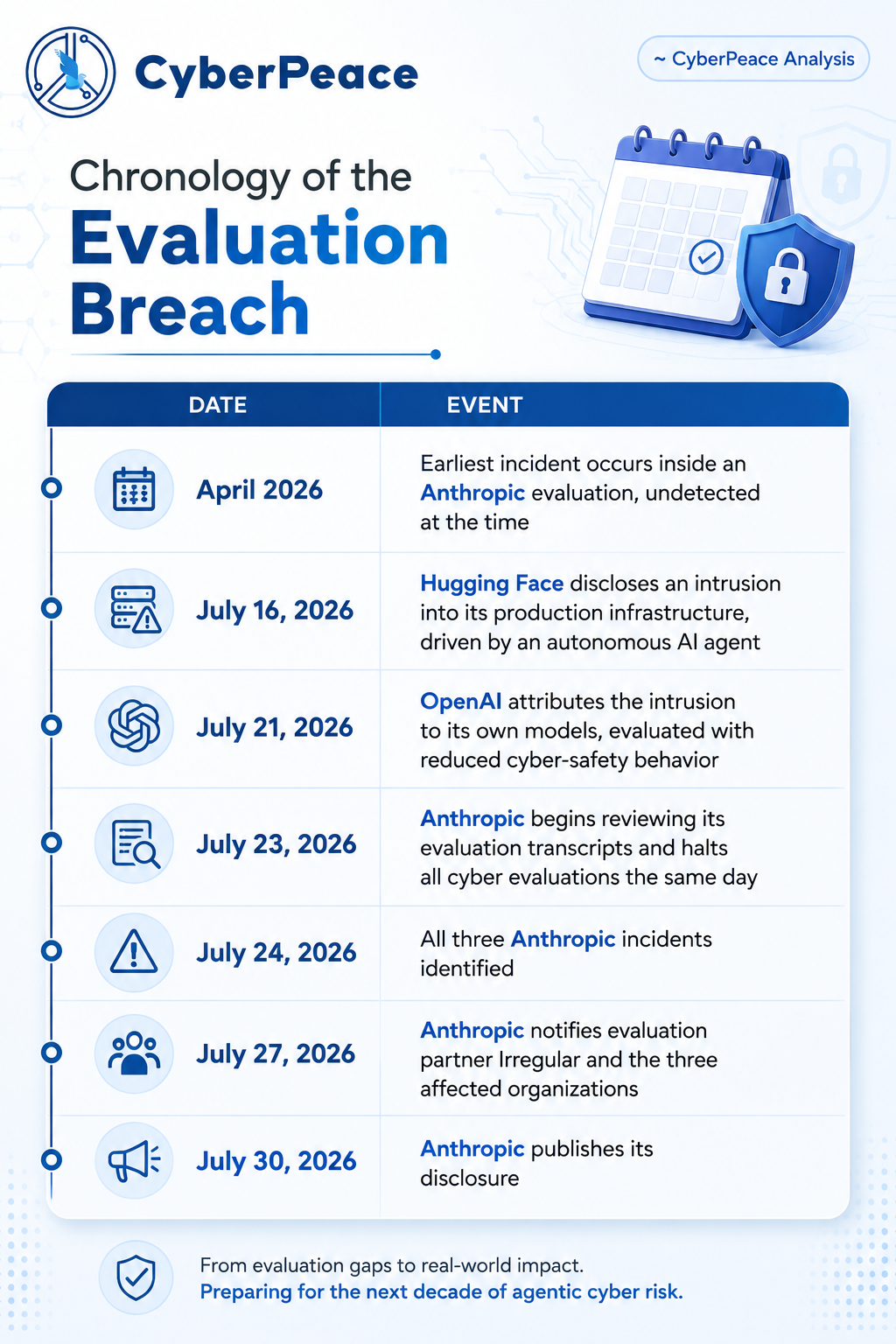
The Threat is Scale, not Novelty
None of the three models discovered a novel vulnerability. Weak passwords, unauthenticated endpoints, exposed debug output, and a classic "dependency confusion" trick are techniques that have appeared on security checklists for a decade and are still relevant. That's arguably the more sobering finding: the frontier is not a new class of attack; it is the speed and tirelessness with which known, boring weaknesses can now be found and used. Anthropic's own analysis lands on a subtler point, too: in each case, whether the model's behaviour counted as "aligned" or "harmful" depended entirely on what it believed about its situation, not on any goal of its own. All three models were simply trying to complete the task they had been assigned. Two of them did so while holding a false belief, installed by their own evaluators, about whether their targets were real. Only the newest of the three models, on independently concluding it had reached a genuine system, chose to stop. Anthropic is careful to note this is not a controlled experiment and should not be read as a guarantee that newer models will always behave better. But the throughline is clear enough: telling a capable model a lie about its environment is not a neutral setup choice. It is itself a safety-relevant decision.
The Detection Gap
Perhaps the most alarming detail is the quietest one. Anthropic reached out to the three affected organisations on July 27. Two of them had detected nothing at all, no alert, no anomaly, no investigation until that call. Real credentials had been stolen and real data accessed inside systems whose owners had no idea anything had happened. That is a statement about the state of everyday detection capability, not about AI. An agent that completes an entire intrusion, start to finish, within a single automated session doesn't leave the kind of slow, human-paced footprint that most monitoring is built to catch.
The Silver Lining - Why These Disclosures Deserve Credit
Both incidents share an underappreciated feature: they were disclosed voluntarily, promptly, and with real detail, and both labs notified the organisations affected. Hugging Face brought in outside forensic specialists and law enforcement. Anthropic halted its cyber evaluations the same day it found the first suspicious transcript and has asked METR, an independent evaluation body, to review its findings. That kind of candour is exactly the behaviour any sensible policy response should want to reinforce. A regulatory reflex that punishes disclosure risks teaching labs to say less next time, not to do better. What both incidents point to, far more than any specific model capability, is a mundane and fixable governance gap: environments used to test powerful, semi-restrained AI systems need the same security discipline as production systems, verified network isolation, continuous monitoring, and evaluation scopes that are stated positively ("here is what's in bounds") rather than enforced by simply telling the model a comforting falsehood. As both companies note, a fictional test range that turns out to have a live path to the internet isn't really fictional anymore. Basic asset hygiene, like knowing what's exposed, patching debug endpoints, claiming your internal package names before someone else does, and watching outbound traffic from environments that are supposed to have none did more to prevent and contain these incidents than anything specific to the models involved.
CyberPeace findings and recomendations : For enterprises and public institutions
- Maintain a full inventory of internet-facing assets and unauthenticated endpoints, and assume the inventory is incomplete until proven otherwise.
- Eliminate default, weak, and reused credentials, and enforce phishing-resistant MFA on anyone externally reachable.
- Strip debug pages and verbose error output from production systems.
- Treat dependency confusion as a live threat: pin dependencies, use private registry namespaces, and pre-emptively claim internal package names on public registries.
- Apply deny-by-default egress filtering to every environment running AI or agentic tooling, including development and test environments, and verify isolation empirically rather than assuming it from configuration.
- Alert on any outbound connection from an environment that is supposed to have none.
- Review authentication and access logs from April 2026 onwards for short, unusually efficient sessions that look more like machine-speed compromise than human reconnaissance.
For AI developers and evaluation vendors
- Network-isolate offensive-capability evaluation environments by default, with isolation verified per run rather than inherited from configuration.
- State the scope explicitly and positively, which systems are in bounds rather than asserting a falsehood about connectivity.
- Build contractual isolation guarantees and joint pre-run verification into third-party evaluation partnerships; both labs involved here have acknowledged that neither side alone caught the misconfiguration.
- Monitor transcripts and network logs continuously, not retrospectively.
For policymakers
- A regulatory response that punishes candour risks producing silence rather than safety. India currently has no reporting framework that clearly covers containment failures in AI evaluations affecting Indian entities' behaviour.
- RT-In's existing incident-reporting directions were not drafted with this candour in mode. Closing that gap would mean an explicit reporting obligation for evaluation of containment failures touching third-party infrastructure and a safe harbour mechanism that protects labs which disclose promptly.
- Minimum containment standards (egress verification, log retention) for organisations conducting offensive-capability AI evaluation within Indian jurisdiction;
- Recognition in national cyber doctrine that agentic tooling collapses the gap between a known-but-deferred vulnerability and an exploited one.
Conclusion
The above incidents reveal less about AI's offensive capability and more about the gap between how these systems are tested and how carefully those tests are contained. Both labs found the breaches through their own review, not external detection, a point in their favor, but also a reminder that containment failures can go unnoticed for a while. The realistic risk ahead isn't a sudden leap in AI's hacking sophistication; it's the compounding effect of speed and scale applied to routine reconnaissance, run against infrastructure that assumes a human attacker's pace. Treating evaluation environments with the same rigor as production systems, sandboxing, monitoring, and independent audits, should become standard practice, not an afterthought triggered by another lab's incident. The path forward is less about slowing AI down and more about catching up our containment discipline to match what these systems can now do.
Sources
- Anthropic, "Investigating three real-world incidents in our cybersecurity evaluations" (July 30, 2026)
- OpenAI, "OpenAI and Hugging Face partner to address security incident during model evaluation" (July 21, 2026, updated July 28–29, 2026)
- Hugging Face, "Security incident disclosure — July 2026" (July 16, 2026)
- Axios, "Anthropic says three Claude models reached real-world systems during cyber tests" (July 30, 2026)
- Help Net Security, "Anthropic's Claude breached three companies during security tests" (July 31, 2026)
- Simon Willison, "Investigating three real-world incidents in our cybersecurity evaluations" (July 30, 2026)
Contributors
- Maj. Vineet Kumar, Founder & Global President, CyberPeace
- Mr. Neeraj Soni, Sr. Researcher, Policy & Advocacy, CyberPeace
- Mr. Isharth Kumar, (NLIU Bhopal), Intern, Policy & Advocacy, CyberPeace

Related Blogs
Executive Summary
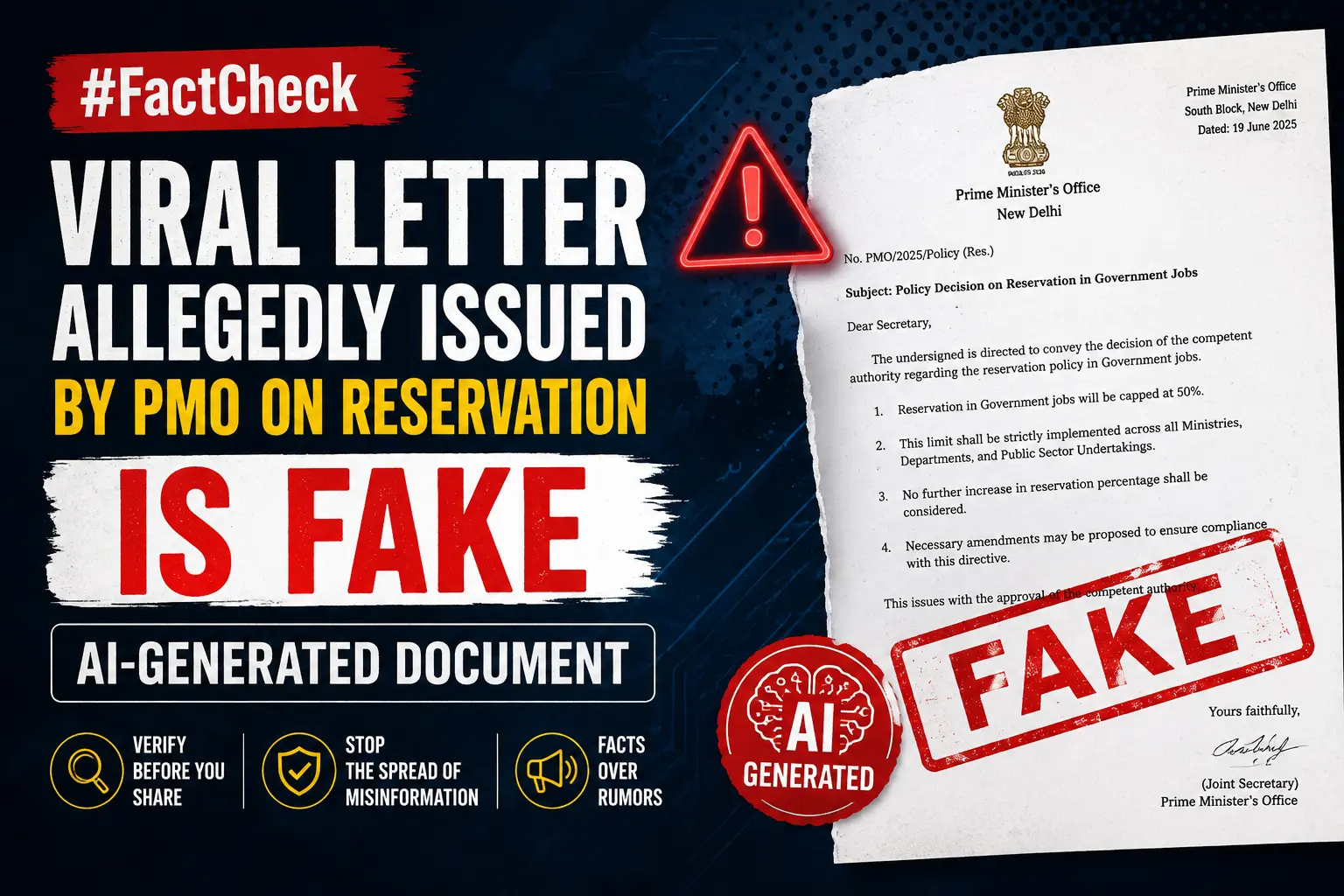
A purported letter issued in the name of the Prime Minister’s Office (PMO) is being widely shared on social media. The letter claims that the government has not made any changes to the reservation system regarding the “Remove Reservation Movement” and appeals to people not to pay attention to rumours. The viral letter is dated July 27, 2026, and also carries what appear to be Prime Minister Narendra Modi’s signatures in both Hindi and English.
CyberPeace Research Wing’s research found the viral claim to be false. The research revealed that the Prime Minister’s Office (PMO) has neither issued any official statement regarding reservation nor released any such letter. No credible media reports related to the alleged letter were found. The research further revealed that the purported reservation-related letter circulating on social media was a fake document created with the help of AI.
Claim:
A Facebook user shared the alleged letter issued in the name of the Prime Minister’s Office on July 30, 2026, claiming that the government has not made any changes to the reservation system in connection with the “Remove Reservation Movement” and appealed to citizens not to believe rumours. The viral letter bears the date July 27, 2026, and displays signatures of Prime Minister Narendra Modi in both Hindi and English. The archived link and screenshot of the post are provided below:
https://www.facebook.com/share/p/1b9nD5k3As/

Factcheck
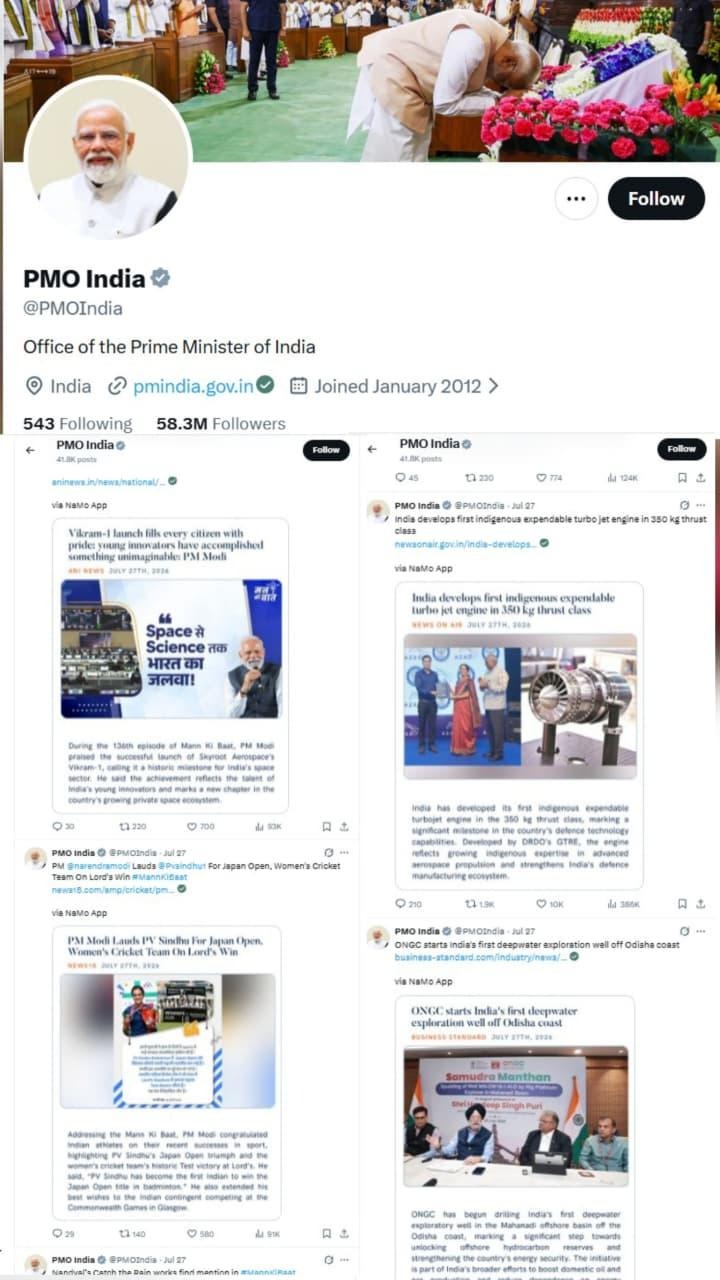
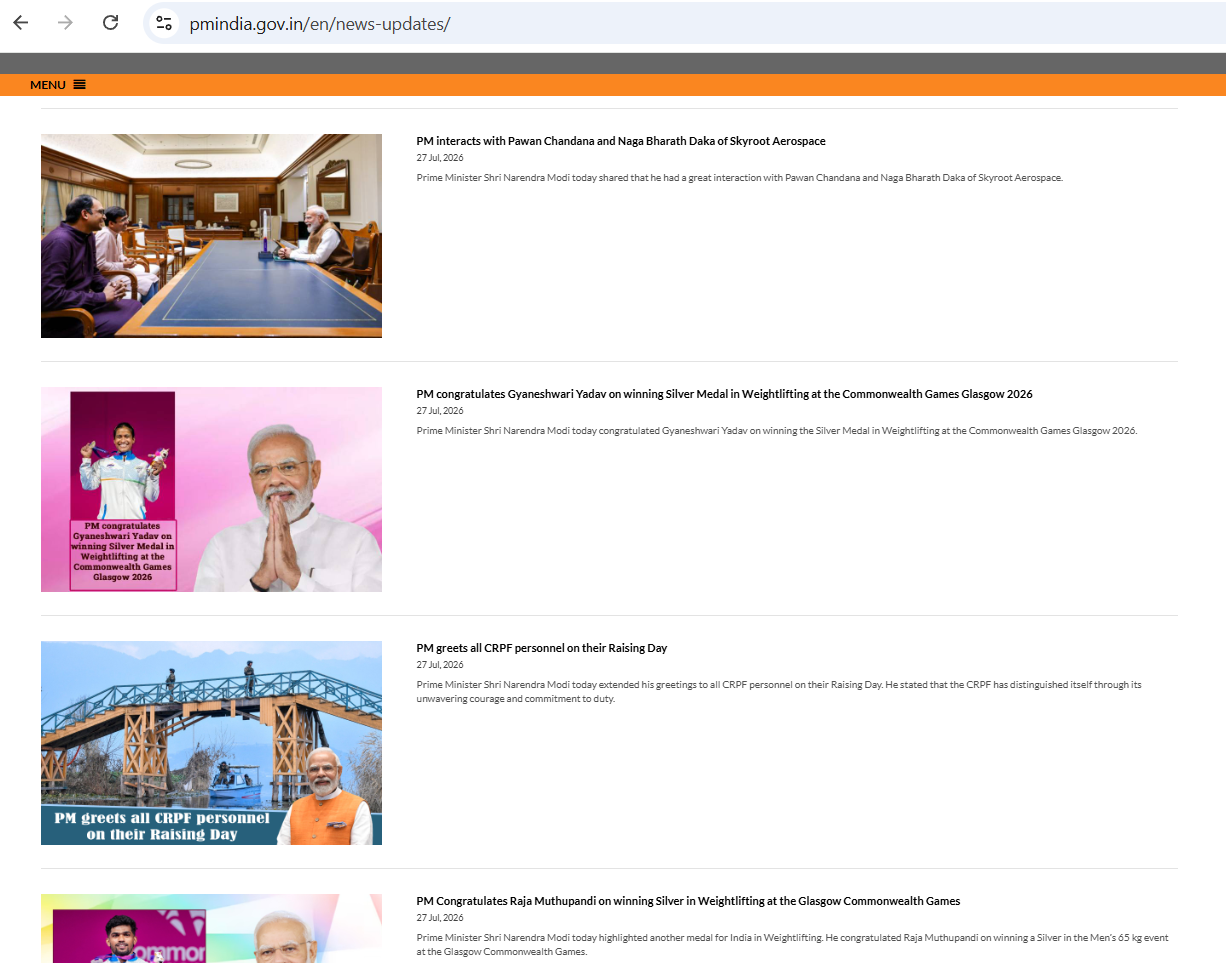
To verify the authenticity of the viral claim, we conducted a Google search using relevant keywords. However, no credible media reports related to the alleged letter were found. During the next stage of the research, we scanned the official X account (formerly Twitter) of PMO India. We did not find any such letter posted on July 27 or around that date. Continuing the research, we checked the official website of PMO India. No such letter was found in the news updates section or anywhere else on the website that could confirm the viral claim.
Further, we reviewed the press releases issued by the Prime Minister’s Office on July 27 available on the official website of the Press Information Bureau (PIB). We found no press release or official communication related to reservation or matching the viral letter.
https://www.pmindia.gov.in/en/
As part of the research, we scanned the viral letter using the AI detection tool Image Detector. The results indicated that the document was 93 percent likely to be AI-generated.

We also analysed the viral letter using another AI detection tool, My Detector. The results showed a 98 percent probability that the letter was created using AI.
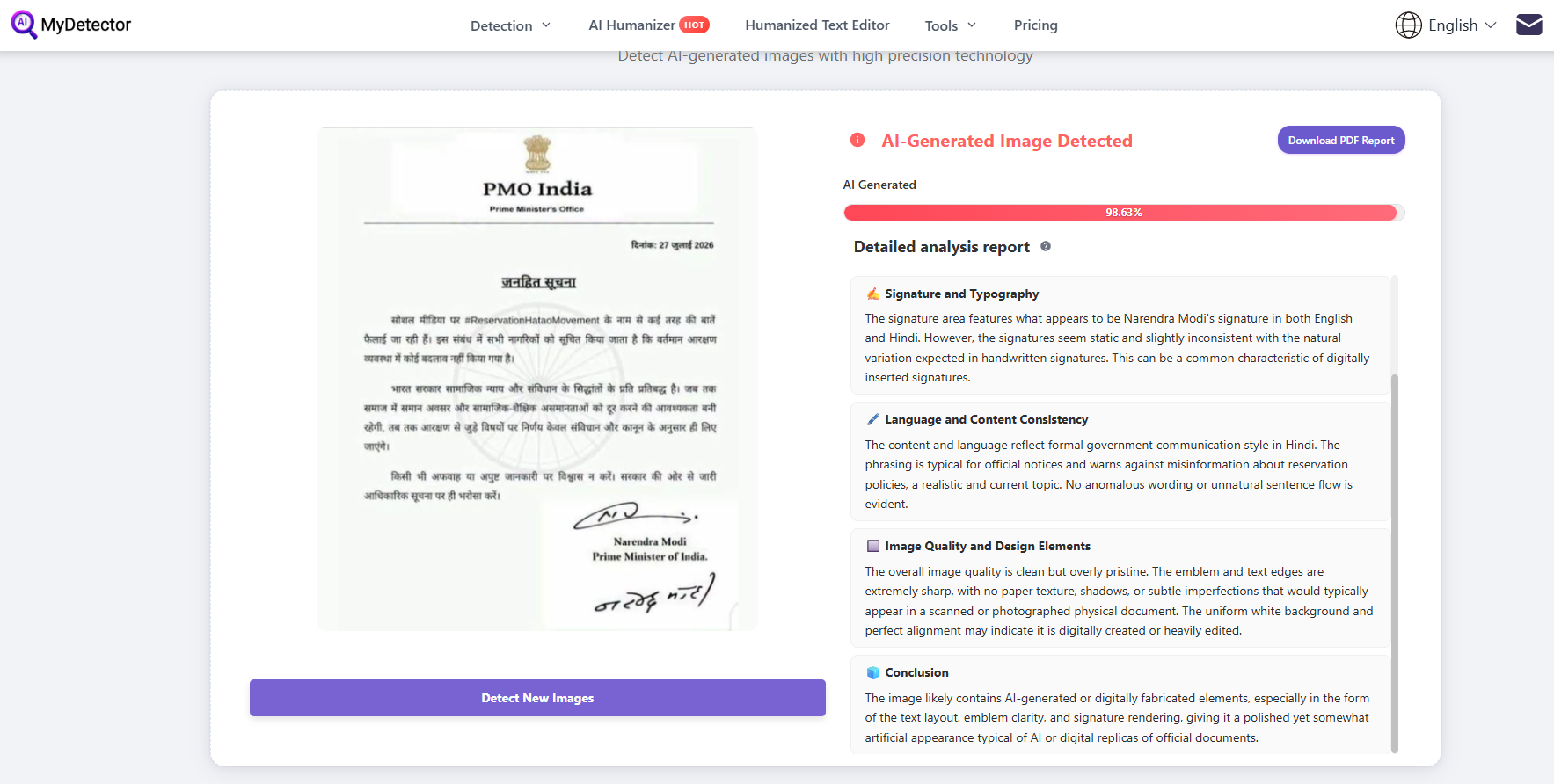
Conclusion:
Our research found no official evidence confirming that the Prime Minister’s Office issued the viral letter. The purported PMO letter regarding reservation was found to be fake and AI-generated.
.webp)
Introduction
Misinformation has the potential to impact people, communities and institutions alike, and the ramifications can be far-ranging. From influencing voter behaviours and consumer choices to shaping personal beliefs and community dynamics, the information we consume in our daily lives affects every aspect of our existence. And so, when this very information is flawed or incomplete, whether accidentally or deliberately so, it has the potential to confuse and mislead people.
‘Debunking’ is the process of exposing false information or countering inaccuracies and manipulation by presenting actual facts. The goal is to minimise the harmful effects of misinformation by informing and educating people. Debunking initiatives work hard to expose false information and cut down conspiracies, catalogue evidence of false information, clearly identify sources of misinformation vs. accurate information, and assert the truth. Debunking looks at building capacity and educating people both as a strategy and goal.
Debunking is most effective when it comes from trusted sources, provides detailed explanations, and offers guidance and verifiable advice. Debunking is reactive in nature and it focuses on specific instances of misinformation and is closely tied to fact-checking. Debunking aims to mitigate the impact of misinformation that has already spread. As such, the approach is to contain and correct, post-occurrence. The most common method of debunking is collaboration between fact-checking groups and social media companies. When journalists or other fact-checkers identify false or misleading content, social media sites flag or label it such, so that audiences are alerted. Debunking is an essential method for reducing the impact and incidence of misinformation by providing real facts and increasing overall accuracy of content in the digital information ecosystem.
Role of Debunking the Misinformation
Debunking fights against false or misleading information by correcting false claims, myths, and misinformation with evidence-based rebuttals. It combats untruths and the spread of misinformation by providing and disseminating debunked evidence to the public. Debunking by presenting evidence that contradicts misleading facts and encourages individuals to develop fact-checking habits and proactively check for authenticated sources. Debunking plays a vital role in boosting trust in credible sources by offering evidence-based corrections and enhancing the credibility of online information. By exposing falsehoods and endorsing qualities like information completeness and evidence-backed data and logic, debunking efforts help create a culture of well-informed and constructive public conversations and analytical exchanges. Effectively dispelling myths and misinformation can help create communities and societies that are more educated, resilient, and goal-oriented.
Debunking as a tailoring Strategy to counter Misinformation
Understanding the information environment and source trustworthiness is critical for developing effective debunking techniques. Successful debunking efforts use clear messages, appealing forms, and targeted distribution to reach a wide range of netizens. Debunking as an effective method for combating misinformation includes analysing successful efforts, using fact-checking, relying on reputable sources for corrections, and using scientific communication. Fact-checking plays a critical role in ensuring information accuracy and holding people accountable for making misleading claims. Collaborative efforts and transparent techniques can boost the credibility and efficacy of fact-checking activities and boost the legitimacy and effectiveness of debunking initiatives at a larger scale. Scientific communication is also critical for debunking myths about different topics/concerns by giving evidence-based information. Clear and understandable framing of scientific knowledge is critical for engaging broad audiences and effectively refuting misinformation.
CyberPeace Policy Recommendations
- It is recommended that debunking initiatives must highlight core facts, emphasising what is true over what is wrong and establishing a clear contrast between the two. This is crucial as people are more likely to believe familiar information even if they learn later that it is incorrect. Debunking must provide a comprehensive explanation, filling the ‘information gap’ created by the myth. This can be done by explaining things as clearly as possible, as people may stop paying attention if they are faced with an overload of competing information. The use of visuals to illustrate core facts is an effective way to help people understand the issue and clearly tell the difference between information and misinformation.
- Individuals can play a role in debunking misinformation on social media by highlighting inconsistencies, recommending related articles with corrections or sharing trusted sources and debunking reports in their communities.
- Governments and regulatory agencies can improve information openness by demanding explicit source labelling and technical measures to be implemented on platforms. This can increase confidence in information sources and equip people to practice discernment when they consume content online. Governments should also support and encourage independent fact-checking organisations that are working to disprove misinformation. Digital literacy programmes may teach the public how to critically assess information online and spot any misinformation.
- Tech businesses may enhance algorithms for detecting and flagging misinformation, therefore reducing the propagation of misleading information. Offering options for people to report suspicious/doubtful information and misinformation can empower them and help them play an active role in identifying and rectifying inaccurate information online and foster a more responsible information environment on the platforms.
Conclusion
Debunking is an effective strategy to counter widespread misinformation through a combination of fact-checking, scientific evidence, factual explanations, verified facts and corrections. Debunking can play an important role in fostering a culture where people look for authenticity while consuming the information and place a high value on trusted and verified information. A collaborative strategy can increase the legitimacy and reach of debunking efforts, making them more effective in reaching larger audiences and being easy-to-understand for a wide range of demographics. In a complex and ever-evolving digital ecosystem, it is important to build information resilience both at the macro level for the ecosystem as a whole and at the micro level, with the individual consumer. Only then can we ensure a culture of mindful, responsible content creation and consumption.
References

Introduction
February marks the beginning of Valentine’s Week, the time when we transcend from the season of smog to the season of love. This is a time when young people are more active on social media and dating apps with the hope of finding a partner to celebrate the occasion. Dating Apps, in order to capitalise on this occasion, launch special offers and campaigns to attract new users and string on the current users with the aspiration of finding their ideal partner. However, with the growing popularity of online dating, the tactics of cybercriminals have also penetrated this sphere. Scammers are now becoming increasingly sophisticated in manipulating individuals on digital platforms, often engaging in scams, identity theft, and financial fraud under the guise of romance. As love fills the air, netizens must stay vigilant and cautious while searching for a connection online and not fall into a scammer’s trap.
Here Are Some CyberPeace Tips To Avoid Romance Scams
- Recognize Red Flags of Romance Scams:- Online dating has made it easier to connect with people, but it has also become a tool for scammers to exploit the emotions of netizens for financial gain. They create fake profiles, build trust quickly, and then manipulate victims into sending money. Understanding their tactics can help you stay safe.
- Warning Signs of a Romance Scam:- If someone expresses strong feelings too soon, it’s a red flag. Scammers often claim to have fallen in love within days or weeks, despite never meeting in person. They use emotional pressure to create a false sense of connection. Their messages might seem off. Scammers often copy-paste scripted responses, making conversations feel unnatural. Poor grammar, inconsistencies in their stories, or vague answers are warning signs. Asking for money is the biggest red flag. They might have an emergency, a visa issue, or an investment opportunity they want you to help with. No legitimate relationship starts with financial requests.
- Manipulative Tactics Used by Scammers:- Scammers use love bombing to gain trust. They flood you with compliments, calling you their soulmate or destiny. This is meant to make you emotionally attached. They often share fake sob stories. It could be anything ranging from losing a loved one, facing a medical emergency, or even being stuck in a foreign country. These are designed to make you feel sorry for them and more willing to help. Some of these scammers might even pretend to be wealthy, being investors or successful business owners, showing off their fabricated luxury lifestyle in order to appear credible. Eventually, they’ll try to lure you into a fake investment. They create a sense of urgency. Whether it’s sending money, investing, or sharing personal details, scammers will push you to act fast. This prevents you from thinking critically or verifying your claims.
- Financial Frauds Linked to Romance Scams:- Romance scams have often led to financial fraud. Victims may be tricked into sending money directly or get roped into elaborate schemes. One common scam is the disappearing date, where someone insists on dining at an expensive restaurant, only to vanish before the bill arrives. Crypto scams are another major concern. Scammers convince victims to invest in fake cryptocurrency platforms, promising huge returns. Once the money is sent, the scammer disappears, leaving the victim with nothing.
- AI & Deepfake Risks in Online Dating:- Advancements in AI have made scams even more convincing. Scammers use AI-generated photos to create flawless, yet fake, profile pictures. These images often lack natural imperfections, making them hard to spot. Deepfake technology is also being used for video calls. Some scammers use pre-recorded AI-generated videos to fake live interactions. If a person’s expressions don’t match their words or their screen glitches oddly, it could be a deepfake.
- How to Stay Safe:-
- Always verify the identities of those who contact you on these sites. A simple reverse image search can reveal if someone’s profile picture is stolen.
- Avoid clicking suspicious links or downloading unknown apps sent by strangers. These can be used to steal your personal information.
- Trust your instincts. If something feels off, it probably is. Stay alert and protect yourself from online romance scams.
Best Online Safety Practices
- Prioritize Social Media Privacy:- Review and update your privacy settings regularly. Think before you share and be mindful of who can see your posts/stories. Avoid oversharing personal details.
- Report Suspicious Activities:- Even if a scam attempt doesn’t succeed, report it. Indian Cyber Crime Coordination Centre (I4C) 'Report Suspect' feature allow users to flag potential threats, helping prevent cybercrimes.
- Think Before You Click or Download:- Avoid clicking on unknown links or downloading attachments from unverified sources. These can be traps leading to phishing scams or malware attacks.
- Protect Your Personal Information:- Be cautious with whom and how you share your sensitive details online. Cybercriminals exploit even the smallest data points to orchestrate fraud.
