
When a Video Game Starts Looking Like a Slot Machine | Play or Pay? The Gaming-Gambling Line Is Getting Blurry
Think about the difference between a video game and gambling the way most people were taught to understand it. A video game is something you play, maybe you spend money on it upfront, maybe you buy an expansion pack, but what you get in return is fixed and known. Gambling is different: you put money in, and what comes back is uncertain, decided by chance, with real financial stakes attached to the outcome. For decades, that distinction was reasonably clear. It no longer is.
Across a growing number of mobile games and gaming platforms, the two have started to blend into each other. Games increasingly include features where a player pays real money for a randomised reward, a mechanic structurally identical to a slot machine or a scratch card, just wrapped in animation, sound effects, and gaming language that makes it feel like part of the game rather than a bet. Because this trend targets an audience that skews young, and because it deliberately makes gambling like behaviour feel like ordinary play, the UN Office on Drugs and Crime recently flagged it as a serious and growing concern. Understanding exactly what is happening, and why it matters, starts with their warning.
What UNODC is actually warning about
The claim traces back to UNODC's July 2026 report, An Interconnected Criminal Ecosystem: Transnational Organised Crime Threat Assessment for Southeast Asia 2026. Delphine Schantz, UNODC's regional representative for South-East Asia and the Pacific, put the core problem plainly: the line between online gaming and online gambling is becoming increasingly blurred, and platforms have converged through design features that deliberately exploit that ambiguity. Online gaming, by definition, never required money changing hands. What the report documents is a shift where mobile accessibility, deliberately addictive design, and the introduction of real monetary stakes are pulling younger users into something that looks and feels like gaming but functions, mechanically, like gambling.
The report's most striking finding is not really about the games themselves. It is about what happens after. UNODC found that illegal online gambling platforms operating across the region do not simply extract money from young users; they generate a secondary population of indebted, criminally exposed young people who become vulnerable to recruitment into broader criminal networks, including debt collection operations, money mule schemes, and the scam compounds the report documents elsewhere. In other words, the gambling loss is often only the first harm. The debt it creates becomes the entry point into something considerably worse.
The mechanics of the convergence
This is not a vague, impressionistic claim. Academic researchers have spent close to a decade documenting the specific design features responsible for blurring gaming and gambling, and loot boxes sit at the centre of that research. A loot box is a purchasable in game item containing randomised rewards, structurally similar to a scratch card or a slot pull, wrapped in gaming aesthetics, animated reveal sequences, anticipation building sound design, that make the underlying mechanic easy to overlook. Researchers writing in Nature Human Behaviour as early as 2018 argued loot boxes are psychologically akin to gambling, and subsequent studies have consistently found meaningful associations between loot box engagement and problem gambling severity in young people. One widely cited cross sectional study estimated that between 16 and 21 percent of surveyed young people had engaged in gambling like video game practices at least once in the preceding year, and found that people who engaged in one such practice were highly likely to engage in several more, suggesting these mechanics function less as isolated features and more as an interconnected ecosystem designed to normalise wagering behaviour early.
What makes this genuinely difficult to regulate is precisely the ambiguity Schantz pointed to. A loot box does not always pay out in real currency; often the reward is a cosmetic item, a weapon skin, or in game currency that can then be resold or traded on secondary markets, creating real monetary value once removed from the platform that generated it. That one extra step, converting a virtual reward into tradeable value outside the game itself, has repeatedly let gambling like mechanics avoid classification under gambling law, even as researchers increasingly argue the psychological experience for the user is functionally identical. Regulators in several countries, including the UK, South Korea, and parts of Europe, have wrestled with exactly this classification problem for years, generally landing on disclosure requirements, probability labelling, and age restrictions rather than outright bans, an approach critics argue leaves the core mechanic intact while addressing only its edges.
The mobile phone has made all of this considerably harder to contain. Where gambling once required a physical location, an ID check, or at minimum a desktop browser, mobile gaming apps put the same monetised, chance based mechanics directly into a pocket, often accessible without any meaningful age verification beyond a self reported birth date a user can simply falsify. UNODC's own framing of "mobile access" as a driving factor is not incidental; it is arguably the single structural change that turned what was once a manageable regulatory grey zone into a rapidly scaling public health concern.
Why age matters so much here
Financial literacy research is fairly consistent on this point: the capacity to reason clearly about risk, probability, and long term financial consequence continues developing well into a person's twenties. Marketing a mechanic engineered around variable reward schedules, the same principle behind slot machine design, to an audience whose risk judgment is still forming is not an accident of overlapping demographics. It is, as UNODC's own language suggests, closer to a deliberate exploitation of that gap.
Where India fits into this picture
India has arguably moved further and faster on this exact concern than most jurisdictions. The Promotion and Regulation of Online Gaming Act, 2025, alongside its accompanying 2026 Rules that came into force on 1 May 2026, drew a hard statutory line most countries have avoided: real money online games, including fantasy sports, rummy, poker, and online casino style platforms, are now categorically prohibited in India, not merely regulated. A newly created central regulator, the Online Gaming Authority of India, oversees a separate, permitted category for e-sports and social games, requiring registration, age gating, and grievance redressal mechanisms, while offshore and unregistered real money platforms are now explicitly illegal to operate or use, backed by bank freeze powers and potential prosecution of platform directors.
The government's own stated rationale mirrors UNODC's warning almost exactly. Lawmakers cited addiction and social harm linked to real money games, reports that Indian users lose close to 20,000 crore rupees annually on these platforms, concerns about money laundering and potential terror financing routed through gaming networks, and specifically flagged the vulnerability of teenagers increasingly drawn into fantasy leagues and online poker as a driving justification. India's approach, an outright prohibition on monetary stakes rather than a licensed regulatory model similar to the UK's Gambling Commission or Malta's Gaming Authority, is distinctive by global standards, and reflects a judgement that the gaming gambling boundary has already become too difficult to police through disclosure and age verification alone.
The larger question this leaves open
Whether prohibition succeeds where lighter touch regulation elsewhere has struggled remains genuinely unresolved, and enforcement against offshore platforms determined to evade an Indian ban is likely to be an ongoing challenge rather than a solved problem. What UNODC's warning underscores, and what India's own legislative response implicitly concedes, is that voluntary industry self regulation was never going to be sufficient on its own. Platforms have commercial incentive to keep the gaming gambling boundary blurry, not to clarify it, because that ambiguity is precisely what lets monetised, addictive design features reach audiences who would otherwise be walled off from gambling entirely. Closing that gap convincingly will likely require the kind of cross sector coordination, spanning gaming regulators, financial authorities, and platform accountability, that UNODC's own statement called for, rather than any single fix applied in isolation.
References
- UNODC, "An Interconnected Criminal Ecosystem: Transnational Organised Crime Threat Assessment for Southeast Asia 2026," July 2026.
- The Hawk, "UNODC warns young gamers lured into online gambling." https://www.thehawk.in/news/india/unodc-warns-young-gamers-lured-into-online-gambling
- IAG, "UNODC report says Southeast Asian illegal online gambling creating cycle of crime that targets youth." https://asgam.com/2026/07/22/unodc-report-says-southeast-asian-illegal-online-gambling-creating-cycle-of-crime-that-targets-the-youth/
- GambleAware, "Lifting the Lid on Loot Boxes: Chance-based purchases in videogames and the convergence of gaming and gambling." https://www.gambleaware.org/media/aswow4lr/gaming_and_gambling_report_final_0.pdf Drummond
- A, Sauer JD, "Video game loot boxes are psychologically akin to gambling," Nature Human Behaviour, 2018. PubMed, "Loot Boxes, Gambling, and Problem Gambling Among Young People: Results from a Cross-Sectional Online Survey." https://pubmed.ncbi.nlm.nih.gov/33103911/
- Mondaq, "Play By The New Rules: India's 2026 Online Gaming Law Decoded." https://www.mondaq.com/india/gaming/1785180/play-by-the-new-rules-indias-2026-online-gaming-law-decoded
- CAclubindia, "India's Online Gaming Revolution: A Complete Guide to the Promotion and Regulation of Online Gaming w.e.f 1st May, 2026." https://www.caclubindia.com/articles/indias-online-gaming-revolution-a-complete-guide-to-the-promotion-and-regulation-of-online-gaming-wef-1st-may-2026-55118.asp
- https://www.meity.gov.in/static/uploads/2025/10/8a7f103cefc68ed8aaa2ebc9a2ed7c13.pdf
- https://x.com/UNODC/status/2100560453319467298?s=48&t=3CXE-95D2WFgsLsKDkX_Jg

Related Blogs

Executive Summary
A video of a man dancing is going viral on social media. The man is being claimed to be Jitendra Mishra, the newly appointed CEO of the Ram Mandir Trust and a retired Air Marshal of the Indian Air Force. The claim states that the video shows Jitendra Mishra dancing and drinking alcohol while celebrating his appointment as the CEO of the Ram Mandir Trust. CyberPeace’s Research Wing found that the person seen in the viral video is not Jitendra Mishra, the CEO of the Ram Mandir Trust. The identity of the man seen in the video is different, and the video has been available on social media since November 2025.
Claim:
A user on social media platform X (formerly Twitter) shared the viral video with the caption: “Jitendra Mishra was seen dancing and drinking alcohol while celebrating his appointment. Earlier, those who counted donations used to steal; now the CEO is celebrating with a party. They have turned the temple into a company, brother, and even installed a dance floor.”

Fact Check
To verify the claim, we conducted a reverse image search of the keyframe from the viral video. During the search, we found the same video posted on an Instagram account named Vikas Rana on November 3, 2025.
https://www.instagram.com/reels/DQmLsEYD8nA/
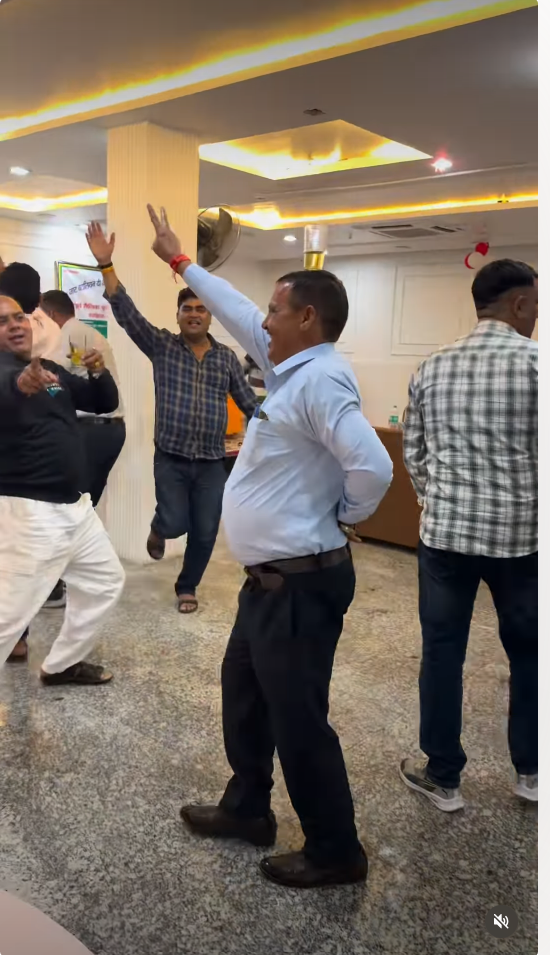
Upon examining Vikas Rana’s Instagram account, we found two videos featuring the person seen dancing. We also found a link to his YouTube channel in Vikas Rana’s Instagram bio.

As part of our research, we further examined Vikas Rana’s YouTube channel. In several videos available on the channel, the person seen in the viral video can be seen. In all the videos, Vikas Rana refers to the person in the viral video as “Captain Sahab.”

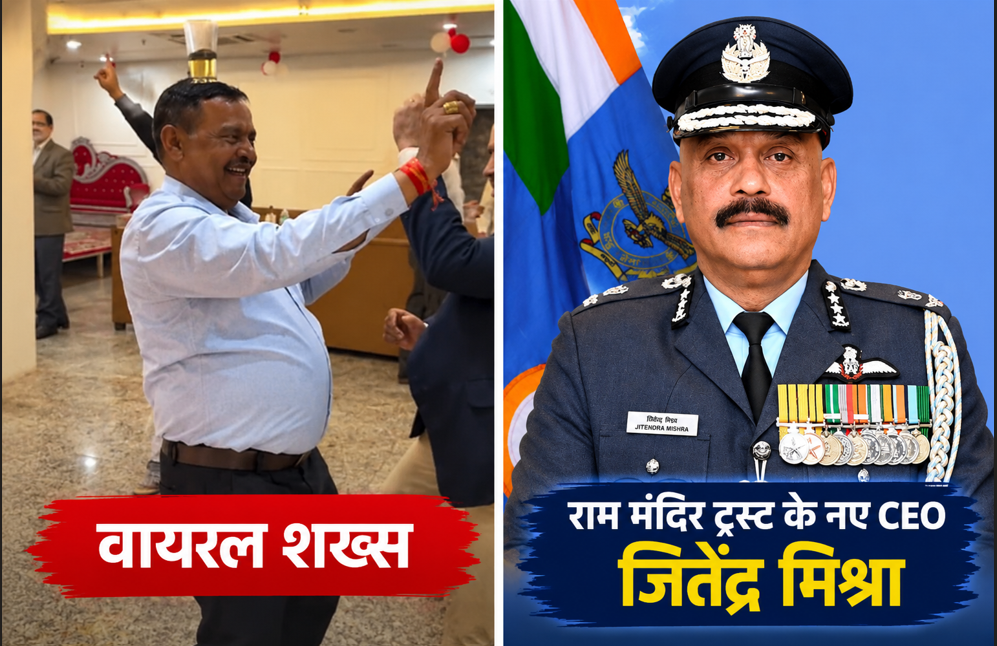
As part of our research, we compared the faces of the person seen in the viral video with those of the newly appointed CEO of the Ram Mandir Trust, Jitendra Mishra. The comparison revealed several differences between Jitendra Mishra’s face and that of the person seen in the viral video.
Conclusion
Our research found that the viral video is not of Jitendra Mishra, the newly appointed CEO of the Ram Mandir Trust. The video was found on Vikas Rana’s Instagram account, where two videos featuring the same person were posted. Further, several videos on Vikas Rana’s YouTube channel feature the same individual, whom Rana refers to as “Captain Sahab.” A facial comparison also revealed clear differences between the person in the viral video and Jitendra Mishra. Therefore, the claim that the viral video shows Jitendra Mishra celebrating his appointment as the Ram Mandir Trust CEO is false.
%20(1).webp)
Introduction
The Central Electricity Authority (CEA) has released the Draft Central Electricity Authority (Cyber Security in Power Sector) Regulations, 2024, inviting ‘comments’ from stakeholders, including the general public, which are to be submitted by 10 September 2024. The new regulation is intended to make India’s power sector more cyber-resilient and responsive to counter emerging cyber threats and safeguard the nation's power infrastructure.
Key Highlights of the CEA’s New (Cyber Security in Power Sector) Regulations, 2024
- Central Electricity Authority has framed the ‘Cyber Security in Power Sector Regulations, 2024’ in the exercise of the powers conferred by sub-section (1) of 177 of the Electricity Act, 2003 in order to make regulations for measures relating to Cyber Security in the power sector.
- The scope of the regulation entails that these regulations will be applicable to all Responsible Entities, Regional Power Committees, Appropriate Commission, Appropriate Government and Associated Power Sector Government Organizations, and Training Institutes recognized by the Authority, Authority and Vendors.
- One key aspect of the proposed regulation is the establishment of a dedicated Computer Security Incident Response Team (CSIRT) for the power sector. This team will coordinate a unified cyber defense strategy throughout the sector, establishing security frameworks, and serving as the main agency for handling incident response and recovery. The CSIRT will also be responsible for creating/developing Standard Operating Procedures (SOPs), security policies, and best practices for incident response activities in consultation with CERT-In and NCIIPC. The detailed roles and responsibilities of CSIRT are outlined under Chapter 2 of the said regulations.
- All responsible entities in the power sector as mentioned under the scope of the regulation, are mandated to appoint a Chief Information Security Officer (CISO) and an alternate CISO, who need to be Indian nationals and who are senior management employees. The regulations specify that these officers must directly report to the CEO/Head of the Responsible Entity. Thus emphasizing the critical nature of CISO’s roles in safeguarding the nation’s power grid sector assets.
- All Responsible Entities shall establish an Information Security Division (ISD) dedicated to ensuring Cyber Security, headed by the CISO and remain operational around the clock. The schedule under regulation entails that the minimum workforce required for setting up an ISD is 04 (Four) officers including CISO and 04 officers/officials for shift operations. Sufficient workforce and infrastructure support shall be ensured for ISD. The detailed functions and responsibilities of ISD are outlined under Chapter 5 regulation 10. Furthermore, the ISD shall be manned by sufficient numbers of officers, having valid certificates of successful completion of domain-specific Cyber Security courses.
- The regulation obliged the entities to have a defined, documented and maintained Cyber Security Policy which is approved by the Board or Head of the entity. The regulation also obliged the entities to have a Cyber Crisis Management Plan (CCMP) approved by the higher management.
- As regards upskilling and empowerment the regulation advocates for organising or conducting periodic Cyber Security awareness programs and Cyber Security exercises including mock drills and tabletop exercises.
CyberPeace Policy Outlook
CyberPeace Policy & Advocacy Vertical has submitted its detailed recommendations on the proposed ‘Cyber Security in Power Sector Regulations, 2024’ to the Central Electricity Authority, Government of India. We have advised on various aspects within the regulation including harmonisation of these regulations with other rules as issued by CERT-In and NCIIPC, at present. As this needs to be clarified which set of guidelines will supersede in case of any discrepancy that may arise. Additionally, we advised on incorporating or making modifications to specific provisions under the regulation for a more robust framework. We have also emphasized legal mandates and penalties for non-compliance with cybersecurity, so as to make sure that these regulations do not only act as guiding principles but also provide stringent measures in case of non-compliance.
References:
Executive Summary
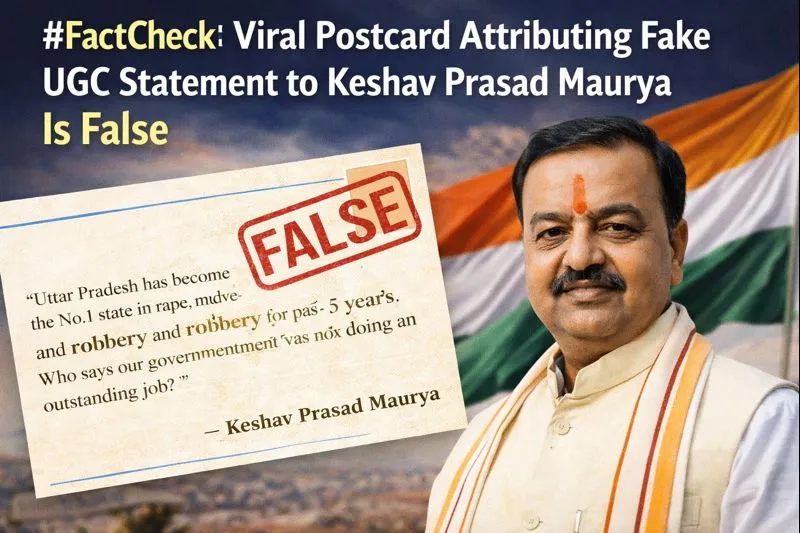
A postcard claiming that Uttar Pradesh Deputy Chief Minister Keshav Prasad Maurya commented on the Supreme Court’s stay on the new UGC regulations is being widely shared on social media. The viral postcard suggests that Maurya stated the Modi government would “fight till its last breath” to implement the UGC law and appealed to Dalit, backward and tribal communities to trust the government as their true well-wisher. However, an research by the CyberPeace has found that the viral postcard is fake. Keshav Prasad Maurya has not made any such statement.
Claim
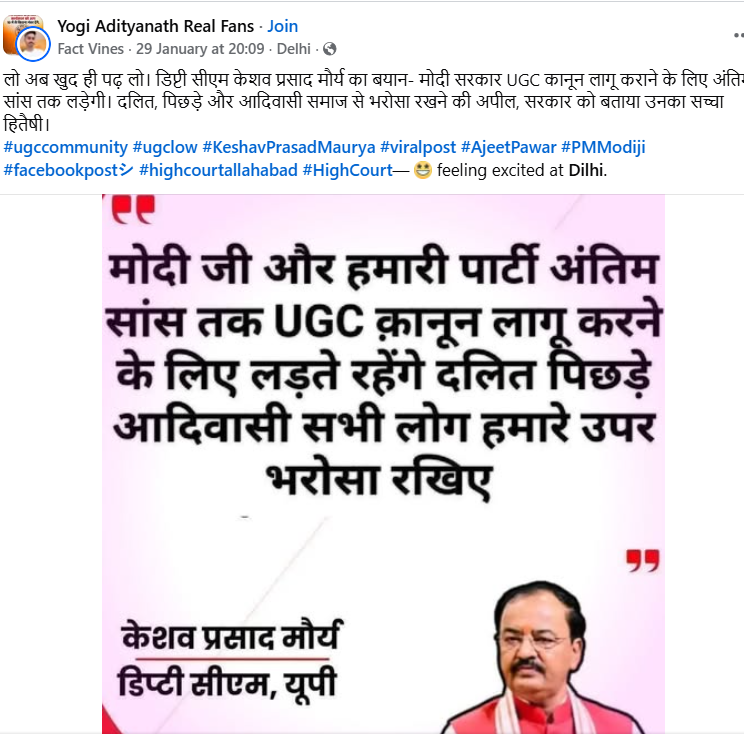
A Facebook user shared the postcard with the caption:“Now read it yourself. Statement of Deputy CM Keshav Prasad Maurya — the Modi government will fight till its last breath to implement the UGC law. An appeal to Dalit, backward and tribal communities to trust the government, calling it their true well-wisher.”
(Archived version of the post available here.)
Fact Check:
During the research, we did not find any credible news reports mentioning such a statement by Deputy Chief Minister Keshav Prasad Maurya regarding the UGC regulations or the Supreme Court’s order. A closer examination of the viral postcard revealed several inconsistencies. Notably, the text on the postcard lacks proper punctuation, such as commas and full stops, which is unusual for professionally designed news graphics. The postcard carries the logo of Navbharat Times (NBT). However, when compared with genuine NBT postcards, the font style used in the viral image does not match NBT’s official design. We also traced the original NBT postcard that appears to have been edited to create the fake one. In the authentic postcard, shared by NBT on January 20, Keshav Prasad Maurya is quoted as saying: Where the lotus has bloomed, it will continue to bloom, and where it has not, under the guidance of PM Modi and the leadership of Nitin Nabin, the lotus will bloom.”
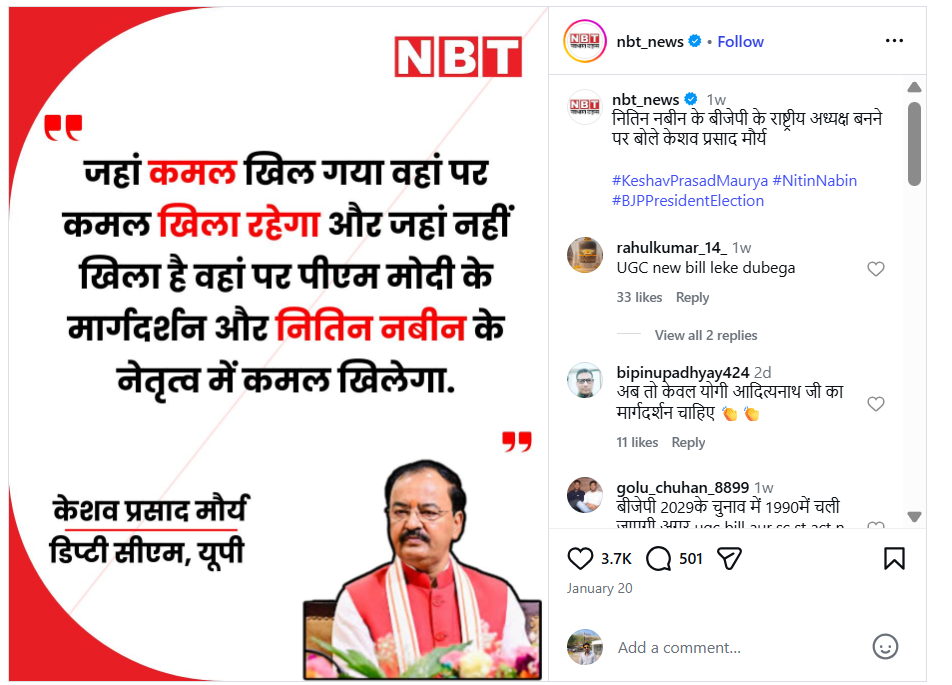
The original statement was digitally altered, and a fabricated quote was inserted to create the viral postcard.
Conclusion
CyberPeace research clearly establishes that the viral postcard is fake. The original Navbharat Times postcard has been tampered with, and Keshav Prasad Maurya’s actual statement has been replaced with a fabricated quote, which is now being circulated with a misleading claim.
