
#FactCheck - Viral Video Falsely Claims RSS Chief Mohan Bhagwat Called for ‘Saffronisation’ of Indian Army
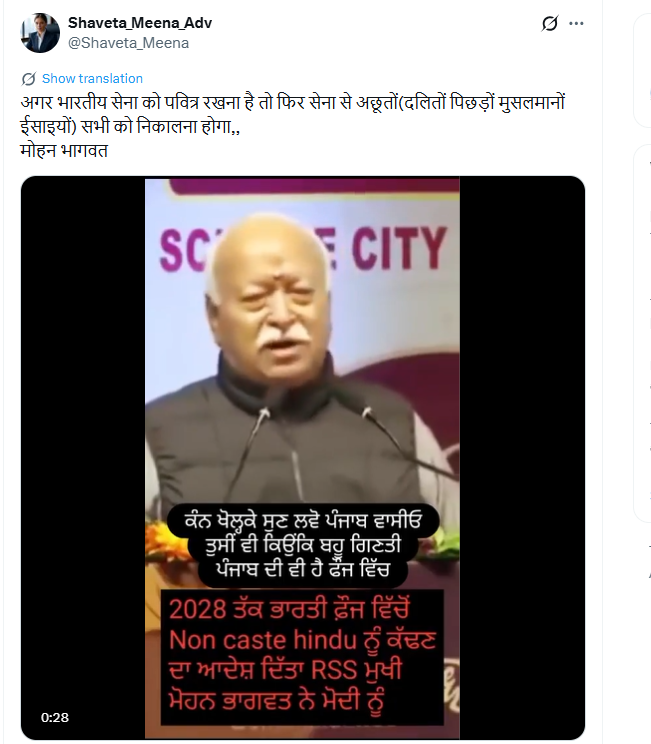
A video purportedly showing Rashtriya Swayamsevak Sangh (RSS) chief Mohan Bhagwat making remarks about the “saffronisation” of the Indian Army has been widely circulated on social media. The clip claims that Bhagwat called for the removal of non-Hindus from the armed forces and linked the issue to future political leadership changes in the country.
Claim
However, a verification by the Cyber Peace Foundation has established that the video is misleading and has been digitally manipulated.
In the video, Bhagwat is allegedly heard saying that unless more than 50 percent of non-Hindus are removed from the Indian Army by 2028, Prime Minister Narendra Modi would be replaced by Uttar Pradesh Chief Minister Yogi Adityanath. The clip further attributes another statement to him, suggesting that he would resign if the Prime Minister were to demand Nitish Kumar’s resignation.
By the time of publication, the video had been viewed over 7,000 times.( lINK, ARCHIVE Link, Screenshot
Fact Check:
The reverse image search also directed the Desk to a video uploaded on CNN-News18’s official YouTube channel on December 21, 2025. The footage was found to be a longer version of the viral clip and was recorded at the RSS centenary event held in Kolkata on the same date. A comparison of both videos confirmed that the background visuals, stage setup and camera angles were identical.
However, a careful review of the original CNN-News18 video revealed that Mohan Bhagwat did not make any of the statements attributed to him in the viral clip.
In his original address, Bhagwat spoke about unity and referred to concerns over increasing atrocities against Hindus in Bangladesh. He made no reference to the Indian Army, nor did he comment on its composition or alleged saffronisation. Here is the link to the original video, along with a screenshot: https://www.youtube.com/watch?v=KnsAUGfBQBk&t=1s

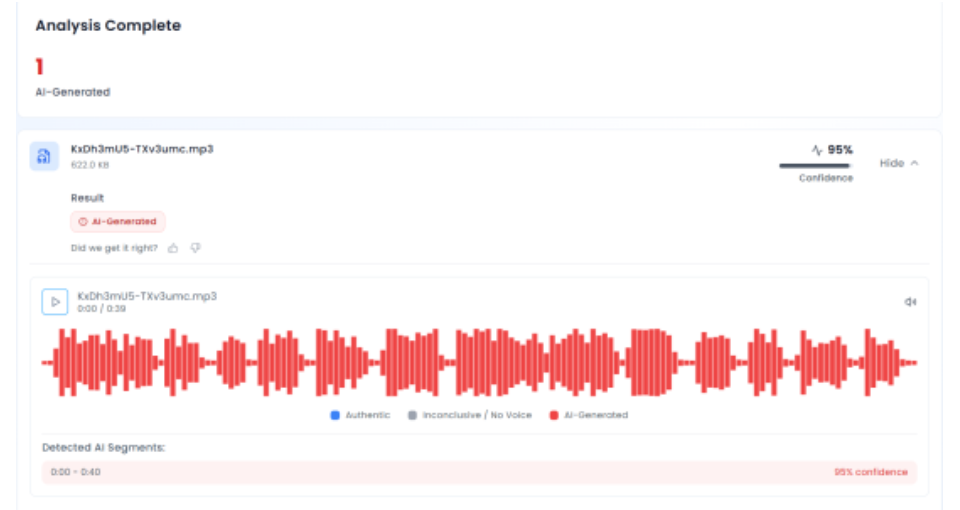
In the next phase of the investigation, the audio track from the viral video was extracted and analysed using the AI audio detection tool Aurigin. The tool’s assessment indicated that the voice heard in the clip was artificially generated, confirming that the audio did not originate from the original speech.
Conclusion
The claim that RSS chief Mohan Bhagwat called for the saffronisation of the Indian Army is false. PTI Fact Check found that the viral video was digitally manipulated, using genuine footage from an RSS centenary event but pairing it with an AI-generated audio track. The altered video was shared online to mislead viewers by falsely attributing statements Bhagwat never made.

Related Blogs
Introduction
With the increasing reliance on digital technologies in the banking industry, cyber threats have become a significant concern. Cyberlaw plays a crucial role in safeguarding the banking sector from cybercrimes and ensuring the security and integrity of financial systems.
The banking industry has witnessed a rapid digital transformation, enabling convenient services and greater access to financial resources. However, this digitalisation also exposes the industry to cyber threats, necessitating the formulation and implementation of effective cyber law frameworks.
Recent Trends in the Banking Industry
Digital Transformation: The banking industry has embraced digital technologies, such as mobile banking, internet banking, and financial apps, to enhance customer experience and operational efficiency.
Open Banking: The concept of open banking has gained prominence, enabling data sharing between banks and third-party service providers, which introduces new cyber risks.
How Cyber Law Helps the Banking Sector
The banking sector and cyber crime share an unspoken synergy due to the mass digitisation of banking services. Thanks to QR codes, UPI and online banking payments, India is now home to 40% of global online banking transactions. Some critical aspects of the cyber law and banking sector are as follows:
Data Protection: Cyberlaw mandates banks to implement robust data protection measures, including encryption, access controls, and regular security audits, to safeguard customer data.
Incident Response and Reporting: Cyberlaw requires banks to establish incident response plans, promptly report cyber incidents to regulatory authorities, and cooperate in investigations.
Customer Protection: Cyberlaw enforces regulations related to online banking fraud, identity theft, and unauthorised transactions, ensuring that customers are protected from cybercrimes.
Legal Framework: Cyberlaw provides a legal foundation for digitalisation in the banking sector, assuring customers that regulations protect their digital transactions and data.
Cybersecurity Training and Awareness: Cyberlaw encourages banks to conduct regular training programs and create awareness among employees and customers about cyber threats, safe digital practices, and reporting procedures.

RBI Guidelines
The RBI, as India’s central banking institution, has issued comprehensive guidelines to enhance cyber resilience in the banking industry. These guidelines address various aspects, including:
Technology Risk Management
Cyber Security Framework
IT Governance
Cyber Crisis Management Plan
Incident Reporting and Response
Recent Trends in Banking Sector Frauds and the Role of Cyber Law
Phishing Attacks: Cyberlaw helps banks combat phishing attacks by imposing penalties on perpetrators and mandating preventive measures like two-factor authentication.
Insider Threats: Cyberlaw regulations emphasise the need for stringent access controls, employee background checks, and legal consequences for insiders involved in fraudulent activities.
Ransomware Attacks: Cyberlaw frameworks assist banks in dealing with ransomware attacks by enabling legal actions against hackers and promoting preventive measures, such as regular software updates and data backups.
Master Directions on Cyber Resilience and Digital Payment Security Controls for Payment System Operators (PSOs)
Draft of Master Directions on Cyber Resilience and Digital Payment Security Controls for Payment System Operators (PSOs) issued by the Reserve Bank of India (RBI). The directions provide guidelines and requirements for PSOs to improve the safety and security of their payment systems, with a focus on cyber resilience. These guidelines for PSOs include mobile payment service providers like Paytm or digital wallet payment platforms.
Here are the highlights-
The Directions aim to improve the safety and security of payment systems operated by PSOs by providing a framework for overall information security preparedness, with an emphasis on cyber resilience.
The Directions apply to all authorised non-bank PSOs.
PSOs must ensure adherence to these Directions by unregulated entities in their digital payments ecosystem, such as payment gateways, third-party service providers, vendors, and merchants.
The PSO’s Board of Directors is responsible for ensuring adequate oversight over information security risks, including cyber risk and cyber resilience. A sub-committee of the Board may be delegated with primary oversight responsibilities.
PSOs must formulate a Board-approved Information Security (IS) policy that covers roles and responsibilities, measures to identify and manage cyber security risks, training and awareness programs, and more.
PSOs should have a distinct Board-approved Cyber Crisis Management Plan (CCMP) to detect, contain, respond, and recover from cyber threats and attacks.
A senior-level executive, such as a Chief Information Security Officer (CISO), should be responsible for implementing the IS policy and the cyber resilience framework and assessing the overall information security posture of the PSO.
PSOs need to define Key Risk Indicators (KRIs) and Key Performance Indicators (KPIs) to identify potential risk events and assess the effectiveness of security controls. The sub-committee of the Board is responsible for monitoring these indicators.
PSOs should conduct a cyber risk assessment when launching new products, services, technologies, or significant changes to existing infrastructure or processes.
PSOs, including inventory management, identity and access management, network security, application security life cycle, security testing, vendor risk management, data security, patch and change management life cycle, incident response, business continuity planning, API security, employee awareness and training, and other security measures should implement various baseline information security measures and controls.
PSOs should ensure that payment transactions involving debit to accounts conducted electronically are permitted only through multi-factor authentication, except where explicitly permitted/relaxed.

Conclusion
The relationship between cyber law and the banking industry is crucial in ensuring a secure and trusted digital environment. Recent trends indicate that cyber threats are evolving and becoming more sophisticated. Compliance with cyber law provisions and adherence to guidelines such as those provided by the RBI is essential for banks to protect themselves and their customers from cybercrimes. By embracing robust cyber law frameworks, the banking industry can foster a resilient ecosystem that enables innovation while safeguarding the interests of all stakeholders or users.

Introduction
Indian Cybercrime Coordination Centre (I4C) was established by the Ministry of Home Affairs (MHA) to provide a framework for law enforcement agencies (LEAs) to deal with cybercrime in a coordinated and comprehensive manner. The Indian Ministry of Home Affairs approved a scheme for the establishment of the Indian Cyber Crime Coordination Centre (I4C) in October 2018. I4C is actively working towards initiatives to combat the emerging threats in cyberspace and it has become a strong pillar of India’s cyber security and cybercrime prevention. The ‘National Cyber Crime Reporting Portal’ equipped with a 24x7 helpline number 1930, is one of the key components of the I4C.
On 10 September 2024, I4Ccelebrated its foundation day for the first time at Vigyan Bhawan, New Delhi. This celebration marked a major milestone in India’s efforts against cybercrimes and in enhancing its cybersecurity infrastructure. Union Home Minister and Minister of Cooperation, Shri Amit Shah, launched key initiatives aimed at strengthening the country’s cybersecurity landscape.
Launch of Key Initiatives to Strengthen Cybersecurity
- Cyber Fraud Mitigation Centre (CFMC): As a product of Prime Minister Shri Narendra Modi’s vision, the Cyber Fraud Mitigation Centre (CFMC), was incorporated to bring together banks, financial institutions, telecom companies, Internet Service Providers, and law enforcement agencies on a single platform to tackle online financial crimes efficiently. This integrated approach is expected to minimise the time required to streamline operations and to track and neutralise cyber fraud.
- Cyber Commando: The Cyber Commandos Program is an initiative in which a specialised wing of trained Cyber Commandos will be established in states, Union Territories, and Central Police Organizations. These commandos will work to secure the nation’s digital space and counter rising cyber threats. They will form the first line of defence in safeguarding India from the growing cyber threats.
- Samanvay Platform: The Samanvay platform is a web-based Joint Cybercrime Investigation Facility System that was introduced as a one-stop data repository for cybercrime. It facilitates cybercrime mapping, data analytics, and cooperation among law enforcement agencies across the country. This will play a pivotal role in fostering collaborations in combating cybercrimes. Mr. Shah recognised the Samanvay platform as a crucial step in fostering data sharing and collaboration. He called for a shift from the “need to know” principle to a “duty to share” mindset in dealing with cyber threats. The Samanvay platform will serve as India’s first shared data repository, significantly enhancing the country’s cybercrime response.
- Suspect Registry: The Suspect Registry Portal is a national-level platform that has been designed to track cybercriminals. The portal registry will be connected to the National Cybercrime Reporting Portal (NCRP) which aims to help banks, financial intermediaries, and law enforcement agencies strengthen fraud risk management. The initiative is expected to improve the real-time tracking of cyber suspects, preventing repeat offences and improving fraud detection mechanisms.
Rising Digitalization: Prioritizing Cybersecurity
The number of internet users in India has grown from 25 crores in 2014 to 95 crores in 2024, accompanied by a 78-foldincrease in data consumption. This growth is echoed in the number of growing cybersecurity challenges in the digital era. With the rise of digital transactions through Jan Dhan accounts, Rupay debit cards, and UPI systems, Shri Shah underscored the growing threat of digital fraud. He emphasised the need to protect personal data, prevent online harassment, and counter misinformation, fake news, and child abuse in the digital space.
The three new criminal laws, the Bharatiya Nyaya Sanhita (BNS), Bharatiya Nagrik Suraksha Sanhita (BNSS), and Bharatiya Sakshya Adhiniyam (BSA), which aim to strengthen India’s legal framework for cybercrime prevention, were also referred to in the address bythe Home Minister. These laws incorporate tech-driven solutions that will ensure investigations are conducted scientifically and effectively.
Mr. Shah emphasised popularising the 1930Cyber Crime Helpline. Additionally, he noted that I4C has issued over 600advisories, blocked numerous websites and social media pages operated by cybercriminals, and established a National Cyber Forensic Laboratory in Delhi. Over 1,100 officers have already received cyber forensics training under theI4C umbrella.
In response to the regional cybercrime challenges, the formation of Joint Cyber Coordination Teams in cybercrime hotspot areas like Mewat, Jamtara, Ahmedabad, Hyderabad, Chandigarh, Visakhapatnam and Guwahati was highlighted as a coordinated response to local cybercrime hotspot issues.
Conclusion
With the launch of initiatives like the Cyber Fraud Mitigation Centre, the Samanvay platform, and the Cyber Commandos Program, I4C is positioned to play a crucial role in combating cybercrime. The I4C is moving forward with a clear vision for a secure digital future and safeguarding India's digital ecosystem.
References:
● https://pib.gov.in/PressReleaseIframePage.aspx?PRID=2053438
.webp)
Introduction
YouTube is testing a new feature called ‘Notes,’ which allows users to add community-sourced context to videos. The feature allows users to clarify if a video is a parody or if it is misrepresenting information. The feature builds on existing features to provide helpful content alongside videos. Currently under testing, the feature will be available to a limited number of eligible contributors who will be invited to write notes on videos. These notes will appear publicly under a video if they are found to be broadly helpful. Viewers will be able to rate notes into three categories: ‘Helpful,’ ‘Somewhat helpful,’ or ‘Unhelpful’. Based on the ratings, YouTube will determine which notes are published. The feature will first be rolled out on mobile devices in the U.S. in English. The Google-owned platform will look at ways to improve the feature over time, including whether it makes sense to expand it to other markets.
YouTube To Roll Out The New ‘Notes’ Feature
YouTube is testing an experimental feature that allows users to add notes to provide relevant, timely, and easy-to-understand context for videos. This initiative builds on previous products that display helpful information alongside videos, such as information panels and disclosure requirements when content is altered or synthetic. YouTube in its blog clarified that the pilot will be available on mobiles in the U.S. and in the English language, to start with. During this test phase, viewers, participants, and creators are invited to give feedback on the quality of the notes.
YouTube further stated in its blog that a limited number of eligible contributors will be invited via email or Creator Studio notifications to write notes so that they can test the feature and add value to the system before the organisation decides on next steps and whether or not to expand the feature. Eligibility criteria include having an active YouTube channel in good standing with Yotube’s Community Guidelines.
Viewers in the U.S. will start seeing notes on videos in the coming weeks and months. In this initial pilot, third-party evaluators will rate the helpfulness of notes, which will help train the platform’s systems. As the pilot moves forward, contributors themselves will rate notes as well.
Notes will appear publicly under a video if they are found to be broadly helpful. People will be asked whether they think a note is helpful, somewhat helpful, or unhelpful and the reasons for the same. For example, if a note is marked as ‘Helpful,’ the evaluator will have the opportunity to specify if it is so because it cites high-quality sources or is written clearly and neutrally. A bridging-based algorithm will be used to consider these ratings and determine what notes are published. YouTube is excited to explore new ways to make context-setting even more relevant, dynamic, and unique to the videos we are watching, at scale, across the huge variety of content on YouTube.
CyberPeace Analysis: How Can Notes Help Counter Misinformation
The potential effectiveness of countering misinformation on YouTube using the proposed ‘Notes’ feature is significant. Enabling contributors to include notes on videos can offer relevant and accurate context to clarify any misleading or false information in the video. These notes can aid in enhancing viewers' comprehension of the content and detecting misinformation. The participation from users to rate the added notes as helpful, somewhat helpful, and unhelpful adds a heightened layer of transparency and public participation in identifying the accuracy of the content.
As YouTube intends to gather feedback from its various stakeholders to improve the feature over time, one can look forward to improved policy and practical over time: the feedback mechanism will allow for continuous refinement of the feature, ensuring it effectively addresses misinformation. The platform employs algorithms to identify helpful notes that cater to a broad audience across different perspectives. This helps showcase accurate information and combat misinformation.
Furthermore, along with the Notes feature, YouTube should explore and implement prebunking and debunking strategies on the platform by promoting educational content and empowering users to discern between fact and any misleading information.
Conclusion
The new feature, currently in the testing phase, aims to counter misinformation by providing context, enabling user feedback, leveraging algorithms, promoting transparency, and continuously improving information quality. Considering the diverse audience on the platform and high volumes of daily content consumption, it is important for both the platform operators and users to engage with factual, verifiable information. The fallout of misinformation on such a popular platform can be immense, and so, any mechanism or feature that can help counter the same must be developed to its full potential. Apart from this new Notes feature, YouTube has also implemented certain measures in the past to counter misinformation, such as providing authenticated sources to counter any election misinformation during the recent 2024 elections in India. These efforts are a welcome contribution to our shared responsibility as netizens to create a trustworthy, factual and truly-informational digital ecosystem.
References:
- https://blog.youtube/news-and-events/new-ways-to-offer-viewers-more-context/
- https://www.thehindu.com/sci-tech/technology/internet/youtube-tests-feature-that-will-let-users-add-context-to-videos/article68302933.ece
