
TRAI on Promotional Messages & Calls

Introduction
The Telecom Regulatory Authority of India (TRAI), on March 13 2023, published a new rule to regulate telemarketing firms. Trai has demonstrated strictness when it comes to bombarding users with intrusive marketing pitches. In a report, TRAI stated that 10-digit mobile numbers could not be utilised for advertising. In reality, different phone numbers are given out for regular calls and telemarketing calls. Hence, it is an appropriate and much-required move in order to suppress and eradicate phishing scammers and secure the Indian Cyber-ecosystem at large.
What are the new rules?
The rules state that now 10-digit unregistered mobile numbers for promotional purposes would be shut down over the following five days. The rule claim that calling from unregistered mobile numbers had been banned was published on February 16. In this case, using 10-digit promotional messages for promotional calling will end within the following five days. This step by TRAI has been seen after nearly 6-8 months of releasing the Telecommunication Bill, 2022, which has focused towards creating a stable Indian Telecom market and reducing the phoney calls/messages by bad actors to reduce cyber crimes like phishing. This is done to distinguish between legitimate and promotional calls. According to certain reports, some telecom firms allegedly break the law by using 10-digit mobile numbers to make unwanted calls and send promotional messages. All telecom service providers must execute the requirements under the recent TRAI directive within five days.
How will the new rules help?
The promotional use of a cellphone number with 10 digits was allowed since the start, however, with the latest NCRB report on cyber crimes and the rising instances and reporting of cyber crimes primarily focused towards frauds related to monetary gains by the bad actors points to the issue of unregulated promotional messages. This move will act as a critical step towards eradicating scammers from the cyber-ecosystem, TRAI has been very critical in understanding the dynamics and shortcomings in the regulation of the telecom spectrum and network in India and has shown keen interest towards suppressing the modes of technology used by the scammers. It is a fact that the invention of the technology does not define its use, the policy of the technology does, hence it is important to draft ad enact policies which better regulate the existing and emerging technologies.
What to avoid?
In pursuance of the rules enacted by TRAI, the business owners involved in promotional services through 10-digit numbers will have to follow these steps-
- It is against the law to utilise a 10-digit cellphone number for promotional calls.
- You should stop doing so right now.
- Your mobile number will be blocked in the following five days if not.
- Users employed by telemarketing firms are encouraged to refrain from using the system in such circumstances.
- Those working for telemarketing firms are encouraged not to call from their mobile numbers.
- Users should phone the company’s registered mobile number for promotional purposes.
Conclusion
The Indian netizen has been exposed to the technology a little later than the western world. However, this changed drastically during the Covid-19 pandemic as the internet and technology penetration rates increased exponentially in just a couple of months. Although this has been used as an advantage by the bad actors, it was pertinent for the government and its institutions to take an effective and efficient step to safeguard the people from financial fraud. Although these frauds occur in high numbers due to a lack of knowledge and awareness, we need to work on preventive solutions rather than precautionary steps and the new rules by TRAI point towards a safe, secured and sustainable future of cyberspace in India.

Related Blogs

March 3rd 2023, New Delhi: If you have received any message that contains a link asking users to download an application to avail Income Tax Refund or KYC benefits with the name of Income Tax Department or reputed Banks, Beware!
CyberPeace Foundation and Autobot Infosec Private Limited along with the academic partners under CyberPeace Center of Excellence (CCoE) recently conducted five different studies on phishing campaigns that have been circulating on the internet by using misleading tactics to convince users to install malicious applications on their devices. The first campaign impersonates the Income Tax Department, while the rest of the campaigns impersonate ICICI Bank, State Bank of India, IDFC Bank and Axis bank respectively. The phishing campaigns aim to trick users into divulging their personal and financial information.
After a detailed study, the research team found that:
- All campaigns appear to be an offer from reputed entities, however hosted on third-party domains instead of the official website of the Income Tax Department or the respective Banks, raising suspicion.
- The applications ask several access permissions of the device. Moreover some of them seek users to provide full control of the device. Allowing such access permission could result in a complete compromise of the system, including access to sensitive information such as microphone recordings, camera footage, text messages, contacts, pictures, videos, and even banking applications.
- Cybercriminals created malicious applications using icons that closely resemble those of legitimate entities with the intention of enticing users into downloading the malicious applications.
- The applications collect user’s personal and banking information. Getting into this type of trap could lead users to face significant financial losses.
- While investigating the impersonated Income Tax Department’s application, the Research team identified the application sends http traffic to a remote server which acts as a Command and Control (CnC/C2) for the application.
- Customers who desire to avail benefits or refunds from respective banks, download relevant apps, believing that the chosen app will assist them. However, they are not always aware that the app may be fraudulent.
“The Research highlights the importance of being vigilant while browsing the internet and not falling prey to such phishing attacks. It is crucial to be cautious when clicking on links or downloading attachments from unknown sources, as they may contain malware that can harm the device or compromise the data.” spokesperson, CyberPeace added.
In addition to this in an earlier report released in last month, the same research team had drawn attention to the WhatsApp messages masquerading as an offer from Tanishq Jewellers with links luring unsuspecting users with the promise of free valentine’s day presents making the rounds on the app.
CyberPeace Advisory:
- The Research team recommends that people should avoid opening such messages sent via social platforms. One must always think before clicking on such links, or downloading any attachments from unauthorised sources.
- Downloading any application from any third party sources instead of the official app store should be avoided. This will greatly reduce the risk of downloading a malicious app, as official app stores have strict guidelines for app developers and review each app before it gets published on the store.
- Even if you download the application from an authorised source, check the app’s permissions before you install it. Some malicious apps may request access to sensitive information or resources on your device. If an app is asking for too many permissions, it’s best to avoid it.
- Keep your device and the app-store app up to date. This will ensure that you have the latest security updates and bug fixes.
- Falling into such a trap could result in a complete compromise of the system, including access to sensitive information such as microphone recordings, camera footage, text messages, contacts, pictures, videos, and even banking applications and could lead users to financial loss.
- Do not share confidential details like credentials, banking information with such types of Phishing scams.
- Never share or forward fake messages containing links on any social platform without proper verification.

As e-commerce companies expand their base and sell a wide range of products on their platforms, attackers continue to look for newer avenues to exploit and potential loopholes to perpetuate scams. A recent method used by scammers is the brushing scam, which targets online shoppers to drive sales. As per reports, it is already being conducted on popular and trusted e-commerce websites such as Amazon and Alibaba Express, and online shoppers must exercise caution with regard to the packages they receive.
The Brushing Scam
Deriving its name from China’s e-commerce practice, this scam includes sellers creating and sending fake orders to unsuspecting individuals, posing to be from e-commerce websites in order to ‘brush up’ the sales figures of their product. The products received are usually low quality and contain items such as low-cost jewellery, seeds, and random gadgets, among other things. The aim is to manipulate reviews for a particular product and make it seem popular so other buyers online are encouraged to purchase the items marketed. Most online shoppers today check reviews before making a purchase, and popular items and seemingly-trustworthy reviews can go a long way towards influencing customer behaviour. Since many platforms do include labels to authenticate reviews tied to genuine purchases to counter fake reviews, scammers have evolved a step further to develop an MO for fake reviews that holds up against basic levels of scrutiny. Some of the packages received under the brushing scam also have QR codes which once scanned lead the receiver to malicious websites.
CyberPeace Insights
Mysterious deliveries that have no information but your name and address may seem tempting to many, as receivers might assume that it could be a marketing gig and free products to try for the sake of promoting a product. The credibility of such deliveries increases as they are packaged to show that these are delivered through trusted online shopping and e-commerce sites. However, even though receiving products for free might seem harmless, it is advised that unknown items be dealt with carefully, more so when addressed to an individual with personal details. Receiving an order itself is an indication that personal information such as one’s name and address has been compromised, and it is likely that the sellers are involved in procuring personal information through a third party, often using illegal methods.
Registering complaints to the concerned e-commerce websites is encouraged, as the frequency of cases raises questions and encourages platforms to take action to ensure a secure buying and delivery experience from their end. An awareness of such scams being carried out for their customers could encourage caution on the part of these platforms and prove to be helpful in addressing the issue on multiple levels. On the part of the receivers, they can change the passwords of their e-commerce accounts and use a 2FA (2-factor authentication) for better security. They should also exercise caution while receiving such parcels, and avoid scanning QR codes on suspicious items.
References
- https://www.livemint.com/technology/tech-news/brushing-scam-explained-from-fake-orders-to-reviews-how-fraudsters-are-manipulating-online-shopping-platforms-11735824384866.html
- https://www.indiatvnews.com/technology/news/beware-of-amazon-scams-how-fraudsters-use-fake-reviews-to-sell-counterfeit-products-2025-01-02-969115
- https://www.indiatoday.in/technology/news/story/brushing-scam-now-makes-buzz-as-it-targets-online-shoppers-everything-you-need-to-know-2659172-2025-01-03
- https://www.msn.com/en-in/money/news/brushing-scam-now-makes-buzz-as-it-targets-online-shoppers-everything-you-need-to-know/ar-AA1wTvon

Executive Summary
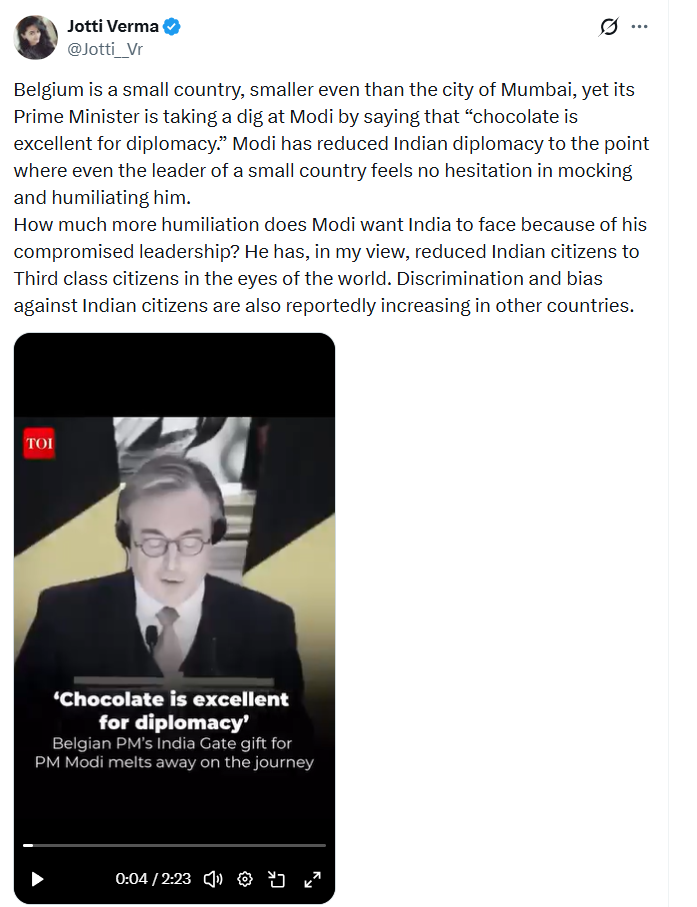
Belgian Prime Minister Bart De Wever is on an official visit to India. During the visit, he met Prime Minister Narendra Modi. Meanwhile, a video of his speech is going viral on social media. In his speech, Bart De Wever can be heard saying to PM Modi, “Chocolate is excellent for diplomacy, but not for diplomatic travel.” The video is being shared with the claim that Belgian Prime Minister Bart De Wever took a jibe at Prime Minister Narendra Modi’s diplomacy by referring to “chocolate diplomacy.” A research done by the CyberPeace Research Wing found that Belgian Prime Minister Bart De Wever had brought an unusual and thoughtful gift for Prime Minister Narendra Modi. It was a miniature replica of Delhi’s iconic India Gate, made entirely from Belgian chocolate. However, the chocolate replica melted during the journey to India. Referring to the incident, Bart De Wever made the remark in a humorous manner, saying that the chocolate gift could not withstand the journey. The video is now being shared by users with a misleading claim.
Claim:
X user Jyoti Verma wrote, “Belgium is a small country, smaller than the city of Mumbai, yet its Prime Minister is taking a jibe at Modi by saying that ‘chocolate is a very good thing for diplomacy.’ Modi has brought the level of Indian diplomacy down so much that even the leader of a small country does not hesitate to mock and belittle him. How much more humiliation does Modi want India to face because of his weak leadership? In my view, he has turned Indian citizens into ‘third-class’ citizens in the eyes of the world. There are also reports that discrimination and bias against Indian citizens are increasing in other countries.”
https://x.com/Jotti__Vr/status/2096154750425424086?s=20
Fact Check
During the research of the claim, a search using relevant keywords led us to the full video of the Belgian Prime Minister posted on ANI’s official X handle. In the video, Bart De Wever can be seen mentioning the chocolate replica of India Gate during a joint press conference with Prime Minister Narendra Modi.
https://x.com/ANI/status/2095426762243281060?s=20
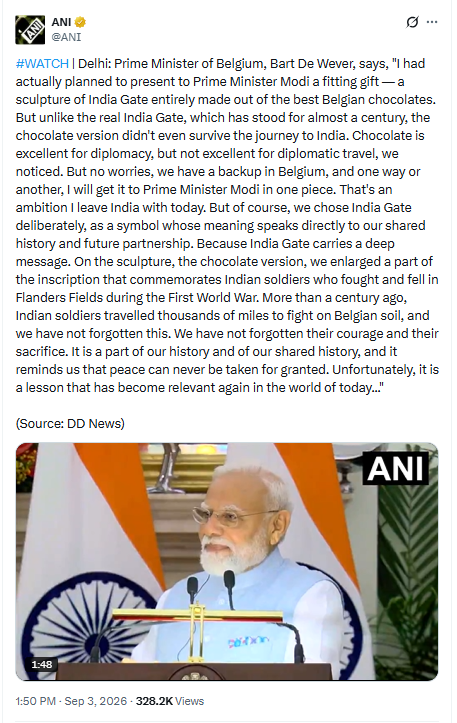
As part of the research, we found a report published on the Times of India website on September 4, 2026. According to the report, Belgian Prime Minister Bart De Wever arrived in India carrying a unique and special gift for Prime Minister Narendra Modi. It was a miniature replica of Delhi’s iconic India Gate, made entirely of Belgian chocolate. However, there was one problem—the chocolate replica melted during the journey to India. During a joint press conference with Prime Minister Modi in New Delhi on September 3, De Wever shared the anecdote in a light-hearted manner. He said he had planned to gift Modi a replica of India Gate made from “the finest Belgian chocolate.” However, unlike the real India Gate, which has stood for nearly a century, the chocolate replica did not survive the journey intact. De Wever jokingly remarked, “Chocolate is great for diplomacy, but not for diplomatic travel.”

Conclusion:
Our research found that the viral claim is misleading. Belgian Prime Minister Bart De Wever did indeed bring a miniature replica of India Gate made entirely of Belgian chocolate as a gift for Prime Minister Narendra Modi. However, the claim that the replica “melted during the journey” needs context. De Wever mentioned the incident humorously during his joint press conference with PM Modi, explaining that the chocolate replica did not survive the journey intact. Therefore, the viral post is based on a genuine incident but may present the context in a misleading manner.
