
The Machine That Started the Fire Is Now Selling Us the Fire Extinguisher
Introduction
"Artificial Intelligence may be the new charlatan in town"
There is something almost wonderfully Indian about our current relationship with artificial intelligence. We are simultaneously afraid of it, fascinated by it, regulating it, funding it, using it and occasionally asking it to write the regulation meant to control it. In contrast, artificial intelligence seems to have figured out the oldest trick in the book: create an issue and then figure out how to solve it. Both the deepfake and the deepfake detector can be produced by it. It has the ability to both generate and detect false information. It can both authenticate and mimic your voice. It can create a fake image and determine if it is fake. The machine ,in other words, is increasingly becoming both the burglar and the security system. We now refer to this as innovation. Perhaps nothing better captures this peculiar moment than India’s most recent regulatory actions. The government has strengthened regulations pertaining to synthetic content such as requiring labelling and expediting the removal of illegal AI-generated information. After a legitimate government or court order, platforms are expected to take action within three hours, significantly reducing the removal window for some content. It took years for the internet to become ubiquitous. There are now three hours for the law to become transitory. This is the first great paradox of AI governance. Technology operates at the speed of creation. Law operates at the speed of procedure. The citizen is seated between the two.
The Age of the Digital Double
Indian courts are already dealing with this issue in more tangible ways. Cricket player Yuvraj Singh recently received relief from the Delhi High Court in a personality-rights case involving deepfakes created by AI and unlawful use of his identity. Courts have intervened against AI-generated and modified content in similar cases involving other public individuals. As a result, the law faces an odd dilemma: What exactly belongs to a person? In the past, humans used comparatively stable identifiers to understand identity, such as a name, portrait, signature, or voice. That simplicity has been disrupted by AI. You can now detach your face from your body. You may separate your throat from your voice. It is possible to distinguish between your emotions and your expressions. It is possible to fabricate your political beliefs without engaging in politics. The legitimacy of a person's existence is being requested to be protected by the law, not just their property which is a far more difficult issue.
When Artificial Intelligence Enters the Courtroom
The irony becomes richer when AI enters the courtroom itself. Courts are creating guidelines for the use of AI in the courtroom, just as they are being challenged to decide what happens when AI creates reality outside of it. Human primacy, accountability, transparency, data protection and judicial independence are highlighted in the Supreme Court’s proposed rules on the use of AI in courts. After all, there is one situation in which the justification that “the AI said so” should never be accepted. A hallucinated judgment is more than just a mistake in technology. It may turn into a mistake of authority in a legal system. A precedent can be confidently created by a machine. It can be cited with confidence by a lawyer and maybe then brought before a court for consideration. All of a sudden, we have created a flawless little bureaucratic ecology where everyone has been duped despite no one's intention to do so. It's not inevitable that machines will turn malevolent, but rather that people will grow unduly reliant on machines that seem authoritative.
The Great AI Contradiction
We asked, "What can AI do?" for years.What can AI do for us, we then enquired? We are starting to wonder what AI might do to humans. The following query ought to be more challenging: When it does, who is at fault? Because AI systems don't cleanly fit into the legal frames we inherited, that question becomes very challenging. Developers, model providers, data providers, deployers, platforms, and end users are among them. There may occasionally be a middleman. There is a victim occasionally. Surprisingly, there can occasionally be multiple roles at once. This point is made in a recent working paper on AI and consumer rights in India: while current consumer protection laws may apply to AI harms, the conventional division of accountability among manufacturers, sellers, and service providers becomes challenging when AI systems involve a much more dispersed value chain.
The Misunderstanding on AI’s Intelligence
This is the point at which our sense for policy sometimes fails. We are concerned that AI will develop superintelligence. The more imminent threat can be much less dramatic. It is not necessary for AI to surpass human intelligence in order to wreak great harm. All it needs to do is become more convincing, quicker, and less expensive than human verification. Artificial general intelligence is not necessary for a fraudster to con an elderly person. A supercomputer is not necessary for a political manipulator to create a candidate's voice. A stalker can create an intimate deepfake without being conscious. A pupil can file a hallucinated case citation without the assistance of a robot attorney. Ordinary human wrongdoing magnified by incredible technical magnitude is what it is.
The Real Test of AI Governance
The number of standards we create, the number of committees we form, or the number of compliance boxes platforms check will not ultimately determine the success of AI regulation. Something considerably simpler will be used to measure it. Can the legal system advise a regular citizen where to go, what to do, and who will be held accountable when an AI system impersonates, defrauds, surveils, manipulates, or denies them a service?
The presence of accountability following failure, not the absence of failure.
Sometimes the most advanced piece of technology in the room is still an old-fashioned institution: a law that works, a regulator that responds, a court that understands the technology and a human being willing to take responsibility. Because if AI is going to be both the fire and the fire extinguisher, we should at least make sure that someone other than the machine owns the building.
References
- https://economictimes.indiatimes.com/news/india/government-tightens-deepfake-rules-mandates-ai-content-labels-and-three-hour-takedown-timeline/articleshow/133011656.cms?utm_source=chatgpt.com&from=mdr
- https://theleaflet.in/law-and-technology/explained-the-supreme-court-of-indias-draft-regulations-for-use-of-artificial-intelligence-in-courts-2026
- https://www.bananaip.com/intellepedia/yuvraj-singh-personality-rights-ai-deepfakes-delhi-high-court/

Related Blogs

Introduction
Misinformation has been a significant concern in recent times, especially in the online information landscape. This past month, misinformation has been linked to the communal tensions that have flared up in the North Tripura district. While the law enforcement agencies were quick to respond, misinformation about the law and order situation spread rapidly. Shri Amitabh Ranjanon, Tripura’s Director General of Police, issued a public statement on 21st October 2024, Monday, clarifying “The state's law and order situation has improved, and misinformation is being spread about it”. This instance is a classic example of how misinformation can affect the delivery of good governance to citizens or hamper the relationship between the citizenry and the state mechanisms. Such misinformation undermines the efforts of the law enforcement agencies striving to maintain peace, and distorted narratives can colour public opinion about the authorities and create cycles of misplaced distrust.
DGP's Statement
DGP Amitabh Ranjanon clarified during an event to commemorate Police Commemoration Day, stating that the state has recorded a lesser number of crimes this year compared to the last 10 years. He emphasized that senior police officials promptly respond to any law and order issues and additional forces have been deployed as necessary. Ranjan highlighted the peaceful celebration of Durga Puja as a testament to the effective law enforcement measures in place, demonstrating communal harmony.
Impact of Misinformation in communal settings
Misinformation in communal settings can cause anxiety, fear, and distrust among community members, leading to conflicts. It undermines public confidence in law enforcement and government institutions. The spread of false information can erode trust in law enforcement and government bodies, hindering their ability to address and solve conflicts. Therefore, precise data and accurate information are essential in every environment to avoid the harm caused by misinformation.
Preventive Measures Against Misinformation
- Look for authenticated sources
In a digital landscape filled with information from various sources, it’s essential to differentiate between credible and unreliable content. Authenticated sources are typically reputable organizations and officials. Users must rely on authenticated sources to ensure the information's accuracy and credibility. Users must verify the source, confirm the claims made in the source by comparing them with other credible sources for accuracy, and follow fact-checking practices.
- Exercise caution on social media information
Social media platforms can rapidly disseminate information, but they can also serve as breeding grounds for misinformation. The ease of sharing content can lead to the spread of unverified claims, rumours, or even outright falsehoods. Therefore, exercising caution when engaging with information on these platforms is crucial. Users must scrutinize headlines and images as well, especially since misleading images can distort the truth with the advent of AI. One must always read beyond the headline and check the context of the images used and not make split-second decisions and impressions. Users must engage in critical thinking and share informed opinions responsibly, to promote discussions about the validity of shared content.
- Role of Awareness
Awareness about misinformation is essential for navigating the complexities of modern communication. People can make better decisions and help create a more informed society by being aware of the strategies used to disseminate false information. Users need to become knowledgeable about typical misinformation strategies, hone their cognitive abilities to critically assess internet content, and verify the reliability of sources before they form opinions, make decisions or share ahead.
Final words
By integrating these simple best practices into our daily lives we can cultivate a more informed public, reduce the spread of online misinformation, and enhance critical thinking skills among peers and the larger digital community.
References
- https://www.theweek.in/wire-updates/national/2024/10/21/cal8-tr-dgp.html
- https://www.newindianexpress.com/nation/2024/Oct/21/tripura-dgp-says-misinformation-being-spread-about-states-law-and-order-situation
- https://indianexpress.com/article/north-east-india/tripura/police-inaction-tripura-dgp-amitabh-ranjan-sharp-decline-crime-rate-9632509/
- https://www.newindianexpress.com/nation/2024/Oct/21/tripura-dgp-says-misinformation-being-spread-about-states-law-and-order-situation

Executive Summary
A video showing a helicopter engulfed in flames is being widely circulated on social media with the claim that it depicts an American Black Hawk helicopter shot down by Iran during the ongoing Middle East conflict. However, research by the CyberPeace Research Wing found the claim to be false. The viral footage is old and dates back to February 2020, showing a helicopter shot down in Syria, not Iran.
Claim
A Facebook post shared from Nigeria on April 6, 2026, claimed: “The moment an American Black Hawk helicopter was struck by an Iranian heat-seeking missile.” The post, which has been shared over 100 times, includes a 50-second video showing a helicopter exploding mid-air and crashing to the ground.

Fact Check
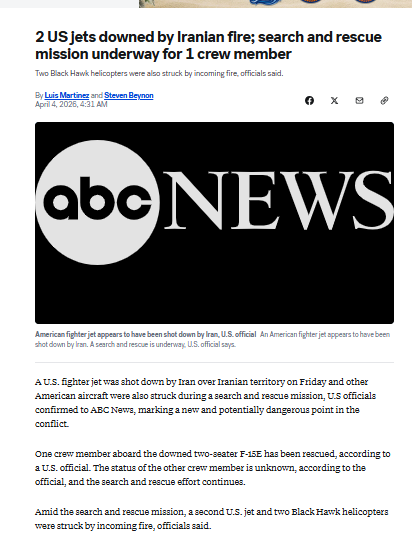
On April 3, a US F-15E Strike Eagle was reportedly shot down over Iran, marking the first such incident since the start of the ongoing Middle East conflict.
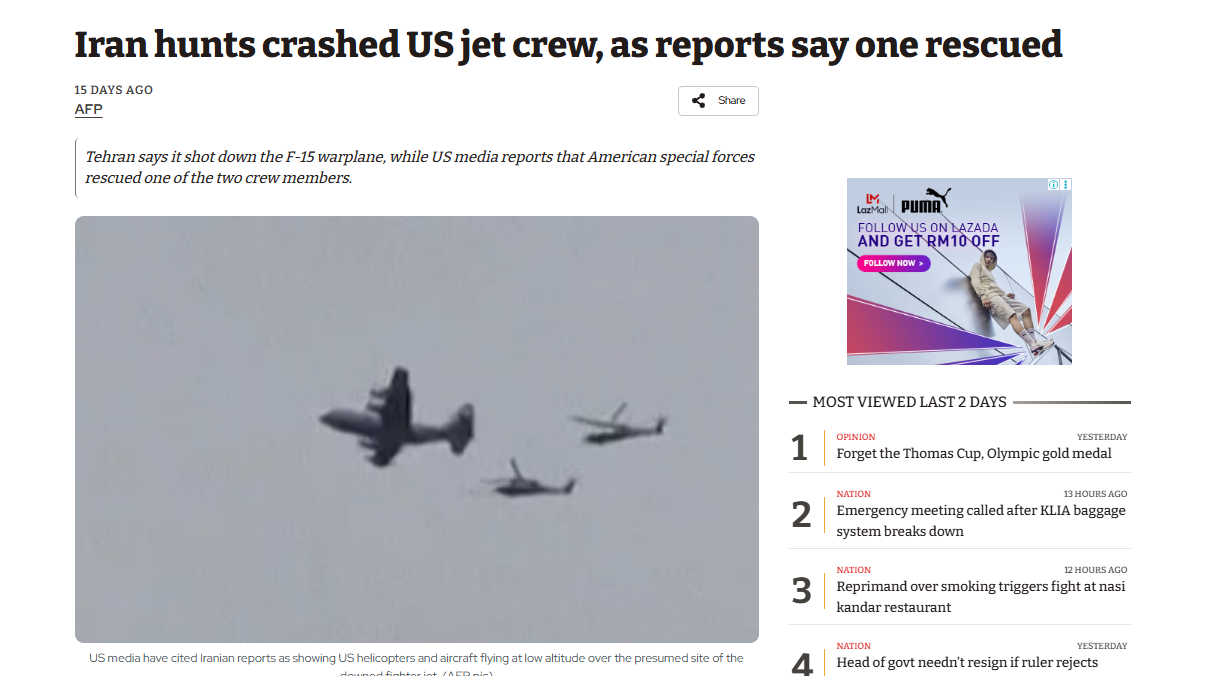
Two Black Hawk helicopter deployed for a search-and-rescue mission for the jet’s crew were also hit by Iranian fire but managed to return to base, despite some crew members being injured.
- http://abcnews.com/Politics/us-fighter-jet-iran-search-rescue-officials/story?id=131685787&utm_source=chatgpt.com
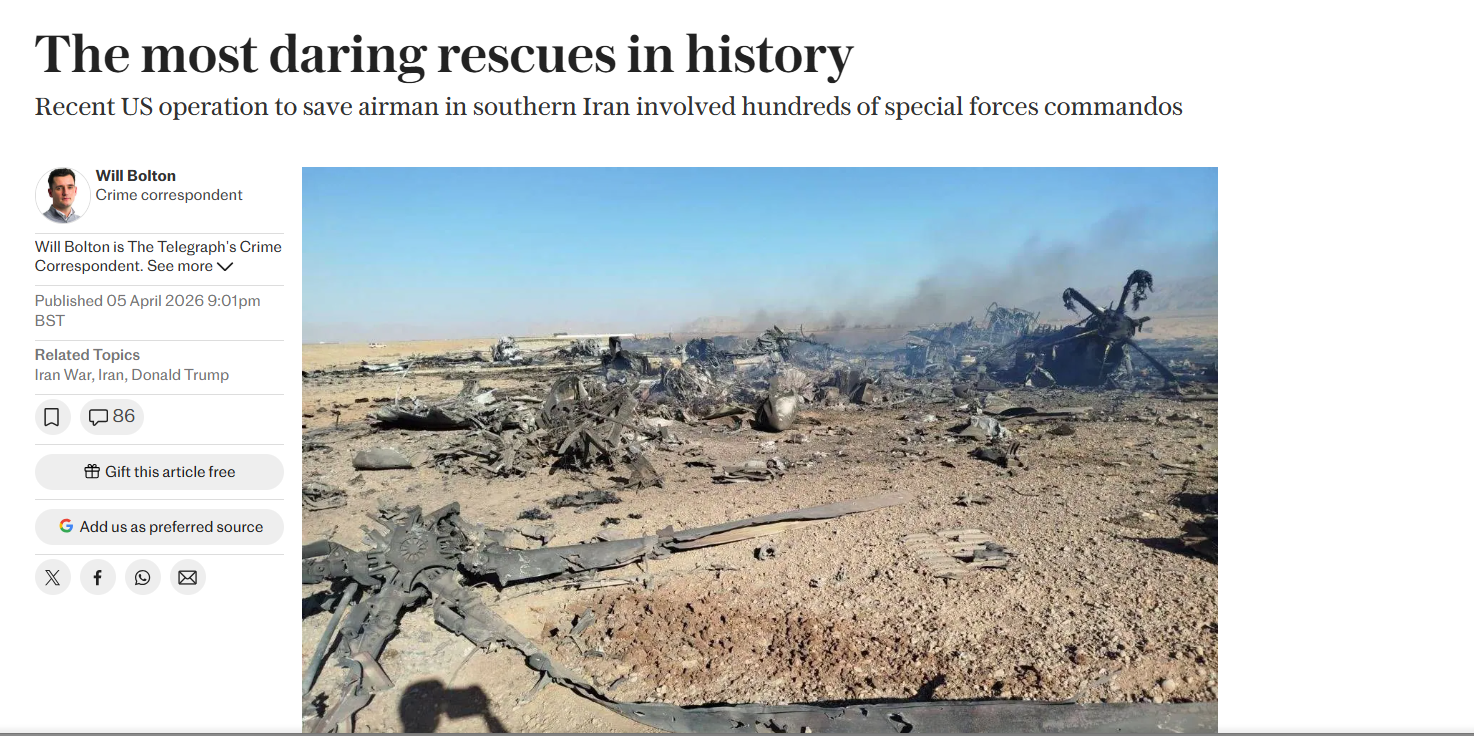
US President Donald Trump had earlier announced the recovery of a missing pilot, describing it as “one of the most daring search and rescue operations in US history.
”
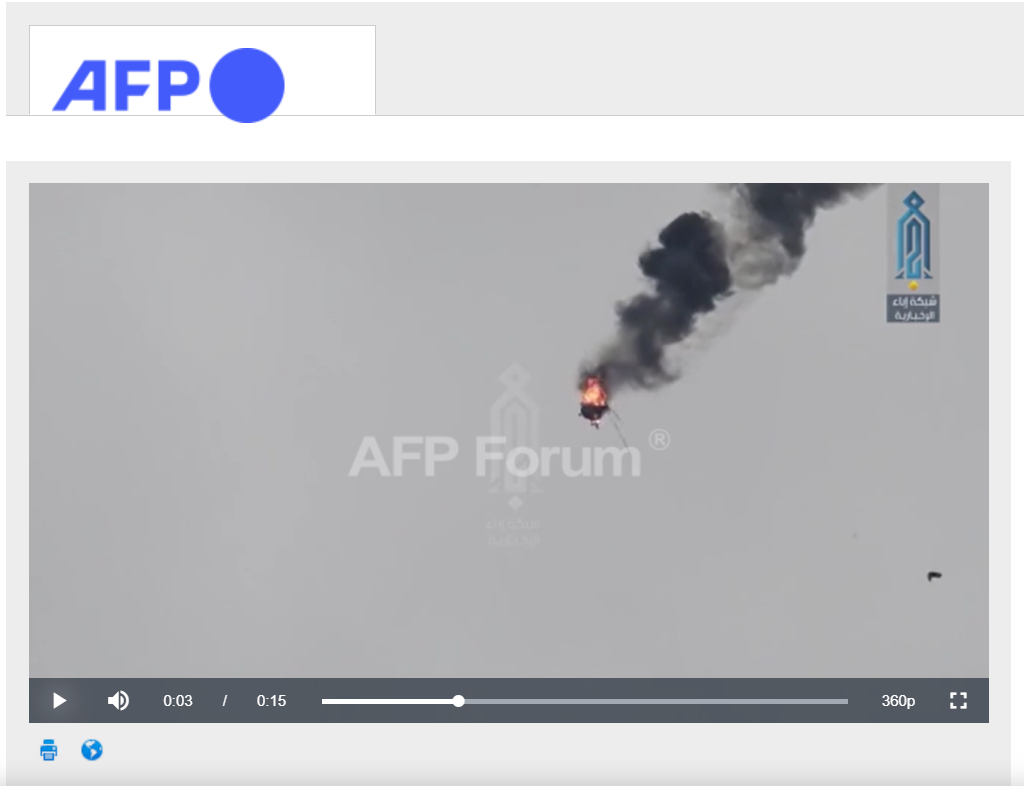
However, the viral video being shared as evidence of the downing of a US aircraft predates these events. Using reverse image search on keyframes from the clip, we found a longer version published by Euronews on February 11, 2020. The Arabic title of the video translates to: “Syrian regime helicopter shot down in Idlib, two pilots killed.” Reports indicate that the incident occurred in Idlib, Syria, in February 2020, where a military helicopter was shot down and caught fire before crashing.

The incident was also covered by other international media outlets, including AFP, which distributed images and videos of the crash.
- https://www.afpforum.com/AFPForum/Search/ViewMedia.aspx?mui=1&hid=5DFA75509C25E3CDC3F24CA3B41C1A9A854C8AA3EB2BC1C64FCC0192F0506138
Conclusion
The viral claim is false. The footage does not show an American helicopter shot down by Iran. Instead, it is an old video from February 2020 depicting a helicopter crash in Syria, which is being shared with a misleading and unrelated narrative.

About Customs Scam:
The Customs Scam is a type of fraud where the scammers pretend to be from the renowned courier office company (DTDC, etc.), or customs department or other government entities. They try to deceive the targets to transfer the money to resolve the fake customs related concerns. The Research Wing at CyberPeace along with the Research Wing of Autobot Infosec Private Ltd. delved into this case through Open Source Intelligence methods and undercover interactions with the scammers and concluded with some credible information.
Case Study:
The victim receives a phone call posing as a renowned courier office (DTDC, etc.) employee (in some case custom’s officer) that a parcel in the name of the victim has been taken into custody because of inappropriate content. The scammer provides the victim an employee ID, FIR number to prove the authenticity of the case and also they show empathy towards the victim. The scammer pretends to help the victim to connect with a police officer for further action. This so-called police officer shows transparency in his work. He asks him to join a skype video call and he even provides time to install the skype app. He instructs the victim to connect with the skype id provided by the fake police officer where the scammer created a fake police station environment. He also claims that he contacted the headquarters and the victim’s phone number is associated with many illegal activities to create panic to the victim. Then the scammers also ask the victim to give their personal details such as home address, office address, aadhar card number, PAN card number and screenshot of their bank accounts along with their available account balance for the sake of so-called investigation. Sometimes scammers also demand a high amount of money to resolve the issue and create fake urgency to trap the victim in making the payment. He sternly warns the victim not to contact any other police officials or professionals, making it clear that doing so would only lead to more trouble.
Analysis & Findings:
After receiving these kinds of complaints from multiple sources, the analysis was done on the collection of phone numbers from where the calls originated. These phone numbers were analysed for alias name, location, Telecom operator, etc. Further, we have verified the number to check whether the number is linked with any social media account on reputed platforms like Google, Facebook, Whatsapp, Twitter, Instagram, Linkedin, and other classified platforms such as Locanto.
- Phone Number Analysis: Each phone number looks authentic, cleverly concealing the fraud. Sometimes scammers use virtual/temporary phone numbers for these kinds of scams. In this case the victim was from Delhi, so the scammer posed themselves from Delhi Police station, while the phone numbers belong to a different place.
- Undercover Interactions: The interactions with the suspects reveals their chilling way of modus operandi. These scammers are masters of psychological manipulation. They threaten the victims and act as if they are genuine LEA officers.
- Exploitation Tactics: They target unsuspecting individuals and create fear and fake urgency among the targets to extract sensitive information such as Aadhaar, PAN card and bank account details.
- Fraud Execution: The scammers demand for the payment to resolve this issue and they make use of the stolen personally identifiable information. Once the victims transfer the money, the fraudsters cut off all the communication.
- Outcome for Victims: The scammers act so genuine and they frame the incidents so realistic, victims don't realise that they are trapped in this scam. They suffer severe financial loss and psychological trauma.
Recommendations:
- Verify Identities: It is important to verify the identity of any individual, especially if they demand personal information or payment. Contact the official agency directly using verified contact details to confirm the authenticity of the communication.
- Education on Personal Information: Provide education to people to protect their personal identity numbers like Aadhaar and PAN card number. Always emphasise the possible dangers connected to sharing such data in the course of phone conversations.
- Report Suspicious Activity: Prompt reporting of suspicious phone calls or messages to relevant authorities and consumer protection agencies helps in tracking down scammers and prevents people from falling. Report to https://cybercrime.gov.in or reach out to helpline@cyberpeace.net for further assistance.
- Enhanced Cybersecurity Measures: Implement robust cybersecurity measures to detect and mitigate phishing attempts and fraudulent activities. This includes monitoring and blocking suspicious phone numbers and IP addresses associated with scams.
Conclusion:
In the Customs Scam fraud, the scammers pretend to be a custom or any government official and sometimes threaten the targets to get the details such as Aadhaar, PAN card details, screenshot of their bank accounts along with their available balance in their account. The phone numbers used for these kinds of scams were analysed for any suspicious activity. It is found that all the phone numbers look authentic concealing the fraudentent activities. The interactions made with them reveals that they create fearness and urgency between the individuals. They act as if they are genuine officer’s and ask for money to resolve this issue. It is important to stay vigilant and not to share any personal or financial information. When facing these kinds of scams, report and spread awareness among individuals.
