
Italian Agency impose strict measures on OpenAI’s ChatGPT”
Key points: Data collection, Protecting Children, and Awareness
Introduction
The evolution of technology has drastically changed over the period impacting mankind and their lifestyle. For every single smallest aspect, humans are reliable on the computers they have manufactured. The use of AI has almost hindered mankind, kids these days are more lethargic to work and write more sensibly on their own, but they are more likely interested in television, video games, mobile games, etc. School kids use AI just to complete their homework. Is it a good sign for the country’s future? The study suggests that Tools like ChatGPT is a threat to humans/a child’s potential to be creative and make original content requiring a human writer’s insight. Tools like ChatGPT can remove students’ artistic voices rather than using their unique writing style.
Does any of those browsers or search engines use your search history against you? or How do non-users tend to lose their private info on such a search engine?
Are there any safety measures that one’s the government of a particular country taking to protect their people’s rights?
Some of us might wonder how these two fancy-looking world merge and into, Arey they a boon or curse?
So here’s the top news getting flooded all over the world through the internet,
“Italian Agency impose strict measures on OpenAI’s ChatGPT”
Italy becomes the first Western European country to take serious measures about using Open AI ChatGPT. An Italian Data Protection agency named Garante has set mandates on ChatGPT. Garante has raised concerns about privacy violations and the inability to verify the age of users. Garate has also claimed that the AI ChatBot is violating the EU’s General Data Protection Regulation (GDPR). In a press release, Garante demanded OpenAI take necessary actions.
To begin with, Garante has demanded that OpenAI’s ChatGPT should increase its transparency and give a comprehensive statement about its data processing practices. OpenAI must specify between obtaining user consent for processing users’ data to train its AI model or may rely on a legitimate basis. OpenAI must maintain the privacy of users’ data.
In addition, ChatGPT should also take measures to prevent minors from accessing the technology at such an early stage of life, which could hinder their brain power. ChatGPT should add some age verification system to prevent minors from accessing explicit content. Moreover, Garante suggests that OpenAI should spread awareness among its users about their data being processed to train its AI model. Garante has set a deadline of April 30 for ChatGPT to complete the given tasks. Until then, its service should be banned in the country.
Child safety while surfing on ChatGpt
Italian agency demands age limitation to surf and an age verification method to exclude users under the age of 13, and parental authority should be required for users between the ages of 13 and 18. As this is a matter of security. Children might get exposed to explicit content invalidated to their age or explore illegitimate content. The AI chatbot doesn’t have the sense to determine which content is appropriate for the underage audience. Due to tools like chatbots, subjective things/information are already available to young students, leading to endangered irrespective of their future. As ChatGpt can hinder their potential and ability to create original and creative content for young minds. It is a threat motivation to humans’ motivation to write. Moreover, when students need time to think and analyze they get lethargic due to tools like ChatGPT, and the practice they need fades away.
Collection of User’s Data
According to some reports from the company’s privacy policy, OpenAI ChatGpt collects an assortment of additional data. The first two questions are for a free trial when a session starts. It asks for your Login, and SignUp through your Gmail account collects your IP address, browser type, and the data you put in the form of input, i.e. it collects data on the user’s interaction with the website, It also collects the user’s data like session time, cookies through third party may tend to sell it to an unspecified third party.
This snapshot shows that they have added a few things after Garante’s draft.
Conclusion
AI chatbot – Chatgpt is an advanced technology tool that makes work a little easier, but one surfing on such tools must stay aware of the information they are asking for. Such AI bots are trained to understand mankind, its job is to give a helping hand and not doltish. In case of this, some people tend to provide sensitive information unknowingly, young minds get exposed to explicit information. Such bots need to put some age limitations. Such innovations keep taking place, but it’s individuals’ responsibility what actions to be allowed to access their online connected device. Unlike the Italian Agency, which has taken some preventive measures to keep their user’s data safe, also looking at the adverse effect of such chatbots on a young mind.

Related Blogs

Executive Summary
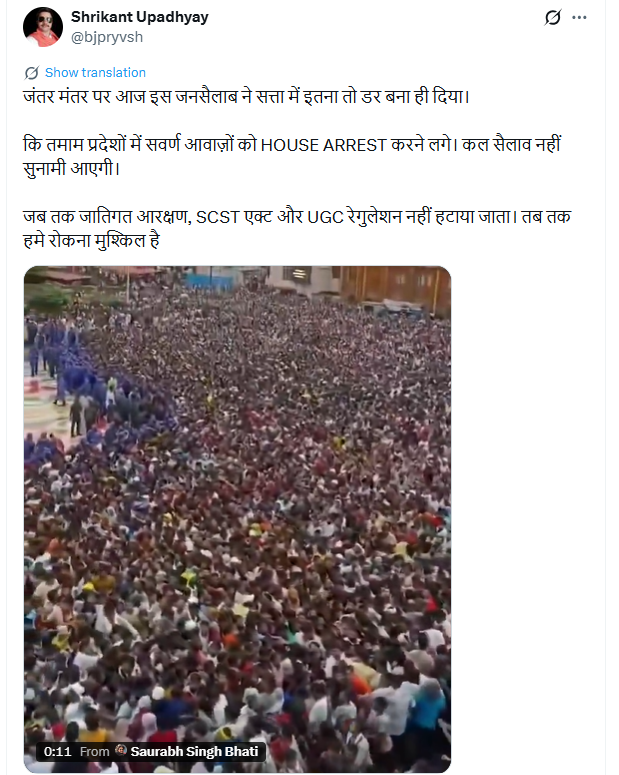
A video showing a massive crowd is being shared on social media with the claim that it shows an anti-reservation protest held at Jantar Mantar. However, a research done by the research wing of the CyberPeace revealed that the video is not from any anti-reservation protest at Jantar Mantar, but from the Jagannath Rath Yatra organized in Puri, Odisha.
Claim:
The video is being shared on X (formerly Twitter) with a viral caption that translates to: “Today, this massive gathering at Jantar Mantar created so much fear in the ruling government that upper-caste voices are being put under HOUSE ARREST across various states. Tomorrow will bring a tsunami, not just a surge. Until caste-based reservation, the SC/ST Act, and UGC regulations are removed, it will be difficult to stop us.”
https://x.com/bjpryvsh/status/2091554860785438887?s=20
Fact Check:
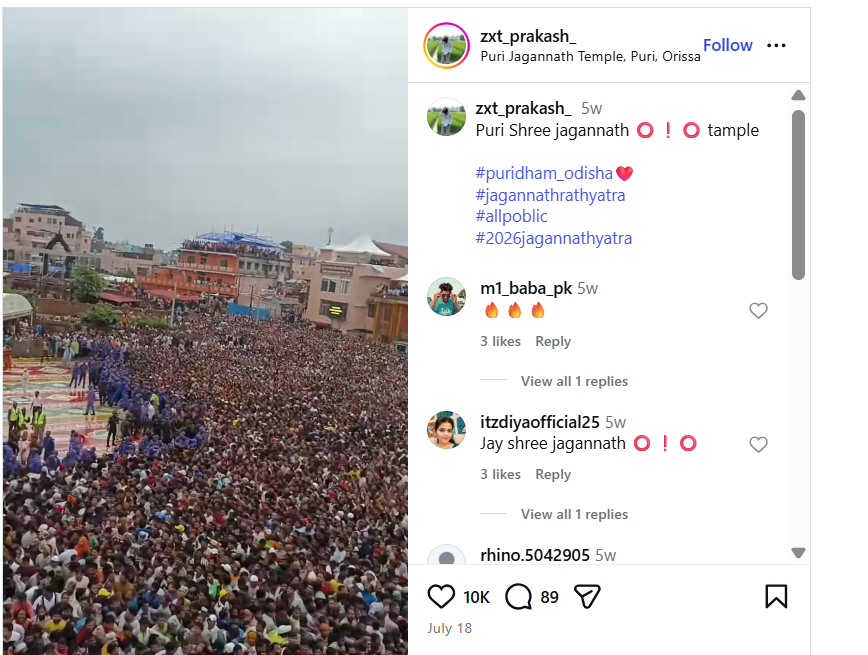
To investigate the viral video, reverse image searches were conducted using keyframes extracted from the clip. This led to an Instagram post uploaded on July 18. The caption accompanying the video clearly identified the footage as being from the Jagannath Rath Yatra in Puri, Odisha.
https://www.instagram.com/p/Da7tF2Etiae/
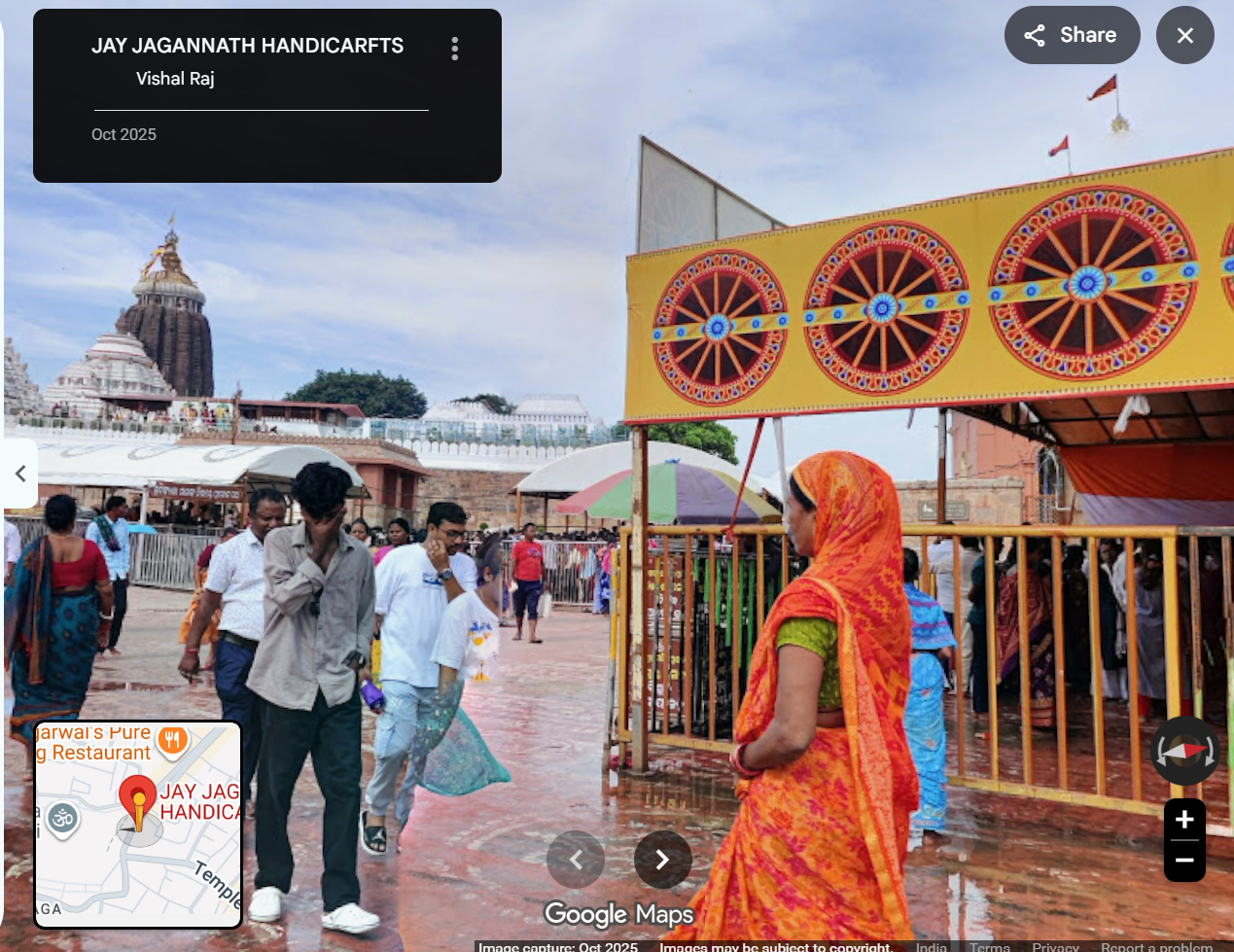
The visuals in the video were matched with the surroundings of the Jagannath Temple in Puri available on Google Maps Street View, confirming beyond doubt that the location in the video is near the Jagannath Temple in Puri.
https://www.google.com/maps/place/JAY+JAGANNATH+HANDICARFTS/@
Similar visuals were found in photos uploaded by the X account of The New Indian Express Odisha on July 16, 2026. The imagery in these photographs closely matched the scenes in the viral video, and the caption stated that they were captured during the Jagannath Rath Yatra in Puri.
https://x.com/XpressOdisha/status/2077697637688775015

Conclusion:
Based on the evidence gathered during our research, it is clear that the video being falsely circulated as an anti-reservation protest at Jantar Mantar is actually footage of the Jagannath Rath Yatra in Puri, Odisha.

Introduction
How Generative Artificial Intelligence, or GenAI, is changing the employee workday is no longer limited to writing emails or debugging code, but now also includes analysing contracts, generating reports, and much more. The use of AI tools in everyday work has become commonplace, but the speed at which companies have adopted these technologies has created a new kind of risk. Unlike threats that come from an outside attacker, Shadow AI is created inside an organisation by a legitimate employee who uses unapproved AI tools to make their work more efficient and productive. In many cases, the employee is unaware of the potential security, data privacy, and compliance risks involved in using such tools to perform their job duties.
What Is Shadow AI?
Shadow AI is when individuals use AI tools at work that aren’t provided by the company, like tools or other software programs, without the knowledge or permission of the employer. Examples of shadow AI include:
- Using personal ChatGPT or other chatbot accounts to complete tasks at the office
- Uploading business-related documents to online AI technologies for analysis or summarisation.
- Copying proprietary source code into an online AI model for debugging
- Installing browser extensions and add-ons that are not approved by IT or Security personnel.
How Shadow AI Is Harmful
1. Uncontrolled Data Exposure
When employees access or input information into their user-created AI, it becomes outside the controls of the company, such as both employee personal information and any third-party personal information, private company information (such as source code or contracts), and company internal strategies. After a user enters data into their user-created AIs, the company loses all ability to monitor how that data is stored, processed, or maintained. A data leak situation exists without a malicious cyberattack. The biggest risk of a data leak is not maliciousness but rather the loss of control and governance over sensitive data.
2. Regulatory and Legal Non-Compliance
Data protection laws like GDPR, India’s Digital Personal Data Protection (DPDP) Act, HIPAA, and other relevant sectoral laws require businesses to process data in accordance with the law, to minimise the amount of data they use, and to be accountable for their actions. Shadow AI often results in the unlawful use of personal data due to a lack of a legal basis for the processing, unauthorised cross-border data transfers, and not having appropriate contractual protections in place with their AI service providers. Regulators do not see the convenience of employees as an excuse for not complying with the law, and therefore, the organisation is ultimately responsible for any violations that occur.
3. Loss of Intellectual Property
Employees frequently use AI tools to speed up tasks involving proprietary information—debugging code, reviewing contracts, or summarising internal research. When done using unapproved AI platforms, this can expose trade secrets and intellectual property, eroding competitive advantage and creating long-term business risk.
Real-Life Example: Samsung’s ChatGPT Data Leak
In 2023, a case study exemplifying the Shadow AI risk occurred when Samsung Electronics placed a temporary ban on employee access to ChatGPT and other AI tools after reports from engineers revealed they were using ChatGPT to create debugging processes for internal source code and to summarise meeting notes. Consequently, confidential source code related to semiconductors was inadvertently uploaded onto a public AI platform. While there were no known incursions into the company’s system due to this incident, Samsung faced a significant challenge: once sensitive information is input into a public AI tool, it exists on external servers that are outside of the company’s purview or control.
As a result of this incident, Samsung restricted employee use of ChatGPT on corporate devices, issued a series of internal communications prohibiting the sharing of corporate data with public AI tools, and increased the urgency of their discussions regarding the adoption of secure, enterprise-level AI (artificial intelligence) solutions.
What Organisations Are Doing Today
Many organisations respond to Shadow AI risk by:
- Blocking access at the network level
- Circulating warning emails or policies
While these actions may reduce immediate exposure, they fail to address the root cause: employees still need AI to perform their jobs efficiently. As a result, bans often push AI usage underground, increasing Shadow AI rather than eliminating it.
Why Blocking AI Does Not Work—Governance Does
History has demonstrated that prohibition does not work - we see this when trying to block access to cloud storage, instant messaging and collaboration tools. Employees are forced to use personal devices and/or accounts when their employers block AI, which means employers do not have real-time visibility into how their employees are using these technologies, and creates friction with the security and compliance team as they try to enforce the types of tools their employees can use. Prohibiting AI adoption will not stop it from being adopted; it will just create a challenge for employers regarding how safe and responsible it is. The challenge for effective organisations is therefore to shift from denial and develop governance-first AI strategies aimed at controlling data usage, protection and security, rather than merely restricting access to a list of specific tools.
Shadow AI: A Silent Legal Liability Under the GDPR
Shadow AI isn't a problem for the Information Technology Department; it is a failure of Governance, Compliance and Law. By using AI tools that have not been approved as a result, the organisation processes personal data without a lawful basis (Article 6 of the General Data Protection Regulation (GDPR)), repurposes data for use beyond its original intent and in breach of the Purpose Limitation (Article 5(1)(b)), and routinely exceeds necessity and in breach of Data Minimisation (Article 5(1)(c)). The outcome of these actions is the use of tools that involve International Data Transfers Without Authorisation and are therefore in breach of Chapter V, and violate Article 32 because there are no enforceable safeguards in place. Most significantly, the failure to demonstrate Oversight, Logging and Control under Articles 5(2) and 24 constitutes a failure in Accountability. Therefore, from a Regulatory perspective, Shadow AI is not accidental and is not defensible.
The Right Solution: Secure and Governed AI Adoption
1. Provide Approved AI Tools
Employers have an obligation to supply business-approved AI technology for helping workers to be productive while maintaining maximum protections, like storing data separately and not using employees' data for training a model; defining how long data is kept, and the rules around deleting that data. When employees are provided with verified and secure AI options that align with their work processes, they will rely significantly less on Shadow AI.
2. Enforce Zero-Trust Data Access
The governance of AI systems must follow the principles of "zero trust," granting access to data only through the principle of "least privilege," which means that data access will only be allowed by the system user, and providing continuous verification of user-identity and context; this supports and helps establish context-aware controls to monitor and track all user activities, which will be especially important as agent-like AI systems become increasingly autonomous and are capable of operating at machine-speed where even small errors in configuration, will result in rapid and large expose to data.
3. Apply DLP and Audit Logging
It is important to have robust data loss prevention measures in place to protect sensitive data that is sent outside an organisation. The first end user or machine that accesses the data should be detailed in a comprehensive audit log that indicates when and how the data is accessed. In combination with other controls, these measures create accountability, comply with regulations, and assist with appropriately detecting and responding to incidents.
4. Maintain Visibility Across AI, Cloud, and SaaS
Security teams need unified visibility across AI tools, personal cloud applications, and SaaS platforms. Risks move across systems, and controls must follow the data wherever it flows.
Conclusion
This new threat exposes an organisation to the risk of data loss through leaks, regulatory fines, liability for the loss of intellectual property, and reputational damage, all of which can occur without any intent to cause harm. The way forward is not to block AI, but to adopt a clear framework built on governance, visibility, and secure enablement. This approach allows organisations to use AI with confidence, while ensuring trust, accountability, and effective oversight to protect data and support AI in reaching its full transformative potential. AI use is encouraged, but it must be done responsibly, ethically, and securely.
References
- https://bronson.ai/resources/shadow-ai/
- https://www.varonis.com/blog/shadow-ai
- https://www.waymakeros.com/learn/gdpr-hipaa-shadow-ai-compliance-nightmare
- https://www.forbes.com/sites/siladityaray/2023/05/02/samsung-bans-chatgpt-and-other-chatbots-for-employees-after-sensitive-code-leak/
- https://www.usatoday.com/story/special/contributor-content/2025/05/23/shadow-ai-the-hidden-risk-in-todays-workplace/83822081007

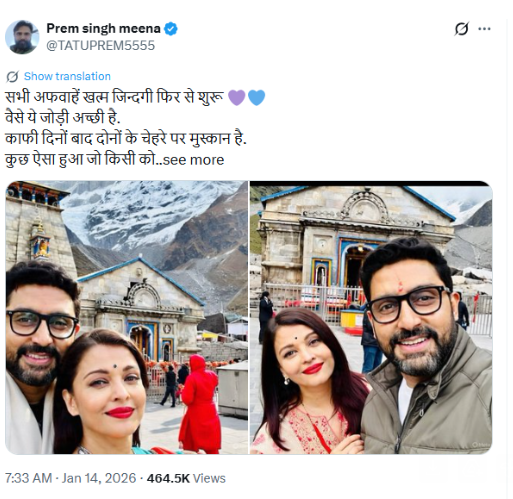
A photo featuring Bollywood actor Abhishek Bachchan and actress Aishwarya Rai is being widely shared on social media. In the image, the Kedarnath Temple is clearly visible in the background. Users are claiming that the couple recently visited the Kedarnath shrine for darshan.
Cyber Peace Foundation’s research found the viral claim to be false. Our research revealed that the image of Abhishek Bachchan and Aishwarya Rai is not real, but AI-generated, and is being misleadingly shared as a genuine photograph.
Claim
On January 14, 2026, a user on X (formerly Twitter) shared the viral image with a caption suggesting that all rumours had ended and that the couple had restarted their life together. The post further claimed that both actors were seen smiling after a long time, implying that the image was taken during their visit to Kedarnath Temple.
The post has since been widely circulated on social media platforms
Fact Check:
To verify the claim, we first conducted a keyword search on Google related to Abhishek Bachchan, Aishwarya Rai, and a Kedarnath visit. However, we did not find any credible media reports confirming such a visit.
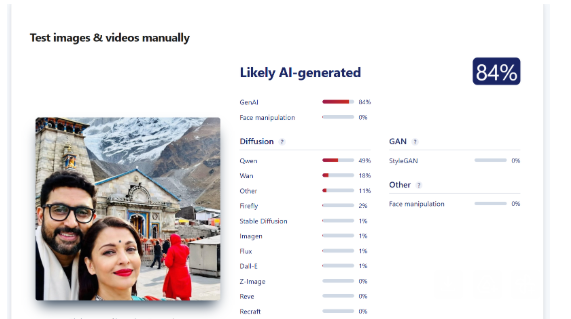
On closely examining the viral image, several visual inconsistencies raised suspicion about it being artificially generated. To confirm this, we scanned the image using the AI detection tool Sightengine. According to the tool’s analysis, the image was found to be 84 percent AI-generated.
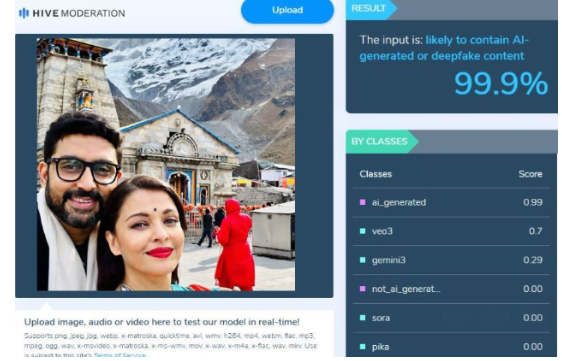
Additionally, we scanned the same image using another AI detection tool, HIVE Moderation. The results showed an even stronger indication, classifying the image as 99 percent AI-generated.
Conclusion
Our research confirms that the viral image showing Abhishek Bachchan and Aishwarya Rai at Kedarnath Temple is not authentic. The picture is AI-generated and is being falsely shared on social media to mislead users.
