
India’s New SIM-Linked Messaging Regulations - A Major Initiative to Curb Cybercrime at Its Roots
Introduction
The digital communication landscape in India is set to change significantly as the Department of Telecommunications is preparing to implement new rules for messaging apps that operate using SIM cards. This step is part of the government’s effort to tackle cybercrime at its roots by enforcing stricter verification and reducing the number of communication platforms that can be misused. One clear change that users will notice is that WhatsApp Web sessions will now be automatically logged out every six hours, disrupting the previously uninterrupted use across multiple devices. Although this may appear to be a simple inconvenience, the measure is part of a broader plan to address the growing problem of cyber fraud. Cybercriminals exploit messaging apps like WhatsApp without keeping the registered SIM in the device, making it difficult to trace fraud. These efforts are surely gonna address these challenges at the root.
The Incident: What Has Changed?
The new regulations will make it mandatory for messaging platforms to create a direct link between user accounts and verified SIM identities. By this method, every account in the network can be associated with a valid and traceable mobile number. Because of this requirement, it is expected that WhatsApp is going to tighten the management of device sessions. The six-hour logout cycle for WhatsApp Web is implemented to prevent long-lived and unmonitored sessions that are sometimes taken advantage of in account takeovers, device-based breaches, and remote access scams. This change significantly affects the user experience. WhatsApp Web, often used for communication, customer support, and coordination, will now require more frequent authentication through mobile devices. Though mobile access remains uninterrupted, desktop and browser-linked sessions will be subjected to tighter security controls.
Why Identity-Linked Messaging Matters
India is facing a rapidly evolving cybercrime ecosystem in which messaging applications play a central role. Scammers often rely on fake, unverified, or illegally obtained SIM cards to create temporary accounts that can be used for various illegal activities, such as sending phishing messages, impersonating government officials, and deceiving victims through call centres set up for scams.
The new rules take into consideration the following main issues:
- Anonymity of accounts makes large-scale fraud possible: Criminals operate bulk scams using hundreds of SIM-linked accounts.
- Freedom to drop identities: Illegal SIMs are discarded after fraud, making it difficult for the police to trace the criminals.
- Multi-device vulnerabilities that last for a long time: Access without permission to WhatsApp Web sessions that last for a long time is seen as the main reason for OTP theft, account hijacking, and on-device social engineering.
The government wants to disrupt these foundations by enforcing stricter traceability.
A Sector Under Strain: Misuse of Messaging Platforms
Messaging apps have turned out to be the most important thing in India's digital life, from communication to enterprise. This very widespread use of messaging apps has made them an easy target for cybercriminals.
The scams that are frequently visible are:
- WhatsApp groupsare used for job and loan scams
- False communication from banks, government departments, and payment applications
- Sextortion and blackmail through unverified accounts
- Remote-access fraud with attackers who are watching WhatsApp Web sessions
- Coordinated spread of false information and distribution of deepfake videos
The employment of AI-generated personas and "SIM farms" has made it harder to secure the systems even more. Unless there is a very strict linking of users to authenticated SIM credentials, the platforms might degenerate into uncontrollable rafts of cybercrime.
Government and Regulatory Response
The Department of Telecommunications is initiating a process of stricter compliance measures and cooperating with the Ministry of Home Affairs, along with the Indian Cyber Crime Coordination Centre. The main points of the directions include the following:
- Identity verification linked to a SIM is mandatory for the creation of messaging accounts
- Device re-authentication on platforms often starts with WhatsApp Web
- Coordination with the telecom operators to the extent of getting suspicious login patterns
- Protocols for the sharing of data with law enforcement in the course of cybercrime investigations
- Compliance checks of digital platforms to verify adherence to national safety guidelines
This coordinated effort reflects the understanding that the security of communication platforms is the responsibility of both the regulators and the service providers.
The Bigger Picture: Strengthening India’s Digital Trust
The fresh regulations are in step with the worldwide trend where the platforms of messaging have to be more responsible, as governments are demanding more and more from them. The same discussions are going on in the EU, UK, and certain Southeast Asian regions.
For India, it is imperative to enhance identity management because:
- The nation has the largest base of messaging users in the whole world
- Cybercrime is increasing at a rate quicker than that of traditional crime
- Digital government services rely on communications that are secure
- Identity integrity is the basis for trust in online transactions and digital payments
The six-hour logout policy for WhatsApp Web is a small action, but it is an indication of a bigger transformation towards a regulation that is active rather than just policing that is reactive.
What Needs to Happen Next?
The implementation of SIM-linked regulations must involve several subsequent measures to make them effective.
- Strengthening Digital Literacy: It is necessary to educate users about the benefits of frequent logouts and security improvements.
- Ensuring Privacy Protections: The DPDP Act should create a strong barrier against the misuse of personal data in identity-linked messaging that will be implemented.
- Collaboration with Platforms: Messaging services should seek to secure authentication under the compromise of safety checks.
- Monitoring SIM fraud at the source: Illicit SIM provisioning enforcement is the main source of criminals, not just changing their methods.
- Continuous Review and Feedback: Policymaking needs to keep pace with real-life difficulties and new inventions in technology.
Conclusion
India's announcement to impose regulations on messaging apps with SIM linkage is a major step forward in preventing cybercrime from occurring in the first place. Although the immediate effect, like the six-hour logout requirement for WhatsApp Web, may annoy users, it is nevertheless part of a bigger goal: to develop a more secure and trustworthy digital communication environment.
Securing the communication that links millions of people is vital as India becomes more and more digital. Through a combination of regulatory measures, technological protection, and user education, the country is headed toward a time when criminals in the cyber world will find it very difficult to operate and where consumers will be able to interact online with much more confidence and safety.
References
- https://thehackernews.com/2025/12/india-orders-messaging-apps-to-work.html
- https://indianexpress.com/article/explained/explained-sci-tech/whatsapp-web-automatic-log-out-six-hourse-reason-10394142/
- https://www.ndtv.com/india-news/explained-how-will-new-sim-binding-rule-affect-whatsapp-signal-telegram-9728710
- https://www.hindustantimes.com/india-news/no-whatsapp-without-active-sim-centre-issues-new-rules-dot-sim-binding-prevent-cyber-crimes-101764495810135.html

Related Blogs
Introduction
The Ministry of Electronics and Information Technology (MEITy) released the Draft Information Technology (Intermediary Guidelines and Digital Media Ethics Code) Second Amendment Rules, 2026 on March 30, 2026, inviting public comments with a response window closing on April 14. This is a limited 15-day period for public input on proposed rules that will have major constitutional impacts. The brevity and timing of this opportunity demonstrate debatable commitment to stakeholder engagement and meaningful consultation by the drafting agency.
While MEITY describes the proposed amendments as "clarificatory and procedural nature," an analysis shows they will have substantive effects. Collectively, the amended language changes significantly how online speech will be regulated in India by providing the executive with more concentrated regulatory authority, limiting the required transparency of content enforcement, mandating greater retention of data without proportionality-based safeguards, and placing excessive compliance burden on intermediaries. Each of these changes has consequences beyond just changes in process and together, these changes collectively raise substantial concerns regarding compliance with Articles 14, 19, and 21 of the Constitution of India.
The Constitutional Baseline: Shreya Singhal and the Limits of Intermediary Liability
India’s Supreme Court decision in Shreya Singhal v Union of India (2015) 5 SCC 1 provides the foundation for intermediary liability, wherein the Court read down Section 79(3)(b) of the IT Act, 2000, holding that intermediaries are required to act upon receiving actual knowledge only through a court order or a valid notification by the appropriate government authority. The Supreme Court’s decision intended to provide a constitutional protection to intermediaries from being subjected to informal, unverified executive pressure to take down content by requiring that any such order be subject to some level of legal objective credibility or threshold.
Rule 3(4) of the proposed amendments places that balance under significant strain. By requiring intermediaries to comply with advisories, directions, standard operating procedures, codes of practice, and guidelines issued by the Ministry — and tying non-compliance to the loss of safe harbour — the draft effectively lowers the constitutional threshold that Shreya Singhal was designed to maintain. Compliance obligations now potentially arise from instruments that carry no judicial sanction and no mandatory public disclosure.
Rule 3(4): Delegated Legislation or Executive Overreach
The rule-making power conferred on the Central Government under Section 87 of the IT Act is limited to carrying out the provisions of the Act. It does not authorise the creation of new substantive obligations. This principle has been consistently affirmed in Indian Express Newspapers v. Union of India (1985) 1 SCC 641 and Confederation of Ex-Servicemen Associations v. Union of India (2006) 8 SCC 399, where the Court held that delegated legislation must remain within the four corners of the parent statute.
Rule 3(4) tests those limits. It converts executive advisories into binding compliance instruments without a clear statutory foundation in either Section 79 or Section 87. Although the proposed rule requires that such instruments specify their legal basis, there is no requirement that they be published or made publicly accessible. This creates a framework in which legality risks becoming circular — instruments claimed to be lawful solely by reference to a provision that does not clearly authorise them, shielded from scrutiny by their own opacity. Justice Chandurkar’s judgment in Kunal Kamra v. Union of India identified precisely this defect in the Fact Check Unit amendment. Rule 3(4) replicates the structural problem in a broader form.
Compliance Pressure and the Logic of Over-Censorship
The practical consequence of Rule 3(4) lies not only in its legality but in how it reshapes incentive structures for platforms. An intermediary facing the permanent threat of safe harbour loss will not wait to assess the legal merit of each advisory. The rational calculation is to comply early, broadly, and without friction. Lawful content — particularly satire, political commentary, and journalism — becomes vulnerable not because it is unlawful, but because it presents regulatory risk.
This dynamic was visible on 18 March 2026, when stand-up comedian Pulkit Mani (@hunnywhoisfunny) found his satirical Instagram reel being restricted across India. The video had accumulated over 16.5 million views. Users encountered a notice citing Section 79(3)(b) of the IT Act. No reasons were publicly provided. No prior hearing was offered. The same night, several political parody and satire accounts were withheld on X.
Data Retention, Privacy, and the Proportionality Test
The amendments to Rules 3(1)(g) and 3(1)(h) extend data retention obligations by making them additional to requirements under any other law. The existing 180-day floor for retained user data — covering removed content, registration information, and associated records — becomes a minimum rather than a ceiling. No maximum is specified, and no proportionality requirement accompanies the extension.
This raises direct concerns under Article 21 as interpreted in Justice K.S. Puttaswamy v. Union of India (2017) 10 SCC 1, which held that any state intrusion into privacy must satisfy the triple test of legality, necessity, and proportionality. Undefined retention periods, with no statutory ceiling and no requirement of purpose limitation, risk failing all three. The longer user data is held, including metadata, device information, and records of removed content, the greater the exposure to surveillance, unauthorised access, and use beyond the original justification.
Circumventing Judicial Scrutiny Through Procedural Redesign
The Bombay High Court, in its August 2021 order, stayed provisions of the IT Rules’ oversight mechanism as prima facie violative of Article 19(1)(a). The Madras High Court in T.M. Krishna v. Union of India affirmed that stay, cautioning that government-controlled media oversight risked undermining press independence. Both matters remain pending before the Delhi High Court.
The amendments to Rules 8(1) and 14 restructure the same oversight machinery through a modified procedural design. By extending the Inter-Departmental Committee’s jurisdiction to cover “matters” referred by the Ministry with no requirement of a complainant, no defined subject matter, and no guaranteed prior hearing, the proposed rules effectively reconstitute what courts found constitutionally suspect. Individual users posting news and current affairs content are now brought within reach of blocking mechanisms originally designed for institutional publishers.
Conclusion
As seen above, the Draft IT Rules 2026 are unable to meet the constitutional and judicial requirements to regulate free speech. What the proposed amendments construct is a durable system in which platforms self-censor under liability pressure, data is retained without proportionate justification, and content oversight expands through procedural adjustment rather than parliamentary legislation. Regulation of the digital public sphere is both legitimate and necessary. But it must be anchored in law, not in the quiet authority of executive advisories. The law must ultimately remain anchored in constitutional values, guided by the enduring principles of justice, equity, and good conscience.
The comment period closes on 14 April 2026.
Submissions may be sent to itrules.consultation@meity.gov.in.
References
- https://www.meity.gov.in/static/uploads/2026/03/30591fc6e322dcbcc9dae84a0f02e9e7.pdf
- https://www.meity.gov.in/static/uploads/2026/03/a71a21d35c107f2e528363d3eb17646a.pdf
- https://www.meity.gov.in/static/uploads/2026/02/550681ab908f8afb135b0ad42816a1c9.pdf
- https://neopolitico.com/india/government-blocks-viral-satirical-reel-impersonating-pm-modi-raising-fresh-questions-on-free-speech-and-digital-regulation/
- https://internetfreedom.in/sound-the-alarm-iffs-first-read-on-meitys-draft-it-rules-second-amendment-2026/

Executive Summary
A purported clipping from an Australian newspaper is being circulated on social media with the claim that it published a report stating that people attended Prime Minister Narendra Modi’s public event in Melbourne only because free roti and curry were being served. CyberPeace Research Wing’s research found the viral newspaper clipping to be fake and digitally edited. Our research revealed that The Age, the newspaper featured in the viral image, did not publish any such report in its July 10 edition. Prime Minister Narendra Modi arrived in Melbourne, Australia, on July 8, after concluding his visit to Indonesia. On July 9, he addressed the Indian diaspora at Melbourne's stadium alongside Australian Prime Minister Anthony Albanese, with more than 30,000 people attending the event. The viral newspaper clipping falsely links this event to a fabricated headline claiming that “the crowd gathered because free roti and curry were being served.”
Claim
Sharing the purported newspaper clipping, an X user wrote:“Modi supporters go anywhere for free food! If there is anything left to disgrace the country, let us know. Free curry and roti were served using taxpayers’ money to gather a crowd at PM Modi’s event in Australia. Australian newspaper report.”
https://x.com/ssrajputINC/status/2075806767129235668
https://archive.ph/https://x.com/ssrajputINC/status/2075806767129235668

Fact Check
To verify the authenticity of the purported Australian newspaper clipping, we first extracted keyframes and performed a reverse image search. During the research, we found that the original newspaper clipping had been posted on X by journalist Aman Sharma on July 10, 2026. The original clipping contained no such report as the one seen in the viral image. According to the caption of the post, the newspaper coverage was published by Australian newspapers during Prime Minister Narendra Modi’s visit to Australia.
https://x.com/AmanKayamHai_/status/2075362478364787165/photo/3

Since Prime Minister Modi's Melbourne event took place on July 9, we examined the July 10 digital edition of The Age. We found the same coverage on Pages 4 and 5 of the newspaper. However, there was no report mentioning that people attended the event because free food was being distributed. Instead, the space shown in the viral clipping actually carried a report about Australian Opposition Leader Angus Taylor's criticism of far-right Senator Pauline Hanson's One Nation party. https://edition.theage.com.au/shortcode/THE965/archive

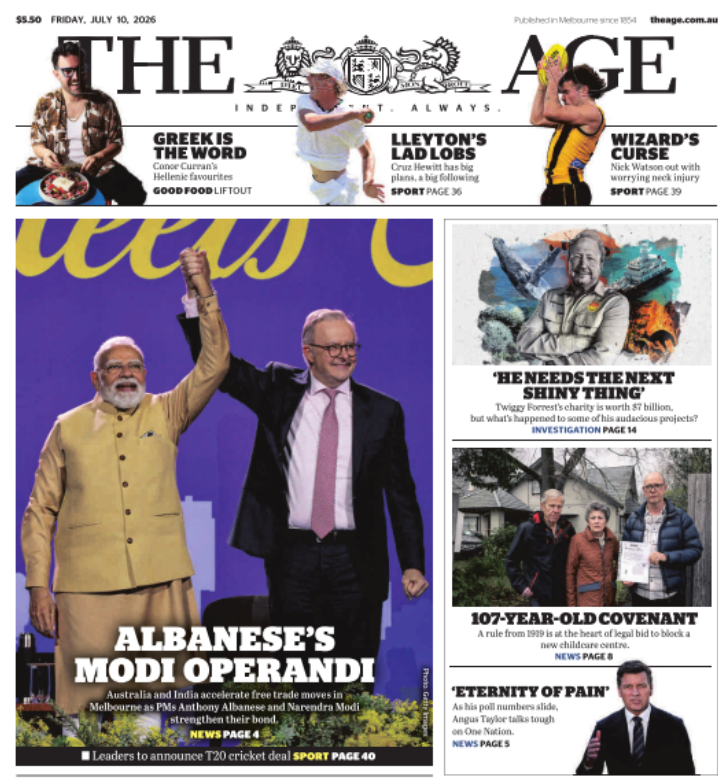
Our comparison confirmed that the viral image had been digitally altered, with the original news story replaced by fabricated text to falsely suggest that The Age had published such a report.
Conclusion
Our research found that the purported Australian newspaper clipping is fake and digitally edited. The Age did not publish any report claiming that people attended Prime Minister Narendra Modi's Melbourne event because free roti and curry were being served. The viral image has been manipulated to spread a false narrative and is being shared with a misleading claim.

Executive Summary
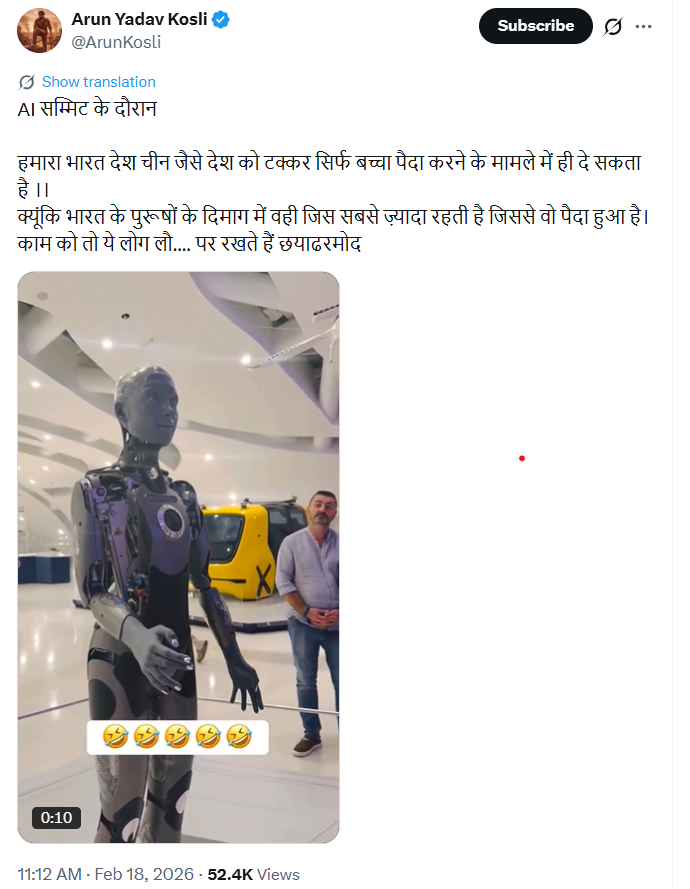
A video circulating widely on social media shows a man interacting with a humanoid robot and using abusive language, after which the robot asks him to maintain politeness. Several users shared the clip claiming that the incident took place during a recent AI summit in New Delhi. The video triggered strong reactions online, with some users demanding legal action against the individual. However, research by CyberPeace found the claim to be misleading.
Claim
Social media users claimed that the viral video showing a man abusing a robot was recorded during an AI summit in New Delhi, India.
Fact Check
To verify the claim, we conducted a reverse image search of the individual seen in the video. The search led us to an Instagram post uploaded by a Pakistani account identifying the individual as Kashif Zameer.

Further keyword searches helped us locate his Instagram profile, where the same video had been uploaded on February 17, 2026. The post included hashtags such as “Dubai,” indicating the actual location of the incident. The profile also lists Lahore, Pakistan, as the user’s location and describes him as a businessman and social media personality.

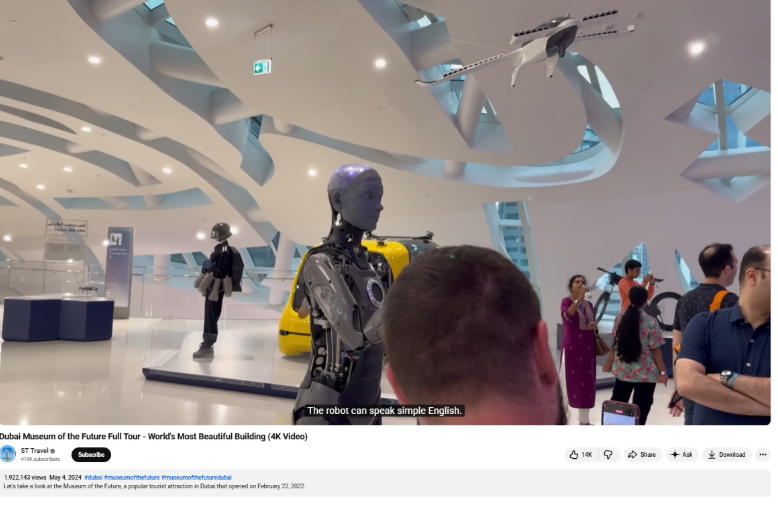
To confirm the location shown in the video, we conducted additional searches using keywords such as “Dubai” and “humanoid robot.” The research revealed that the robot featured in the clip is “Ameca,” located at the Museum of the Future in Dubai.
Conclusion
The viral claim is false. The video is not related to any AI summit held in New Delhi. The incident occurred in Dubai, and the person seen in the video is not an Indian citizen.
