
From Posts to Plumbing: How India Is Rewiring Big Tech
Introduction
At 4 pm on August 3, 2026, representatives of Meta, X, Snapchat and Google walked into a room in Parliament to face India's Standing Committee on Communications and Information Technology. On paper, it looked like one more instance of a routine that has repeated for half a decade: a Big Tech company gets called in, questioned, and sent away with a warning. But this summons, and the fortnight of scrutiny that has followed it, reveals something different about the direction of India's digital governance in 2026. The government's question has stopped being, "Will you take this post down?" It has increasingly become, "How does your platform actually work, and can we redesign the parts we don't like?"
The trigger: A technical glitch that became a systemic complaint
The proximate cause of the August 3 hearing was almost trivial by itself. On July 23, Prime Minister Narendra Modi posted a video on Instagram and Facebook about the government's crackdown on examination paper leaks. Meta briefly restricted the Facebook version before restoring it, blaming the removal on a technical error in its automated filters.
That explanation didn't satisfy the Ministry of Electronics and Information Technology (MEITY), which called it inadequate, and the incident became the occasion for a much broader reckoning. Committee chairperson Nishikant Dubey summoned Meta, X, Snapchat and Google to examine three things: the online safety of women and children; the data privacy of ordinary citizens, including farmers and labourers; and how far platforms actually comply with India's law-and-order requirements. Days later, MeitY brought Meta's global team in for two days of direct questioning that stretched into a third day of technical discussions covering child sexual abuse material (CSAM), deepfakes, bot accounts and, notably, the design of Instagram's content-recommendation algorithm itself.
From takedown notices to systems audits
For most of the last decade, India's approach to online harm ran through blocking orders and the "notice-and-takedown" machinery built into the IT Rules, 2021: a court or government authority flags a specific URL or post, the platform has a fixed window to act, and non-compliance risks the loss of legal immunity. It was a model built around individual pieces of content.
What is unfolding now looks structurally different. Officials aren't only asking Meta to remove a video; they are asking why its recommendation systems keep resurfacing flagged material, why "verified" accounts belonging to prominent or official figures don't have extra layers of human review before restriction, and why bot-detection and CSAM-screening pipelines aren't catching harmful content before it spreads. The Supreme Court-monitored committee tracking "digital arrest" fraud has gone further still, directing MeitY, the Department of Telecommunications and the Indian Cyber Crime Coordination Centre (I4C) to study time-based restrictions on audio and video calls altogether, a proposal that touches the basic architecture of how calling features work, not any single conversation.
Parliament's committee has separately pushed for a national registration system that would require every intermediary operating in India to publicly list its grievance officer, nodal contact and compliance officer as a response to law enforcement's repeated difficulty simply reaching a platform when something goes wrong. It has also asked for tighter regulation of digital advertising, which officials say is routinely exploited for cyber fraud, and for rules under Section 67C of the IT Act governing how long intermediaries must preserve user data. None of this is about any one post; it is about redesigning the infrastructure platforms use to operate in India.
Messaging apps and the encryption problem
Nowhere is the shift from "content" to "architecture" clearer than in the government's dealings with peer-to-peer messaging platforms. WhatsApp has spent years contesting the traceability requirement under Rule 4(2) of the IT Rules in the Delhi High Court, arguing it would rather exit India than build a permanent capability to identify the "first originator" of every message since doing so would mean re-engineering its end-to-end encryption for all users, not just suspects.
That fight has resurfaced in a new form. In a submission to the parliamentary committee, WhatsApp argued that new rules requiring platforms to detect and label AI-generated "synthetic" content cannot technically apply inside encrypted chats because no one outside a conversation "not even WhatsApp" can see what's inside it. Signal has proven even harder to engage with: MeitY told the committee it has struggled to establish formal contact with the app, which does not publicly list a grievance officer, exposing how little leverage the government currently has over encrypted, minimally staffed platforms compared with advertising-funded giants like Meta and Google. The proposal to cap or restrict call durations to fight "digital arrest" scams is, in effect, an attempt to regulate a messaging feature rather than any message sent through it, perhaps the clearest sign yet that the fight has moved from posts to plumbing.
The future of "safe harbour"
Underpinning all of this is Section 79 of the IT Act, the "safe harbour" clause that shields platforms from liability for what their users post, provided they exercise due diligence. That protection is now being squeezed from three directions at once. The parliamentary committee has unanimously recommended withdrawing safe harbour from platforms that don't comply with Indian law and said it should be pulled specifically from Meta unless its CEO apologises over the PM's video takedown, though a committee cannot itself revoke a statutory protection; only Parliament can amend Section 79. Separately, the Supreme Court-monitored panel on digital-arrest fraud is examining an explicit provision making intermediaries liable for the misuse of their platforms so that fraud victims could claim compensation directly. And MeitY's draft Second Amendment Rules, circulated in March 2026, go furthest of all: they propose making safe harbour conditional on real-time compliance with executive directions, rather than a general protection available to any platform that follows published rules, which is a more direct, command-driven model than even the European Union's Digital Services Act.
Why this matters beyond the headlines
For the ordinary internet user, none of this is abstract. A registration-and-disclosure regime, together with faster and more accountable grievance handling, could make it easier to get genuinely harmful content addressed. But architecture-level intervention cuts both ways. Rules aimed at traceability or at labelling encrypted content risk weakening the very privacy protections that make messaging apps trustworthy in the first place, and a safe harbour that hinges on obeying informal executive directions, rather than settled published law, hands the government far more day-to-day leverage over what stays online. The Supreme Court has listed the digital-arrest matter for September 16; how it, and Parliament, ultimately treat Section 79 will decide whether India's platforms remain neutral pipes carrying other people's speech or become extensions of state enforcement.
Conclusion
India’s digital-governance battle is no longer confined to individual posts or takedown orders. It is increasingly about the architecture beneath the internet: recommendation engines, encryption, verification, data retention and safe-harbour protections. That shift may strengthen accountability and user safety, but it also expands the state’s influence over digital infrastructure. As Parliament and the Supreme Court confront these questions, India faces a fundamental choice: regulate platforms or reshape how they operate.
Sources
- Parliament panel summons Meta, X, Google, Snapchat over digital safety — Hindustan Times
- Parliamentary panel summons Meta, Google, X and Snapchat over social media regulation — Economic Times
- Parliamentary Panel Summons Meta, X, Google on Digital Safety Rules — Asianet Newsable
- Panel Summons Meta, X, Snapchat, Google for Safety Review — New Kerala
- Meta, X, Google and Snapchat summoned by parliamentary panel on August 3 — BestMediaInfo

Related Blogs
Executive Summary
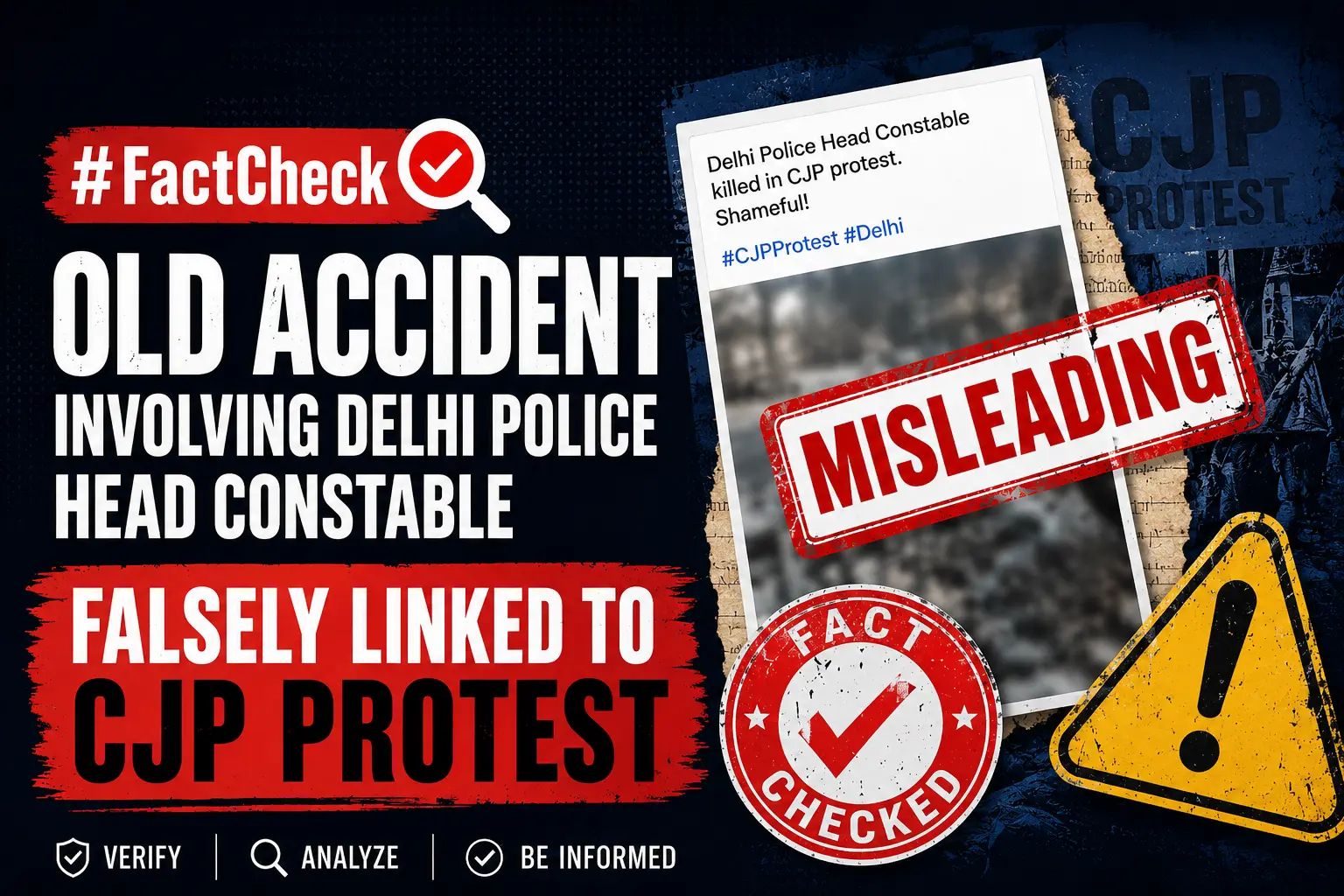
A social media post is being widely circulated claiming that Delhi Police personnel Amit died during the Cockroach Janata Party (CJP) ‘Sansad Chalo’ protest held on July 20, 2026. The post attempts to link his death to violence that allegedly took place during the demonstration. CyberPeace Research Wing’s research found the claim to be false. The research revealed that the death of Head Constable Amit was not related to the CJP protest held on July 20. He died on July 15 after being hit by a speeding vehicle while on duty at Singhu Border. An old accident has been falsely linked to the recent protest through a misleading claim.
Claim:
A Facebook user shared a post on July 23, 2026, claiming that a police personnel was martyred during the alleged protest carried out by “student goons and their supporters from Congress and Kejriwal’s party” on July 20. The user further claimed that the protest was responsible for the death of a police personnel and questioned criticism over alleged police action against protesters.
The post’s link, archive link and screenshot are provided below:
https://www.facebook.com/photo?fbid=3562630610568369&set=a.100838436747621
https://ghostarchive.org/archive/m8QM8

Fact Check:
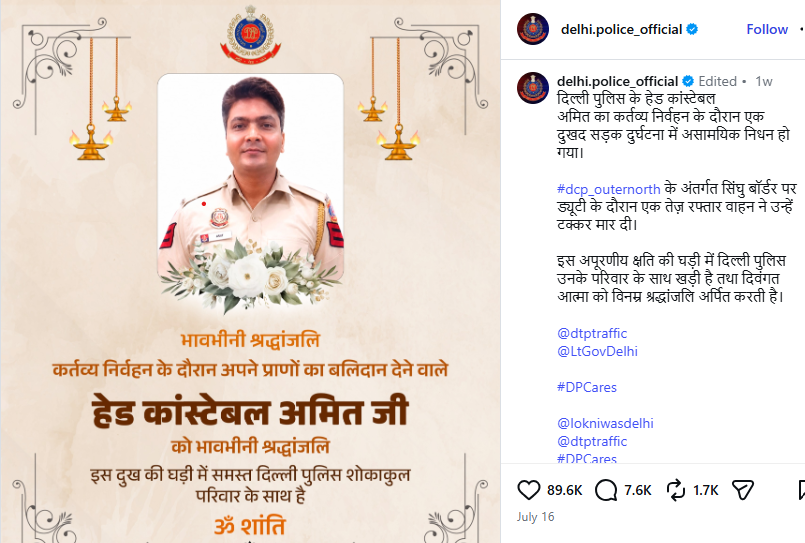
To verify the authenticity of the viral claim, the Desk first examined the official social media accounts of Delhi Police. During the research, the Desk found a post shared on Delhi Police’s official Instagram account on July 16, 2026, which contained the same image being circulated in the viral post.
https://www.instagram.com/p/Da19BQxEmQv/?igsh=cnN1bXZhaHg5OWRs
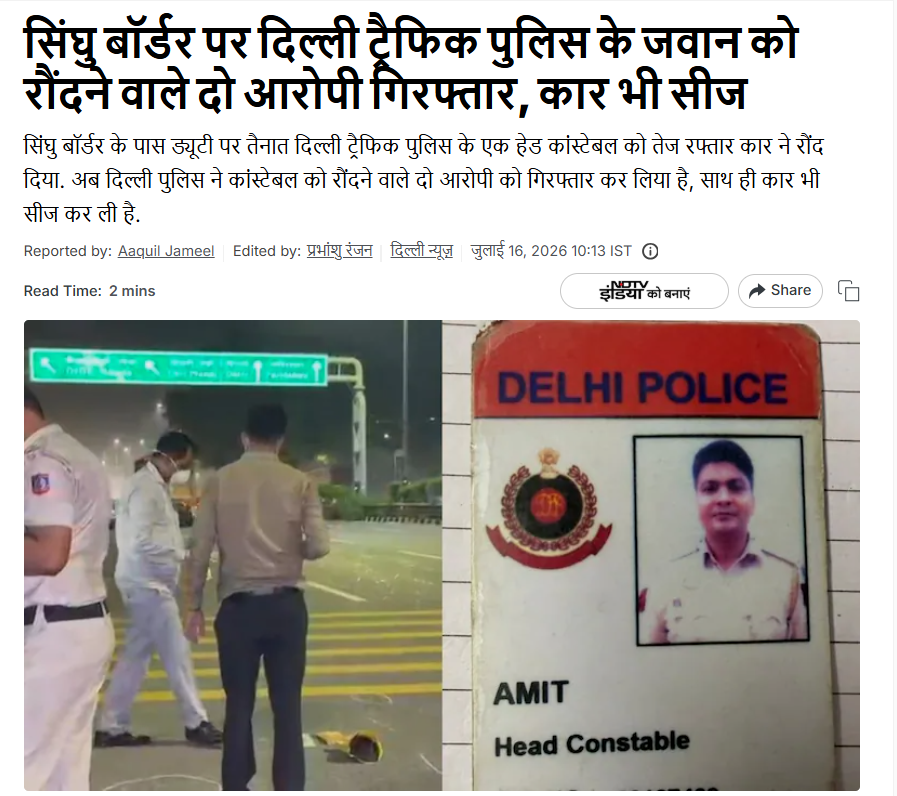
In the next stage of the research, the Desk found an NDTV report published on July 16, 2026. According to the report, Delhi Police had arrested two accused in connection with the death of Head Constable Amit. The arrested individuals were identified as Kuldeep alias Karan and Neeraj. The report stated that police had also seized the vehicle bearing registration number DL11CG2268, which was involved in the accident. An FIR was registered at Alipur Police Station and further research was underway.
Further research led the Desk to a related post on the Facebook page of Delhi Samachar TV. According to the post, the hit-and-run case involving Head Constable Amit, who was hit while performing duty at Singhu Border (NH-44), was solved by Delhi Police within hours. The police team arrested two accused and recovered the vehicle used in the incident.
The post’s link and screenshot are provided below:
https://www.facebook.com/reel/1006635078843860

Conclusion:
The research established that the death of Delhi Police Head Constable Amit was not connected to the CJP ‘Sansad Chalo’ protest held on July 20, 2026. Amit died on July 15 after being hit by a speeding vehicle while on duty at Singhu Border. The old accident is being falsely linked to the recent protest with a misleading claim.
Executive Summary
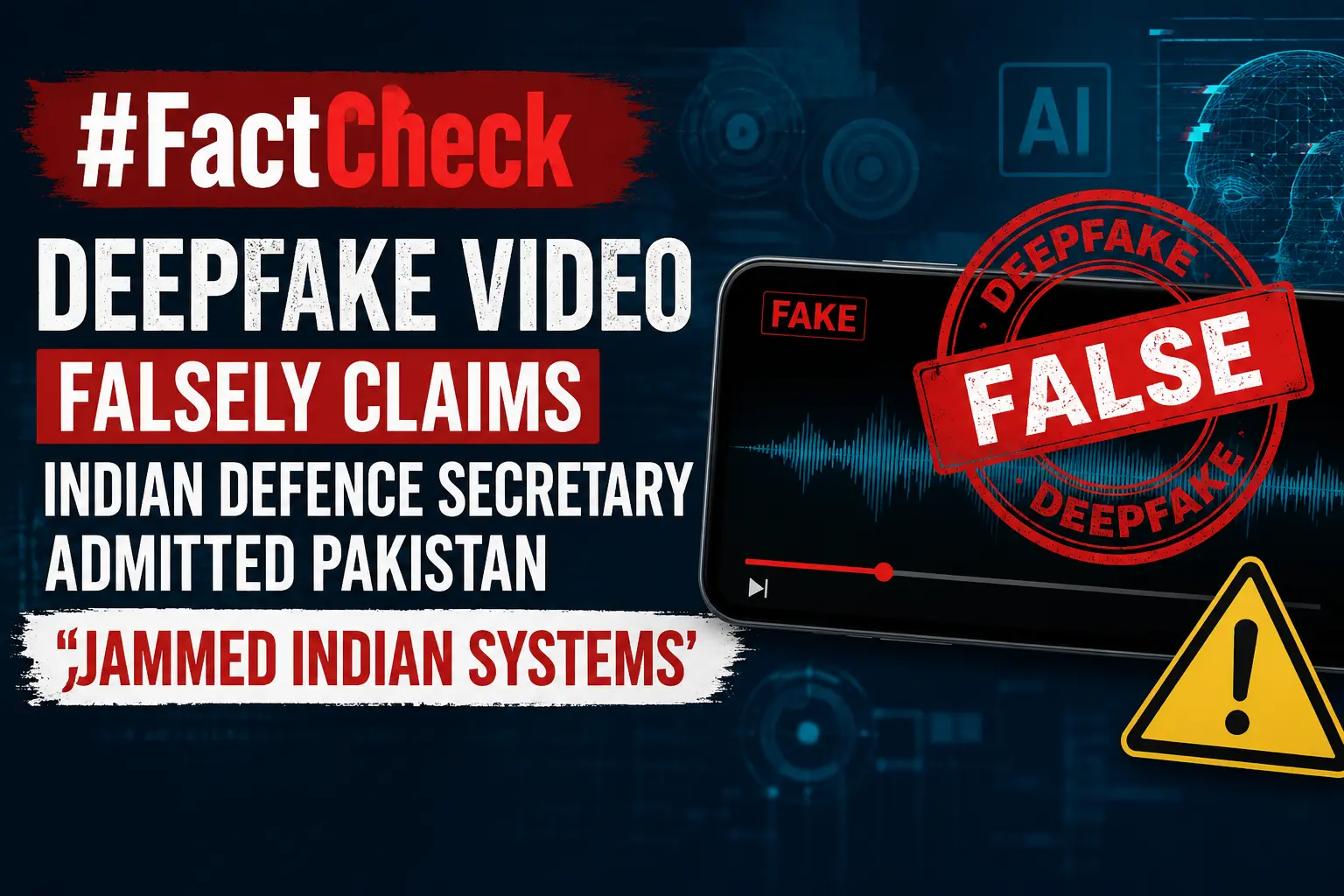
A video allegedly showing India’s Defence Secretary Rajesh Kumar Singh making remarks about Pakistan’s cyber capabilities is being widely shared on social media. The clip claims that Singh admitted Pakistan had “jammed Indian systems” on May 10 and described Pakistan’s cyber and electronic warfare capabilities as a major challenge for India. Research by CyberPeace Research Wing found that the viral clip is an AI-generated deepfake being circulated to spread misinformation. Rajesh Kumar Singh never made any such statement.
Claim
An X user shared the viral video claiming that India’s Defence Secretary had acknowledged Pakistan’s technological superiority. The post alleged that Singh admitted Pakistan successfully jammed Indian systems and claimed that India was lagging behind in cyber and electronic warfare technology.

Fact Check
To verify the claim, we searched relevant keywords on Google but found no credible media reports carrying such a statement from the Defence Secretary. We then extracted keyframes from the viral clip and conducted a reverse image search. During the research, we found the original video uploaded on the YouTube channel of ANI on April 30, 2026.

A review of the full video confirmed that Rajesh Kumar Singh never made the remarks heard in the viral clip. The original footage had been manipulated and altered using AI-generated audio techniques.
Conclusion
Our research confirms that the viral video is fake and AI-manipulated. The statement attributed to India’s Defence Secretary Rajesh Kumar Singh is fabricated, and the deepfake clip is being shared with misleading claims to spread disinformation.
Introduction
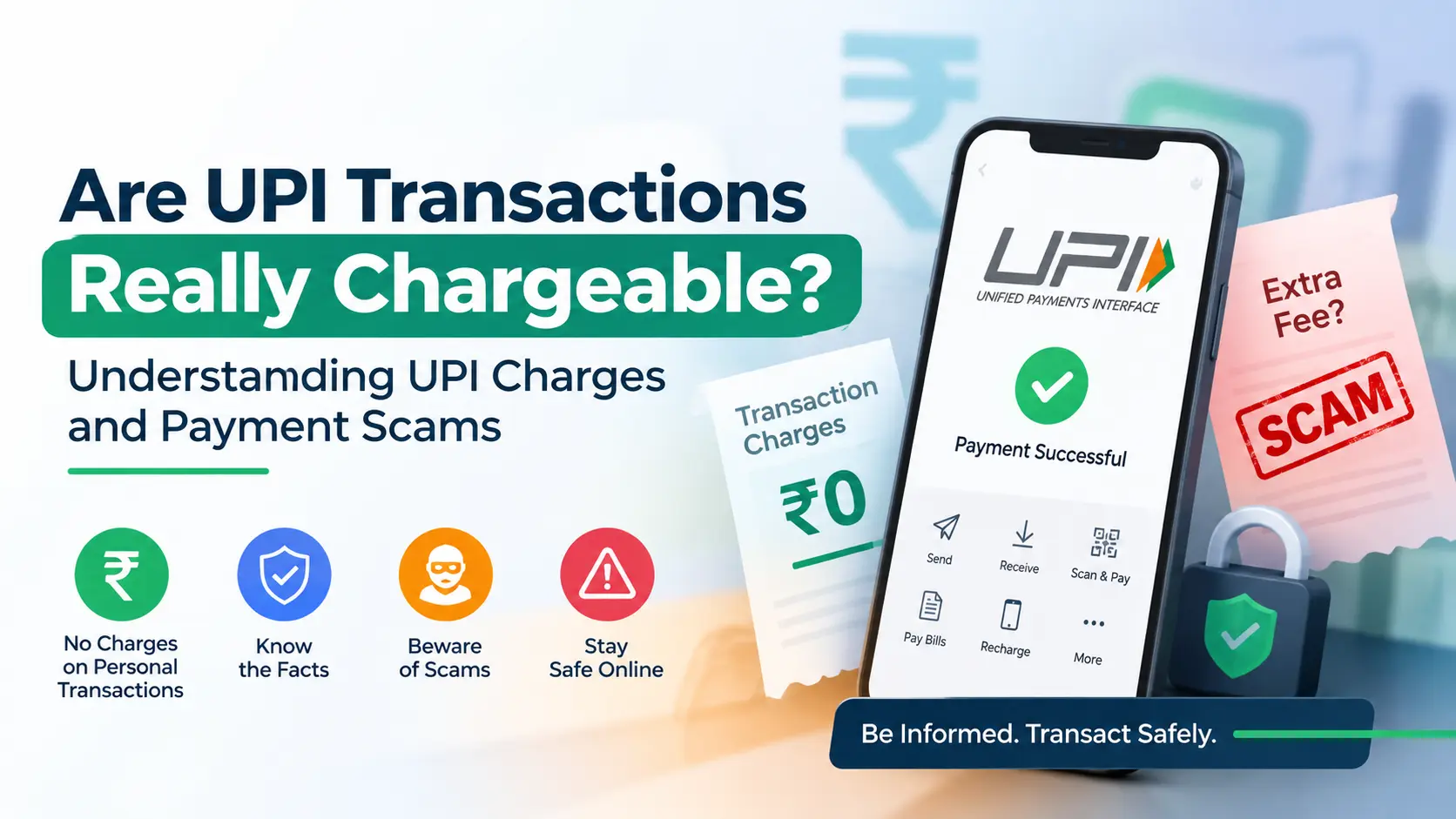
For most of us, UPI is part of daily routine: scan a QR code for chai, send money to family, split a bill, or pay a shopkeeper in seconds. That convenience is exactly why a message saying “UPI charges are coming” can cause confusion. Scammers can use that uncertainty through fake calls, WhatsApp messages, payment links, or edited screenshots. This blog keeps the topic simple: what MDR means, which UPI payments remain free, how scammers misuse the word “fee”, and what a reader should do when a payment request does not look right.
News in Focus: Why the “UPI Charge” Headline Needs Context
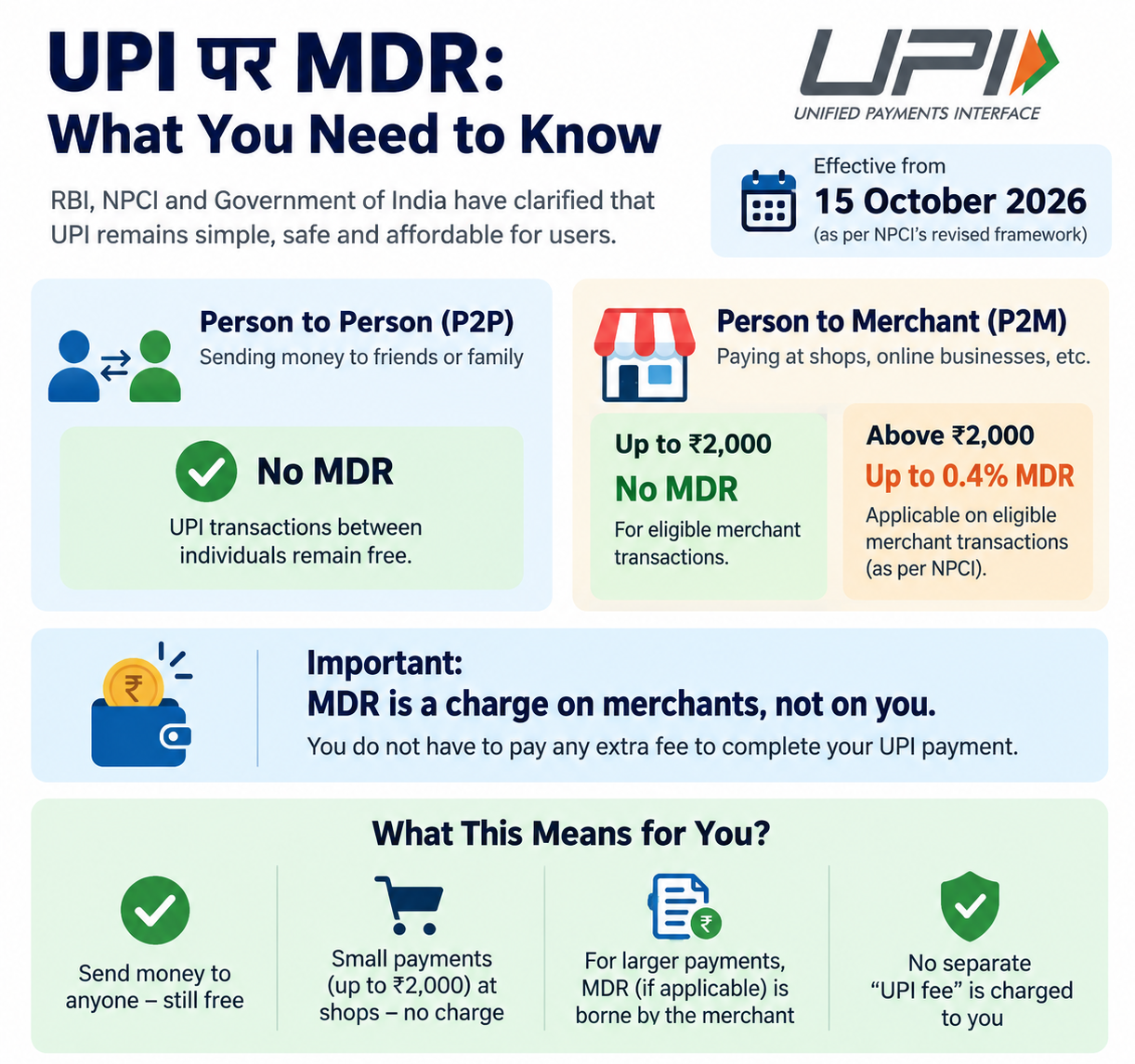
On 15 September 2026, the Ministry of Finance clarified the revised UPI framework. From 15 October 2026, a 0.4% MDR will apply to specified P2M transactions above ₹2,000, subject to the published conditions and caps. P2P transfers remain free, payments to merchants up to ₹2,000 remain free, and the government states that MDR is an ecosystem charge, not a customer fee. Banks are to ensure it is not passed on to customers. [1]
So, What Does This Mean for an Everyday User?
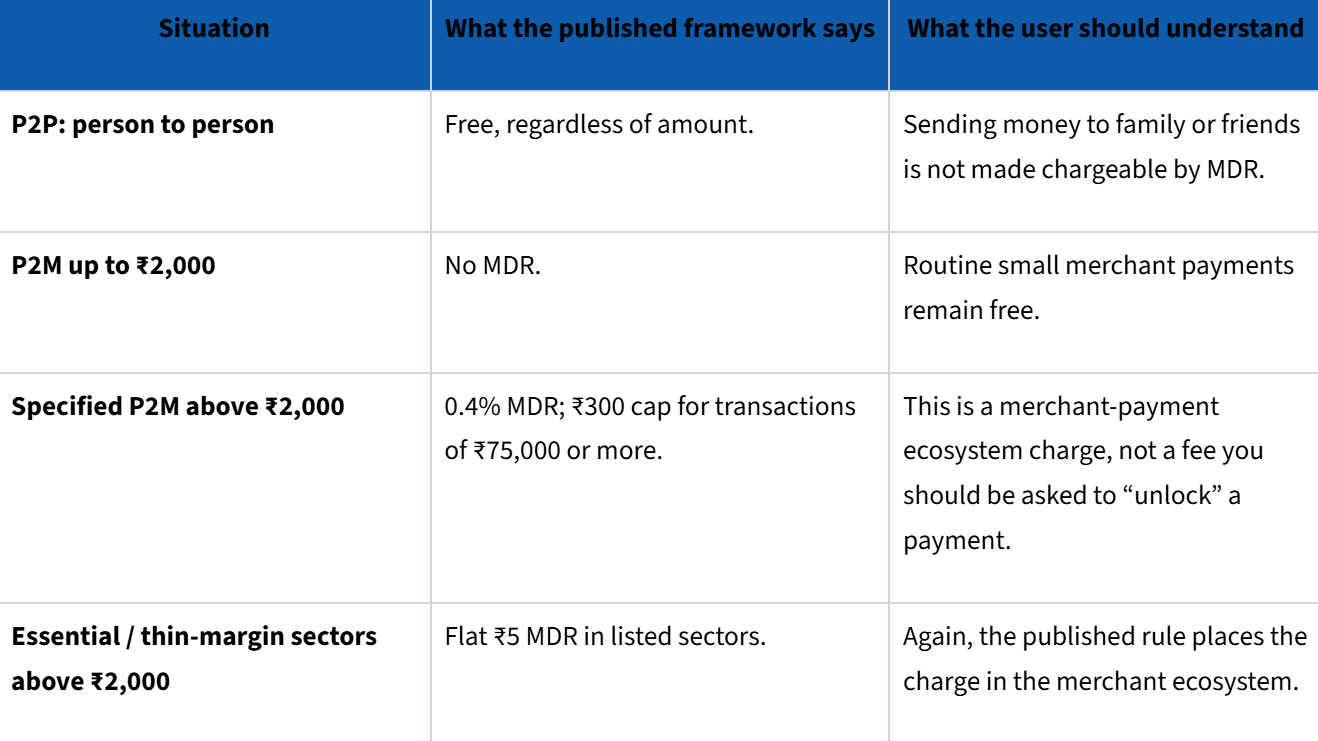
The important distinction is between a legitimate MDR rule and a scammer’s request for money. A message saying “pay ₹99 to release your UPI transaction” is not made genuine by mentioning NPCI, a bank, a government notice, or a news report.
A Related Cyber-Fraud Headline: Do Not Mix Two Different Issues
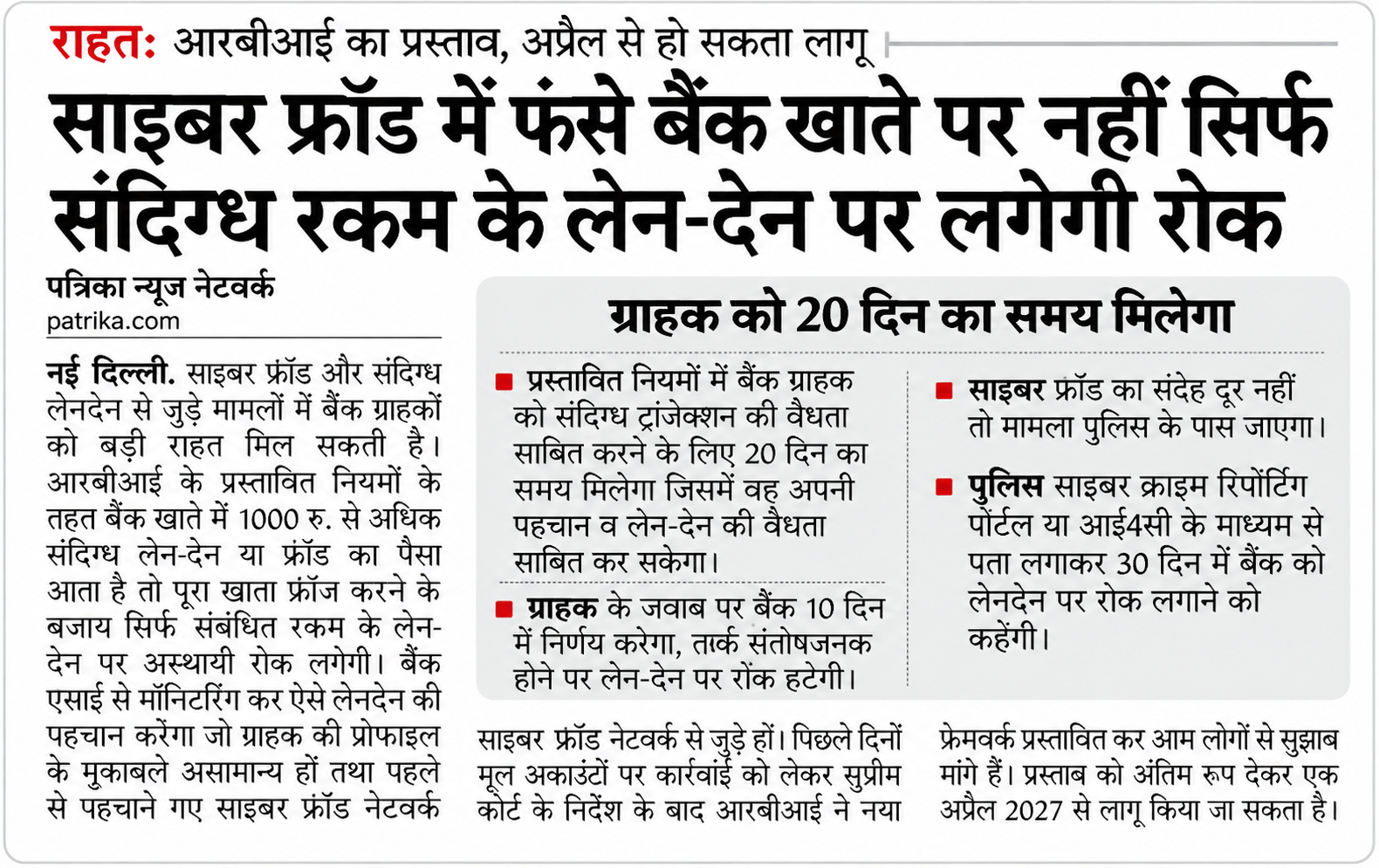
The supplied newspaper clipping discusses a separate cyber-fraud issue involving suspicious transactions and bank accounts linked to cybercrime. It is useful context, but it should not be read as proof that ordinary UPI users must pay a special “verification” or “release” fee. Separating the two issues helps prevent panic and misinformation.
Where Scammers Use the Confusion
“Pay a small fee to receive money”
A simple red flag is the demand for an upfront fee: “Your refund is ready, pay a processing fee first.” NPCI warns that scanning a QR code and entering a UPI PIN is for making a payment, not for receiving money or cashback. [2]
Fake payment success screens
Another common trick targets merchants: a fraudster shows a convincing “Payment Successful” screenshot and collects goods before the seller checks the account. In August 2026, Delhi Police reported a case involving allegedly fake or manipulated Paytm/UPI screenshots, followed by an attempt to gain access to victims’ mobile phones. [3] In September, police in Jharsuguda and Basti reported similar fake-confirmation cases; the Basti case involved a fabricated SBI YONO screenshot. [4][5]
“Your UPI is blocked because of new charges”
Scammers also borrow the language of genuine policy announcements. The caller creates urgency, claims your account is restricted, and asks you to install an app, share an OTP, approve a collect request, or transfer a small amount “for verification”. A real headline does not make an unexpected payment request genuine.
The Five-Second UPI Safety Check
Puse Before You Pay
WHO is asking? WHAT exactly are they asking you to do? WHERE did the payment request appear? WHEN did the request arrive? WHY would you need to pay to receive money? Verify the transaction in your own bank or UPI app. Merchants should not rely on a screenshot shown by a customer. Customers should not treat a QR code, collect request, or incoming message as proof that they are “receiving” money. Read the final authorisation screen before entering the UPI PIN. NPCI says users should never share the PIN and that bank customer support will not ask for it. [6]
If You Think You Have Been Scammed
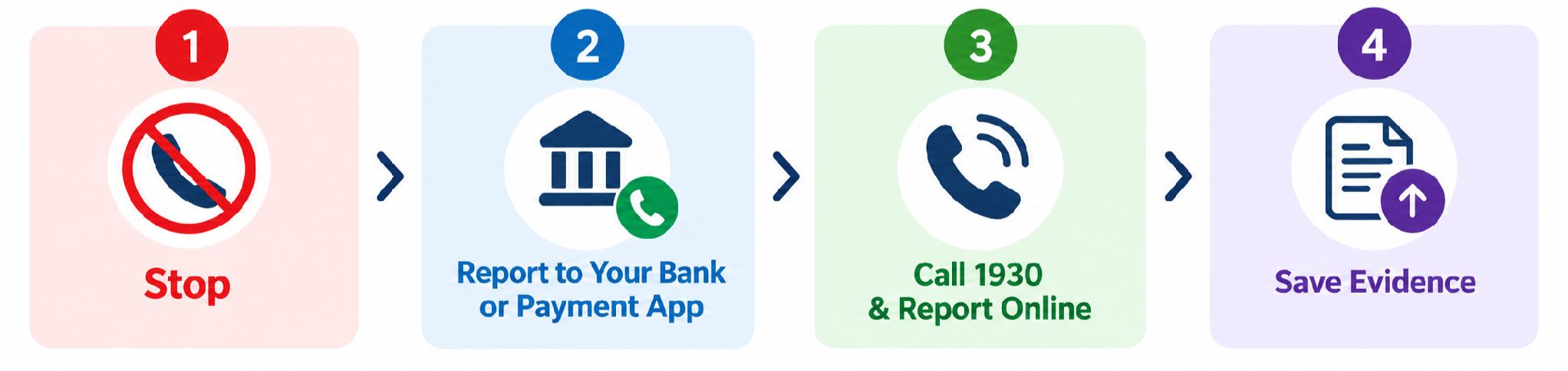
- Stop engaging with the suspected caller, account, or chat. Do not send another payment to “fix” the first one.
- Contact your bank or the relevant payment app using an official support channel and report the transaction.
- For financial cyber fraud in India, call 1930 as soon as possible and report the incident through the National Cyber Crime Reporting Portal. The official portal identifies 1930 as the helpline for immediate reporting of financial cyber fraud. [7]
- Keep the transaction ID, screenshots, phone numbers, messages, and dates. Do not delete useful evidence.
Conclusion
The safest way to understand the UPI charge discussion is to slow the headline down. Yes, a revised MDR framework has been announced for certain merchant transactions above ₹2,000 from 15 October 2026. But that does not make a P2P transfer subject to a “release fee”, and it does not make an unsolicited ₹49, ₹99, or ₹199 demand legitimate. Check the transaction type, confirm where the charge sits, verify the payment in your own app or bank account, and never disclose your UPI PIN. Digital safety is not about fearing every payment; it is about recognising when someone asks you to leave the normal payment process.
Remember
UPI convenience should never require blind trust. Verify the sender, verify the screen, verify the transaction.
References
[1] Press Information Bureau, Ministry of Finance, “UPI Continues to Remain Free for Peer to Peer Transactions and 96% of Merchant Transactions,” 15 September 2026. https://www.pib.gov.in/PressReleseDetailm.aspx?PRID=2310586
[2] National Payments Corporation of India (NPCI), “Fraud Awareness,” current guidance on fake cashback links, QR codes and UPI PIN safety. https://www.npci.org.in/fraud-awareness
[3] Hindustan Times / PTI, “Delhi Police arrest man in ₹30.81 lakh cyber fraud involving fake UPI payments,” 26 August 2026. https://www.hindustantimes.com/cities/delhi-news/delhi-police-arrest-man-in-rs-30-81-lakh-cyber-fraud-involving-fake-upi-payments-101787734051785.html
[4] The Times of India, “Two held for fake UPI payment fraud in Jharsuguda,” 11 September 2026. https://timesofindia.indiatimes.com/city/bhubaneswar/two-held-for-fake-upi-payment-fraud-in-jharsuguda/articleshow/134072823.cms
[5] The Times of India, “Basti: 2 held for fake UPI payment scam,” 13 September 2026. https://timesofindia.indiatimes.com/articleshow/134154561.cms
[6] NPCI, “UPI - Frequently Asked Questions,” UPI PIN and transaction-confirmation guidance. https://www.npci.org.in/what-we-do/upi/faqs
[7] Government of India, National Cyber Crime Reporting Portal, financial cyber fraud reporting guidance and helpline 1930. https://www.cybercrime.gov.in/
[8] Moneycontrol, “Don't trust the screenshot: How to spot a fake UPI payment,” 6 August 2026. https://www.moneycontrol.com/news/business/personal-finance/don-t-trust-the-screenshot-how-to-spot-a-fake-upi-payment-13996275.html
Image note: Both visuals were supplied by the requester. Figure 1 was cross-checked against the Ministry of Finance/PIB clarification cited in Reference [1].
