
From Compliance to Forensic Readiness | What DPDP and GRC Mean for Proving Cyber Readiness
Introduction
For years, Indian companies could get away with vague privacy promises. That window closed on 13 November 2025, when the government notified the Digital Personal Data Protection Rules, giving teeth to the broad principles Parliament had passed back in 2023 under the DPDP Act. The Rules turned soft commitments into specific, auditable duties, and a lot of organisations are only now realising how much that actually changes.
Start with Section 8(4). It requires every Data Fiduciary to put "appropriate technical and organisational measures" in place. Most readers skim past "organisational" and focus on the technical half, but that's a mistake, because the word is doing real work. It's asking for defined roles, written policies, staff training, and someone actually watching whether any of it holds up over time, not just firewalls and encryption keys. Section 8(5) goes further, demanding reasonable security safeguards against breaches, and Rule 6 spells out exactly what that phrase means in practice: encrypt data at rest and in transit, restrict access on a need to know basis, require multi factor authentication, log and monitor activity, run regular vulnerability checks, bind your data processors contractually to the same standard, and keep relevant logs for at least a year.
Then there's Rule 7, and this is where the clock starts running. Once a Data Fiduciary becomes aware of a breach, the Data Protection Board must be told without delay, and a full report has to follow within 72 hours covering what happened, when, why, what's being done about it, and confirmation that affected individuals were notified. Unlike GDPR, there's no minimum severity threshold here. A breach affecting ten people triggers the same obligation as one affecting ten million. And CERT-In's existing six hour reporting window under its 2022 Directions still applies separately, which means a serious incident can trigger two overlapping regulatory clocks running side by side.
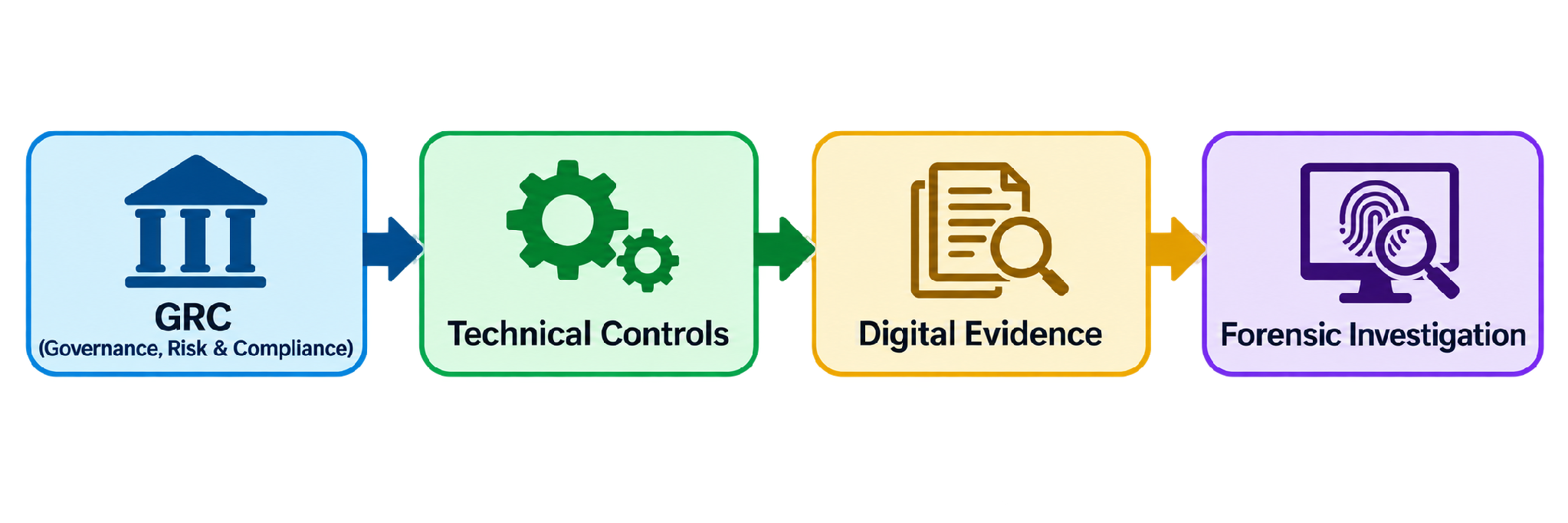
Put all of this together and a pattern emerges. The law assumes an organisation already knows what it's protecting, has actually protected it, kept usable records the whole way through, and can explain clearly what happened the moment something breaks. That coordination job belongs to Governance, Risk and Compliance, or GRC for short. GRC decides who's accountable, which risks actually matter, which controls address them, and how anyone checks whether compliance is real rather than assumed. Skip that structure and security work tends to splinter into a pile of disconnected tasks nobody truly owns.
GRC gives a legal duty somewhere to live. Forensic readiness is what lets an organisation prove, months or years later, that the duty was actually being met.
The Role of Governance, Risk and Compliance
On paper, most cybersecurity programmes look fine. There's an incident response plan somewhere, access control rules exist, logging is "in place," and someone has a title that says they're responsible for security. None of that gets tested until something actually breaks. A phishing compromise, a ransomware infection, a leaked database, a hijacked admin account, whatever the trigger, the questions that follow are always the same, and they're not comfortable ones. What happened, exactly, and when did it start? Which systems, which data, were actually touched? Were the controls the organisation claims to run genuinely functioning at that moment, or just described in a slide deck somewhere? And can anyone produce records solid enough to answer those questions with confidence rather than a shrug?
This is the exact seam where GRC and digital forensics meet. GRC lays out what's expected, who's responsible, and what evidence a control should be generating in the background. Digital forensics is the craft of taking whatever technical traces actually exist and turning them into an account of events that will hold up to scrutiny. Passing an audit was never really the point. Being able to stand in front of a regulator, mid incident, and show that the processes described on paper were real, active, and generating trustworthy evidence, that's the actual bar.
Why Compliance Alone Falls Short
Compliance, in the narrow sense, just means meeting whatever legal, contractual, or internal requirement applies. But a policy sitting in a document repository proves nothing about what actually happens on a Tuesday afternoon when someone requests admin access. A written incident response plan says nothing about whether the team can actually execute it under real pressure, at 2am, with a ransomware note on every screen. A logging policy is close to worthless if the logs it promises were switched off somewhere along the way, or overwritten, or scattered across systems that were never synchronised to the same clock.
NIST's Cybersecurity Framework 2.0 essentially built this concern into its core structure, placing "Govern" alongside Identify, Protect, Detect, Respond, and Recover as one of five equal functions rather than background paperwork sitting off to the side. India's own regulatory posture pushes in the same direction. CERT-In's 2022 Directions require certain incidents to be reported within six hours of discovery, and its guidance for government entities leans heavily on documented incident handling and disciplined evidence practices. The underlying message from both is identical: figure out, before anything goes wrong, whether the evidence you'll eventually need is actually going to exist when someone asks for it.
Where GRC and Forensics Actually Connect
A good GRC programme spells out what's supposed to happen. Forensic readiness is what lets you later prove what actually did.
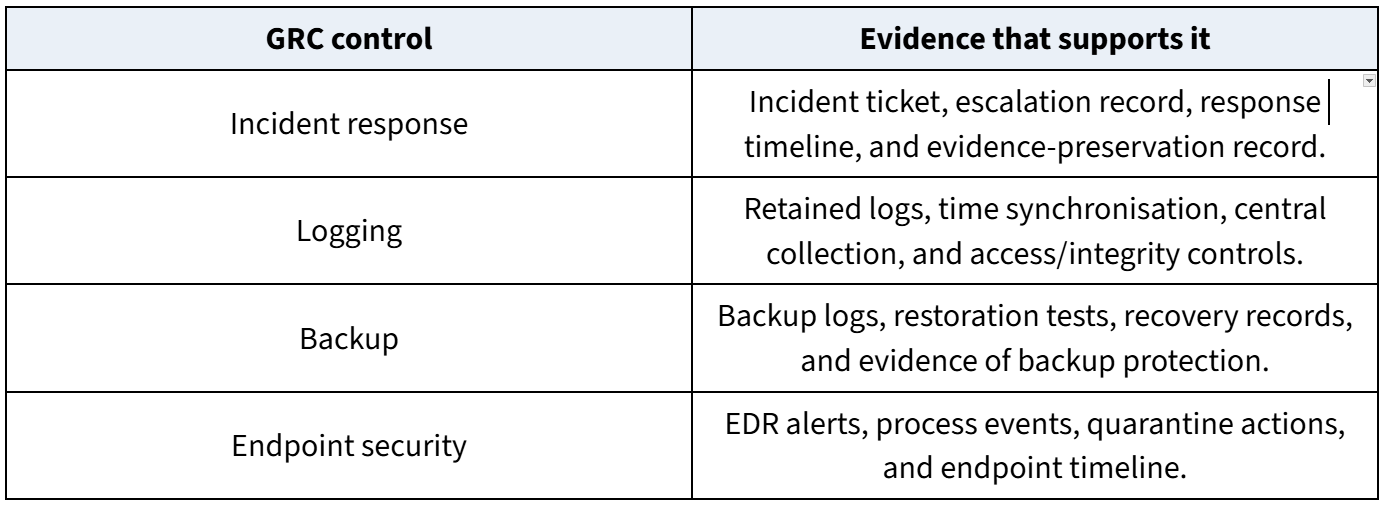
Access control is a useful example here. On the GRC side, an organisation might require least privilege access, multi factor authentication, periodic reviews of who holds privileged accounts, and prompt removal of access once someone leaves or changes roles. On the forensic side, none of that means anything without the underlying records that let investigators actually test it, authentication logs, MFA usage history, privilege change records, and account activity trails. The table below lines up a few common GRC controls against the specific evidence needed to show they were genuinely operating.
A Practical Scenario: After a Ransomware Incident
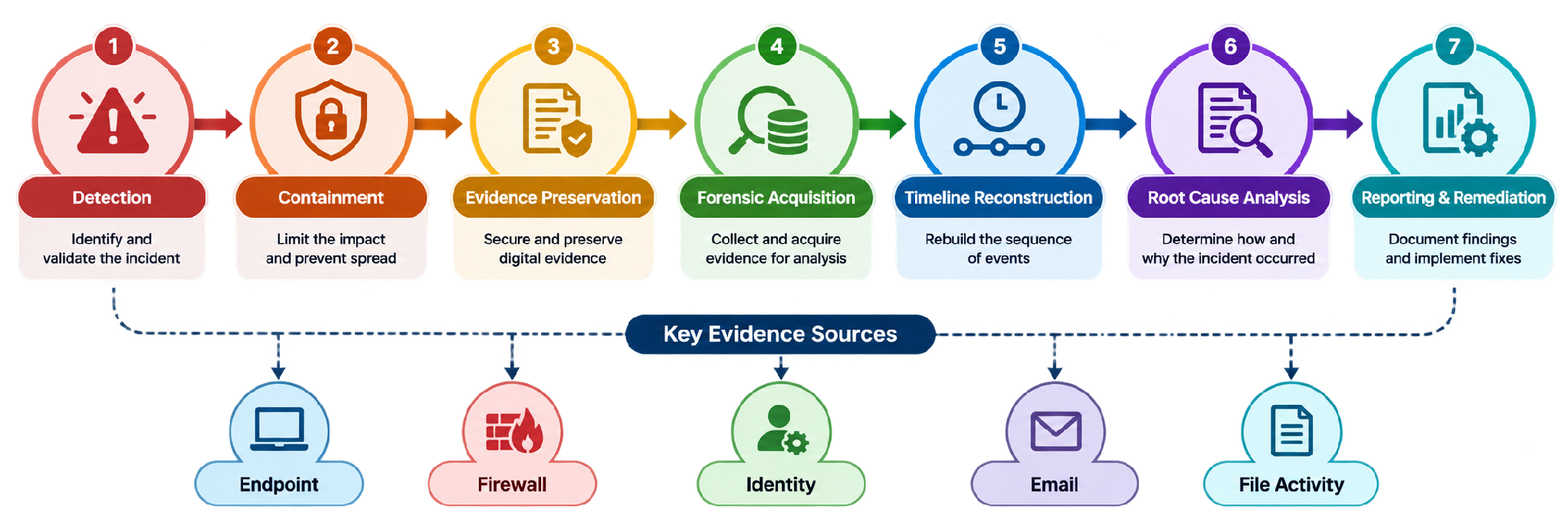
Picture a mid-sized company waking up to find half its file servers encrypted. There's an incident response plan somewhere in the shared drive, technically, but nobody's actually run through it in over a year. The security team isolates the obviously compromised endpoint and starts escalating. Now the forensic side of the house has to reconstruct what happened, working backward through endpoint telemetry, authentication logs, firewall events, email traffic, and file activity, hunting for the original point of entry, how the attacker escalated privileges, how they moved sideways through the network, what data they actually touched, and finally how the ransomware got deployed.
This is where the quality of everything collected beforehand suddenly matters a great deal. If server clocks were never properly synchronised, the timeline investigators build might not line up cleanly enough to trust. If logs only ever lived locally on individual machines rather than being pulled centrally, some of them are probably gone by now. If nobody ever bothered logging administrator actions, there are going to be real, unexplained gaps in the story. And if whatever evidence does exist wasn't collected the right way, its integrity can be challenged later, sometimes fatally, in a legal or regulatory proceeding. CERT-In actually ran a programme on exactly this in July 2026, "Inside the Breach," covering system artefacts, investigative technique, and chain of custody requirements, precisely because this is where real investigations tend to succeed or quietly fall apart.
Building a Forensic Ready GRC Programme
For an organisation starting more or less from scratch, forensic readiness doesn't need to be bolted on as some separate initiative. It can be built straight into the GRC programme that already exists. Start by identifying the systems, applications, cloud services, and privileged accounts that actually matter. Map the real risks and regulatory requirements onto the controls meant to address them. Then get specific about what evidence each control should be generating, and how that evidence gets protected and kept over time. Time synchronisation, centralised logging, tightly controlled access to security records, and clear ownership of preservation, escalation, and investigation all need to exist well before an incident, not be improvised during one. And none of it means much until it's actually been tested, through tabletop exercises and simulated incidents rather than assumed to work because it's written down somewhere. NIST SP 800-61 Revision 3 frames incident response as one continuous loop of preparation, detection, response, recovery, and improvement, rather than a series of separate boxes to check.
There's one question worth asking of every important control an organisation runs: could you actually prove this was working at the moment an incident happened? If the honest answer is no, what you have is a compliance process on paper, and a forensic readiness gap sitting quietly underneath it.
Conclusion
Cyber readiness was never really about how many policies sit in a binder or how many boxes get ticked in an audit. It shows up, or doesn't, in the hours right after something breaks, when an organisation has to move fast, preserve evidence that can actually stand up to scrutiny, explain clearly what happened, and prove that governance and technical controls were genuinely working together rather than just coexisting on paper. GRC sets the direction, the accountability, the risk priorities, and the compliance expectations. Digital forensics does the work of preserving and interpreting the technical evidence once something actually happens. Forensic readiness sits in between the two, making sure they're actually talking to each other long before an incident forces the conversation. The practical task for most organisations comes down to something simple to say, if not always simple to build: design controls that hold up under real incident response, not just an auditor's checklist. The strongest compliance posture was never the one with the thickest binder. It's the one that can back every document up with evidence, on the day it actually matters.
References
- Digital Personal Data Protection Act, 2023, Sections 8(4), 8(5), 8(6). https://www.meity.gov.in/writereaddata/files/Digital%20Personal%20Data%20Protection%20Act%202023.pdf
- Digital Personal Data Protection Rules, 2025, Rules 6 and 7, notified 13 November 2025. https://www.meity.gov.in
- National Institute of Standards and Technology, The NIST Cybersecurity Framework (CSF) 2.0, CSWP 29, 2024. https://csrc.nist.gov/pubs/cswp/29/the-nist-cybersecurity-framework-csf-20/final
- Indian Computer Emergency Response Team (CERT-In), Directions under Section 70B of the Information Technology Act, 2000, dated 28 April 2022. https://www.cert-in.org.in/Directions70B.jsp
- Indian Computer Emergency Response Team (CERT-In), Guidelines on Information Security Practices for Government Entities. https://www.cert-in.org.in/Downloader?fileName=CIPS-2026-0014.pdf&pageid=5&type=2
- National Institute of Standards and Technology, SP 800-86: Guide to Integrating Forensic Techniques into Incident Response, 2006. https://csrc.nist.gov/pubs/sp/800/86/final
- International Organization for Standardization, ISO/IEC 27037:2012, Guidelines for identification, collection, acquisition and preservation of digital evidence. CERT-In, "Inside the Breach: Advanced Cyber Forensics & Incident Investigation," 31 July 2026. https://www.cert-in.org.in/s2cMainServlet?pageid=PRSTNVIEW03&reCode=CIWS-2026-3569
- National Institute of Standards and Technology, SP 800-61 Rev. 3: Incident Response Recommendations and Considerations for Cybersecurity Risk Management, 2025. https://csrc.nist.gov/pubs/sp/800/61/r3/final
- Matters.ai, "DPDP Breach Notification: 72-Hour Rule & ₹200 Cr Penalty." https://www.matters.ai/article/dpdp-breach-notification MediaNama, "Data Breach Reporting Timeline of DPDP Rules 2025 Explained." https://www.medianama.com/2025/11/223-data-breach-reporting-timeline-of-dpdp-rules-2025-explained/

Related Blogs

Introduction
An age of unprecedented problems has been brought about by the constantly changing technological world, and misuse of deepfake technology has become a reason for concern which has also been discussed by the Indian Judiciary. Supreme Court has expressed concerns about the consequences of this quickly developing technology, citing a variety of issues from security hazards to privacy violations to the spread of disinformation. In general, misuse of deepfake technology is particularly dangerous since it may fool even the sharpest eye because they are almost identical to the actual thing.
SC judge expressed Concerns: A Complex Issue
During a recent speech, Supreme Court Justice Hima Kohli emphasized the various issues that deepfakes present. She conveyed grave concerns about the possibility of invasions of privacy, the dissemination of false information, and the emergence of security threats. The ability of deepfakes to be created so convincingly that they seem to come from reliable sources is especially concerning as it increases the potential harm that may be done by misleading information.
Gender-Based Harassment Enhanced
In this internet era, there is a concerning chance that harassment based on gender will become more severe, as Justice Kohli noted. She pointed out that internet platforms may develop into epicentres for the quick spread of false information by anonymous offenders who act worrisomely and freely. The fact that virtual harassment is invisible may make it difficult to lessen the negative effects of toxic online postings. In response, It is advocated that we can develop a comprehensive policy framework that modifies current legal frameworks—such as laws prohibiting sexual harassment online —to adequately handle the issues brought on by technology breakthroughs.
Judicial Stance on Regulating Deepfake Content
In a different move, the Delhi High Court voiced concerns about the misuse of deepfake and exercised judicial intervention to limit the use of artificial intelligence (AI)-generated deepfake content. The intricacy of the matter was highlighted by a division bench. The bench proposed that the government, with its wider outlook, could be more qualified to handle the situation and come up with a fair resolution. This position highlights the necessity for an all-encompassing strategy by reflecting the court's acknowledgement of the technology's global and borderless character.
PIL on Deepfake
In light of these worries, an Advocate from Delhi has taken it upon himself to address the unchecked use of AI, with a particular emphasis on deepfake material. In the event that regulatory measures are not taken, his Public Interest Litigation (PIL), which is filed at the Delhi High Court, emphasises the necessity of either strict limits on AI or an outright prohibition. The necessity to discern between real and fake information is at the center of this case. Advocate suggests using distinguishable indicators, such as watermarks, to identify AI-generated work, reiterating the demand for openness and responsibility in the digital sphere.
The Way Ahead:
Finding a Balance
- The authorities must strike a careful balance between protecting privacy, promoting innovation, and safeguarding individual rights as they negotiate the complex world of deepfakes. The Delhi High Court's cautious stance and Justice Kohli's concerns highlight the necessity for a nuanced response that takes into account the complexity of deepfake technology.
- Because of the increased complexity with which the information may be manipulated in this digital era, the court plays a critical role in preserving the integrity of the truth and shielding people from the possible dangers of misleading technology. The legal actions will surely influence how the Indian judiciary and legislature respond to deepfakes and establish guidelines for the regulation of AI in the nation. The legal environment needs to change as technology does in order to allow innovation and accountability to live together.
Collaborative Frameworks:
- Misuse of deepfake technology poses an international problem that cuts beyond national boundaries. International collaborative frameworks might make it easier to share technical innovations, legal insights, and best practices. A coordinated response to this digital threat may be ensured by starting a worldwide conversation on deepfake regulation.
Legislative Flexibility:
- Given the speed at which technology is advancing, the legislative system must continue to adapt. It will be required to introduce new legislation expressly addressing developing technology and to regularly evaluate and update current laws. This guarantees that the judicial system can adapt to the changing difficulties brought forth by the misuse of deepfakes.
AI Development Ethics:
- Promoting moral behaviour in AI development is crucial. Tech businesses should abide by moral or ethical standards that place a premium on user privacy, responsibility, and openness. As a preventive strategy, ethical AI practices can lessen the possibility that AI technology will be misused for malevolent purposes.
Government-Industry Cooperation:
- It is essential that the public and commercial sectors work closely together. Governments and IT corporations should collaborate to develop and implement legislation. A thorough and equitable approach to the regulation of deepfakes may be ensured by establishing regulatory organizations with representation from both sectors.
Conclusion
A comprehensive strategy integrating technical, legal, and social interventions is necessary to navigate the path ahead. Governments, IT corporations, the courts, and the general public must all actively participate in the collective effort to combat the misuse of deepfakes, which goes beyond only legal measures. We can create a future where the digital ecosystem is safe and inventive by encouraging a shared commitment to tackling the issues raised by deepfakes. The Government is on its way to come up with dedicated legislation to tackle the issue of deepfakes. Followed by the recently issued government advisory on misinformation and deepfake.
References:
.webp)
Smart Wearable devices are designed to track several activities in defined parameters and are increasingly becoming a part of everyday life. According to Markets and Markets Report, the global wearable tech market is projected to reach a staggering USD 256.4 billion by 2026. One of the main areas of use of wearable devices is health, including biomedical research, health care, personal health practices and tracking, technology development, and engineering. These wearable devices often include digital health technologies such as consumer smartwatches that monitor an individual's heart rate and step count, and other body-worn sensors like those that continuously monitor blood glucose concentration.
Wearable devices used by the general population are getting increasingly popular. Health devices like fitness trackers and smartwatches enable continuous monitoring of personal health. Privacy is an emerging concern due to the real-time collection of sensitive data. Vulnerabilities due to unauthorised access or discrimination in case of information being revealed without consent are the primary concerns with these devices. While these concerns are present a lot of related misinformation is emerging due to the same.
While wearable devices typically come with terms of use that outline how data is collected and used, and there are regulations in place such as EU Law GDPR, such regulations largely govern the regulatory compliances on the handling of personal data, however, the implementation and compliances by the manufacturer is a one another aspect which might present the question on privacy protection. In addition, beyond the challenge of regulatory compliance, the rise of myths and misinformation surrounding wearable tech presents a separate issue.
Common Misconceptions About Privacy with Wearable Tech
- With the rapid development and growth of wearable technology their use has been subject to countless rumours which fuel misinformation narratives in the minds of general public. Addressing these misconceptions and privacy concerns requires targeted strategies.
- A prevalent misconception is that they are constantly spying on users. While wearable devices collect users’ data in real time, their vulnerability to unauthorised access is similar to that of a non-wearable device. The issue is of consent when it comes to wearable technology because it gives the ability to record. If permissions are not asked when a person is being recorded then the data is accessible to external entities.
- There is a common myth that wearable tech is surveillance tool. This is entirely a conjecture. These devices collect the user data with their prior consent and have been created to provide them with real-time information, most commonly physical health information. Since users choose the information shared, the idea of wearable tech serving as a surveillance tool is unfounded.
- Another misconception about wearable tech is that it can diagnose medical conditions. These devices collect real-time health data, such as heart rate or activity levels, they are not designed for medical diagnosis. The data collected may not always be accurate or reliable for clinical use to be interpreted by a healthcare professional. This is mainly because the makers of these devices are not held to the safety and liability standards that medical providers are.
- A prevalent misconception is that wearable tech can cure health issues, which is simply untrue. Wearable tech devices are essentially tracking the health parameters that a user sets. It in no way is a cure for any health issue that one suffers from. A user can manage their health based on the parameters they set on the device such as the number of steps that they walk, check on the heart rate and other metrics for their mental satisfaction but they are not a cure to treat diseases. Wearable tech acts as alerts, notifying users of important health metrics and encouraging proactive health management.
Addressing Privacy and Health Concerns in Wearable Tech
Wearable technology raises concerns for privacy and health due to the colossal amount of personal data collected. To address these, strong data protection measures are essential, ensuring that sensitive health information is securely stored and shared only with consent. Providing users with control over their data is one of the ways to build user trust. It includes enabling them to opt in, access, or delete the data in question. Regulators should establish clear guidelines, ensuring wearables ensure the compliances with data protection regulations like HIPPA, GDPR or DPDP Act, whichever is applicable as per the jurisdiction. Furthermore, global standards for data encryption, device security, and user privacy should be implemented to mitigate risks. Transparency in data usage and consistent updates to software security are also crucial for protecting users' privacy and health while promoting the responsible use of wearable tech.
CyberPeace Insights
- Making informed decisions about wearable tech starts with thorough research. Start by reading reviews and comparing products to assess their features, compatibility, and security standards.
- Investigate the manufacturer’s reputation for data protection and device longevity. Understanding device capabilities is crucial. One should evaluate whether the wearable meets their needs, such as fitness tracking, health monitoring, or communication features. Consider software security and updates, and data accuracy when comparing options. Opt for devices that offer two-factor authentication for an additional layer of security.
- Check the permissions requested by the accompanying app; only grant access to data that is necessary for the device's functionality. Always read the terms of use to understand your rights and responsibilities regarding the use of the device. Review and customize data-sharing settings for better control to prevent unauthorised access.
- Staying updated on the tech is equally important. A user should follow the advancements in wearable technology be it regular security updates, or regulatory changes that may affect privacy and usability. This ensures getting tech that aligns with user lifestyle while meeting privacy and security expectations.
Conclusion
Privacy and Misinformation are key concerns that emerge due to the use of wearable tech designed to offer benefits such as health monitoring, fitness tracking, and personal convenience. It requires a combination of informed decision-making by users and stringent regulatory oversight to overcome the issues that emerge due to misinformation about these devices. Users must ensure they understand the capabilities and limitations of their devices, from data accuracy to privacy risks. Additionally, manufacturers and regulators need to prioritise transparency, data protection, and compliance with global standards like GDPR or DPDP to build trust. As wearable tech continues to evolve, a balanced approach to innovation and privacy will be essential in fostering its responsible and beneficial use for all.
References
- https://thehealthcaretechnologyreport.com/privacy-data-security-concerns-rise-as-healthcare-wearables-gain-popularity/
- https://journals.plos.org/digitalhealth/article?id=10.1371/journal.pdig.0000104
- https://www.marketsandmarkets.com/Market-Reports/wearable-electronics-market-983.html?gclid=Cj0KCQjwgMqSBhDCARIsAIIVN1V0sqrk6SpYSga3rcDtWcwh8npZ08L0_s4X91gh7yPAa6QmsctB-lMaAlpqEALw_wcB
- https://www.cambridge.org/core/journals/legal-information-management/article/health-data-on-the-go-navigating-privacy-concerns-with-wearable-technologies/05DAF11EFA807051362BB39260C4814C

Executive Summary:
Old footage of Indian Cricketer Virat Kohli celebrating Ganesh Chaturthi in September 2023 was being promoted as footage of Virat Kohli at the Ram Mandir Inauguration. A video of cricketer Virat Kohli attending a Ganesh Chaturthi celebration last year has surfaced, with the false claim that it shows him at the Ram Mandir consecration ceremony in Ayodhya on January 22. The Hindi newspaper Dainik Bhaskar and Gujarati newspaper Divya Bhaskar also displayed the now-viral video in their respective editions on January 23, 2024, escalating the false claim. After thorough Investigation, it was found that the Video was old and it was Ganesh Chaturthi Festival where the cricketer attended.
Claims:
Many social media posts, including those from news outlets such as Dainik Bhaskar and Gujarati News Paper Divya Bhaskar, show him attending the Ram Mandir consecration ceremony in Ayodhya on January 22, where after investigation it was found that the Video was of Virat Kohli attending Ganesh Chaturthi in September, 2023.


The caption of Dainik Bhaskar E-Paper reads, “ क्रिकेटर विराट कोहली भी नजर आए ”
Fact Check:
CyberPeace Research Team did a reverse Image Search of the Video where several results with the Same Black outfit was shared earlier, from where a Bollywood Entertainment Instagram Profile named Bollywood Society shared the same Video in its Page, the caption reads, “Virat Kohli snapped for Ganapaati Darshan” the post was made on 20 September, 2023.

Taking an indication from this we did some keyword search with the Information we have, and it was found in an article by Free Press Journal, Summarizing the article we got to know that Virat Kohli paid a visit to the residence of Shiv Sena leader Rahul Kanal to seek the blessings of Lord Ganpati. The Viral Video and the claim made by the news outlet is false and Misleading.
Conclusion:
The recent Claim made by the Viral Videos and News Outlet is an Old Footage of Virat Kohli attending Ganesh Chaturthi the Video back to the year 2023 but not of the recent auspicious day of Ram Mandir Pran Pratishtha. To be noted that, we also confirmed that Virat Kohli hadn’t attended the Program; there was no confirmation that Virat Kohli attended on 22 January at Ayodhya. Hence, we found this claim to be fake.
- Claim: Virat Kohli attending the Ram Mandir consecration ceremony in Ayodhya on January 22
- Claimed on: Youtube, X
- Fact Check: Fake
