
Fairness as a Non-Negotiable in Public Administration - Case Brief: Karthick Theodore vs. Registrar General and Ors. (W.A.(MD)No.1901 of 2021)
Procedural History:
The case started with a 2011 Madras High Court ruling that included the appellant’s personal information. In the case discussed, the court decided in 2024, the appellant went to the Madurai Bench of the Madras High Court to request that his name and other identifying information from that previous ruling be redacted. He argued that his right to privacy under Article 21 of the Indian Constitution was violated by the ongoing release of such private information into the public arena. He claimed that the revelation had hurt him in real ways, such as having his application for an Australian visa denied. Therefore, without compromising the ideals of open justice, the current procedures aimed to have the court recognize a person’s “Right to be Forgotten” within a broader framework of privacy and data protection.
Background and Factual Matrix
The appellant was charged under Sections 417 and 376 of the IPC. The trial court convicted him in 201, but later, the High Court in 2014 fully, completely and unconditionally acquitted him, which was not based on the benefit of doubt. Following the acquittal, he remarried and has three children. The judgment of both the High Court and the Trial Court has personal and intimate details about him. Being available in the public domain has caused him significant repercussions, as he was denied a visa to travel to Australia by authorities, citing the criminal cases. The appellant has filed a plea seeking a mandamus directing the Registrar General, Additional Registrar General, and Registrar (IT-Statistics) as R1, R2, R3 to redact his name and other identities from the acquittal judgment. He has sought a direction from Ikanoon Software Development Private Limited (R4) to reflect the redaction in its publication.
Issue
- Whether a writ of mandamus can lie against a High Court for redaction of personal details from its own judgment, or does such a prayer tantamount to a High Court issuing a writ against itself?
- Whether the High Court, being a Court of Record under Article 215 of the Indian Constitution, is entitled to preserve its record for perpetuity in its original form without any modification or redaction?
- Whether the ‘Right to be Forgotten' can be recognised and enforced in the absence of a specific statutory provision or Supreme Court direction, given that it constitutes an exception to the fundamental principle of open courts and open justice?
Adjudication and Reasoning
The division bench has allowed the Writ appeal and granted the following relief:
- R4 directed to take down the judgment in Crl.A. (MD) No.321 of 2011 dated 30.04.2014 forthwith.
- R1 to R3 directed to redact the name and other details of the Writ Petitioner relating to his identity from the judgment dated 30.04.2014 in Crl.A.(MD) No. 321 of 2011 and ensure that only the redacted judgment is available for publication or for uploading.
Rule
- Courts have a wide discretion in deciding whether to allow redaction or not. Such discretion can either be granted at the request of the party seeking redaction or, in appropriate cases, even suo moto by the court.
- The accused who have earned full, complete and unconditional acquittal without any benefit of doubt have a legitimate claim to move forward for redaction of personal information.
- The open Court doesn’t require absolute disclosure of all personal information, and the courts, while deciding the concern of privacy and the right to ensure that in litigations to leave behind parts of their past which are no longer relevant, have to balance the concept of open Court on the one hand and privacy concerns of a citizen on the other.
- As the High Court is the repository of a wide range of information and is entitled to preserve the original record in perpetuity. However, without diluting the sanctity of the original record, the public reflection of that record can be moderated to preserve the privacy of the person to whom that record pertains.
Reasoning
- Drawing on the judgment K.S. Puttaswamy v. Union of India, the court found Article 21 to protect not only informational privacy but also the "right to be forgotten," which gives individuals the right to request the deletion of any personal data when there is no longer any legitimate public interest in retaining such information. Such irreparable reputational damage is thus an infringement on constitutional privacy that demands judicial redaction.
- The court rejected the argument that a writ against its own order is impermissible, drawing a distinction between challenging the legal correctness of a judgment and seeking redaction of personal information. Allowing redaction will not question the validity of the judgment; rather, it will simply change its public appearance to ensure privacy.
- Since a High Court is a Court of Record with an obligation to preserve its judgments in their unaltered form forever, the court held here that such internal maintenance of complete records was not incompatible with the issuance of a redacted public version. Institutional integrity is maintained when the original kept in the archives is supplemented with a public version that masks the privacy areas.
- Open justice principles work to establish transparency, accountability, and public confidence, but these are not absolute. The court took a proportionality stance: personal identifiers, where they neither educate nor have precedential value and continue to inflict harm, may be expunged without affecting the established legal principles of judgment.
- Although the DPDP Act exempts courts from several statutory obligations, the court held that it can, by virtue of its inherent discretion, protect personal data, and in so doing, exercise that power without the need for any legislative command. Traditionally the Madras High Court rules provide for the possibility of restriction of certified copies, thus establishing redaction as feasible both legally and administratively.

Related Blogs
Executive Summary
A Pakistani propaganda account on social media has claimed that Russian President Vladimir Putin ignored Indian Prime Minister Narendra Modi and stood alongside the Pakistani Prime Minister. Research by CyberPeace’s research wing found that PM Modi and President Putin held a bilateral meeting on the sidelines of the SCO Summit in Bishkek, Kyrgyzstan. During the meeting, the two leaders exchanged warm greetings and discussed several issues, including the India-Russia strategic partnership.
Claim:
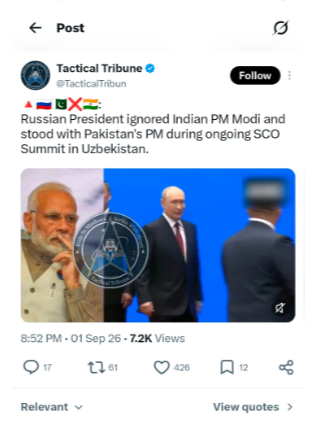
A social media post claims that Russian President Vladimir Putin ignored Prime Minister Narendra Modi and stood alongside the Pakistani Prime Minister.
https://x.com/TacticalTribun/status/2094808040973172786
Fact Check:
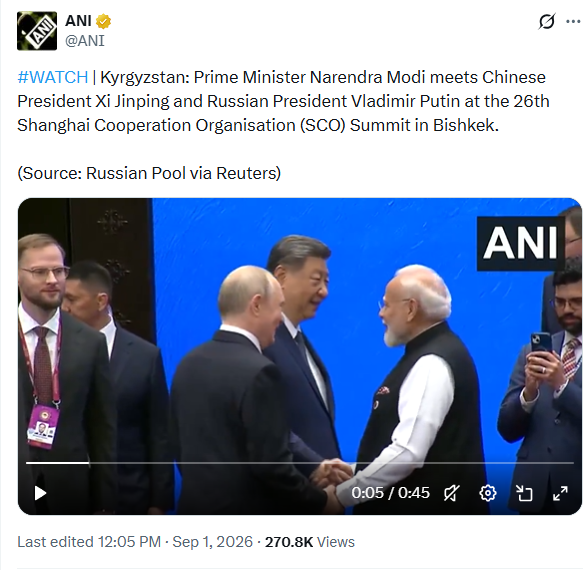
To verify the truth behind the viral claim, we searched Google using relevant keywords related to Prime Minister Narendra Modi’s official visit to Kyrgyzstan. During the search, we found a video posted on ANI’s X handle on September 1, 2026. According to the video, Prime Minister Narendra Modi met Chinese President Xi Jinping and Russian President Vladimir Putin in Bishkek during the 26th Shanghai Cooperation Organisation (SCO) Summit.
https://x.com/ANI/status/2094675518897692896
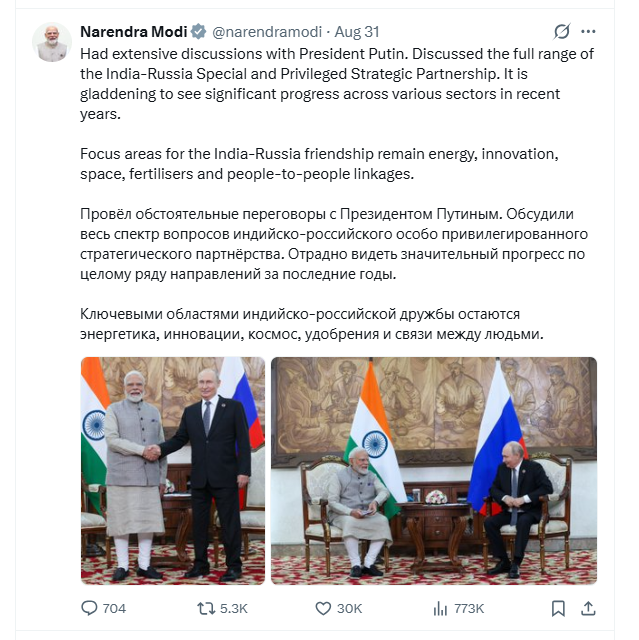
In the next step of our research, we scanned Prime Minister Narendra Modi’s X account, where we found a post dated August 31, 2026. In the post, PM Modi wrote, “Had extensive discussions with President Putin. Discussed the full range of the India-Russia Special and Privileged Strategic Partnership. It is gladdening to see significant progress across various sectors in recent years. Focus areas for the India-Russia friendship remain energy, innovation, space, fertilisers and people-to-people linkages.”
https://x.com/narendramodi/status/2094433881714032725?s=20
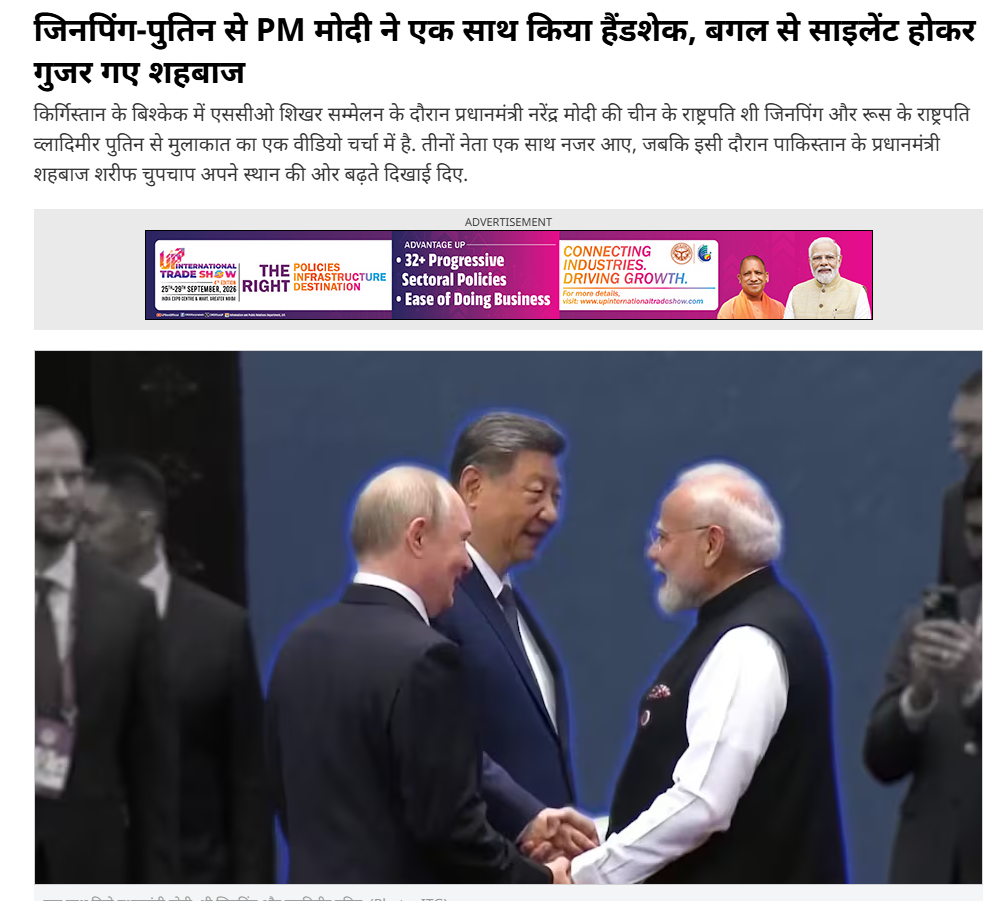
At the end of our research, we found a report published on the Aaj Tak website on September 1, 2026. According to the report, Prime Minister Narendra Modi was in Bishkek, the capital of Kyrgyzstan, where he attended the Shanghai Cooperation Organisation (SCO) Summit. Several leaders of the organisation, including Chinese President Xi Jinping, Russian President Vladimir Putin and Pakistani Prime Minister Shehbaz Sharif, also attended the summit. During the summit, a moment was captured in which PM Modi warmly greeted Chinese President Xi Jinping and Russian President Vladimir Putin together, while Shehbaz Sharif was seen quietly walking past them.
Conclusion:
Our research established that the claim that Russian President Vladimir Putin ignored Prime Minister Narendra Modi and gave preference to the Pakistani Prime Minister is misleading. The viral post presents video footage from different occasions out of context. In reality, Prime Minister Narendra Modi and President Putin held a bilateral meeting, during which the two leaders discussed several key issues, including the India-Russia strategic partnership.
Introduction
Deepfakes are artificial intelligence (AI) technology that employs deep learning to generate realistic-looking but phoney films or images. Algorithms use large volumes of data to analyse and discover patterns in order to provide compelling and realistic results. Deepfakes use this technology to modify movies or photos to make them appear as if they involve events or persons that never happened or existed.The procedure begins with gathering large volumes of visual and auditory data about the target individual, which is usually obtained from publicly accessible sources such as social media or public appearances. This data is then utilised for training a deep-learning model to resemble the target of deep fakes.
Recent Cases of Deepfakes-
In an unusual turn of events, a man from northern China became the victim of a sophisticated deep fake technology. This incident has heightened concerns about using artificial intelligence (AI) tools to aid financial crimes, putting authorities and the general public on high alert.
During a video conversation, a scammer successfully impersonated the victim’s close friend using AI-powered face-swapping technology. The scammer duped the unwary victim into transferring 4.3 million yuan (nearly Rs 5 crore). The fraud occurred in Baotou, China.
AI ‘deep fakes’ of innocent images fuel spike in sextortion scams
Artificial intelligence-generated “deepfakes” are fuelling sextortion frauds like a dry brush in a raging wildfire. According to the FBI, the number of nationally reported sextortion instances came to 322% between February 2022 and February 2023, with a notable spike since April due to AI-doctored photographs. And as per the FBI, innocent photographs or videos posted on social media or sent in communications can be distorted into sexually explicit, AI-generated visuals that are “true-to-life” and practically hard to distinguish. According to the FBI, predators often located in other countries use doctored AI photographs against juveniles to compel money from them or their families or to obtain actual sexually graphic images.
Deepfake Applications
- Lensa AI.
- Deepfakes Web.
- Reface.
- MyHeritage.
- DeepFaceLab.
- Deep Art.
- Face Swap Live.
- FaceApp.
Deepfake examples
There are numerous high-profile Deepfake examples available. Deepfake films include one released by actor Jordan Peele, who used actual footage of Barack Obama and his own imitation of Obama to convey a warning about Deepfake videos.
A video shows Facebook CEO Mark Zuckerberg discussing how Facebook ‘controls the future’ with stolen user data, most notably on Instagram. The original video is from a speech he delivered on Russian election meddling; only 21 seconds of that address were used to create the new version. However, the vocal impersonation fell short of Jordan Peele’s Obama and revealed the truth.
The dark side of AI-Generated Misinformation
- Misinformation generated by AI-generated the truth, making it difficult to distinguish fact from fiction.
- People can unmask AI content by looking for discrepancies and lacking the human touch.
- AI content detection technologies can detect and neutralise disinformation, preventing it from spreading.
Safeguards against Deepfakes-
Technology is not the only way to guard against Deepfake videos. Good fundamental security methods are incredibly effective for combating Deepfake.For example, incorporating automatic checks into any mechanism for disbursing payments might have prevented numerous Deepfake and related frauds. You might also:
- Regular backups safeguard your data from ransomware and allow you to restore damaged data.
- Using different, strong passwords for different accounts ensures that just because one network or service has been compromised, it does not imply that others have been compromised as well. You do not want someone to be able to access your other accounts if they get into your Facebook account.
- To secure your home network, laptop, and smartphone against cyber dangers, use a good security package such as Kaspersky Total Security. This bundle includes anti-virus software, a VPN to prevent compromised Wi-Fi connections, and webcam security.
What is the future of Deepfake –
Deepfake is constantly growing. Deepfake films were easy to spot two years ago because of the clumsy movement and the fact that the simulated figure never looked to blink. However, the most recent generation of bogus videos has evolved and adapted.
There are currently approximately 15,000 Deepfake videos available online. Some are just for fun, while others attempt to sway your opinion. But now that it only takes a day or two to make a new Deepfake, that number could rise rapidly.
Conclusion-
The distinction between authentic and fake content will undoubtedly become more challenging to identify as technology advances. As a result, experts feel it should not be up to individuals to discover deep fakes in the wild. “The responsibility should be on the developers, toolmakers, and tech companies to create invisible watermarks and signal what the source of that image is,” they stated. Several startups are also working on approaches for detecting deep fakes.
Introduction
Established in the US, one of the world’s largest cab networks came into existence in 2010 and, since its inception, has expanded all over the globe with operations in 10,000 cities across 71 countries. It made a remarkable start in India in 2017 and, since then, has seen a rise in the customers and drivers for the company. India is among the largest markets for Uber, with 600,000 monthly drivers and 8.5 million monthly riders.
GeM
Government e-Marketplace (GeM) is a one-stop portal to facilitate online procurement of common-use Goods & Services required by various Government Departments / Organizations / PSUs. GeM aims to enhance transparency, efficiency and speed in public procurement. It provides the tools of e-bidding, reverses e-auction and demand aggregation to facilitate government users achieve the best value for their money. Government e-Marketplace owes its genesis to the recommendations of two Groups of Secretaries to the Prime Minister in January 2016. They recommended setting up a dedicated e-market for different goods & services procured or sold by Government/PSUs besides reforming DGS&D. Subsequently, the Finance Minister, in his Budget speech for FY 2016-17, announced setting up of a technology-driven platform to facilitate procurement of goods and services by various Ministries and agencies of the Government. The portal was launched on 9th August 2016 by the Commerce & Industry Minister.
Uber-GeM collaboration
The cab network giant has registered on the portal of the Government E-marketplace and has declared that it will offer its services to Government officials from Ministries and PSUs. The project is currently in its pilot phase and shall be executed systematically to cover all the ministries and PSUs in the nation. The officials can book cabs at a fixed price with no cancellation or surge fees on the rides. The authorised officials will be able to book a cab from the portal and select from the list of drivers available. It will be a cashless/cardless ride for the officials; additional vehicle categories for government riders have been added, namely, GeM Yatraa Hatch and GeM Yatraa Sedan, and there will be hourly rentals for multiple-stops, allowing the government officials to enjoy the flexible and easily accessible network of cabs in major cities.
Advantages
Such collaboration between Government institutions and corporates will go a long way to secure a stable equilibrium in the market. Uber, a US-based company, enjoys a vast user base in India and has created new job avenues. The advantages of the collaboration between GeM and Uber are as follows-
Easy accessibility
This will undoubtedly provide ease in accessibility in terms of being in a new place, and language barriers will no longer exist with such options for Government officials.
Increased jobs for drivers
With more cabs being engaged with ministries and PSUs, it is pertinent that the requirement for drivers will grow, thus increasing the employability rate in India and allowing the user to have an uninterrupted experience.
Ease of travel and commuting
This move will provide flexibility, thus leading to more ease in travel in cases of emergencies or places inaccessible by trains or other modes of transport.
Rise in travel and tourism
Coupled with the other factors, the opportunities for the users to visit different places will be an added advantage which will help boost the tourism industry, thus creating a balance in the market.
Sustainable Government corporate relationship

Such collaborations between the government and corporates will be substantial, signifying the ease of doing business in India. They will also act as a beacon of example for compliance with opportunities for the other companies and stakeholders.
Opportunities for collaboration with ingenious start-ups
With such major corporate joining hands with the government, the indigenous start-ups will have various opportunities to engage with companies and recreate similar businesses rooted in India, thus transforming the economy.
Conclusion
Transportation and communication play a vital role in our lives, thus, such collaboration will go a long way in creating a better and more uniform user experience in the country. This also goes a long way to showcase that the Governmental platforms also offer services of a global standard. Such portals exist in South Korea, Singapore, the US and Europe. The network of cabs can only be sustained using the locals as drivers, hence these collaborations are win-win for all as the market dynamics are improving, employability will increase, and improved user experience will be seen.
