
#FactCheck-Viral Video Claiming to Show Flooded Chapra Railway Station Is AI-Generated
Executive Summary
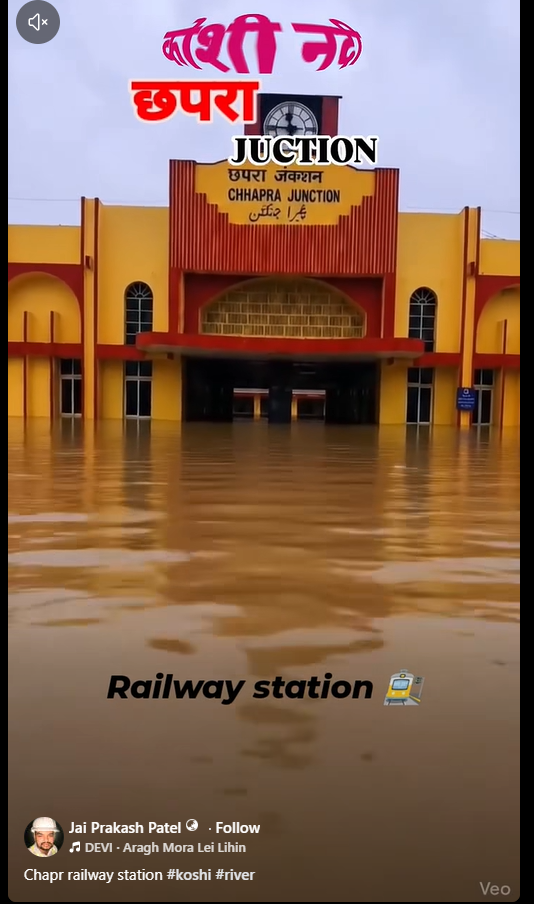
A video is being shared on social media showing a railway station completely submerged in water. The video is being shared with the claim that it shows Chapra Railway Station in Bihar, where severe waterlogging occurred following heavy rainfall. The water level in the video appears so high that even the platforms are not visible. A research done by the Research Wing of the CyberPeace found the viral claim to be false. Our research revealed that the viral video is AI-generated and is being shared on social media with a misleading claim.
Claim:
A user on the social media platform Facebook shared the viral video on August 31, 2026, claiming that Chapra Railway Station had been inundated. The link to the post, archived link, and screenshots are provided below.
https://www.facebook.com/reel/1393870102719178
Fact Check
To debunk the viral claim, we searched Google using relevant keywords. However, we could not find any credible media reports confirming the claim. As the next step in our research, we also checked the status of trains arriving at and departing from Chapra Railway Station. We reasoned that if the station had actually been submerged to the extent shown in the video, rail operations would likely have been disrupted and some trains might have been cancelled. However, our research found no information about any train operating from Chapra being cancelled.

Upon closely examining the viral video, we suspected that it might be AI-generated. We subsequently scanned the video using the AI detection tool Hive Moderation. According to the tool’s results, the viral video was found to be 99 percent AI-generated.

As part of the next step of our research, we scanned the viral video using another AI detection tool, Wasitai AI. According to the tool’s results, the viral video is AI-generated.

Conclusion
Our research found that the viral video is AI-generated and is being shared on social media with a misleading claim.

Related Blogs

Introduction
A new dawn in the realm of cyber security and criminal justice is on the horizon. Maharashtra's Deputy Chief Minister, Devendra Fadnavis, has recently announced the advent of the country's most sophisticated cyber lab—a bastion against the dark arts of cybercrime. This announcement, made with the gravitas befitting a statesman, was not merely a bureaucratic note; it was a clarion call to a future where technology and law converge to create a safer society.
The cyber lab, poised to be the largest and most modern of its kind, is not just a facility—it is a symbol of the state's commitment to harnessing the power of technology in the ceaseless battle against crime. Fadnavis, who also holds the state's home portfolio, underscored the significance of this initiative during a function where he also emphasised the need for the Maharashtra police to brace themselves for the enforcement of three transformative criminal laws set to take effect from the first of July 2024.
In compliance with the New Laws
These laws—the Bharatiya Nyaya Sanhita, the Bharatiya Nagarik Suraksha Sanhita, and the Bharat Sakshya Act—They are not mere statutory texts; they are the architects of a new edifice of criminal justice, designed with the mortar of modern electronic and technical evidence to buttress the conviction rates and fortify the legal system.
At the inauguration of the Evidence Management Centre (EMC) and the Evidence Dispatch Van (EDV) in Navi Mumbai, Fadnavis spoke with an air of prescience about the radical shifts these new acts will engender. The EMC, a paragon of innovation with its no-human-intervention ethos, is set to revolutionise the procedure of handling evidence, thereby amplifying the likelihood of securing convictions in an era increasingly marred by cyber frauds and hacking escapades.
Recent Trend
The Deputy Chief Minister's vision extends beyond the present, into a realm where blockchain technology becomes an ally of law enforcement, rendering evidence tampering an obsolete concern. Under the new legislative framework, expert collection of evidence is mandated for crimes with sentences exceeding seven years, a move that underscores the gravity with which digital and electronic evidence is now regarded.
The Cyber Lab
The Navi Mumbai police Commissionerate stands as the vanguard of this new legal era, being the first in the country to align with the upcoming laws. As digital transactions burgeon, so too does the evil of cybercrime. Fadnavis assures us that the cyberlaw, a veritable nexus of modernity, will bring together banks, non-banking financial companies (NBFCs), and social media platforms on a unified platform to detect and thwart crimes with alacrity.
This announcement was made in the presence of Maharashtra's Director General of Police, Rashmi Shukla, and Navi Mumbai's police commissioner, Milind Bharambe, both of whom are key figures in the conception of this project. Their attendance shows the collective resolve of Maharashtra's law enforcement to elevate its capabilities in cybercrime prevention.
Conclusion
The establishment of this cyber lab is a vivid thread woven with the intent to protect the digital integrity of its citizens. It is a testament to the state's foresight and its unwavering commitment to staying abreast of the evolving landscape of crime and technology. As we stand on the cusp of this new era, we are reminded that the fight against crime is perennial, but with such pioneering initiatives, victory is not just a possibility—it is an inevitability.
References
- https://indianexpress.com/article/cities/mumbai/navi-mumbai-cyber-lab-criminal-laws-fadnavis-9206801/
- https://www.the420.in/why-maharashtras-new-cyber-lab-could-be-a-game-changer-for-national-security/
- https://apacnewsnetwork.com/2024/03/navi-mumbai-to-host-indias-most-advanced-crime-busting-lab-boosting-conviction-rates-maharashtra-deputy-cm-fadnavis-announces/

Executive Summary
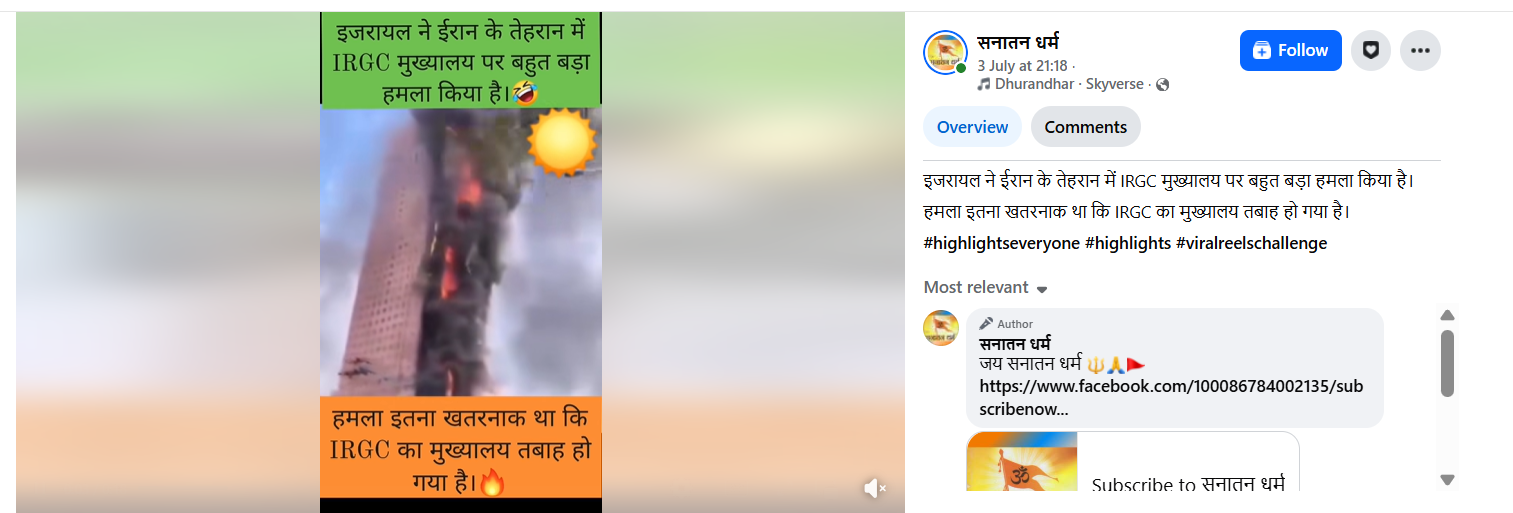
A video showing a massive fire in a high-rise building is being widely shared on social media. The footage shows a tall building engulfed in flames with thick smoke rising from it. Users are circulating the video with multiple claims. Some social media users claim that the video is from Tehran, Iran, where Israel allegedly carried out an attack on the headquarters of the Islamic Revolutionary Guard Corps (IRGC). Others are sharing the same video as an alleged strike by the United States Air Force on the IRGC headquarters. CyberPeace Research Wing’s research found the claim to be misleading. The video is not related to any Israeli or U.S. military strike on Iran’s IRGC. In reality, it shows a massive fire that broke out in a skyscraper in Changsha, China, in 2022.
Claim
On Facebook, a user shared the viral video on 3 July 2026, claiming: “Israel has carried out a massive attack on IRGC headquarters in Tehran, Iran. The headquarters has been destroyed in the strike.” The post link, archive link, and screenshots are provided below.
https://archive.ph/7BknH
https://www.facebook.com/watch/?v=1530020795436530
Fact Check
During verification, we extracted keyframes from the viral video and performed a reverse image search using Google Lens. The research led us to the same footage uploaded on the official YouTube channel of Hindustan Times on 16 September 2022. According to the video description, the incident shows a massive fire at a high-rise building in Changsha, China, not any military strike in Iran.
https://www.youtube.com/watch?v=Cphle9wkjCE

The video description states that the incident took place in a 42-storey building in Changsha, which housed the offices of the state-owned telecommunications company China Telecom. Authorities had initially confirmed that no casualties were reported. Further research led us to a report published on The Guardian website three years ago, which also contained visuals matching the viral footage.
https://www.theguardian.com/world/2022/sep/16/major-fire-breaks-out-at-skyscraper-in-changsha-china
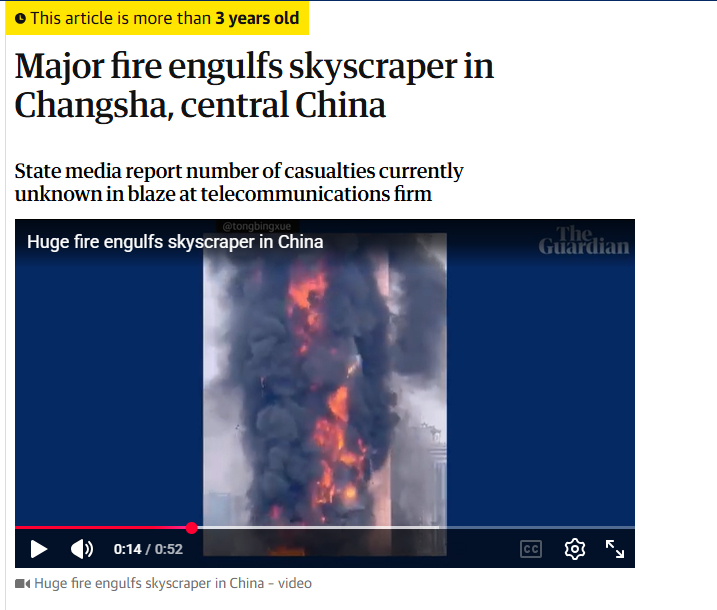
According to The Guardian report, the 42-storey, 218-metre-high building was constructed in 2000 and is located near a major ring road. The report also confirmed that there were no reported fatalities in the incident.
Conclusion
The research clearly found that the viral video does not show an Israeli or U.S. attack on Iran’s IRGC headquarters. The footage is from a massive fire that broke out in a skyscraper in Changsha, China, in 2022. Therefore, the claim being circulated on social media is false and misleading.

Executive Summary
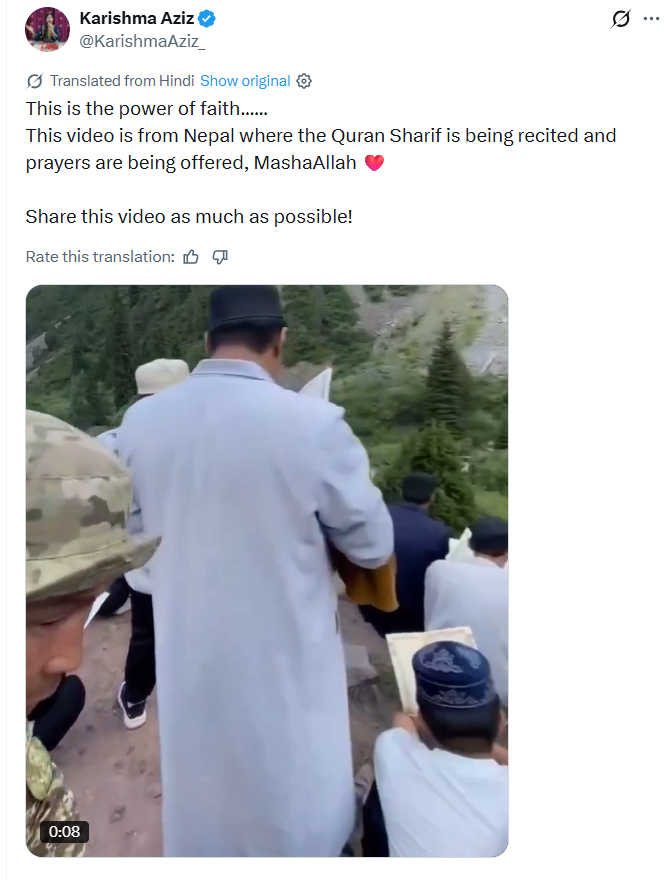
A video is being shared on social media with the claim that the Quran is being recited in Nepal to seek protection from floods. Research by the CyberPeace Research Wing found that the video is actually from Kyrgyzstan, a Central Asian country, and dates back to June. It shows people praying for the safety of a six-year-old boy who had been swept away by floodwaters.
Claim:
The video is being shared on X with a caption making the viral claim. It reads, “This is the power of faith. This video is from Nepal, where the Holy Quran is being recited and prayers are being offered. Mashallah.”
https://x.com/KarishmaAziz_/status/2095053199531286855
Fact Check
During our research into the viral video claiming that the Quran is being recited in Nepal to seek protection from floods, a reverse image search using keyframes led us to the same video uploaded on an Instagram account on June 25.
https://www.instagram.com/reels/DaAtnyUN4WP/

We translated the bio of the said Instagram account and found that it is associated with the Press Department of the Ministry of Emergency Situations in Kyrgyzstan’s Chuy Region. We also found several videos uploaded on the account featuring uniformed personnel wearing the same attire as those seen in the viral video.

The life jackets worn by the uniformed personnel in these videos also clearly bear the words “Kyrgyzstan Rescue.”

During our research, we also found several Instagram posts published on June 25 featuring visuals similar to those in the viral video. The captions stated that Hafizs were reciting the Quran and offering prayers for the safety of a six-year-old boy during his rescue operation.
https://www.instagram.com/reels/DaBK3nYtfDf/https://www.instagram.com/reels/DaBK3nYtfDf/
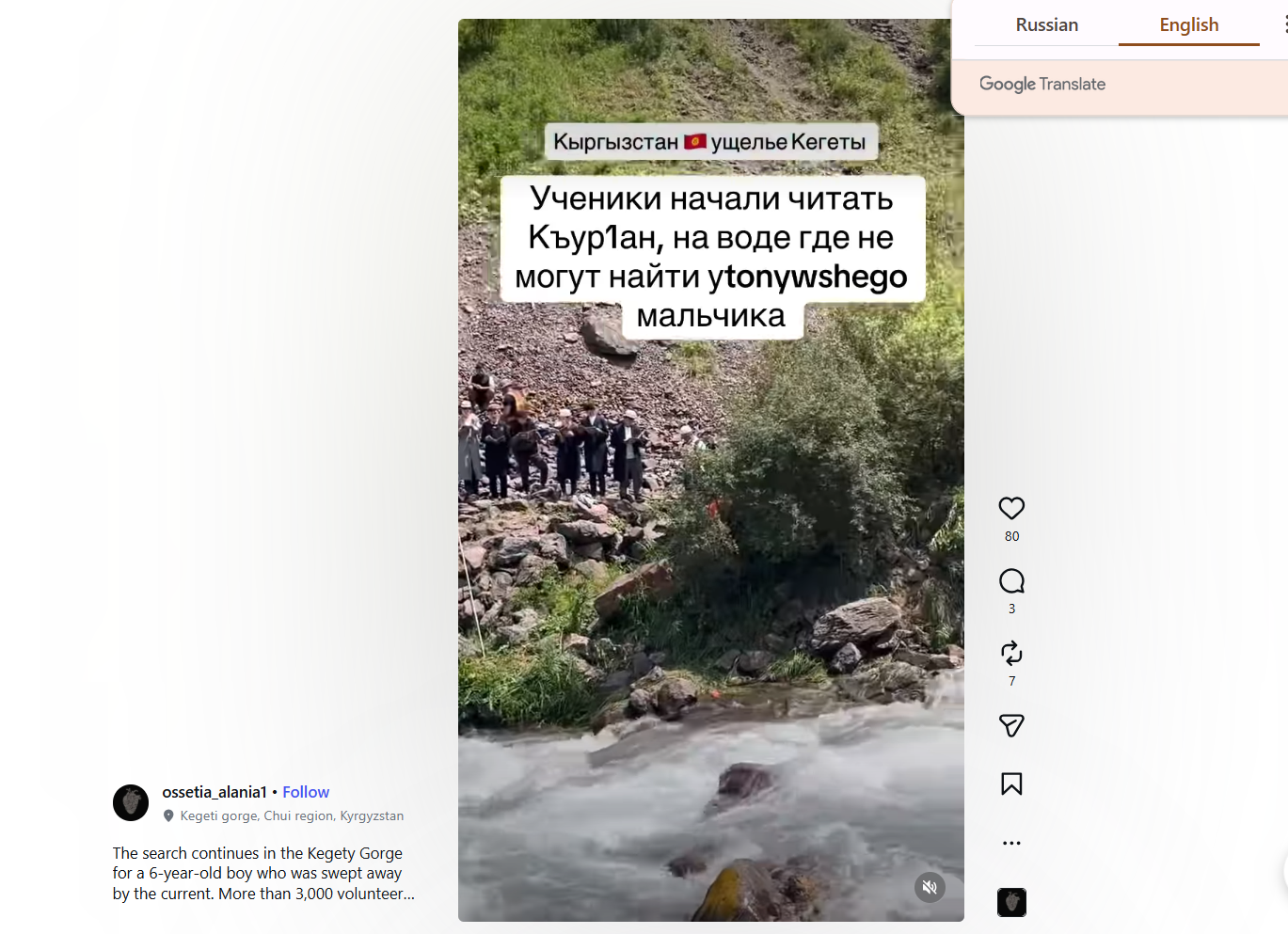
In this regard, we also found a report published on June 26 by a Kyrgyz news website. The report stated that on June 23, a car carrying two women and five children fell into the Kegety River. The two women and three children managed to get out of the vehicle, but two children remained trapped inside. The body of a 12-year-old girl had already been recovered by the rescue team. Later, on June 26, the body of the other child was also recovered.

Conclusion
Our research found that the viral claim is false. The video being shared with the claim that the Quran was being recited in Nepal to seek protection from floods is actually from Kyrgyzstan and dates back to June. The evidence gathered during our research, including the original social media posts and reports from Kyrgyzstan, confirms that the footage is related to a rescue operation involving children after a car fell into the Kegety River. Therefore, the viral video has no connection with the recent floods in Nepal and is being shared with a false claim.
