
#FactCheck: AI-Generated Video Falsely Shared as Charkhi Dadri Firing Footage
Executive Summary
A video showing a black Scorpio being sprayed with bullets is being widely shared on social media.The video is being circulated with the claim that it shows the real footage of the firing incident in Haryana’s Charkhi Dadri on August 6, when around 30 rounds were allegedly fired at a Scorpio outside the City Police Station. The CyberPeace Research Wing found the claim to be false. The research established that the viral video is AI-generated and is being shared with a misleading claim.
Claim
A Facebook user shared the viral video with a caption stating, "Gunshots ring out in Haryana… panic grips the area! A firing incident reportedly took place in Charkhi Dadri, Haryana, during an alleged dispute between two groups on Thursday. According to reports, six people were injured, with two said to be in critical condition. Police are investigating the matter. What steps should be taken to prevent such incidents in your city?"
https://www.facebook.com/reel/991406893937983

FactCheck
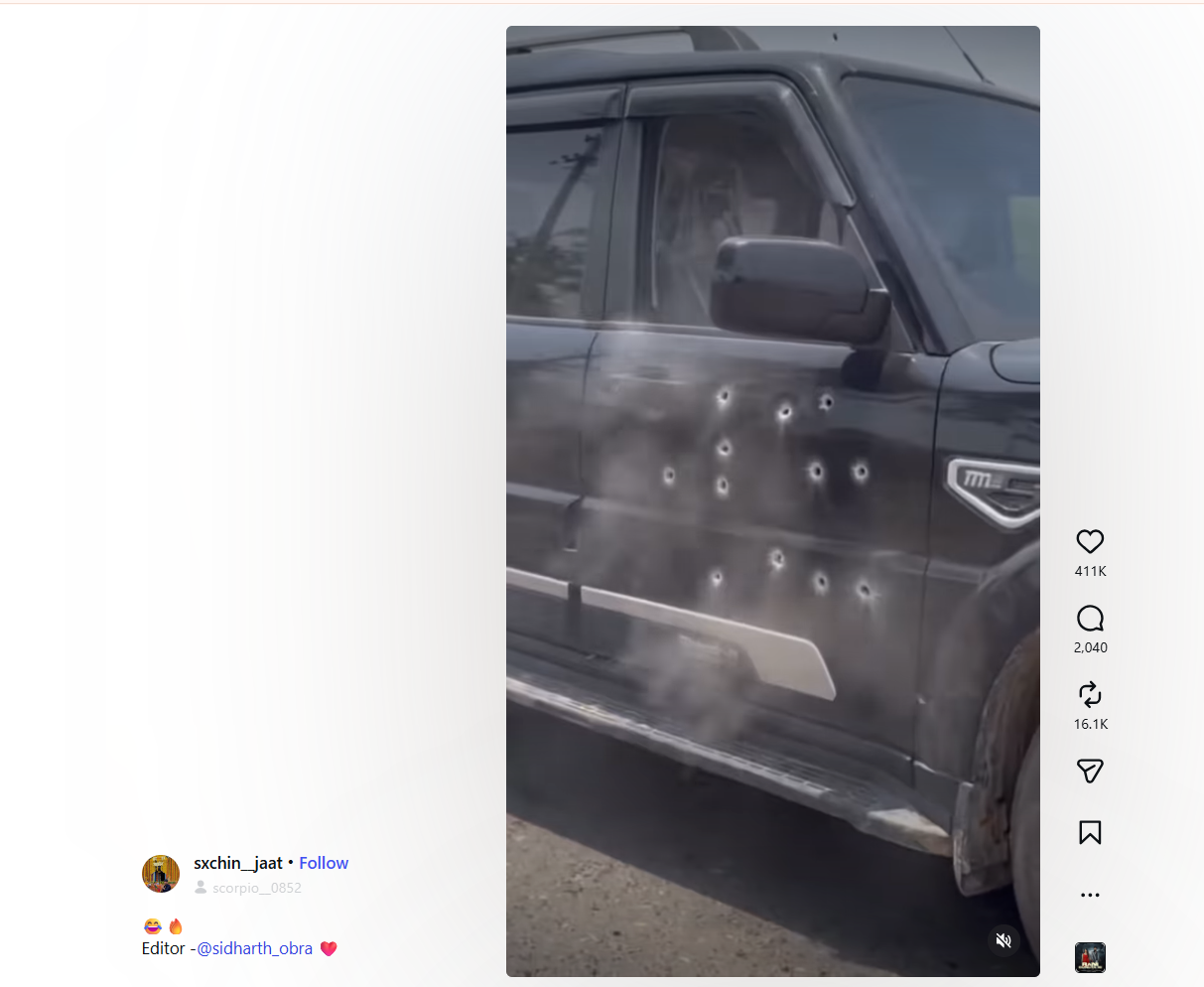
To verify the claim, we extracted keyframes from the viral clip and conducted a reverse image search. During the search, we found an older post containing the same video on an Instagram account named ‘sxchin_jaat’. The video was uploaded on May 12, well before the Charkhi Dadri firing incident of August 6.
The earlier upload establishes that the viral clip is unrelated to the firing incident in Charkhi Dadri.
https://www.instagram.com/reels/DYOOXiASH4h/
We then examined the viral video closely and noticed visual characteristics that raised suspicions that it could be AI-generated. The video was subsequently analysed using Hive Moderation, which indicated a 96 per cent probability of AI-generated content.
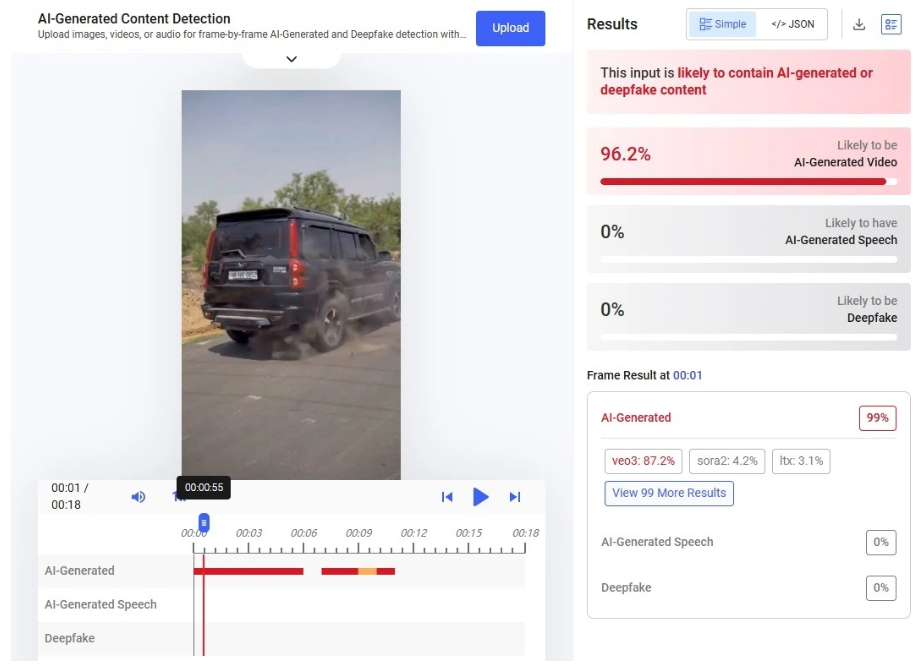
As part of the next stage of verification, we analysed the video using another AI detection tool, Undetectable AI. The tool also identified the viral video as AI-generated.

Conclusion
The viral claim is false. The video being shared as authentic footage of the August 6 firing incident in Charkhi Dadri is not genuine. The clip was posted online as early as May 12 and AI detection tools also identified it as AI-generated. The video is therefore being circulated with a misleading claim linking it to the Charkhi Dadri firing incident.

Related Blogs

Executive Summary
Assembly election results for West Bengal, Assam, Kerala, Tamil Nadu and the Union Territory of Puducherry have been declared, with the Bharatiya Janata Party (BJP) set to form the government in West Bengal after defeating the Trinamool Congress (TMC). Amid celebrations and reports of violence in the state, several misleading videos and images are also circulating on social media. One such viral clip shows people waving the Indian tricolour and saffron flags during a street celebration. Social media users are claiming that the video captures people celebrating a political change and BJP’s victory in West Bengal. Research by CyberPeace Research Wing found that the claim is false. The viral video is not from West Bengal but from Prayagraj and actually shows celebrations after India’s victory in the ICC Men's T20 World Cup 2026.
Claim
An X user named “Ashok Shrivastav” shared the video on May 6, 2026, claiming that people in West Bengal were celebrating the departure of Mamata Banerjee and the TMC government. The user further claimed that people were waving only the national flag and saffron flags, not BJP flags.
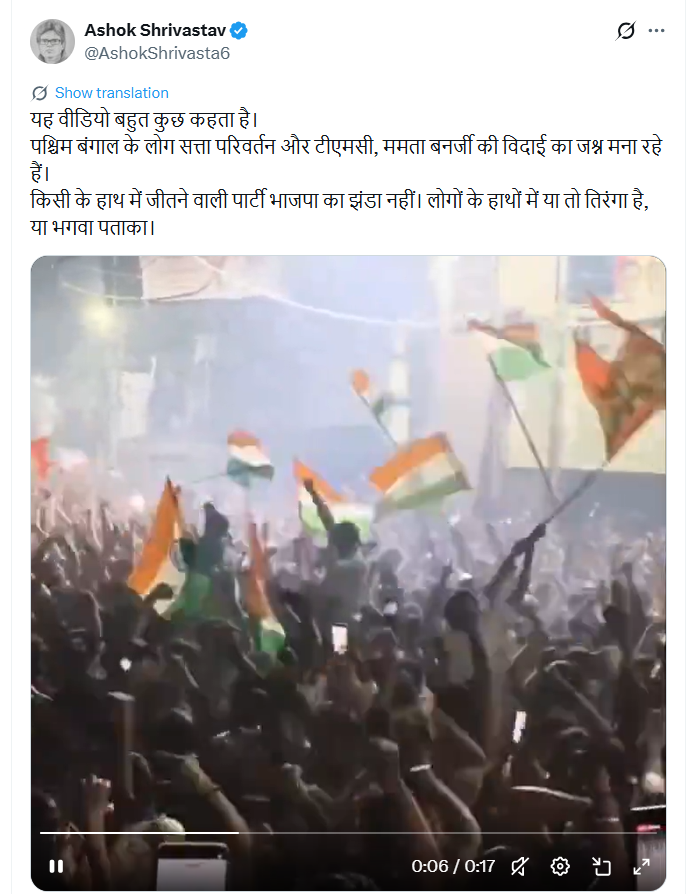
Fact Check
To verify the claim, we extracted several keyframes from the viral video and conducted a reverse image search using Google Lens. The clip was found on multiple social media handles falsely linked to West Bengal.
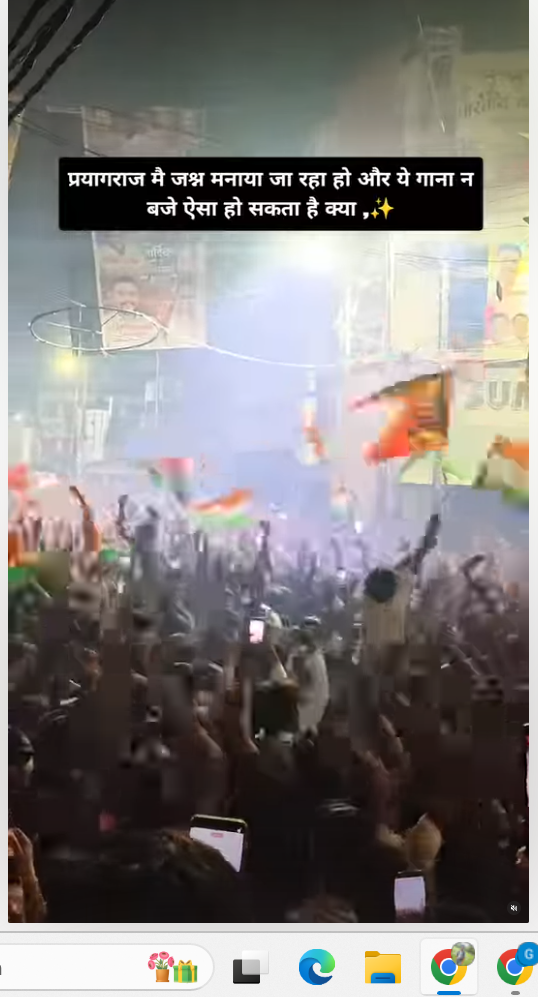
However, the oldest version of the video was uploaded on March 8, 2026, by an Instagram page named “Streets of Sangam.” The caption identified the location as Prayagraj and included hashtags related to the World Cup and Loknath. During the comparison of the viral and original videos, we noticed a shop sign reading “Suman Ornaments.” Using Google Street View, we traced the location to Baba Loknath area in Prayagraj, where the same shop could be identified near Loknath Gate.
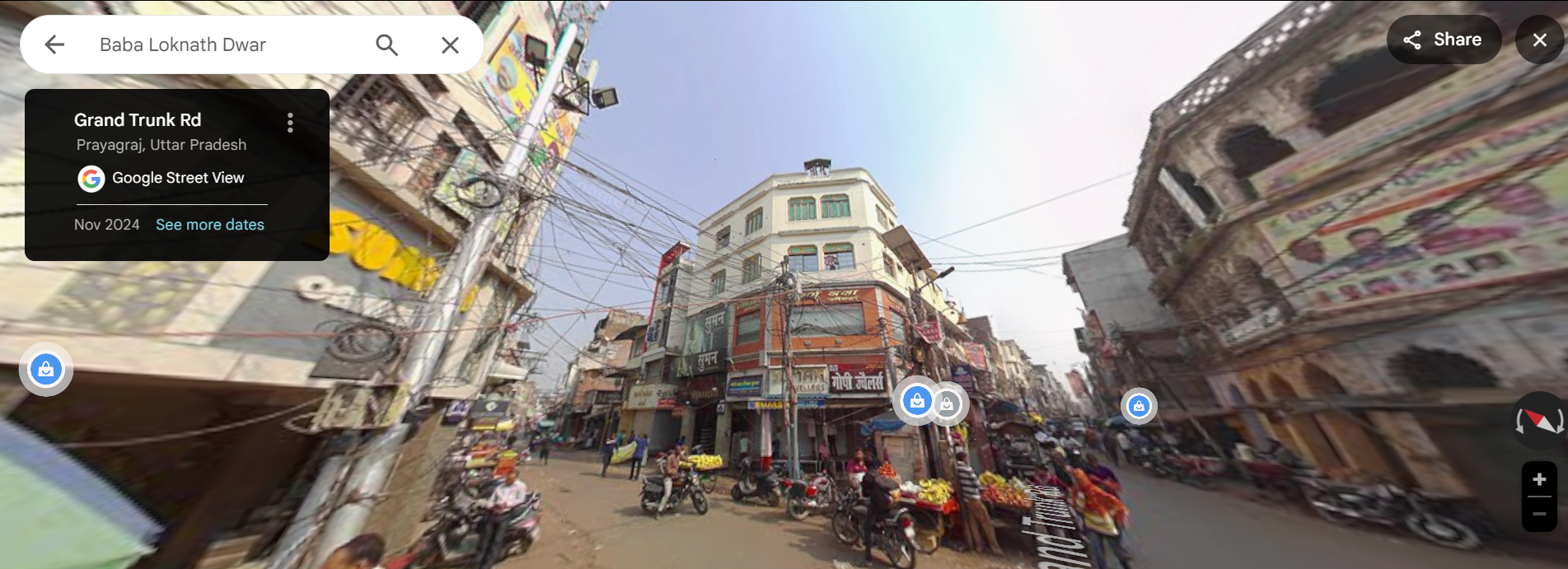
Conclusion
Our research confirms that the viral claim is fake. The video being shared as BJP victory celebrations in West Bengal is actually from Prayagraj, Uttar Pradesh, and dates back to March 2026, when locals celebrated Team India’s T20 World Cup victory. The old clip is now being misleadingly circulated with a false political narrative.

Introduction
The ramifications of cybercrime can be far-reaching. Depending on the size of the attack, even entire countries can be affected if their critical infrastructure is connected to the internet. The vast majority of security breaches start within the perimeter and most internet attacks are socially engineered. Unwittingly trusting any email or web request from an unknown sender creates a potential danger for those organisations that depend on the Internet for their business functions. In this ever-evolving digital downtown yet another group has emerged from its darkest corners of targeting the UK’s very bastion of British and global heritage; a treasure trove of around 14 million volumes, ancient manuscripts, in the precious British Library. A group self-identified as Rhysida. Their bold maneuver, executed with the stealth of seasoned cyber brigands, has cast a shadow as long and dark as those found in the Gothic novels that rest on the library's shelves. The late October cyber-attack has thrust the British Library into an unnerving state of chaos, a situation more commonly aligned with works of dystopian fiction than the everyday reality of a revered institution.
The Modus Operandi
The gang uses all-new Rhysida ransomware to jeopardize Virtual Private Networks, which is typically used by library staff to gain access to their employee’s systems remotely. The Ransomware presents itself as a regular decoy file in a familiar fashion as regular phishing attacks in an email, tricking its victim and downloading itself into the host system. Once the malware enters the system it stays dormant and lurks around the system for a period of time. The new malware has significantly reduced the dwell time from 4 days to less than 24 hours which enables it to evade periodic system checks to avoid detection.
Implications of Cyber Attack
Implications of the cyber-attack have been sobering and multifaceted. The library's systems, which serve as the lifeline for countless scholars, students, and the reading public, were left in disarray, unsettlingly reminiscent of a grand mansion invaded by incorporeal thieves. The violation has reverberated through the digital corridors of this once-impenetrable fortress, and the virtual aftershocks are ongoing. Patrons, who traverse a diverse spectrum of society, but share a common reverence for knowledge, received unsettling news: the possibility that their private data has been compromised—a sanctity breached, revealing yet again how even the most hallowed of spaces are not impervious to modern threats.
It is with no small sense of irony that we consider the nature of the stolen goods—names, email addresses, and the like. It is not the physical tomes of inestimable value that have been ransacked, but rather the digital footprints of those who sought the wisdom within the library's walls. This virtual Pandora's Box, now unleashed onto the dark web, has been tagged with a monetary value. Rhysida has set the ominous asking price of a staggering $740,000 worth of cryptocurrency for the compromised data, flaunting their theft with a hubris that chills the spine.
Yet, in this convoluted narrative unfolds a subplot that offers some measure of consolation. Payment information purports the library has not been included in this digital heist, offering a glint of reassurance amidst the prevailing uncertainty. This digital storm has had seismic repercussions: the library's website and interconnected systems have been besieged and access to the vast resources significantly hampered. The distressing notice of a 'major technology outage' transformed the digital facade from a portal for endless learning to a bulletin of sorrow, projecting the sombre message across virtual space.
The Impact
The impact of this violation will resonate far beyond the mere disruption of services; it signals the dawn of an era where venerable institutions of culture and learning must navigate the depths of cybersecurity. As the library grapples with the breach, a new front has opened in the age-old battle for the preservation of knowledge. The continuity of such an institution in a digitised world will be tested, and the outcome will define the future of digital heritage management. As the institution rallies, led by Roly Keating, its Chief Executive, one observes not a defeatist retreat, but a stoic, strategic regrouping. Gratitude is extended to patrons and partners whose patience has become as vital a resource as the knowledge the library preserves. The reassurances given, while acknowledging the laborious task ahead, signal not just an intention to repair but to fortify, to adapt, to evolve amidst adversity.
This wretched turn of events serves as a portentous reminder that threats to our most sacred spaces have transformed. The digital revolution has indeed democratised knowledge but has also exposed it to neoteric threats. The British Library, a repository of the past, must now confront a distinctly modern adversary. It requires us to posit whether our contemporary guardians of history are equipped to combat those who wield malicious code as their weapons of choice.
Best Practices for Cyber Resilience
It is crucial to keep abreast with recent developments in cyberspace and emerging trends. Libraries in the digital age must ensure the protection of their patron’s data by applying comprehensive security protocols to safeguard the integrity, availability and confidentiality of sensitive information of their patrons. A few measures that can be applied by libraries include.
- Secured Wi-Fi networks: Libraries offering public Wi-Fi facilities must secure them with strong encryption protocols such as WPA 3. Libraries should establish separate networks for internal operations allowing separation of staff and public networks to protect sensitive information.
- Staff Training Programs: To avoid human error it is imperative that comprehensive training programs are conducted on a regular basis to generate greater awareness of cyber threats among staff and educate them about best practices of cyber hygiene and data security.
- Data Backups and Recovery Protocols: Patrons' sensitive data should be updated and backed up regularly. Proper verification of the user’s data integrity is crucial and should be stored securely in a dedicated repository to ensure full recovery of the user’s data in the event of a breach.
- Strong Authentication: Strong authentication to enhance library defenses is crucial to combat cyber threats. Staff and Patrons should be educated on strong password usage and the implementation of Multi-Factor Authentication to add an extra layer of security.
Conclusion
Finally, whatever the future holds, what remains unassailable is the cultural edifice that is the British Library. Its trials and tribulations, like those of the volumes it safeguards, become a part of a larger narrative of endurance and defiance. In the canon of history—filled with conflicts and resolutions—the library, like the lighter anecdotes and tragic tales it harbours, will decidedly hold its place. And perhaps, with some assurance, we might glean from the sentiment voiced by Milton—an assurance that the path from turmoil to enlightenment, though fraught with strenuous challenges, is paved with lessons learned and resilience rediscovered. Cyberspace is constantly evolving hence it is in our best interest to keep abreast of all developments in this digital sphere. Maximum threats can be avoided if we are vigilant.
References:

Executive Summary:
A video purporting to be from Lal Chowk in Srinagar, which features Lord Ram's hologram on a clock tower, has gone popular on the internet. The footage is from Dehradun, Uttarakhand, not Jammu and Kashmir, the CyberPeace Research Team discovered.
Claims:
A Viral 48-second clip is getting shared over the Internet mostly in X and Facebook, The Video shows a car passing by the clock tower with the picture of Lord Ram. A screen showcasing songs about Lord Ram is shown when the car goes forward and to the side of the road.

The Claim is that the Video is from Kashmir, Srinagar

Similar Post:

Fact Check:
The CyberPeace Research team found that the Information is false. Firstly we did some keyword search relating to the Caption and found that the Clock Tower in Srinagar is not similar to the Video.

We found an article by NDTV mentioning Srinagar Lal Chowk’s Clock Tower, It's the only Clock Tower in the Middle of Road. We are somewhat confirmed that the Video is not From Srinagar. We then ran a reverse image search of the Video by breaking down into frames.
We found another Video that visualizes a similar structure tower in Dehradun.

Taking a cue from this we then Searched for the Tower in Dehradun and tried to see if it matches with the Video, and yes it’s confirmed that the Tower is a Clock Tower in Paltan Bazar, Dehradun and the Video is actually From Dehradun but not from Srinagar.
Conclusion:
After a thorough Fact Check Investigation of the Video and the originality of the Video, we found that the Visualisation of Lord Ram in the Clock Tower is not from Srinagar but from Dehradun. Internet users who claim the Visual of Lord Ram from Srinagar is totally Baseless and Misinformation.
- Claim: The Hologram of Lord Ram on the Clock Tower of Lal Chowk, Srinagar
- Claimed on: Facebook, X
- Fact Check: Fake
