
#FactCheck -Viral Video of Israeli Strike in Lebanon Misrepresented as Iranian Attack on US Base in Kuwait
Executive Summary
Amid heightened tensions in West Asia following the conflict involving the United States, Israel and Iran, a video showing a large explosion behind a building is being widely shared on social media.
Users claim that the footage shows an Iranian missile strike on a US military base in Kuwait. However, CyberPeace Research Wing research found the claim to be misleading. The viral video is actually from an Israeli airstrike in southern Lebanon. While Kuwait said its air defence systems intercepted missiles and drones during regional hostilities, the viral footage has no connection to any alleged attack on a US base in Kuwait.
Claim
An Instagram user, “indiscope24hr,” shared the video on May 28, 2026, with text overlaid on the clip stating:“Iran launches a deadly missile attack on a US base in Kuwait.”The caption claimed that Iran targeted a US airbase in retaliation for American military action and that Kuwait’s air defence systems were intercepting incoming missiles and drones.

Fact Check
To verify the claim, we extracted key frames from the viral video and conducted a reverse image search using Google Lens. This led us to a post shared on May 28, 2026, by the Instagram account “iltv_israel,” which identified the footage as an Israeli Air Force strike on a Hezbollah target in the southern Lebanese city of Tyre.

Further research found the same footage in a video report uploaded by the New York Post’s YouTube channel on May 28, 2026. According to the report, Israel carried out strikes targeting Hezbollah positions in Tyre, southern Lebanon.

We also found the clip in a video report published by NBC News. The report stated that Israel intensified strikes in southern Lebanon despite an existing ceasefire agreement.
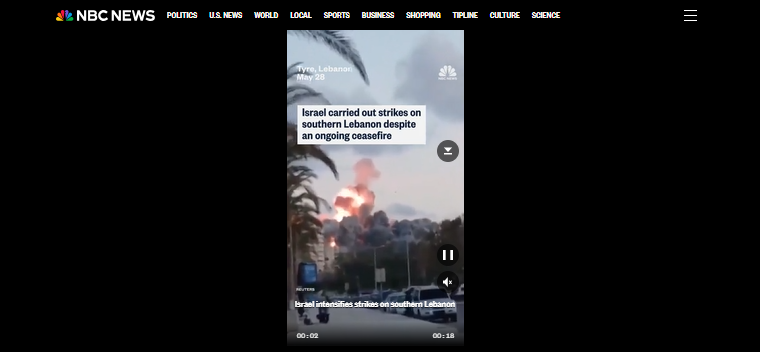

The matching visuals across these reports confirm that the viral footage originated from Lebanon and not from Kuwait.
Conclusion
The viral claim is misleading. The video does not show an Iranian missile strike on a US military base in Kuwait. It actually depicts an Israeli airstrike carried out in the Lebanese city of Tyre on May 28, 2026, and is being shared with a false context on social media.

Related Blogs

Executive Summary:
A photoshopped image circulating online suggests Prime Minister Narendra Modi met with militant leader Hafiz Saeed. The actual photograph features PM Modi greeting former Pakistani Prime Minister Nawaz Sharif during a surprise diplomatic stopover in Lahore on December 25, 2015.
The Claim:
A widely shared image on social media purportedly shows PM Modi meeting Hafiz Saeed, a declared terrorist. The claim implies Modi is hostile towards India or aligned with terrorists.

Fact Check:
On our research and reverse image search we found that the Press Information Bureau (PIB) had tweeted about the visit on 25 December 2015, noting that PM Narendra Modi was warmly welcomed by then-Pakistani PM Nawaz Sharif in Lahore. The tweet included several images from various angles of the original meeting between Modi and Sharif. On the same day, PM Modi also posted a tweet stating he had spoken with Nawaz Sharif and extended birthday wishes. Additionally, no credible reports of any meeting between Modi and Hafiz Saeed, further validating that the viral image is digitally altered.


In our further research we found an identical photo, with former Pakistan Prime Minister Nawaz Sharif in place of Hafiz Saeed. This post was shared by Hindustan Times on X on 26 December 2015, pointing to the possibility that the viral image has been manipulated.
Conclusion:
The viral image claiming to show PM Modi with Hafiz Saeed is digitally manipulated. A reverse image search and official posts from the PIB and PM Modi confirm the original photo was taken during Modi’s visit to Lahore in December 2015, where he met Nawaz Sharif. No credible source supports any meeting between Modi and Hafiz Saeed, clearly proving the image is fake.
- Claim: Debunking the Edited Image Claim of PM Modi with Hafiz Saeed
- Claimed On: Social Media
- Fact Check: False and Misleading
.webp)
In what is being stated by experts to be one of the largest data breaches of all time, approximately 16 billion passwords were exposed online last week. According to various news reports, the leak contains credentials spanning a broad array of online services, including Facebook, Instagram, Gmail, etc., creating a serious alarm across the globe. Cybersecurity specialists have noted that this leak poses immense risks of account takeovers, identity theft, and enabling phishing scams. The leaked data is being described as a “collection-of-collections,” with multiple previously breached databases compiled into one easy-to-access repository for cybercriminals.
Infostealer Malware and Why It’s a Serious Threat
This incident brought to light a type of malware that experts refer to as the Infostealer. Just as the name suggests, this is a malware program made expressly to take personal information from compromised computers and devices, including cookies, session tokens, browser data, login credentials, and more. It targets high-value credentials, as opposed to ransomware, which encrypts files for ransom, or spyware that passively watches users. Once installed, they silently gather passwords, screenshots, and other information while hiding inside unassuming software, such as a game, utility, or browser plugin. Once stolen, these credentials are then combined by hackers to create databases, which are then offered for sale on dark web forums or even made public, as was the case in this breach. This is particularly risky since, if session tokens or other browser data are also taken, these credentials can be used to get around even two-factor authentication. As a result, the leak would also enable the rise of other crimes such as phishing.
Guidelines for protection
In response to this breach, India’s Computer Emergency Response Team (CERT-IN) issued an advisory, urging all internet users to take immediate action to protect their accounts. Although this is in response to the specific data leak, these are some key measures advised to be followed to maintain a general standard of cyber hygiene at all times.
- Reset your passwords: In case of incidents such as the above, users are advised to change the passwords of their accounts immediately. More so of the ones that have been compromised and need to be prioritised, such as email, online banking, and social media etc.
- Use strong, unique passwords and password manager features: Avoid password reuse across platforms. Using a password manager on a trusted platform can aid in storing and recalling them for different accounts.
- Monitor account activity: Check activity logs, especially for signs of unrecognised login attempts or password-reset notifications.
- Enable Multi-Factor Authentication (MFA): The user is advised to enable two-step verification (via an app like Google Authenticator or a hardware key), which will add an extra security layer.
- Phishing attacks: Cybercriminals will likely attempt to use leaked credentials to impersonate legitimate companies and send phishing emails. Read carefully before clicking on any links or attachments received.
- Scan devices for malware: Run updated antivirus or anti-malware scans to catch and remove infostealers or other malicious software lurking on your device.
Why This Data Breach is a Wake-Up Call
With 16 billion credentials exposed, this breach highlights the critical need for robust personal cybersecurity hygiene. It also reveals the persistent role of infostealer malware in feeding a global cybercrime economy, one where credentials are the most valuable assets. As Infosecurity Europe and other analysts highlight, infostealers are lightweight, often distributed via phishing or malicious downloads, and are highly effective at lifting data in the background without alerting the user. Even up-to-date antivirus software can struggle to catch new variants, making proactive security practices with respect to such malware all the more essential. In a time where data is everything, access to credentials can derive power and safety, regarding it must be kept in check.
Conclusion
This breach is a reminder that cybersecurity is a shared responsibility. Even with protective systems in place with respect to the industries and official authorities, every internet user must do their part in protecting themselves through cyber hygiene practices such as resetting passwords, using multi-factor authentication, staying vigilant against phishing scams, and ensuring devices are regularly scanned for malware. While breaches like this can seem overwhelming and might create a surge of panic, practical measures go a long way in mitigating exposure. Staying informed and proactive is the best defence one can adopt in a rapidly evolving threat landscape.
References
- https://economictimes.indiatimes.com/news/international/us/16-billion-passwords-exposed-in-unprecedented-cyber-leak-of-2025-experts-raise-global-alarm/articleshow/121961165.cms?from=mdr
- https://timesofindia.indiatimes.com/technology/tech-news/16-billion-passwords-leaked-on-internet-what-you-need-to-know-to-protect-your-facebook-instagram-gmail-and-other-accounts/articleshow/121967191.cms
- https://indianexpress.com/article/technology/tech-news-technology/16-billion-passwords-leaked-online-what-we-know-10077546/
- https://indianexpress.com/article/technology/tech-news-technology/16-billion-passwords-leaked-online-what-we-know-10077546/
- https://www.hindustantimes.com/business/certin-issues-advisory-after-data-breach-of-16-billion-credentials-asks-people-to-change-passwords-101750779940872.html
- https://www.cert-in.org.in/s2cMainServlet?pageid=PUBVLNOTES02&VLCODE=CIAD-2025-0024
- https://www.infosecurityeurope.com/en-gb/blog/threat-vectors/guide-infostealer-malware.html

Executive Summary:
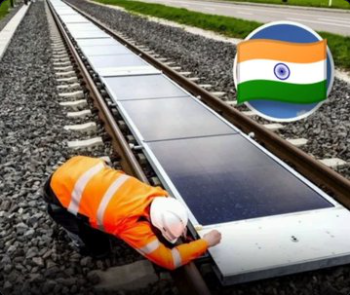
Social media has been overwhelmed by a viral post that claims Indian Railways is beginning to install solar panels directly on railway tracks all over the country for renewable energy purposes. The claim also purports that India will become the world's first country to undertake such a green effort in railway systems. Our research involved extensive reverse image searching, keyword analysis, government website searches, and global media verification. We found the claim to be completely false. The viral photos and information are all incorrectly credited to India. The images are actually from a pilot project by a Swiss start-up called Sun-Ways.
Claim:
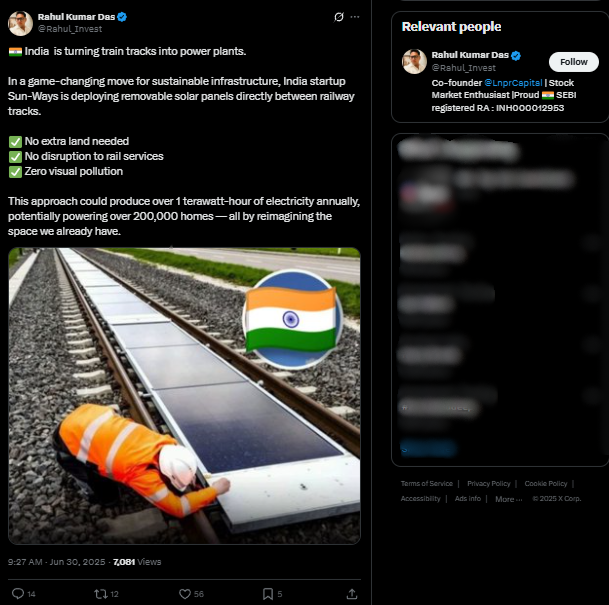
According to a viral post on social media, Indian Railways has started an all-India initiative to install solar panels directly on railway tracks to generate renewable energy, limit power expenses, and make global history in environmentally sustainable rail operations.
Fact check:
We did a reverse image search of the viral image and were soon directed to international media and technology blogs referencing a project named Sun-Ways, based in Switzerland. The images circulated on Indian social media were the exact ones from the Sun-Ways pilot project, whereby a removable system of solar panels is being installed between railway tracks in Switzerland to evaluate the possibility of generating energy from rail infrastructure.

We also thoroughly searched all the official Indian Railways websites, the Ministry of Railways news article, and credible Indian media. At no point did we locate anything mentioning Indian Railways engaging or planning something similar by installing solar panels on railway tracks themselves.
Indian Railways has been engaged in green energy initiatives beyond just solar panel installation on program rooftops, and also on railway land alongside tracks and on train coach roofs. However, Indian Railways have never installed solar panels on railway tracks in India. Meanwhile, we found a report of solar panel installations on the train launched on 14th July 2025, first solar-powered DEMU (diesel electrical multiple unit) train from the Safdarjung railway station in Delhi. The train will run from Sarai Rohilla in Delhi to Farukh Nagar in Haryana. A total of 16 solar panels, each producing 300 Wp, are fitted in six coaches.


We also found multiple links to support our claim from various media links: Euro News, World Economy Forum, Institute of Mechanical Engineering, and NDTV.

Conclusion:
After extensive research conducted through several phases including examining facts and some technical facts, we can conclude that the claim that Indian Railways has installed solar panels on railway tracks is false. The concept and images originate from Sun-Ways, a Swiss company that was testing this concept in Switzerland, not India.
Indian Railways continues to use renewable energy in a number of forms but has not put any solar panels on railway tracks. We want to highlight how important it is to fact-check viral content and other unverified content.
- Claim: India’s solar track project will help Indian Railways run entirely on renewable energy.
- Claimed On: Social Media
- Fact Check: False and Misleading
