
#FactCheck- AI-Generated Image of Narendra Modi Goes Viral Ahead of Kerala Elections
Executive Summary
As Kerala gears up for its upcoming Assembly elections, political activity has intensified across the state. Amid this charged atmosphere, a purported image of Narendra Modi has gone viral on social media. The image shows the Prime Minister holding coconuts, with several photographers around him. It is being claimed that the photo was taken during his recent visit for the 2026 Kerala Assembly election campaign.
However, an research by the CyberPeace has debunked the claim, confirming that the image is fake and generated using artificial intelligence.
Claim
A Facebook user named “Javed Ahmad” shared the viral image on April 6, 2026, with a sarcastic caption suggesting that the Prime Minister was posing for reels during his Kerala visit.
- https://www.facebook.com/Ahmadspeaks4u/posts/pfbid0aRnhwXBjnfSXF9S48vaH1gTQrGQmxnRmhpJCRxMWazqLJhYs6zxM9rot51qtBgRLl
- https://perma.cc/N3AM-Q2YC

Fact Check
To verify the claim, we conducted keyword searches on Google but found no credible news reports supporting it. A reverse image search also did not yield any reliable sources. Additionally, a thorough review of the Prime Minister’s official social media accounts showed no trace of such an image or event. Given these inconsistencies, suspicion arose about the image’s authenticity.
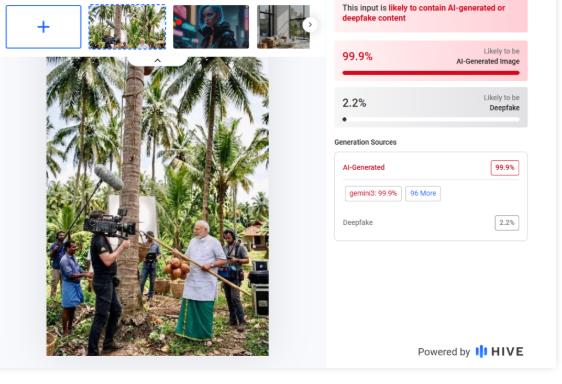
The viral image was then analyzed using AI detection tools. Results from HIVE Moderation indicated a 99% probability that the image is AI-generated.
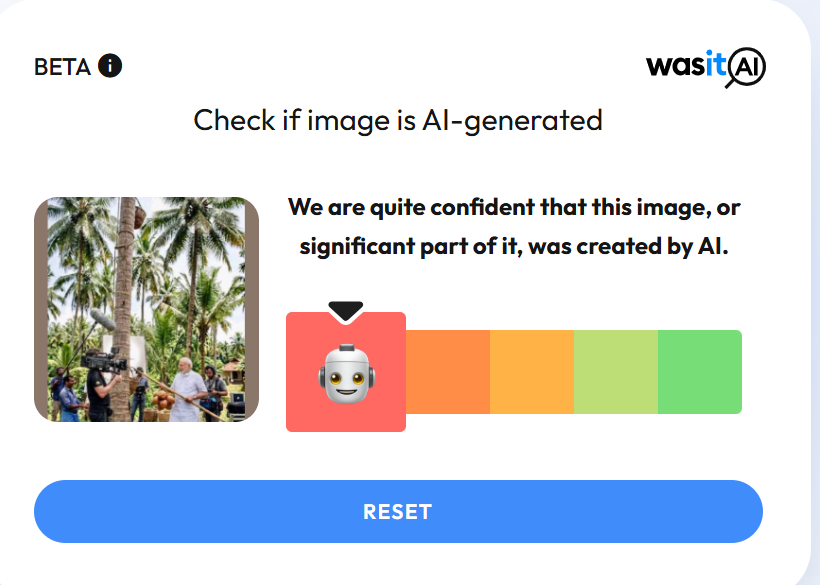
Another tool, Wasit AI, also confirmed that the image is artificially created.
Conclusion
The claim is false. The viral image of Prime Minister Narendra Modi is not real and has been generated using AI tools, likely similar to Google AI.

Related Blogs

Executive Summary
Several social media posts are claiming that Chinese troops have entered nearly 60 kilometres inside Arunachal Pradesh. Amid these claims, a video showing security personnel managing a large crowd is being widely circulated as footage from Arunachal Pradesh. Users are sharing the clip claiming it captures the situation following the alleged Chinese intrusion. CyberPeace Research Wing found the claim to be false. The viral video is not from Arunachal Pradesh. It actually shows Baltal Base Camp during the Amarnath Yatra in Jammu and Kashmir. The Government of India has also categorically denied reports of any recent Chinese intrusion into Indian territory.
Claim
A Facebook user, "Komal Vanshi," shared the video on July 8, 2026, claiming that Chinese People's Liberation Army (PLA) soldiers had entered deep inside Arunachal Pradesh and referring to alleged incidents along the Line of Actual Control (LAC). The post was accompanied by the viral video, suggesting it was related to the alleged intrusion.
https://www.facebook.com/reel/1585091393251089

Fact Check
We first carefully examined the viral video. During the analysis, we noticed barricades bearing the words "Jammu & Kashmir Police." This clearly indicated that the footage could not have been recorded in Arunachal Pradesh.

In the next step, we extracted multiple keyframes from the video and conducted a reverse image search using Google Lens. Although the video was widely shared with the Arunachal Pradesh claim, our search led us to a YouTube Shorts video uploaded on July 7, 2026, identifying the location as Baltal, one of the main base camps for the annual Amarnath Yatra in Jammu and Kashmir.
https://www.youtube.com/watch?v=EEfP2RckyJM

The visual details in the YouTube video matched the viral footage, confirming that it was filmed at Baltal Base Camp and had no connection with Arunachal Pradesh or any alleged Chinese military movement
Conclusion
CyberPeace Research Wing found that the viral claim is false. The video being circulated as evidence of a Chinese military incursion into Arunachal Pradesh actually shows crowd management arrangements at Baltal Base Camp during the Amarnath Yatra in Jammu and Kashmir. The footage has been falsely linked to an unrelated claim about Chinese troops entering Indian territory. There is no evidence that the video depicts any incident related to the India-China border.
Introduction
The ongoing debate on whether AI scaling has hit a wall has been rehashed by the underwhelming response to OpenAI’s ChatGPT v5. AI scaling laws, which describe that machine learning models perform better with increased training data, model parameters and computational resources, have guided the rapid progress of Large Language Models (LLMs) so far. But many AI researchers suggest that further improvements in LLMs will have to be effected through large computational costs by orders of magnitude, which does not justify the returns. The question, then, is whether scaling remains a viable path or whether the field must explore new approaches. This is not just a tech issue but a profound innovation challenge for countries like India, charting their own AI course.
The Scaling Wall: Gaps and Innovation Opportunities
Escalating costs, data scarcity, and diminishing gains mean that simply building larger AI models may no longer guarantee breakthroughs. In such a scenario, LLM developers will have to refine new approaches to training these models, for example, by diversifying data types and redefining training techniques.
This global challenge has a bearing on India’s AI ambitions. For India, where compute and data resources are relatively scarce, this scaling slowdown poses both a challenge and an opportunity. While the India AI Mission embodies smart priorities such as democratising compute resources and developing local datasets, looming scaling challenges could prove a roadblock. Realising these ambitions requires strong input from research and academia, and improved coordination between policymakers and startups. The scaling wall highlights systemic innovation gaps where sustained support is needed, not only in hardware but also in talent development, safety research, and efficient model design.
Way Forward
To truly harness AI’s transformative power, India must prioritise policy actions and ecosystem shifts that support smarter, safer, and context-rich research through the following measures:
- Driving Efficiency and Compute Innovation: Instead of relying on brute-force scaling, India should invest in research and startups working on efficient architectures, energy-conscious training methods, and compute optimisation.
- Investing in Multimodal and Diverse Data: While indigenous datasets are being developed under the India AI Mission through AI Kosha, they must be ethically sourced from speech, images, video, sensor data, and regional content, apart from text, to enable context-rich AI models truly tailored to Indian needs.
- Addressing Core Problems for Trustworthy AI: LLMs offered by all major companies, like OpenAI, Grok, and Deepseek, have the problem of unreliability, hallucinations, and biases, since they are primarily built on scaling large datasets and parameters, which have inherent limitations. India should invest in capabilities to solve these issues and design more trustworthy LLMs.
- Supporting Talent Development and Training: Despite its substantial AI talent pool, India faces an impending demand-supply gap. It will need to launch national programs and incentives to upskill engineers, researchers, and students in advanced AI skills such as model efficiency, safety, interpretability, and new training paradigms
Conclusion
The AI scaling wall debate is a reminder that the future of LLMs will depend not on ever-larger models but on smarter, safer, and more sustainable innovation. A new generation of AI is approaching us, and India can help shape its future. The country’s AI Mission and startup ecosystem are well-positioned to lead this shift by focusing on localised needs, efficient technologies, and inclusive growth, if implemented effectively. How India approaches this new set of challenges and translates its ambitions into action, however, remains to be seen.
References
- https://blogs.nvidia.com/blog/ai-scaling-laws/
- https://www.marketingaiinstitute.com/blog/scaling-laws-ai-wall
- https://fortune.com/2025/02/19/generative-ai-scaling-agi-deep-learning/
- https://indiaai.gov.in/
- https://www.deloitte.com/in/en/about/press-room/bridging-the-ai-talent-gap-to-boost-indias-tech-and-economic-impact-deloitte-nasscom-report.html

Introduction:
The G7 Summit is an international forum that includes member states from France, the United States, the United Kingdom, Germany, Japan, Italy, Canada and the European Union (EU). The annual G7 meeting that is held every year was hosted by Japan this year in May 2023. It took place in Hiroshima. Artificial Intelligence (AI) was the major theme of this G7 summit. Key takeaways from this G7 summit highlight that leaders together focused on escalating the adoption of AI for beneficial use cases across the economy and the government and improving the governing structure to mitigate the potential risks of AI.
Need for fair and responsible use of AI:
The G7 recognises that they really need to work together to ensure the responsible and fair use of AI to help establish technical standards for the same. Members of the G7 countries agreed to adopt an open and enabling environment for the development of AI technologies. They also emphasized that AI regulations should be based on democratic values. G7 summit calls for the responsible use of AI. The ministers discussed the risks involved in AI technology programs like ChatGPT. They came up with an action plan for promoting responsible use of AI with human beings leading the efforts.
Further Ministers from the Group of Seven (G7) countries (Canada, France, Germany, Italy, Japan, the UK, the US, and the EU) met virtually on 7 September 2023 and committed to creating ‘international guiding principles applicable for all AI actors’, and a code of conduct for organisations developing ‘advanced’ AI systems.
What is HAP (Hiroshima AI Process)
Hiroshima AI Process (HAP) aims to establish trustworthy AI technical standards at the international level. The G7 agreed on creating a ministerial forum to prompt the fair use of AI. Hiroshima AI Process (HAP) is an effort by G7 to determine a way forward to regulate AI. The HAP establishes a forum for international discussions on inclusive AI governance and interoperability to achieve a common vision and goal of trustworthy AI at the global level.
The HAP will be operating in close connection with organisations including the Organisation for Economic Co-operation and Development (OECD) and the Global Partnership on AI (GPAI).
This Hiroshima AI Process (HAP) initiated at the Annual G7 Summit held in Hiroshima, Japan is a significant step towards regulating AI and the Hiroshima AI Process (HAP) is likely to conclude by December 2023.
G7 leaders emphasized fostering an environment where trustworthy AI systems are designed, developed and deployed for the common good worldwide. They advocated for international standards and interoperable tools for trustworthy AI that enable Innovation by creating a comprehensive policy framework, including overall guiding principles for all AI actors in the AI ecosystem.
Stressing upon fair use of advanced technologies:
The impact and misuse of generative AI was also discussed by the G7 leaders. The G7 members also stressed misinformation and disinformation in the realm of generative AI models. As they are capable of creating synthetic content such as deepfakes. In particular, they noted that the next generation of interactive generative media will leverage targeted influence content that is highly personalized, localized, and conversational.
In the digital landscape, there is a rapid advancement of technologies such as generative
Artificial Intelligence (AI), deepfake, machine learning, etc. Such technologies offer convenience to users in performing several tasks and are capable of assisting individuals and business entities. Since these technologies are easily accessible, cyber-criminals leverage AI tools and technologies for malicious activities, hence certain regulatory mechanisms at the global level will ensure and advocate for the ethical, reasonable and fair use of such advanced technologies.
Conclusion:
The G7 summit held in May 2023 focused on advanced international discussions on inclusive AI governance and interoperability to achieve a common vision and goal of trustworthy AI, in line with shared democratic values. AI governance has become a global issue, countries around the world are coming forward and advocating for the responsible and fair use of AI and influence on global AI governance and standards. It is significant to establish a regulatory framework that defines AI capabilities and identifies areas prone to misuse. And set forth reasonable technical standards while also fostering innovations. Hence overall prioritizing data privacy, integrity, and security in the evolving nature of advanced technologies.
References:
- https://www.politico.eu/wp-content/uploads/2023/09/07/3e39b82d-464d-403a-b6cb-dc0e1bdec642-230906_Ministerial-clean-Draft-Hiroshima-Ministers-Statement68.pdf
- https://www.g7hiroshima.go.jp/en/summit/about/
- https://www.drishtiias.com/daily-updates/daily-news-analysis/the-hiroshima-ai-process-for-global-ai-governance
- https://www.businesstoday.in/technology/news/story/hiroshima-ai-process-g7-calls-for-adoption-of-international-technical-standards-for-ai-382121-2023-05-20
