#FactCheck -AI-Generated Image Falsely Shows Kavya Maran Hugging Young Cricketer Vaibhav Suryavanshi
Executive Summary
A picture allegedly showing Sunrisers Hyderabad (SRH) owner Kavya Maran emotionally hugging young cricketer Vaibhav Suryavanshi has gone viral on social media. The image is being shared as a genuine photograph from a cricket-related event, with users claiming that Kavya Maran was seen embracing Vaibhav Suryavanshi. However, CyberPeace Research Wing research found the claim to be false. No credible news reports, official statements, or authentic photographs support the incident depicted in the viral image.
Claim
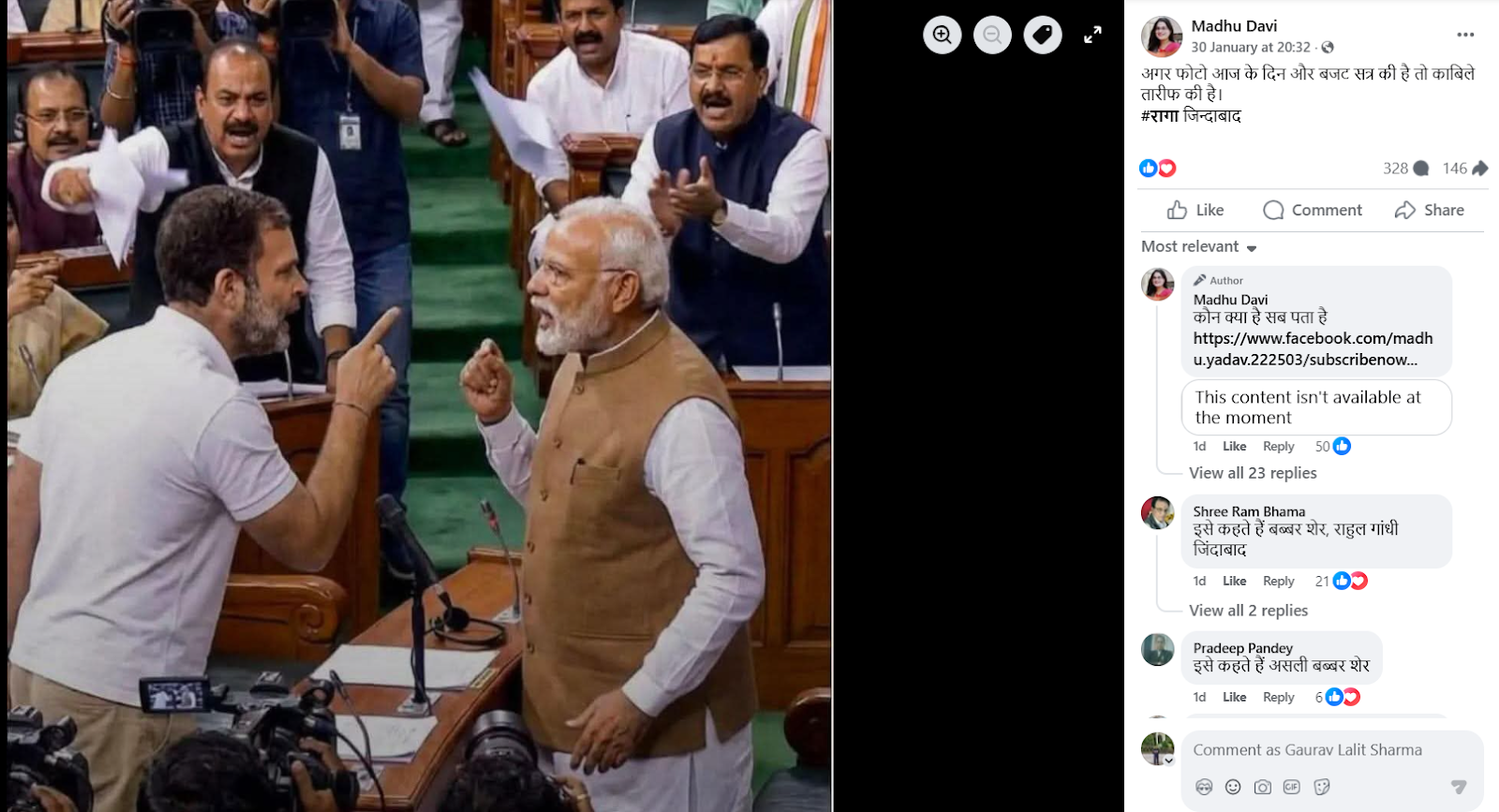
A Facebook user shared the viral image with the caption: “Kavya Maran Hug Vaibhav Suryavanshi 🥰🔥 #cricketnews #RRvsSRH” The link to the post and its screenshot are provided below.

Fact Check
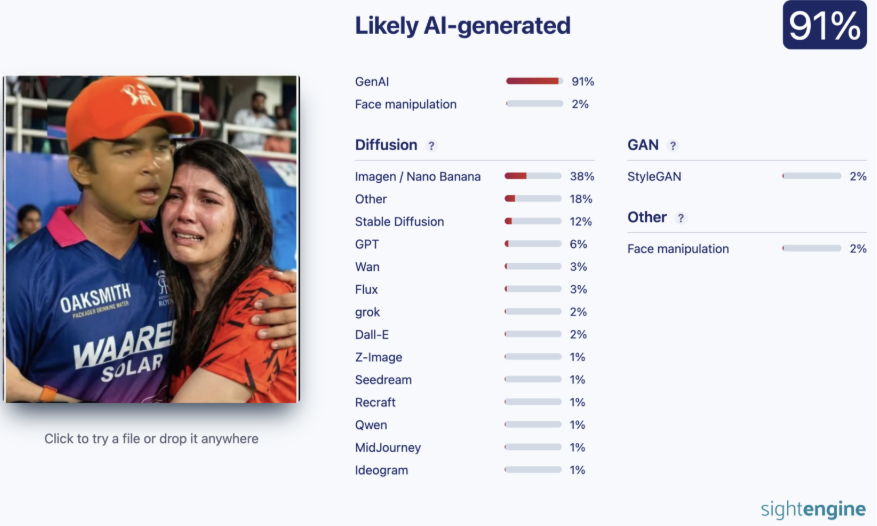
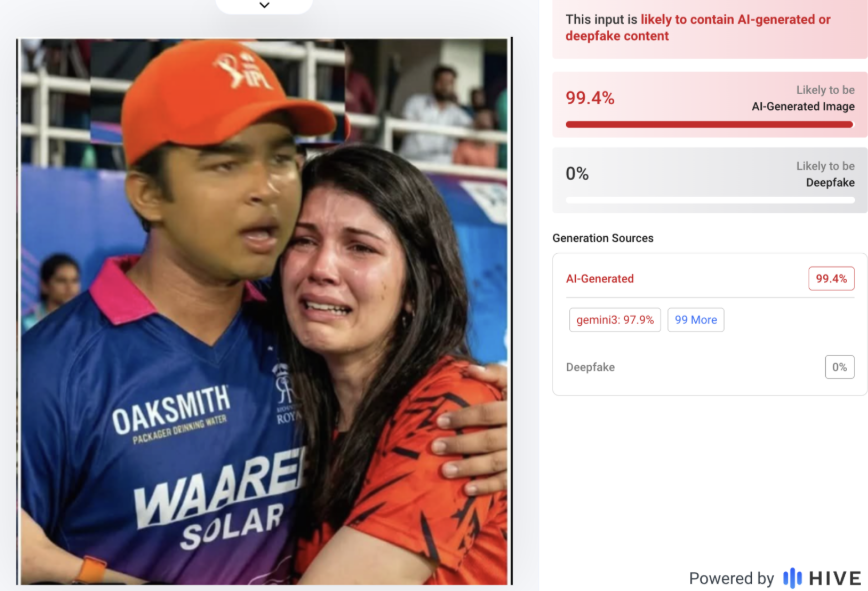
During the research, we found no credible news reports, official statements, or authentic images confirming that Kavya Maran hugged Vaibhav Suryavanshi as shown in the viral picture. To further verify the image, it was analysed using AI detection tools, including Sightengine and Hive Moderation. Both tools indicated a high probability that the image was generated using Artificial Intelligence. The findings suggest that the viral photograph is not a genuine image captured at a real event but a digitally created visual.
Conclusion
Our research found that the viral image showing Kavya Maran emotionally hugging Vaibhav Suryavanshi is not authentic. The picture was generated using AI and does not depict a real incident.
Related Blogs

Introduction: Reasons Why These Amendments Have Been Suggested.
The suggested changes in the Information Technology (Intermediary Guidelines and Digital Media Ethics Code) Rules, 2021, are the much-needed regulatory reaction to the blistering emergence of synthetic information and deepfakes. These reforms are due to the pressing necessity to govern risks within the digital ecosystem as opposed to regular reformation.
The Emergence of the Digital Menace
Generative AI tools have also facilitated the generation of very realistic images, videos, audio, and text in recent years. Such artificial media have been abused to portray people in situations they are not in or in statements they have never said. The market size is expected to have a compound annual growth rate(CAGR) from 2025 to 2031 of 37.57%, resulting in a market volume of US$400.00 bn by 2031. Therefore, tight regulatory controls are necessary to curb a high prevalence of harm in the Indian digital world.
The Gap in Law and Institution
None of the IT Rules, 2021, clearly addressed synthetic content. Although the Information Technology Act, 2000 dealt with identity theft, impersonation and violation of privacy, the intermediaries were not explicitly obligated on artificial media. This left a loophole in enforcement, particularly since AI-generated content might get around the old system of moderation. These amendments bring India closer to the international standards, including the EU AI Act, which requires transparency and labelling of AI-driven content. India addresses such requirements and adapts to local constitutional and digital ecosystem needs.
II. Explanation of the Amendments
The amendments of 2025 present five alternative changes in the current IT Rules framework, which address various areas of synthetic media regulation.
A. Definitional Clarification: Synthetic Generation of Information Introduction.
Rule 2(1)(wa) Amendment:
The amendments provide an all-inclusive definition of what is meant by “synthetically generated information” as information, which is created, or produced, changed or distorted with the use of a computer resource, in a way that such information can reasonably be perceived to be genuine. This definition is intentionally broad and is not limited to deepfakes in the strict sense but to any artificial media that has gone through algorithmic manipulation in order to have a semblance of authenticity.
Expansion of Legal Scope:
Rule 2(1A) also makes it clear that any mention of information in the context of unlawful acts, namely, including categories listed in Rule 3(1)(b), Rule 3(1)(d), Rule 4(2), and Rule 4(4), should be understood to mean synthetically generated information. This is a pivotal interpretative protection that does not allow intermediaries to purport that synthetic versions of illegal material are not under the control of the regulation since they are algorithmic creations and not descriptions of what actually occurred.
B. Safe Harbour Protection and Content Removal Requirements
Amendment, rule 3(1)(b)- Safe Harbour Clarification:
The amendments add a certain proviso to the Rule (3) (1)(b) that explains a deletion or facilitation of access of synthetically produced information (or any information falling within specified categories) which the intermediaries have made in good faith as part of reasonable endeavours or at the receipt of a complaint shall not be considered a breach of the Section 79(2) (a) or (b) of the Information Technology Act, 2000. This coverage is relevant especially since it insures the intermediaries against liability in situations where they censor the synthetic contents in advance of a court ruling or governmental warnings.
C. Labelling and Metadata Requirements that are mandatory on Intermediaries that enable the creation of synthetic content
The amendments establish a new framework of due diligence in Rule 3(3) on the case of intermediaries that offer tools to generate, modify, or alter the synthetically generated information. Two fundamental requirements are laid down.
- The generated information must be prominently labelled or embedded with a permanent, unique metadata or identifier. The label or metadata must be:
- Visibly displayed or made audible in a prominent manner on or within that synthetically generated information.
- It should cover at least 10% of the surface of the visual display or, in the case of audio content, during the initial 10% of its duration.
- It can be used to immediately identify that such information is synthetically generated information which has been created, generated, modified, or altered using the computer resource of the intermediary.
- The intermediary in clause (a) shall not enable modification, suppression or removal of such label, permanent unique metadata or identifier, by whatever name called.
D. Important Social Media Intermediaries- Pre-Publication Checking Responsibilities
The amendments present a three-step verification mechanism, under Rule 4(1A), to Significant Social Media Intermediaries (SSMIs), which enables displaying, uploading or publishing on its computer resource before such display, uploading, or publication has to follow three steps.
Step 1- User Declaration: It should compel the users to indicate whether the materials they are posting are synthetically created. This puts the first burden on users.
Step 2-Technical Verification: To ensure that the user is truly valid, the SSMIs need to provide reasonable technical means, such as automated tools or other applications. This duty is contextual and would be based on the nature, format and source of content. It does not allow intermediaries to escape when it is known that not every type of content can be verified using the same standards.
Step 3- Prominent Labelling: In case the synthetic origin is verified by user declaration or technical verification, SSMIs should have a notice or label that is prominently displayed to be seen by users before publication.
The amendments provide a better system of accountability and set that intermediaries will be found to have failed due diligence in a case where it is established that they either knowingly permitted, encouraged or otherwise failed to act on synthetically produced information in contravention of these requirements. This brings in an aspect of knowledge, and intermediaries cannot use accidental errors as an excuse for non-compliance.
An explanation clause makes it clear that SSMIs should also make reasonable and proportionate technical measures to check user declarations and keep no synthetic content published without adequate declaration or labelling. This eliminates confusion on the role of the intermediaries with respect to making declarations.
III. Attributes of The Amendment Framework
- Precision in Balancing Innovation and Accountability.
The amendments have commendably balanced two extreme regulatory postures by neither prohibiting nor allowing the synthetic media to run out of control. It has recognised the legitimate use of synthetic media creation in entertainment, education, research and artistic expression by adopting a transparent and traceable mandate that preserves innovation while ensuring accountability.
- Overt Acceptance of the Intermediary Liability and Reverse Onus of Knowledge
Rule 4(1A) gives a highly significant deeming rule; in cases where the intermediary permits or refrains from acting with respect to the synthetic content knowing that the rules are violated, it will be considered as having failed to comply with the due diligence provisions. This description closes any loopholes in unscrupulous supervision where intermediaries can be able to argue that they did so. Standard of scienter promotes material investment in the detection devices and censor mechanisms that have been in place to offer security to the platforms that have sound systems, albeit the fact that the tools fail to capture violations at times.
- Clarity Through Definition and Interpretive Guidance
The cautious definition of the term “synthetically generated information” and the guidance that is provided in Rule 2(1A) is an admirable attempt to solve confusion in the previous regulatory framework. Instead of having to go through conflicting case law or regulatory direction, the amendments give specific definitional limits. The purposefully broad formulation (artificially or algorithmically created, generated, modified or altered) makes sure that the framework is not avoided by semantic games over what is considered to be a real synthetic content versus a slight algorithmic alteration.
- Insurance of non-accountability but encourages preventative moderation
The safe harbour clarification of the Rule 3(1)(b) amendment clearly safeguards the intermediaries who voluntarily dismiss the synthetic content without a court order or government notification. It is an important incentive scheme that prompts platforms to implement sound self-regulation measures. In the absence of such protection, platforms may also make rational decisions to stay in a passive stance of compliance, only deleting content under the pressure of an external authority, thus making them more effective in keeping users safe against dangerous synthetic media.
IV. Conclusion
The Information Technology (Intermediary Guidelines and Digital Media Ethics Code) Rules 2025 suggest a structured, transparent, and accountable execution of curbing the rising predicaments of synthetic media and deepfakes. The amendments deal with the regulatory and interpretative gaps that have always existed in determining what should be considered as synthetically generated information, the intermediary liabilities and the mandatory labelling and metadata requirement. Safe-harbour protection will encourage the moderation proactively, and a scienter-based liability rule will not permit the intermediaries to escape liability when they are aware of the non-compliance but tolerate such non-compliance. The idea to introduce pre-publication verification of Significant Social Media Intermediaries adds the responsibility to users and due diligence to the platform. Overall, the amendments provide a reasonable balance between innovation and regulation, make the process more open with its proper definitions, promote responsible conduct on the platform and transform India and the new standards in the sphere of synthetic media regulation. They collaborate to enhance the verisimilitude, defence of the users, and visibility of the systems of the digital ecosystem of India.
V. References
2. https://www.statista.com/outlook/tmo/artificial-intelligence/generative-ai/worldwide

Executive Summary:
A video is being shared on social media showing an aircraft engulfed in massive flames on an airport runway. The video is being linked to the UAE. It is being claimed that a UAE airport was completely destroyed due to recent drone and missile attacks by Iran. Research by the CyberPeace found the viral claim to be false. Our research revealed that the viral video is not real, but AI-generated.
Claim:
On social media platform Facebook, a user shared the viral video on March 3, 2026, and wrote, “Amid the Iran-US-Israel conflict in the Middle East, operations at several major airports, including Dubai International Airport, have been temporarily suspended, causing thousands of flight cancellations and delays. Due to multiple missile and drone attacks from Iran, the United Arab Emirates (UAE) had shut its airspace, and limited structural damage at Dubai Airport was also confirmed, with reports of four staff members being injured. Later, considering the security situation, a limited number of flights were resumed, but full operations are still delayed due to ongoing safety concerns. This tension has significantly impacted regional aviation, travel, and global flight routes.”

Fact Check:
To verify the viral video, we searched relevant keywords on Google. However, we did not find any credible media report confirming the claim.However, we found a video report on the YouTube channel of CNN-News18 mentioning explosions near Dubai Airport after a suspected Iranian drone strike. But the visuals shown in that report are completely different from the viral video.

Upon closely examining the viral video, we noticed several inconsistencies, raising suspicion that it might be AI-generated. We then analyzed the video using the AI detection tool Sightengine. The results indicated that the video is 71 percent likely to be AI-generated.

Conclusion:
Our research found that the viral video is not real, but AI-generated.

Introduction:
With the rapid advancement in technologies, vehicles are also being transformed into moving data centre. There is an introduction of connectivity, driver assistance systems, advanced software systems, automated systems and other modern technologies are being deployed to make the experience of users more advanced and joyful. Software plays an important role in the overall functionality and convenience of the vehicle. For example, Advanced technologies like keyless entry and voice assistance, censor cameras and communication technologies are being incorporated into modern vehicles. Addressing the cyber security concerns in the vehicles the Ministry of Road Transport and Highways (MoRTH) has proposed standard Cyber Security and Management Systems (CSMS) rules for specific categories of four-wheelers, including both passenger and commercial vehicles. The goal is to protect these vehicles and their functions against cyber-attacks or vulnerabilities. This move will aim to ensure standardized cybersecurity measures in the automotive industry. These proposed standards will put forth certain responsibilities on the vehicle manufacturers to implement suitable and proportional measures to secure dedicated environments and to take steps to ensure cyber security.
The New Mandate
The new set of standards requires automobile manufacturers to install a new cybersecurity management system, which will be inclusive of protection against several cyberattacks on the vehicle’s autonomous driving functions, electronic control unit, connected functions, and infotainment systems. The proposed automotive industry standards aim to fortify vehicles against cyberattacks. These standards, expected to be notified by early next month, will apply to all M and N category vehicles. This includes passenger vehicles, goods carriers, and even tractors if they possess even a single electronic control unit. The need for enhanced cybersecurity in the automotive sector is palpable. Modern vehicles, equipped with advanced technologies, are highly prone to cyberattacks. The Ministry of Road Transport and Highways has thus taken a precautionary measure to safeguard all new-age commercial and private vehicles against cyber threats and vulnerabilities.
Cyber Security and Management Systems (CSMS)
The proposed standards by the Ministry of Road Transport and Highways (MoRTH) clarify that CSMS refers to a systematic risk-based strategy that defines organisational procedures, roles, and governance to manage and mitigate risks connected with cyber threats to vehicles, eventually safeguarding them from cyberattacks. According to the draft regulations, all manufacturers will be required to install a cyber security management system in their vehicles and provide the government with a certificate of compliance at the time of vehicle type certification.
Electrical vehicle charging system
Electric vehicle charging stations could also be susceptible and prone to cyber threats and vulnerabilities, which significantly requires to have in place standards to prevent them. It is highlighted that the Indian Computer Emergency Response Team (CERT-In), a designated authority to track and monitor cybersecurity incidents in India, had received reports of vulnerabilities in products and applications related to electric vehicle charging stations. Electric cars or vehicles becoming increasingly popular as the world shifts to green technology. EV owners may charge their cars at charging points in convenient spots. When you charge an EV at a charging station, data transfers between the car, the charging station, and the company that owns the device. This trail of data sharing and EV charging stations in many ways can be exploited by the bad actors. Some of the threats may include Malware, remote manipulation, and disturbing charging stations, social engineering attacks, compromised aftermarket devices etc.
Conclusion
Cyber security is necessary in view of the increased connectivity and use of software systems and other modern technologies in vehicles. As the automotive industry continues to adopt advanced technologies, it will become increasingly important that organizations take a proactive approach to ensure cybersecurity in the vehicles. A balanced approach between technology innovation and security measures will be instrumental in ensuring the cybersecurity aspect in the automotive industry. The recent proposed policy standard by the Ministry of Road Transport and Highways (MoRTH) can be seen as a commendable step to make the automotive industry cyber-resilient and safe for everyone.
References:
- https://economictimes.indiatimes.com/news/india/road-transport-ministry-proposes-uniform-cyber-security-system-for-four-wheelers/articleshow/105187952.cms
- https://www.financialexpress.com/business/express-mobility-cybersecurity-in-the-autonomous-vehicle-the-next-frontier-in-mobility-3234055/
- https://www.gktoday.in/morth-proposes-uniform-cyber-security-standards-for-four-wheelers/
- https://cybersecurity.att.com/blogs/security-essentials/the-top-8-cybersecurity-threats-facing-the-automotive-industry-heading-into-2023