
#FactCheck - Digitally Manipulated Video Misrepresents Surinder Choudhary’s Remarks on PM Modi
Executive Summary
A video circulating on social media claims that Jammu and Kashmir Deputy Chief Minister Surinder Choudhary described Prime Minister Narendra Modi as an agent of Pakistan’s Inter-Services Intelligence (ISI). In the viral clip, Choudhary is allegedly heard accusing the Prime Minister of pushing Kashmir towards Pakistan and claiming that even pro-India Kashmiris are disillusioned with Modi’s policies.
However, research by the CyberPeace research wing has found that the video is digitally manipulated. While the visuals are genuine and taken from a real media interaction, the audio has been fabricated and falsely overlaid to misattribute inflammatory remarks to the Deputy Chief Minister.
Claim
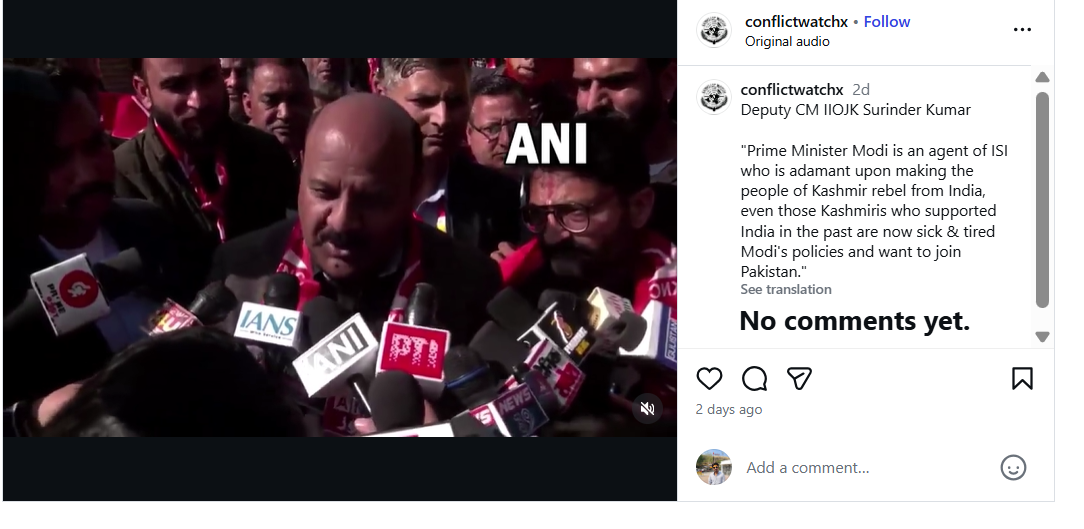
An Instagram account named Conflict Watch shared the video on January 20, claiming that J&K Deputy Chief Minister Surinder Choudhary had called Prime Minister Modi an ISI agent. The video purportedly quoted Choudhary as saying that Modi was elected with Pakistan’s support and that Kashmir would soon become part of Pakistan due to his policies.
Here is the link and archive link to the post, along with a screenshot.
Fact Check:
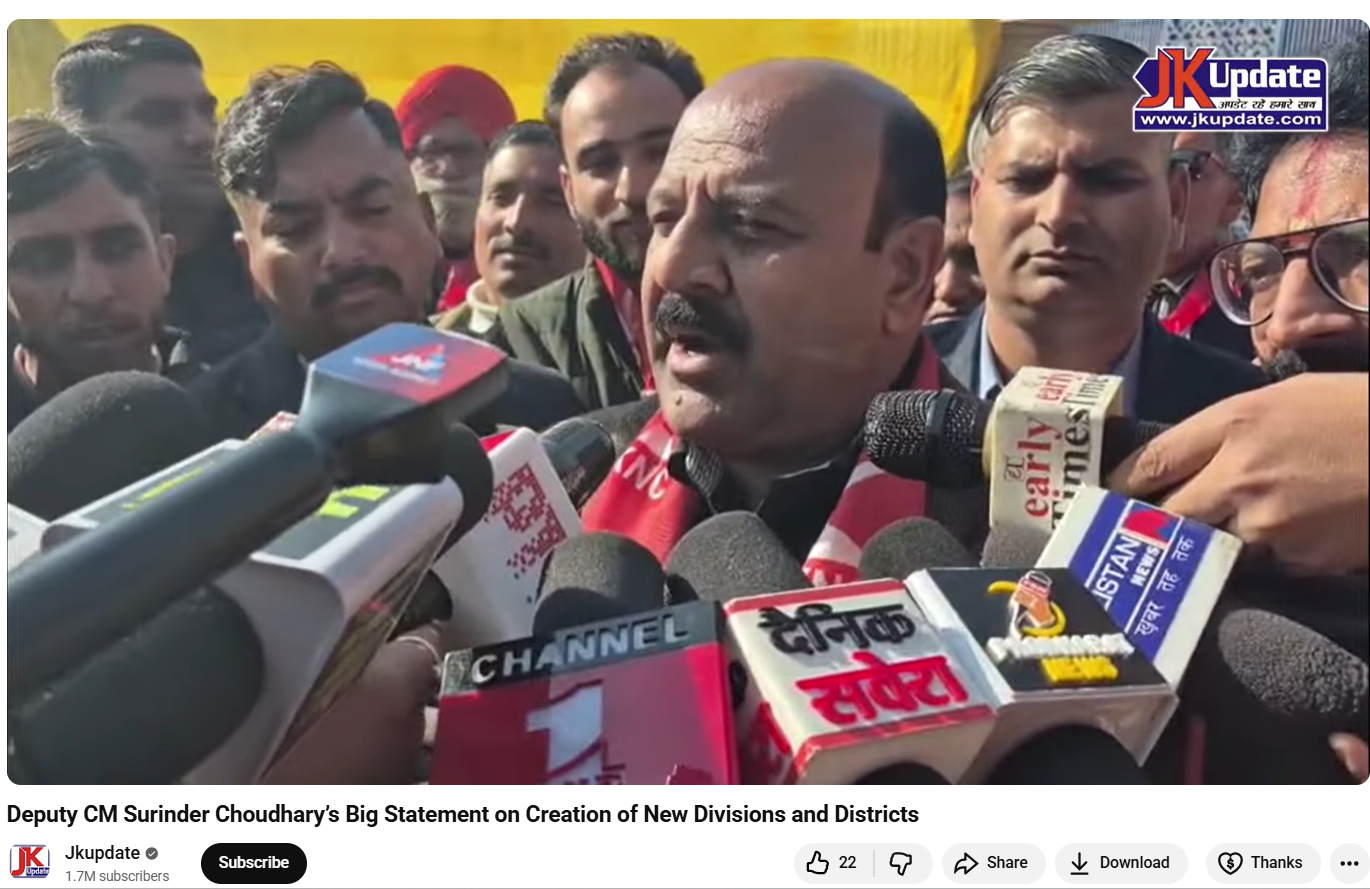
To verify the claim, the Desk conducted a Google Lens search, which led to a video uploaded on January 20, 2026, on the official YouTube channel of Jammu and Kashmir–based news outlet JKUpdate. The footage was an extended version of the viral clip and featured identical visuals. The original video showed Surinder Choudhary addressing the media on the sidelines of the inaugural two-day JKNC Convention of Block Presidents and Secretaries in the Jammu province. A review of the full media interaction revealed that Choudhary did not make any statements calling Prime Minister Modi an ISI agent or suggesting that Kashmir should join Pakistan.
Instead, in the original footage, Choudhary was seen criticising former Jammu and Kashmir Chief Minister and PDP leader Mehbooba Mufti for supporting the BJP during the bifurcation of Jammu and Kashmir and Ladakh into two Union Territories. He also spoke about the challenges faced by the region after the abrogation of Article 370 and demanded the restoration of full statehood for Jammu and Kashmir. During the interaction, Choudhary said that anyone attempting to divide Jammu and Kashmir at the state or regional level was effectively following Pakistan’s agenda and Jinnah’s two-nation theory. He added that such individuals could not be considered patriots.
Here is the link to the video, along with a screenshot.
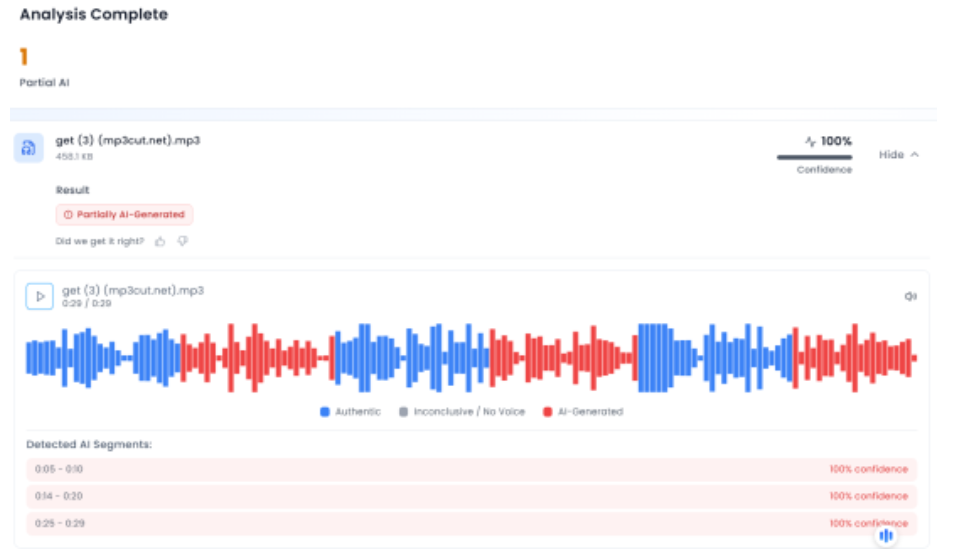
In the next phase of the research , the Desk extracted the audio from the viral clip and analysed it using the AI-based audio detection tool Aurigin. The analysis indicated that the voice in the viral video was partially AI-generated, further confirming that the clip had been tampered with.
Below is a screenshot of the result.
Conclusion
Multiple social media users shared a video claiming it showed Jammu and Kashmir Deputy Chief Minister Surinder Choudhary calling Prime Minister Narendra Modi an agent of the ISI. However, the CyberPeace found that the viral video was digitally manipulated. While the visuals were taken from a genuine media interaction with the leader, a fabricated audio track was overlaid to attribute the statements to him falsely.

Related Blogs

Executive Summary
Misleading claims related to an incident in Delhi are being widely circulated on social media. Several posts allege that an Indian Army brigadier and his son were assaulted while returning from a “dance club party.” The posts further claim that the attack was triggered by remarks related to “Operation Sindoor.” However, research by the CyberPeace found that these claims are completely false and fabricated.
Claim
On social media platform X, some users (including @ManipurPost5) shared posts claiming that an Indian Army brigadier and his son were attacked after returning from a dance club. The posts also alleged that the altercation escalated after someone mocked “Operation Sindoor.”
Fact check
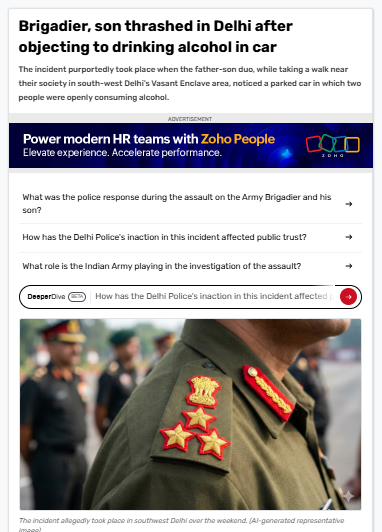
To verify the claim, we conducted keyword searches on Google and found a report published by Republic World on April 14, 2026, which included visuals similar to those being circulated.

According to the report, the victims were identified as Brigadier Parminder Singh Arora, a serving Indian Army officer, and his son Tejas Arora. At the time of the incident, they were taking a walk near their residence after dinner. Reports state that they noticed a group of individuals consuming alcohol inside a parked car in a public place and objected to it. This led to an argument, which later escalated into a violent assault. Around 7–8 individuals allegedly attacked the brigadier and his son, with the son sustaining more serious injuries. Questions have also been raised about the role of police personnel present at the scene. Following the complaint, a case was registered, one police constable was suspended, and two accused individuals have been arrested so far. The vehicle involved has also been seized. Further verification led us to another report published by India Today on April 14, 2026, which corroborated the same details of the incident.
Conclusion
The viral claim is misleading and entirely false.The incident has no connection to any “dance club party” or to “Operation Sindoor.” In reality, the altercation began after the brigadier objected to public drinking near his residence.
.webp)
Executive Summary:
A viral video of the Argentina football team dancing in the dressing room to a Bhojpuri song is being circulated in social media. After analyzing the originality, CyberPeace Research Team discovered that this video was altered and the music was edited. The original footage was posted by former Argentine footballer Sergio Leonel Aguero in his official Instagram page on 19th December 2022. Lionel Messi and his teammates were shown celebrating their win at the 2022 FIFA World Cup. Contrary to viral video, the song in this real-life video is not from Bhojpuri language. The viral video is cropped from a part of Aguero’s upload and the audio of the clip has been changed to incorporate the Bhojpuri song. Therefore, it is concluded that the Argentinian team dancing to Bhojpuri song is misleading.

Claims:
A video of the Argentina football team dancing to a Bhojpuri song after victory.


Fact Check:
On receiving these posts, we split the video into frames, performed the reverse image search on one of these frames and found a video uploaded to the SKY SPORTS website on 19 December 2022.

We found that this is the same clip as in the viral video but the celebration differs. Upon further analysis, We also found a live video uploaded by Argentinian footballer Sergio Leonel Aguero on his Instagram account on 19th December 2022. The viral video was a clip from his live video and the song or music that’s playing is not a Bhojpuri song.

Thus this proves that the news that circulates in the social media in regards to the viral video of Argentina football team dancing Bhojpuri is false and misleading. People should always ensure to check its authenticity before sharing.
Conclusion:
In conclusion, the video that appears to show Argentina’s football team dancing to a Bhojpuri song is fake. It is a manipulated version of an original clip celebrating their 2022 FIFA World Cup victory, with the song altered to include a Bhojpuri song. This confirms that the claim circulating on social media is false and misleading.
- Claim: A viral video of the Argentina football team dancing to a Bhojpuri song after victory.
- Claimed on: Instagram, YouTube
- Fact Check: Fake & Misleading

Introduction
In 2022, Oxfam’s India Inequality report revealed the worsening digital divide, highlighting that only 38% of households in the country are digitally literate. Further, only 31% of the rural population uses the internet, as compared to 67% of the urban population. Over time, with the increasing awareness about the importance of digital privacy globally, the definition of digital divide has translated into a digital privacy divide, whereby different levels of privacy are afforded to different sections of society. This further promotes social inequalities and impedes access to fundamental rights.
Digital Privacy Divide: A by-product of the digital divide
The digital divide has evolved into a multi-level issue from its earlier interpretations; level I implies the lack of physical access to technologies, level II refers to the lack of digital literacy and skills and recently, level III relates to the impacts of digital access. Digital Privacy Divide (DPD) refers to the various gaps in digital privacy protection provided to users based on their socio-demographic patterns. It forms a subset of the digital divide, which involves uneven distribution, access and usage of information and communication technology (ICTs). Typically, DPD exists when ICT users receive distinct levels of digital privacy protection. As such, it forms a part of the conversation on digital inequality.
Contrary to popular perceptions, DPD, which is based on notions of privacy, is not always based on ideas of individualism and collectivism and may constitute internal and external factors at the national level. A study on the impacts of DPD conducted in the U.S., India, Bangladesh and Germany highlighted that respondents in Germany and Bangladesh expressed more concerns about their privacy compared to respondents in the U.S. and India. This suggests that despite the U.S. having a strong tradition of individualistic rights, that is reflected in internal regulatory frameworks such as the Fourth Amendment, the topic of data privacy has not garnered enough interest from the population. Most individuals consider forgoing the right to privacy as a necessary evil to access many services, and schemes and to stay abreast with technological advances. Research shows that 62%- 63% of Americans believe that companies and the government collecting data have become an inescapable necessary evil in modern life. Additionally, 81% believe that they have very little control over what data companies collect and about 81% of Americans believe that the risk of data collection outweighs the benefits. Similarly, in Japan, data privacy is thought to be an adopted concept emerging from international pressure to regulate, rather than as an ascribed right, since collectivism and collective decision-making are more valued in Japan, positioning the concept of privacy as subjective, timeserving and an idea imported from the West.
Regardless, inequality in privacy preservation often reinforces social inequality. Practices like surveillance that are geared towards a specific group highlight that marginalised communities are more likely to have less data privacy. As an example, migrants, labourers, persons with a conviction history and marginalised racial groups are often subject to extremely invasive surveillance under suspicions of posing threats and are thus forced to flee their place of birth or residence. This also highlights the fact that focus on DPD is not limited to those who lack data privacy but also to those who have (either by design or by force) excess privacy. While on one end, excessive surveillance, carried out by both governments and private entities, forces immigrants to wait in deportation centres during the pendency of their case, the other end of the privacy extreme hosts a vast number of undocumented individuals who avoid government contact for fear of deportation, despite noting high rates of crime victimization.
DPD is also noted among groups with differential knowledge and skills in cyber security. For example, in India, data privacy laws mandate that information be provided on order of a court or any enforcement agency. However, individuals with knowledge of advanced encryption are adopting communication channels that have encryption protocols that the provider cannot control (and resultantly able to exercise their right to privacy more effectively), in contrast with individuals who have little knowledge of encryption, implying a security as well as an intellectual divide. While several options for secure communication exist, like Pretty Good Privacy, which enables encrypted emailing, they are complex and not easy to use in addition to having negative reputations, like the Tor Browser. Cost considerations also are a major factor in propelling DPD since users who cannot afford devices like those by Apple, which have privacy by default, are forced to opt for devices that have relatively poor in-built encryption.
Children remain the most vulnerable group. During the pandemic, it was noted that only 24% of Indian households had internet facilities to access e-education and several reported needing to access free internet outside of their homes. These public networks are known for their lack of security and privacy, as traffic can be monitored by the hotspot operator or others on the network if proper encryption measures are not in place. Elsewhere, students without access to devices for remote learning have limited alternatives and are often forced to rely on Chromebooks and associated Google services. In response to this issue, Google provided free Chromebooks and mobile hotspots to students in need during the pandemic, aiming to address the digital divide. However, in 2024, New Mexico was reported to be suing Google for allegedly collecting children’s data through its educational products provided to the state's schools, claiming that it tracks students' activities on their personal devices outside of the classroom. It signified the problems in ensuring the privacy of lower-income students while accessing basic education.
Policy Recommendations
Digital literacy is one of the critical components in bridging the DPD. It enables individuals to gain skills, which in turn effectively addresses privacy violations. Studies show that low-income users remain less confident in their ability to manage their privacy settings as compared to high-income individuals. Thus, emphasis should be placed not only on educating on technology usage but also on privacy practices since it aims to improve people’s Internet skills and take informed control of their digital identities.
In the U.S., scholars have noted the role of libraries and librarians in safeguarding intellectual privacy. The Library Freedom Project, for example, has sought to ensure that the skills and knowledge required to ensure internet freedoms are available to all. The Project channelled one of the core values of the library profession i.e. intellectual freedom, literacy, equity of access to recorded knowledge and information, privacy and democracy. As a result, the Project successfully conducted workshops on internet privacy for the public and also openly objected to the Department of Homeland Security’s attempts to shut down the use of encryption technologies in libraries. The International Federation of Library Association adopted a Statement of Privacy in the Library Environment in 2015 that specified “when libraries and information services provide access to resources, services or technologies that may compromise users’ privacy, libraries should encourage users to be aware of the implications and provide guidance in data protection and privacy.” The above should be used as an indicative case study for setting up similar protocols in inclusive public institutions like Anganwadis, local libraries, skill development centres and non-government/non-profit organisations in India, where free education is disseminated. The workshops conducted must inculcate two critical aspects; firstly, enhancing the know-how of using public digital infrastructure and popular technologies (thereby de-alienating technology) and secondly, shifting the viewpoint of privacy as a right an individual has and not something that they own.
However, digital literacy should not be wholly relied on, since it shifts the responsibility of privacy protection to the individual, who may not either be aware or cannot be controlled. Data literacy also does not address the larger issue of data brokers, consumer profiling, surveillance etc. Resultantly, an obligation on companies to provide simplified privacy summaries, in addition to creating accessible, easy-to-use technical products and privacy tools, should be necessitated. Most notable legislations address this problem by mandating notices and consent for collecting personal data of users, despite slow enforcement. However, the Digital Personal Data Protection Act 2023 in India aims to address DPD by not only mandating valid consent but also ensuring that privacy policies remain accessible in local languages, given the diversity of the population.
References
- https://idronline.org/article/inequality/indias-digital-divide-from-bad-to-worse/
- https://arxiv.org/pdf/2110.02669
- https://arxiv.org/pdf/2201.07936#:~:text=The%20DPD%20index%20is%20a,(33%20years%20and%20over).
- https://www.pewresearch.org/internet/2019/11/15/americans-and-privacy-concerned-confused-and-feeling-lack-of-control-over-their-personal-information/
- https://eprints.lse.ac.uk/67203/1/Internet%20freedom%20for%20all%20Public%20libraries%20have%20to%20get%20serious%20about%20tackling%20the%20digital%20privacy%20divi.pdf
- /https://openscholarship.wustl.edu/cgi/viewcontent.cgi?article=6265&context=law_lawreview
- https://eprints.lse.ac.uk/67203/1/Internet%20freedom%20for%20all%20Public%20libraries%20have%20to%20get%20serious%20about%20tackling%20the%20digital%20privacy%20divi.pdf
- https://bosniaca.nub.ba/index.php/bosniaca/article/view/488/pdf
- https://www.hindustantimes.com/education/just-24-of-indian-households-have-internet-facility-to-access-e-education-unicef/story-a1g7DqjP6lJRSh6D6yLJjL.html
- https://www.forbes.com/councils/forbestechcouncil/2021/05/05/the-pandemic-has-unmasked-the-digital-privacy-divide/
- https://www.meity.gov.in/writereaddata/files/Digital%20Personal%20Data%20Protection%20Act%202023.pdf
- https://www.isc.meiji.ac.jp/~ethicj/Privacy%20protection%20in%20Japan.pdf
- https://socialchangenyu.com/review/the-surveillance-gap-the-harms-of-extreme-privacy-and-data-marginalization/
