
#FactCheck - Edited Video Falsely Attributed to Arnab Goswami; Claim of Remarks Against Prime Minister Modi Is Misleading
A video has been going viral on social media in recent days in which Republic TV’s Editor-in-Chief and anchor Arnab Goswami can allegedly be heard using objectionable language against Prime Minister Narendra Modi. While sharing the video, users are claiming that Arnab Goswami publicly made controversial remarks about the Prime Minister.
An investigation by CyberPeace Foundation found this claim to be completely false. Our probe revealed that the viral video is edited and is being circulated on social media with a misleading narrative. In the original video, Arnab Goswami was not making any personal statement; rather, he was referring to an old statement made by Congress leader Rahul Gandhi.
Viral Claim
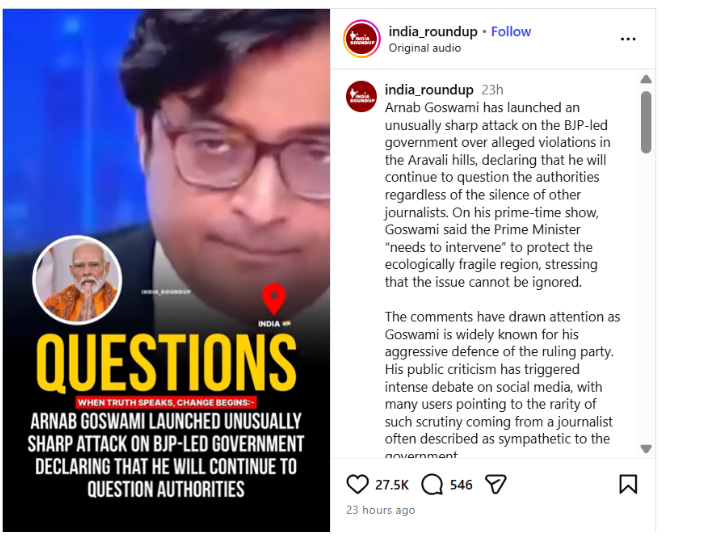
An Instagram user posted this video on 5 January 2026. In the video, a voice resembling Arnab Goswami is heard saying, “Ye jo Narendra Modi hain, ye chhe mahine baad ghar se nahi nikal paayenge aur Hindustan ke log inhein danda maarenge.”
(Translation: “This Narendra Modi will not be able to step out of his house after six months, and the people of India will beat him with sticks.”)
The post link, its archive link, and screenshots can be seen below:
- Instagram link: https://www.instagram.com/reel/DTHrO7bk7Rf/?igsh=MThzbzBlcm82eWN0ZA%3D%3D
- Archive link: https://archive.ph/oaYsf
Fact Check
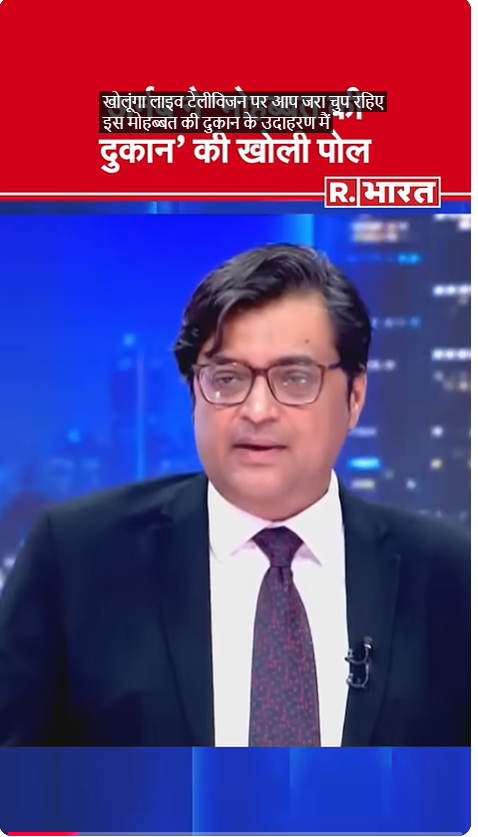
To verify the viral claim, we first examined the video using Google Lens search. During this process, we found a video published on 18 July 2024 on the official YouTube channel of Republic Bharat. The investigation revealed that this video is the longer (extended) version of the viral clip.
After carefully watching the full video, it became clear that Arnab Goswami was not making the statement himself. Instead, he was referring to a remark made by Congress leader Rahul Gandhi during the 2020 Delhi Assembly elections against Prime Minister Narendra Modi. This confirms that the viral video was clipped and presented out of context.
The related video link can be seen below: https://www.youtube.com/shorts/KlQV25-3l8s
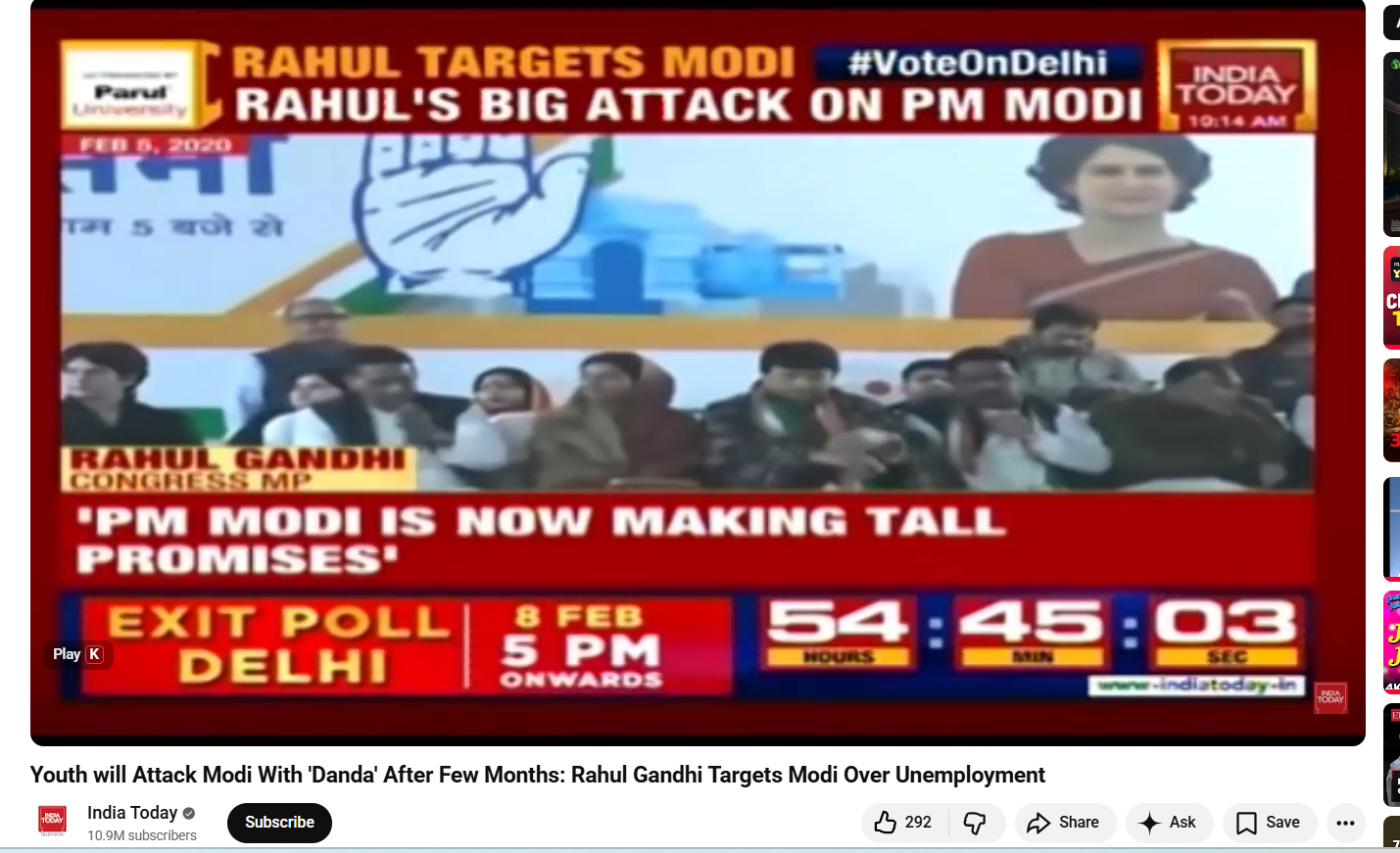
In the next step of the investigation, to verify whether Rahul Gandhi had indeed made such a statement, we conducted a customized keyword search on Google. During this, we found a video published on 6 February 2020 on the official YouTube channel of India Today.
In this video, recorded during a public event ahead of the 2020 Delhi Assembly elections, Rahul Gandhi is seen sharply attacking Prime Minister Narendra Modi, stating that if the Prime Minister fails to resolve the issue of unemployment in the country, the youth would beat him with sticks.
The video link is given below: https://www.youtube.com/watch?v=t5qCSA5nG9Y
Conclusion
The CyberPeace Foundation’s investigation found this claim to be completely fake. The viral video is edited and is being shared in a misleading context. In the original video, Arnab Goswami was referring to an old statement made by Rahul Gandhi, which was selectively clipped and presented in a way that falsely suggests Arnab Goswami himself made objectionable remarks against Prime Minister Narendra Modi.

Related Blogs

Executive Summary
As India concluded its 77th Republic Day celebrations on January 26, 2026, with grandeur and patriotic enthusiasm along the iconic Kartavya Path, a video began circulating on social media claiming to show Indian security personnel failing to perform motorcycle stunts during the ceremonial parade. The short clip allegedly depicts soldiers attempting high-risk, synchronised motorcycle manoeuvres, only to lose balance and fall off their bikes. The visuals were widely shared online with mocking captions, suggesting incompetence during a nationally televised event. However, an research by the CyberPeace found that the video is not authentic and was digitally generated using artificial intelligence.
Claim
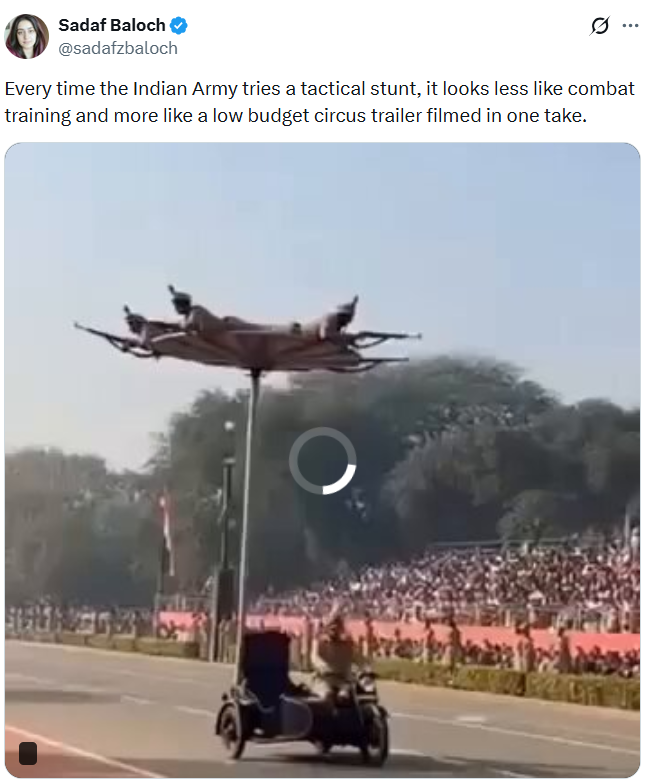
A Pakistan-based X user, Sadaf Baloch (@sadafzbaloch), shared the video on January 27, claiming it showed Indian security personnel failing to execute motorcycle stunts during the Republic Day parade held on January 26, 2026. While sharing the clip, the user wrote:“Every time the Indian Army tries a tactical stunt, it looks less like combat training and more like a low-budget circus trailer filmed in one take.”The post was widely circulated with similar narratives questioning the professionalism of Indian forces.
Here is the link and archive link to the post, along with a screenshot.
To verify the authenticity of the viral video, the Desk conducted a detailed frame-by-frame analysis. During the examination, a watermark linked to ‘Sora’—an AI text-to-video generation model was detected at the 00:05 timestamp. The presence of this watermark strongly indicated that the video was artificially generated and not recorded during a real-world event.
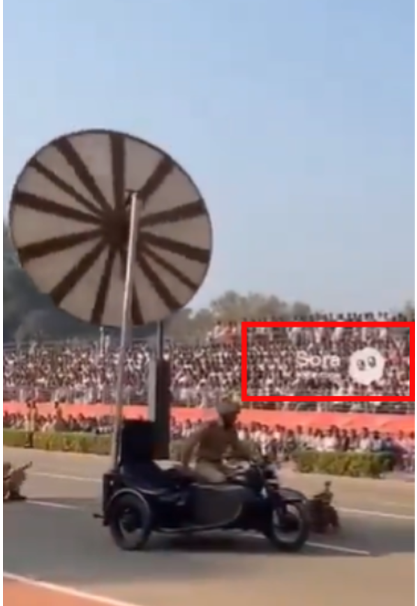
Fact Check:
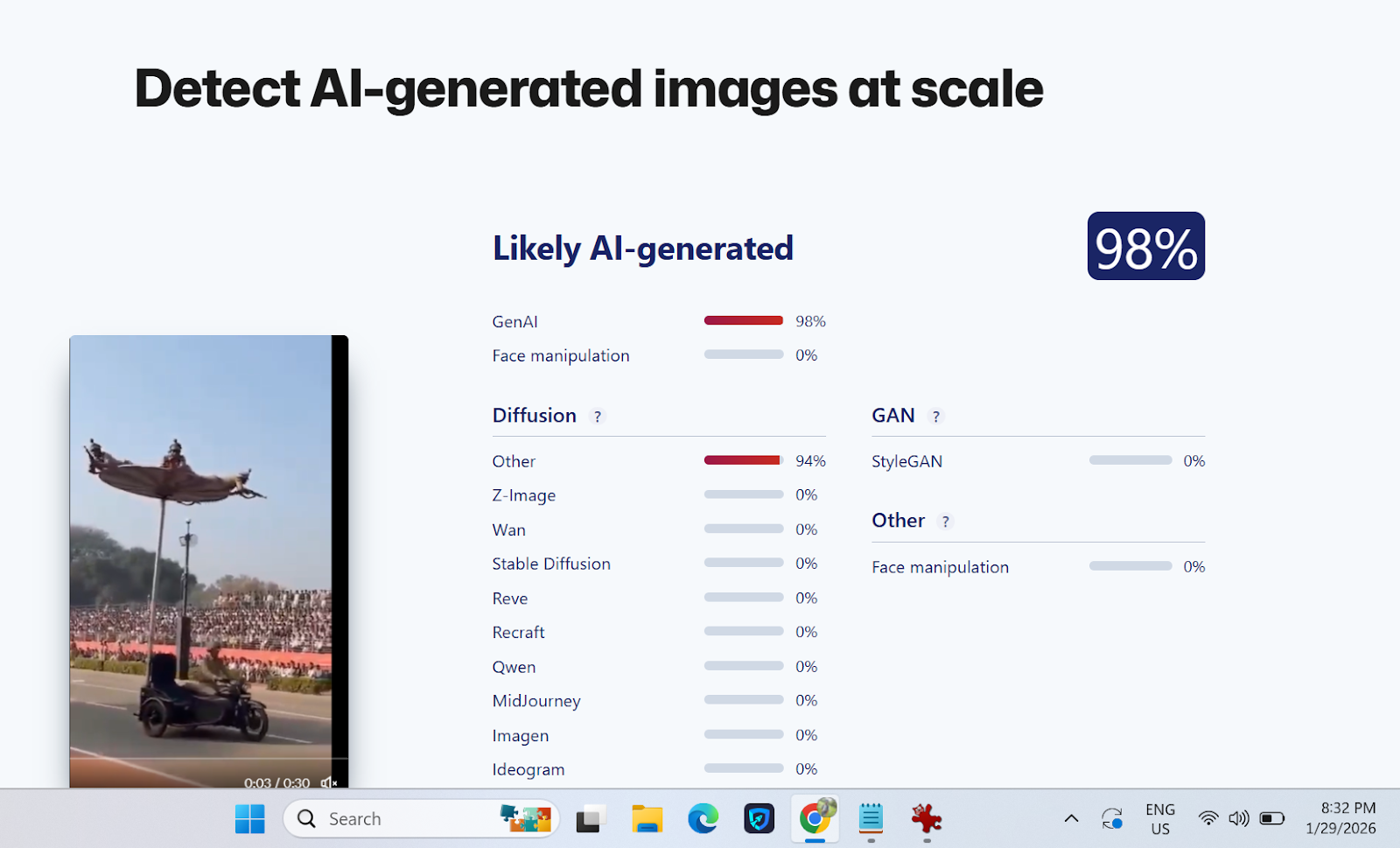
Further visual scrutiny revealed several inconsistencies commonly associated with AI-generated content. The background appeared unnatural and lacked realistic depth, while the movements and reactions of the security personnel looked mechanically exaggerated and inconsistent with real physics. Facial expressions and body motions during the alleged falls also appeared unrealistic. To strengthen the verification, the Desk analysed the clip using Sightengine, an AI-detection tool. The results showed a 98 per cent probability that the video contained AI-generated or deepfake elements.
Below is a screenshot of the result.
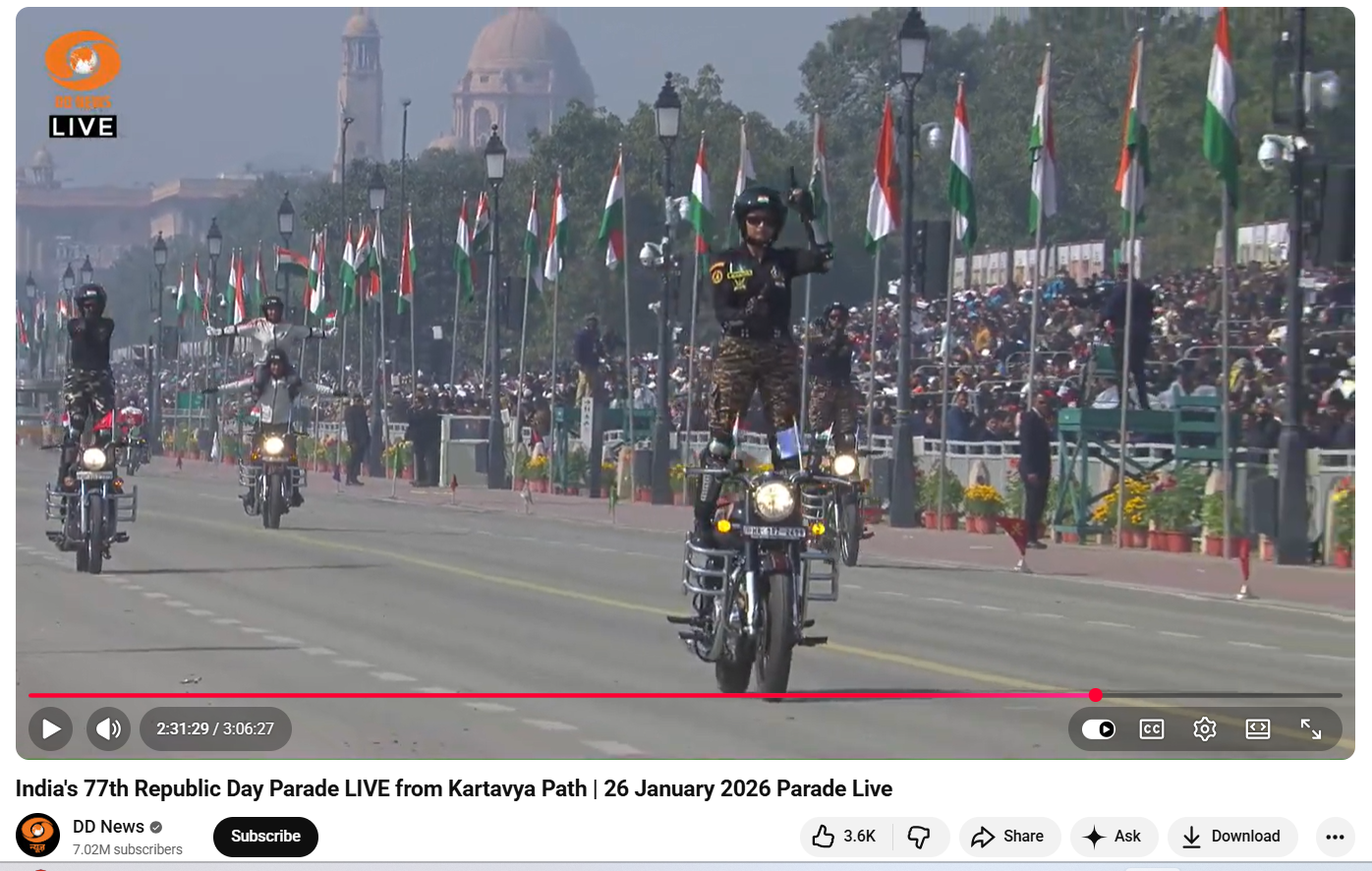
As part of the research , the Desk also conducted a customised keyword search and reviewed official coverage of the Republic Day parade. A full-length video broadcast by DD News on its official YouTube channel was examined. The footage showed joint CRPF and SSB motorcycle teams performing traditional daredevil stunts without any mishap. No incident resembling the viral claim was found in the official broadcast or in any credible media reports.
Here is the video link and a screenshot.
Conclusion
The CyberPeace research confirms that the viral video purportedly showing Indian security personnel failing to perform motorcycle stunts during the 77th Republic Day parade is AI-generated. The clip has been falsely circulated online as genuine content with the intent to mislead viewers and spread misinformation.

Introduction
Whatsapp is one of the leading OTT messaging platforms, which has been owned by the tech giant Meta since 2013. WhatsApp enjoys a user base of nearly 2.24 billion people globally, with almost 487 million users in India. Since the advent of Whatsapp, it has been the most commonly used messaging app, and it has made an impact to such an extent that it is used for professional as well as personal purposes. Meta powers the platform and follows similar guidelines and policies as its parent company.
The New Feature
Users of WhatsApp on the web and desktop can now access one account from various devices. One WhatsApp account may now be used on up to four handsets thanks to a new update from Meta. Be aware that the multi-device capability has been planned for some time and is finally being made available to stable WhatsApp users. Each linked device (up to four devices can be linked) will function independently, and the independent devices will continue to receive messages even if the central device’s network connection is lost. Remember that WhatsApp will automatically log out of all the companion devices if the primary smartphone is dormant for an extended period. Four more gadgets may be a mix of four PCs and smartphones or four smartphones. This feature is now available for updates and downloads on Android as well as iOS platforms.
Potential issues
As we go deeper into the digital age, it is the responsibility of the tech giants to pilot innovation with features of security by design. Thus such new features should be accompanied by coherent safety and security policies or advisories to ensure the users understand the implications of the new features. Convenience over conditions is an essential part of cyberspace. It points to the civic duty of netizens to go through the conditions of any app rather than only focus on the convenience it creates. The following potential issues may arise from the new features on Whatsapp –
- Increased cybercrime- The bad actors now do not need to access SIM cards to commit frauds over the platforms as now on a single number 4 devices can be used hence the cybercriminal activity can increase over the platform. It is also pertinent for the platform to create SoPs for fake accounts which use multiple devices, as they pose a direct threat to the users and their interests.
- Difficulty in identifying and tracing- The LEAs will face a significant issue in identifying the bad actors and tracing them as the individual’s involvement through a linked device needs to be given legal validity and scope for investigation. This may also cause issues in evidence handling and analysis.
- Surge in Misinformation and Disinformation- With access to multiple devices, the screen time of an individual is also bound to increase. This leads to more time spent online, thus causing a rise in instances of misinformation and disinformation by bad actors. Thus the aspect of fack checking is of prime importance.
- Potential Oversharing of Personal Data- With the increased accessibility on different devices, it is very easy for the app to seek data from all devices on which the app is running, thus leading to a bigger reservoir of personal data for the platforms and data fiduciaries.
- Higher risk of Phishing, Ransomware and Malware Attacks- As the devices under the same login credentials and mobile number will increase, the message can be viewed on all the devices, thus increasing the risk of widespread embedded ransomware and malware in multiple devices is and ever-present threat.
- One number, more criminals- This feature will allow cybercriminals to operate using one device only, earlier they used to forge Adhaar cards to get new sims, but this feature will enable the bad actors to commit crimes and attacks from one single SIM using 4 different devices.
- Rise in Digital Footprint- As the number of devices increases, the users will generate more digital footprints. As a tech giant, Meta will have access to a bigger database, which increases the risk of data breaches by third-party actors.
Conclusion
In the fast-paced digital world, it is important to remain updated about new software, technologies and policies for our applications or forms of tech. This was a long-awaited feature from WhatsApp, and its value of it doesn’t lie in technological advancement only but also in the formulation of policies to govern this technology towards the trust and safety aspect of users. The platforms, in synergy with the policy makers, need to create a robust framework to accommodate the new features and add-ons on apps vehicle, staying in compliance with the laws of the land. Awareness about new features and vulnerabilities is a must for all netizens, and it is a shared responsibility for all netizens to spread the word about safety and security mechanisms.

Executive Summary:
A misleading video of a child covered in ash allegedly circulating as the evidence for attacks against Hindu minorities in Bangladesh. However, the investigation revealed that the video is actually from Gaza, Palestine, and was filmed following an Israeli airstrike in July 2024. The claim linking the video to Bangladesh is false and misleading.

Claims:
A viral video claims to show a child in Bangladesh covered in ash as evidence of attacks on Hindu minorities.

Fact Check:
Upon receiving the viral posts, we conducted a Google Lens search on keyframes of the video, which led us to a X post posted by Quds News Network. The report identified the video as footage from Gaza, Palestine, specifically capturing the aftermath of an Israeli airstrike on the Nuseirat refugee camp in July 2024.
The caption of the post reads, “Journalist Hani Mahmoud reports on the deadly Israeli attack yesterday which targeted a UN school in Nuseirat, killing at least 17 people who were sheltering inside and injuring many more.”

To further verify, we examined the video footage where the watermark of Al Jazeera News media could be seen, We found the same post posted on the Instagram account on 14 July, 2024 where we confirmed that the child in the video had survived a massacre caused by the Israeli airstrike on a school shelter in Gaza.

Additionally, we found the same video uploaded to CBS News' YouTube channel, where it was clearly captioned as "Video captures aftermath of Israeli airstrike in Gaza", further confirming its true origin.

We found no credible reports or evidence were found linking this video to any incidents in Bangladesh. This clearly implies that the viral video was falsely attributed to Bangladesh.
Conclusion:
The video circulating on social media which shows a child covered in ash as the evidence of attack against Hindu minorities is false and misleading. The investigation leads that the video originally originated from Gaza, Palestine and documents the aftermath of an Israeli air strike in July 2024.
- Claims: A video shows a child in Bangladesh covered in ash as evidence of attacks on Hindu minorities.
- Claimed by: Facebook
- Fact Check: False & Misleading
