
Building India's Cyber Shield ~ CERT-In's Sandbox, Sovereign AI, and the Push for Resilience
CERT-In, India's national cybersecurity agency, operates under mounting pressure. Cyberattacks in the country have doubled from 1.4 million in FY2022 to 2.9 million in FY2026, even as the window between a vulnerability's discovery and its exploitation continues to narrow. Rather than wait for access to the most advanced AI security tools, some of which face export restrictions, the agency has spent recent months building its own solution.
CERT-In has developed a new sandbox platform built with open-source AI, designed to identify cybersecurity gaps in public-sector systems. The sandbox functions as an isolated testing environment, allowing teams to safely evaluate software and applications without exposing the broader system to risk. Officials have framed this as a foundation rather than a substitute. MeitY Secretary S Krishnan described the platform as a step toward building a secure environment for eventual access to international AI models — suggesting the current approach is understood as an interim measure, not a permanent alternative to global tools.
This effort sits within a broader policy push: encouraging domestic AI development and tightening oversight of AI use in finance and online content. Taken together, these moves suggest a deliberate strategy of capacity-building through incremental, self-reliant steps, rather than a story about capability gaps or resource shortfalls.
A Crisis Measured in Millions
It helps to look at why this matters so much right now. A joint study by the Data Security Council of India and BCG found that recorded cyberattacks in the country roughly doubled in four years, from about 1.4 million in FY22 to 2.9 million in FY26. What's more worrying is how little time defenders now have to react to the average time it takes attackers to exploit a newly found vulnerability dropped from 745 days in FY22 to just 44 days in FY26, largely because attackers are using AI themselves to scout targets and build exploits faster. Banking, financial services, healthcare, telecom and government portals bear the brunt of this, with ransomware-as-a-service groups and state-linked actors increasingly slipping in through vendor portals and supply-chain weak points.
Turning Existing AI Into a Working Defence
CERT-In's Sandbox in Action
Instead of treating the lack of any one frontier model as a dealbreaker, CERT-In simply built its own closed trial platform officials have taken to calling it a "war room" where open-source and other AI models are set loose on software code to find vulnerabilities and shape secure workflows for India's top public sector companies, including in financial services. At a press conference, Meity secretary S. Krishnan pointed out that these substitute models already match roughly 60 to 70 per cent of the performance of the most advanced security-focused systems out there globally. That's a fairly substantial chunk of the capability, and it's coming from tools India can actually access today. The testing has stretched to core digital infrastructure like Aadhaar and government login systems, while some of the country's biggest tech firms are already using currently available AI models to patch widely used enterprise software, banking platforms included. The logic is simple enough: build the muscle now with whatever's on hand, so the enterprise environment is already in better shape by the time more capable tools eventually arrive.
Investing in Sovereign Capability
Arguably the more important move here is a longer-term one , India's bet on building its own frontier-grade security AI. The Centre has reportedly asked domestic AI developers Sarvam AI and BharatGen to build advanced cybersecurity capabilities of their own, hosted on the government's isolated computer infrastructure and eventually put to work protecting critical infrastructure. There's no public timeline yet for when these indigenous models will be ready, but the intent behind the move isn't hard to read: cut India's reliance on any single foreign provider for defending the systems that underpin banking, identity and public administration, while keeping sensitive testing and deployment on Indian soil. Officials have also signalled a preference for on-premises deployment of high-capability AI tools where the stakes are highest, rather than leaning entirely on overseas cloud infrastructure. It's a choice that points toward building lasting, self-reliant capacity rather than making a one-off purchase.
A Tightening Regulatory Net
RBI's Model Risk Guardrails
None of this is happening in a vacuum. On 24 June 2026, the Reserve Bank of India released draft guidance on model risk management that, for the first time, brings AI and machine learning systems used by banks, NBFCs and other regulated entities under a single, board-level governance framework. The draft asks institutions to keep a full inventory of every model they use, rank each one by risk, and build in human override and "kill-switch" mechanisms so a malfunctioning AI system can be shut down immediately. It also makes one thing very clear: banks can't shrug off accountability just because the technology came from a vendor.
MeitY's Deepfake and Synthetic-Content Rules
Around the same time, the Ministry of Electronics and Information Technology notified amendments to the IT Rules that formally define "synthetically generated information," require deepfakes and AI-altered media to carry clear, persistent labels and embedded provenance metadata, and cut the takedown window for unlawful synthetic content down to just three hours. Taken together, the RBI and MeitY rules form the regulatory backbone that CERT-In's technical sandbox is meant to plug into giving India a more coordinated response to both the defensive and the deceptive sides of AI.
One Chain of Command
Officials have gone out of their way to stress that all these moving parts aren't creating confusion in India's cybersecurity reporting structure. CERT-In director general Sanjay Bahl has said the National Security Council Secretariat remains the overarching body, with CERT-In as the top cyber reporting and investigations organisation across sectors, and that sectoral regulators like the RBI and SEBI still report into this one structure rather than running their own parallel systems.
Conclusion
Look at CERT-In's sandbox, the push for sovereign AI, and the tightening regulatory net together, and a clearer picture forms. This isn't really a story about a piece of technology India doesn't have. It's a story about capability being built, deliberately and in the open. The country is using the AI tools available right now to close real security gaps, backing homegrown alternatives for the long haul, and pairing both with governance rules that keep banks, platforms and public infrastructure honest. If there's a lesson in all this, it's that real resilience against a fast-moving cyberthreat landscape rarely arrives all at once. It gets built the way most lasting capability does piece by piece, mostly at home, without waiting for any single outside breakthrough to show up first.
References
- https://inc42.com/buzz/centre-asks-sarvam-ai-bharatgen-to-develop-mythos-like-cyber-ai-models/
- https://inc42.com/buzz/centre-asks-sarvam-ai-bharatgen-to-develop-mythos-like-cyber-ai-models/
- https://www.newkerala.com/news/a/govt-prioritises-access-anthropics-mythos-ai-model-strengthen-475.htm
- https://blog.qualys.com/product-tech/2026/06/24/cert-in-ai-vulnerability-blueprint-machine-speed-risk-operations
- https://www.business-standard.com/technology/tech-news/mythos-threat-govt-tech-firms-test-their-softwares-for-vulnerabilities-126052700386_1.html
- https://inc42.com/buzz/centre-asks-sarvam-ai-bharatgen-to-develop-mythos-like-cyber-ai-models/
- https://www.finextra.com/blogposting/32142/rbis-model-risk-management-guidance-2026--summary
- https://www.medianama.com/2026/06/223-rbi-ai-guidelines-2026-banks-kill-switch/
- https://www.freshfields.com/en/our-thinking/blogs/technology-quotient/india-targets-deepfakes-and-ai-generated-content-key-changes-under-meitys-2026-102mjwn

Related Blogs
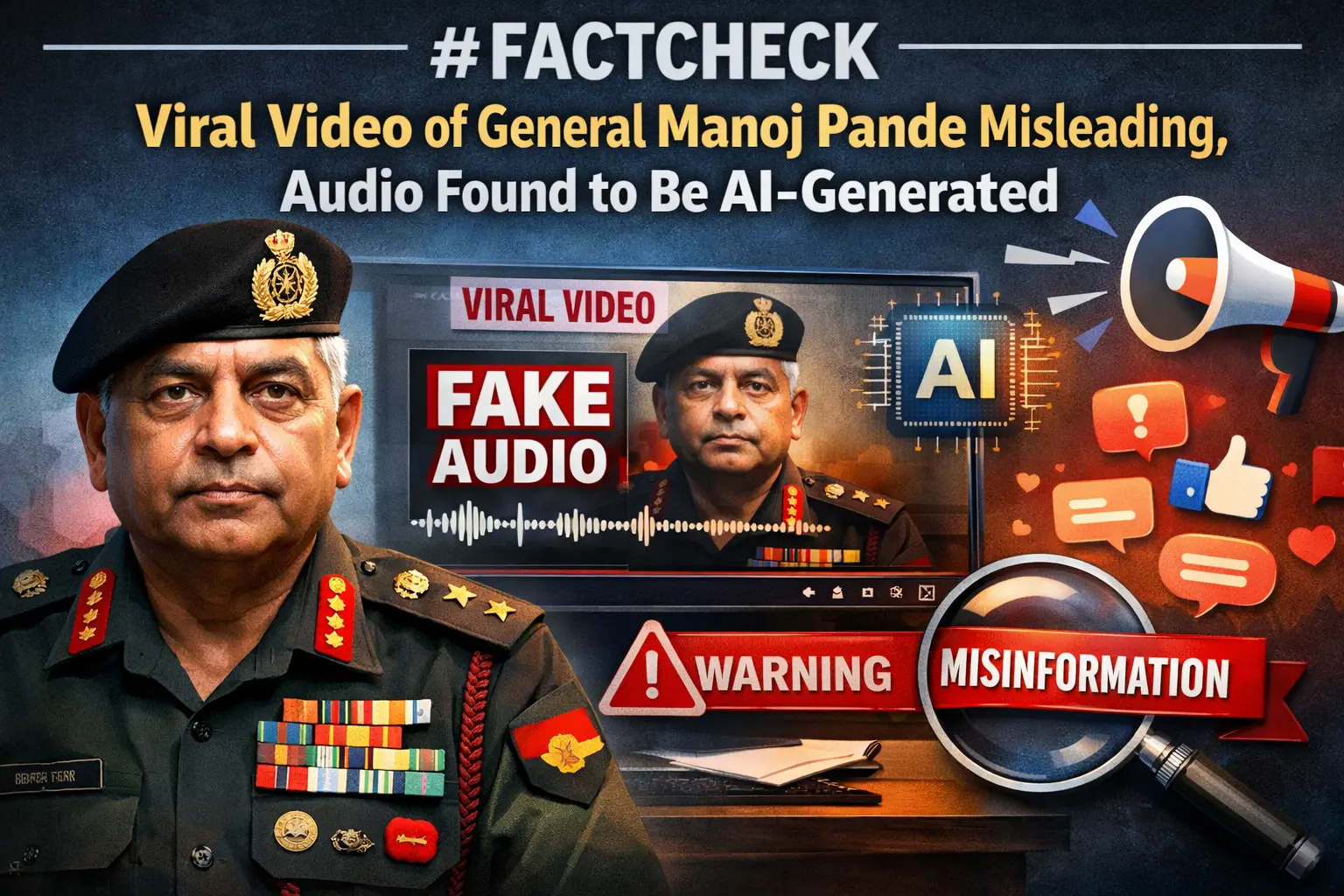
Executive Summary:
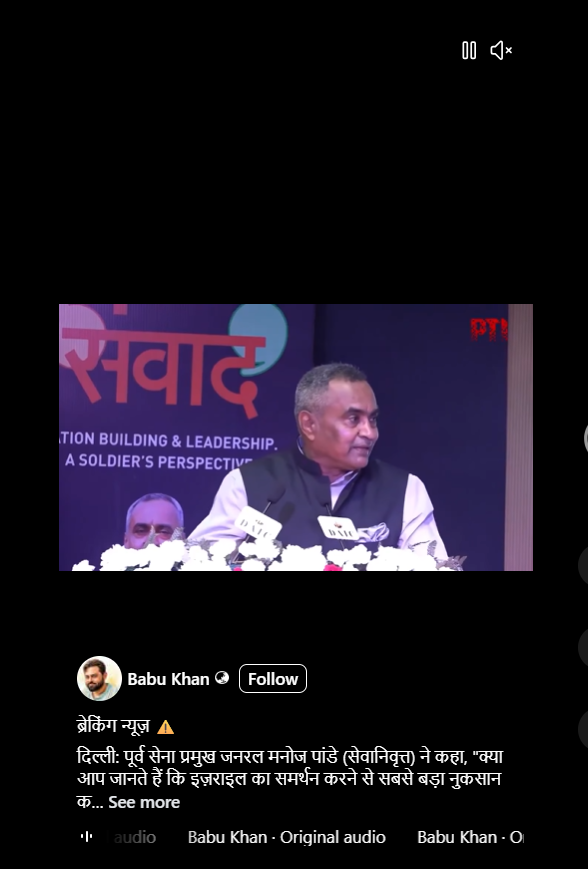
A video of former Army Chief General Manoj Pande is going viral on social media with the claim that he attacked the Modi government, saying that supporting Israel is causing significant harm to the Indian Army. The research by CyberPeace revealed that the audio present in the viral video is AI-generated. No such statement was made in the original video.
Claim:
On social media platform X, while sharing the viral video, users wrote, “Delhi: Former Army Chief General Manoj Pande (Retd.) said, ‘Do you know what the biggest loss of supporting Israel is? Our Indian Army was always trained as a moral force, but the current situation is turning it into an ethnic force. Remember my words, this situation is moving towards a complete rebellion. We have all seen what is happening in Assam.’ ‘The Israeli army stands against humanity, and brutality has become its identity. Our army is becoming like them due to its association. The Modi government and the Sangh Parivar are responsible for this. For both, Israel is an ideal country, and they are running an agenda to turn India into Israel.’”
Fact Check:
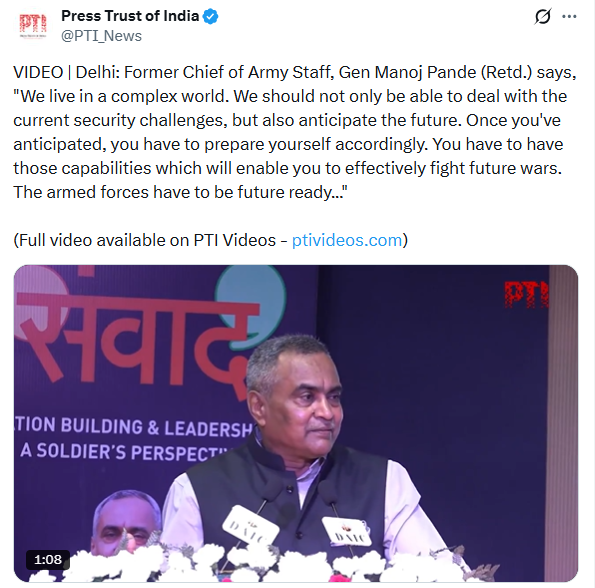
In the research of the viral video claiming that former Army Chief General Manoj Pande attacked the Modi government, we conducted a reverse image search with the help of keyframes. During this process, we found a video uploaded on March 14 on the X account of the news agency Press Trust of India (PTI).
The visuals present in the video matched those in the viral video.
In this video, former Army Chief General Manoj Pande was seen delivering a speech in Marathi and English. However, during this, he was talking about increasing new kinds of capabilities in view of the current situation and not mentioning Israel, as claimed in the viral video. In the approximately 1 minute 15 seconds long video, he did not give any such statement as present in the viral video.
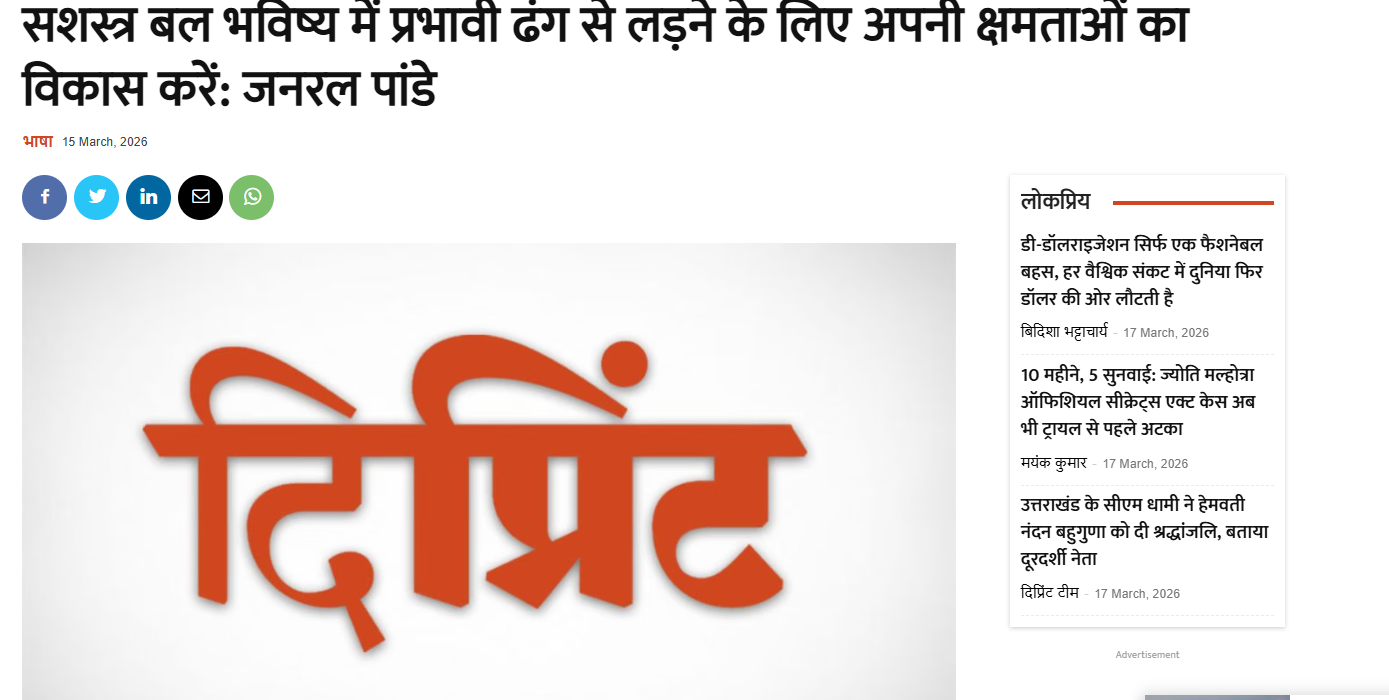
While taking the research forward, we found a report published on March 15, 2026, on the website of ThePrint. This report mentioned the speech delivered by former Army Chief General Manoj Pande, but no report mentioned the statement shown in the viral video.
Conclusion:
Our research found that the audio present in the viral video is AI-generated. In the original video, he did not make any such statement.

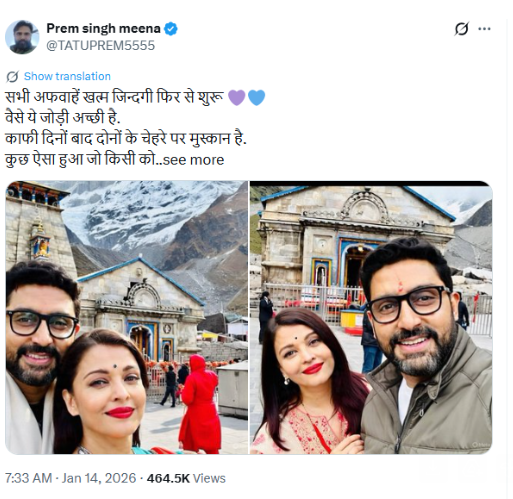
A photo featuring Bollywood actor Abhishek Bachchan and actress Aishwarya Rai is being widely shared on social media. In the image, the Kedarnath Temple is clearly visible in the background. Users are claiming that the couple recently visited the Kedarnath shrine for darshan.
Cyber Peace Foundation’s research found the viral claim to be false. Our research revealed that the image of Abhishek Bachchan and Aishwarya Rai is not real, but AI-generated, and is being misleadingly shared as a genuine photograph.
Claim
On January 14, 2026, a user on X (formerly Twitter) shared the viral image with a caption suggesting that all rumours had ended and that the couple had restarted their life together. The post further claimed that both actors were seen smiling after a long time, implying that the image was taken during their visit to Kedarnath Temple.
The post has since been widely circulated on social media platforms
Fact Check:
To verify the claim, we first conducted a keyword search on Google related to Abhishek Bachchan, Aishwarya Rai, and a Kedarnath visit. However, we did not find any credible media reports confirming such a visit.
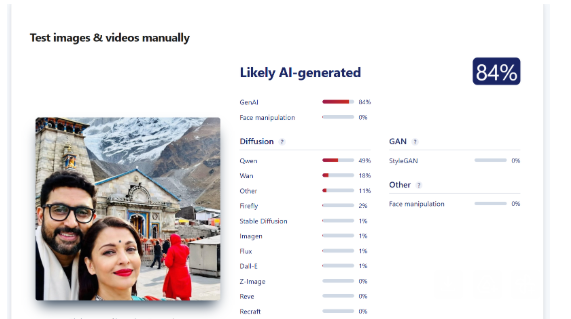
On closely examining the viral image, several visual inconsistencies raised suspicion about it being artificially generated. To confirm this, we scanned the image using the AI detection tool Sightengine. According to the tool’s analysis, the image was found to be 84 percent AI-generated.
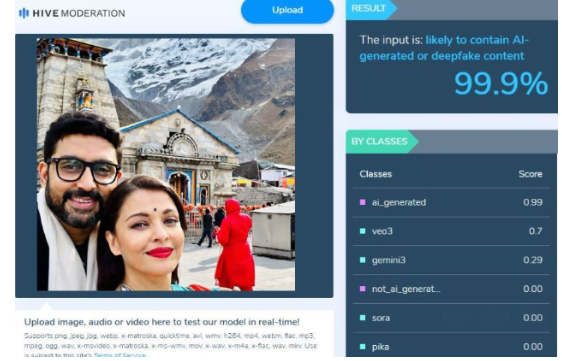
Additionally, we scanned the same image using another AI detection tool, HIVE Moderation. The results showed an even stronger indication, classifying the image as 99 percent AI-generated.
Conclusion
Our research confirms that the viral image showing Abhishek Bachchan and Aishwarya Rai at Kedarnath Temple is not authentic. The picture is AI-generated and is being falsely shared on social media to mislead users.

Executive Summary
A purported front page of The Hindu dated June 6, 1967, is being widely circulated on social media with the claim that then Prime Minister Indira Gandhi had urged Indians not to buy gold in any form and to follow “national discipline” by restricting gold consumption. The viral claim suggests that the appeal was part of the government’s efforts to conserve foreign exchange reserves, which were allegedly under severe pressure at the time. However, research conducted by CyberPeace Research Wing found the claim to be false. Our research revealed that the front page being circulated online is not authentic and has been digitally edited.
Claim
An X (formerly Twitter) user shared the viral newspaper clipping on May 12, 2026, and wrote:“In 1967, during a severe foreign exchange crisis, Indira Gandhi appealed to Indians not to buy gold.From ‘skip one meal’ to ‘don’t buy gold,’ Congress-era governance normalized shortages, restrictions, and sacrifice, while ordinary citizens paid the price for failed economic policies.”

Research
To verify the claim, we examined the official social media accounts of The Hindu. During the research, we found a post published on the publication’s official X account on May 12, 2026, clarifying that the viral image claiming to be the June 6, 1967 front page of The Hindu was digitally altered and not part of its official archives. The newspaper also urged readers to verify information carefully before sharing it online.

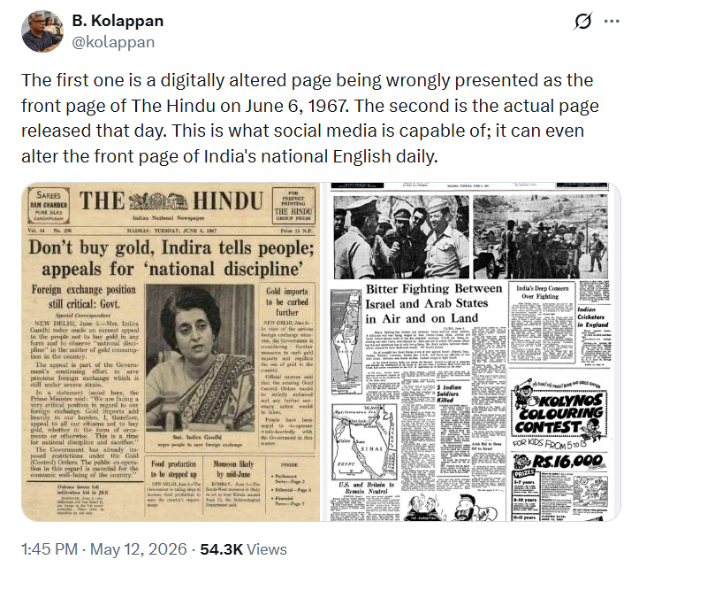
We also found an X post by B Kolappan, a journalist with The Hindu, who shared the original front page of the newspaper dated June 6, 1967, further exposing the viral image as fake.
For context, Prime Minister Narendra Modi, while addressing a public gathering on May 10, 2026, spoke about the possible economic impact of the ongoing conflict in the Middle East and advised people to avoid buying gold for a year, even during weddings or family functions. The viral claim appears to have resurfaced in this backdrop.

Conclusion
Our research found that the alleged 1967 front page of The Hindu circulating on social media is digitally edited and fake. There is no evidence that the viral newspaper page is authentic or part of The Hindu’s archival records.
