
Alert: Cybercriminals Target Taxpayers and Banking Customers with Phishing Campaign and Malicious Application
March 3rd 2023, New Delhi: If you have received any message that contains a link asking users to download an application to avail Income Tax Refund or KYC benefits with the name of Income Tax Department or reputed Banks, Beware!
CyberPeace Foundation and Autobot Infosec Private Limited along with the academic partners under CyberPeace Center of Excellence (CCoE) recently conducted five different studies on phishing campaigns that have been circulating on the internet by using misleading tactics to convince users to install malicious applications on their devices. The first campaign impersonates the Income Tax Department, while the rest of the campaigns impersonate ICICI Bank, State Bank of India, IDFC Bank and Axis bank respectively. The phishing campaigns aim to trick users into divulging their personal and financial information.
After a detailed study, the research team found that:
- All campaigns appear to be an offer from reputed entities, however hosted on third-party domains instead of the official website of the Income Tax Department or the respective Banks, raising suspicion.
- The applications ask several access permissions of the device. Moreover some of them seek users to provide full control of the device. Allowing such access permission could result in a complete compromise of the system, including access to sensitive information such as microphone recordings, camera footage, text messages, contacts, pictures, videos, and even banking applications.
- Cybercriminals created malicious applications using icons that closely resemble those of legitimate entities with the intention of enticing users into downloading the malicious applications.
- The applications collect user’s personal and banking information. Getting into this type of trap could lead users to face significant financial losses.
- While investigating the impersonated Income Tax Department’s application, the Research team identified the application sends http traffic to a remote server which acts as a Command and Control (CnC/C2) for the application.
- Customers who desire to avail benefits or refunds from respective banks, download relevant apps, believing that the chosen app will assist them. However, they are not always aware that the app may be fraudulent.
“The Research highlights the importance of being vigilant while browsing the internet and not falling prey to such phishing attacks. It is crucial to be cautious when clicking on links or downloading attachments from unknown sources, as they may contain malware that can harm the device or compromise the data.” spokesperson, CyberPeace added.
In addition to this in an earlier report released in last month, the same research team had drawn attention to the WhatsApp messages masquerading as an offer from Tanishq Jewellers with links luring unsuspecting users with the promise of free valentine’s day presents making the rounds on the app.
CyberPeace Advisory:
- The Research team recommends that people should avoid opening such messages sent via social platforms. One must always think before clicking on such links, or downloading any attachments from unauthorised sources.
- Downloading any application from any third party sources instead of the official app store should be avoided. This will greatly reduce the risk of downloading a malicious app, as official app stores have strict guidelines for app developers and review each app before it gets published on the store.
- Even if you download the application from an authorised source, check the app’s permissions before you install it. Some malicious apps may request access to sensitive information or resources on your device. If an app is asking for too many permissions, it’s best to avoid it.
- Keep your device and the app-store app up to date. This will ensure that you have the latest security updates and bug fixes.
- Falling into such a trap could result in a complete compromise of the system, including access to sensitive information such as microphone recordings, camera footage, text messages, contacts, pictures, videos, and even banking applications and could lead users to financial loss.
- Do not share confidential details like credentials, banking information with such types of Phishing scams.
- Never share or forward fake messages containing links on any social platform without proper verification.

Related Blogs
Executive Summary
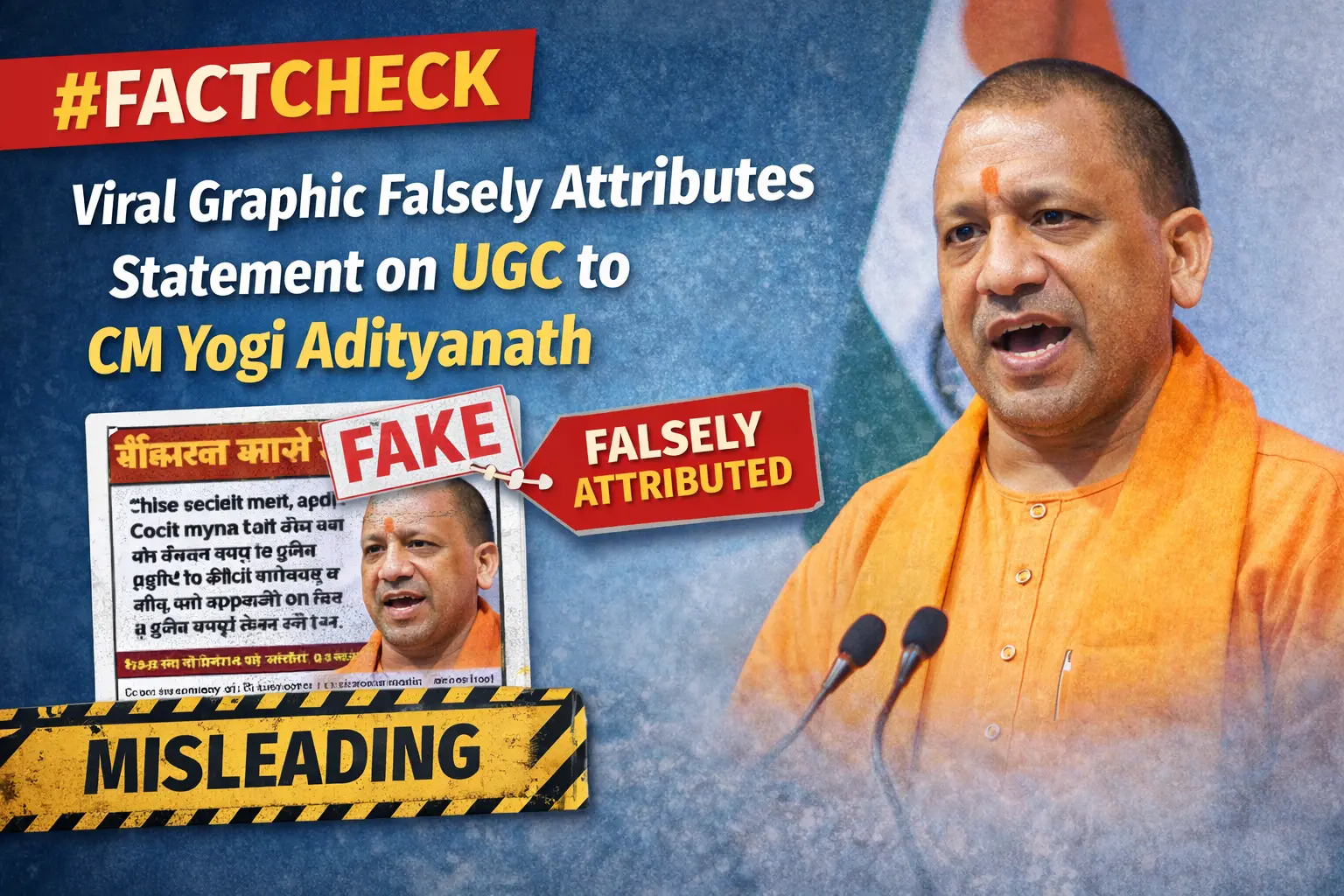
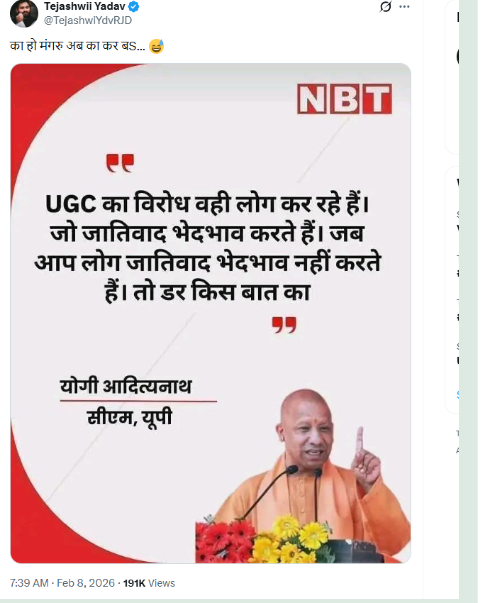
A news graphic is being shared on social media claiming that Uttar Pradesh Chief Minister Yogi Adityanath said,“Those who practice casteism and discrimination are the ones opposing UGC. If you do not indulge in caste-based discrimination, what is there to fear?” The CyberPeace’s research found the viral claim circulating on social media to be false. Our research revealed that Chief Minister Yogi Adityanath never made such a statement. It was also established that the viral news graphic has been digitally edited.
Claim
On February 8, a user on social media platform X (formerly Twitter) shared a news graphic bearing the logo of Navbharat Times, attributing the above statement to CM Yogi Adityanath. The post and its archived version can be seen below, along with screenshots. (Links and screenshots provided)
Fact Check:
To verify the authenticity of the claim, we conducted a keyword-based search on Google. However, we did not find any credible or reliable media report supporting the viral statement. We further examined the official social media accounts of Chief Minister Yogi Adityanath, including his Facebook and Instagram handles. Our review found no post, speech, or statement resembling the claim made in the viral graphic.
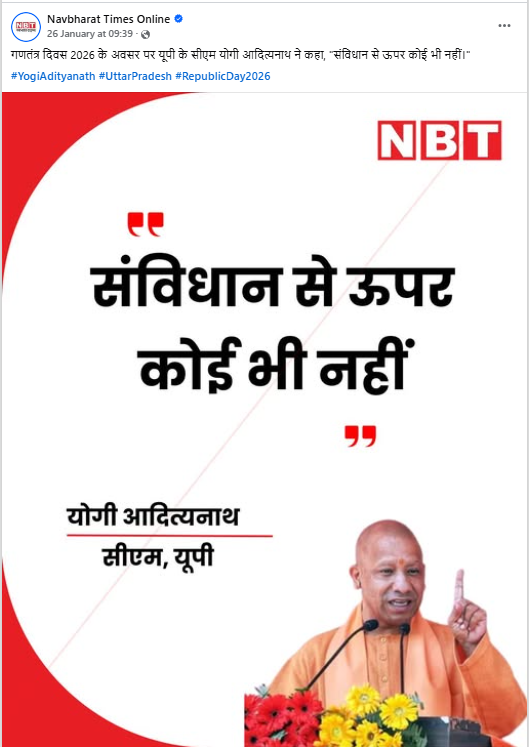
Continuing the research , we examined the official social media accounts of Navbharat Times. During this process, we found the original graphic published on the Navbharat Times Facebook page on January 26, 2026. The caption of the original graphic read: “On the occasion of Republic Day 2026, Uttar Pradesh Chief Minister Yogi Adityanath said, ‘No one is above the Constitution.’”
This clearly differs from the claim made in the viral graphic, indicating that the latter was altered.
Conclusion
Our research confirms that Uttar Pradesh Chief Minister Yogi Adityanath did not make the statement being attributed to him on social media. The viral news graphic is digitally edited and misleading. The claim, therefore, is false.

Introduction
Misinformation spreads faster than a pimple before your best friend's wedding, and these viral skincare hacks on social media can do more harm than good if smeared on without a second thought. The unverified skin care tips, exaggerated results, and product endorsements lacking proper dermatological backing can often lead to breakouts and serious damage.
The Allure and Risks of Online Skincare Trends
In the age of social media, beauty advice is easily accessible, but not all trending skincare hacks are beneficial. Influencers lacking professional dermatological knowledge often endorse "medical grade" skincare products, which may not be suitable for all skin types. The viral DIY skincare hacks, such as natural remedies like multani mitti (Fuller's earth), have found a new audience online. However, suppose such skincare tips are approached without due care and caution regarding their suitability for different skin types, or without the proper formulation of ingredients. In that case, they can result in skin problems. It is crucial to approach online skincare advice with a critical eye, as not all trends are backed by scientific research.
CyberPeace Recommendations
- Influencer Responsibility and Ethical Endorsements in Skincare
Influencers play a crucial role in shaping public perception in the skincare and lifestyle industries. However, they must exercise due diligence before endorsing skincare products or practices, as misinformation can lead to financial loss and health consequences. Influencers should only promote products they have personally tested or vetted by dermatologists or skincare professionals. They should also research the brand's credibility, check ingredients for safety, and understand the product's target audience.
- Strengthening Digital Literacy in Skincare Spaces
CyberPeace highlights that improving digital literacy is one of the best strategies to stop the spread of false information about skincare. Users nowadays, particularly young people, are continuously exposed to a deluge of wellness and beauty-related content. Many people are duped by overstated claims, pseudoscientific cures, and influencer-driven marketing masquerading as sound advice if they lack the necessary digital literacy. We recommend supporting digital literacy initiatives that teach users how to evaluate sources, think critically, and comprehend how algorithms promote content. Long-term impact is thought to be achieved through influencer partnerships, gamified learning modules, and community workshops that promote media literacy.
- Recommendation for Users to Prioritise Research and Critical Thinking
Users should prioritise research and critical thinking when engaging with skincare content online. It's crucial to distinguish between valid advice and misinformation. Thorough research, including expert reviews, ingredient checks, and scientific sources, is essential. Questioning endorsements and relying on trusted platforms and dermatologists can help ensure a skincare routine based on sound practices.
- Mandating Transparency from Influencers and Brands
Enforcing stronger transparency laws for influencers and skincare companies is a key suggestion. Social media influencers frequently neglect to reveal sponsored collaborations or paid advertisements, giving followers the impression that the skincare advice is based on the creators' own experience and objective judgment. This dishonest practice frequently promotes goods with little to no scientific support and feeds false information. The social media companies need to be proactive in identifying and removing content that violates disclosure and advertising guidelines.
- Creating a Verified Registry for Skincare Professionals
Increasing the voices of real experts is one of the most important strategies to build credibility and trust online. The establishment of a publicly available, validated registry of certified dermatologists, cosmetologists, and skincare scientists is suggested by cybersecurity experts and medical professionals. These experts could then receive a "verified expert" badge from social media companies, making it easier for users to discern between content created by unqualified people and genuine, evidence-based advice. Algorithms that promote such verified content would inevitably limit the dissemination of false information.
- Enforcing Platform Accountability and Reporting System
There needs to be platform-level accountability and safeguard mechanisms in case of any false information about skincare. Platforms should monitor repeat offenders and implement a tiered penalty system that includes content removal and temporary or permanent bans on such malicious user profiles.
References

Executive Summary:
A video that circulated on social media to show Iranian President Ebrahim Raisi inside a helicopter moments before the tragic crash on May 20, 2024, has equally been proven to be fake. The validation of information leaves no doubt, that the video was shot in January 2024, which showed Raisi’s visiting Nemroud Reservoir Dam project. As a means of verifying the origin of the video, the CyberPeace Research Team conducted reverse image search and analyzed the information obtained from the Islamic Republic News Agency, Mehran News, and the Iranian Students’ News Agency. Further, the associated press pointed out inconsistencies between the part in the video that went viral and the segment that was shown by Iranian state television. The original video is old and it is not related to the tragic crash as there is incongruence between the snowy background and the green landscape with a river presented in the clip.

Claims:
A video circulating on social media claims to show Iranian President Ebrahim Raisi inside a helicopter an hour before his fatal crash.


Fact Check:
Upon receiving the posts, in some of the social media posts we found some similar watermarks of the IRNA News agency and Nouk-e-Qalam News.

Taking a cue from this, we performed a keyword search to find any credible source of the shared video, but we found no such video uploaded by the IRNA News agency on their website. Recently, they haven’t uploaded any video regarding the viral news.
We closely analyzed the video, it can be seen that President Ebrahim Raisi was watching outside the snow-covered mountain, but in the internet-available footage regarding the accident, there were no such snow-covered mountains that could be seen but green forest.
We then checked for any social media posts uploaded by IRNA News Agency and found that they had uploaded the same video on X on January 18, 2024. The post clearly indicates the President’s aerial visit to Nemroud Dam.

The viral video is old and does not contain scenes that appear before the tragic chopper crash involving President Raisi.
Conclusion:
The viral clip is not related to the fatal crash of Iranian President Ebrahim Raisi's helicopter and is actually from a January 2024 visit to the Nemroud Reservoir Dam project. The claim that the video shows visuals before the crash is false and misleading.
- Claim: Viral Video of Iranian President Raisi was shot before fatal chopper crash.
- Claimed on: X (Formerly known as Twitter), YouTube, Instagram
- Fact Check: Fake & Misleading
