
131 percent increase in viruses targeted towards remote workers: Fortinet
"Cybercriminals are unleashing a surprisingly high volume of new threats in this short period of time to take advantage of inadvertent security gaps as organizations are in a rush to ensure business continuity.”
Cyber security firm Fortinet on Monday announced that over the past several weeks, it has been monitoring a significant spike in COVID-19 related threats.
An unprecedented number of unprotected users and devices are now online with one or two people in every home connecting remotely to work through the internet. Simultaneously there are children at home engaged in remote learning and the entire family is engaged in multi-player games, chatting with friends as well as streaming music and video. The cybersec firm’s FortiGuard Labs is observing this perfect storm of opportunity being exploited by cybercriminals as the Threat Report on the Pandemic highlights:
A surge in Phishing Attacks: The research shows an average of about 600 new phishing campaigns every day. The content is designed to either prey on the fears and concerns of individuals or pretend to provide essential information on the current pandemic. The phishing attacks range from scams related to helping individuals deposit their stimulus for Covid-19 tests, to providing access to Chloroquine and other medicines or medical device, to providing helpdesk support for new teleworkers.
Phishing Scams Are Just the Start: While the attacks start with a phishing attack, their end goal is to steal personal information or even target businesses through teleworkers. Majority of the phishing attacks contain malicious payloads – including ransomware, viruses, remote access trojans (RATs) designed to provide criminals with remote access to endpoint systems, and even RDP (remote desktop protocol) exploits.
A Sudden Spike in Viruses: The first quarter of 2020 has documented a 17% increase in viruses for January, a 52% increase for February and an alarming 131% increase for March compared to the same period in 2019. The significant rise in viruses is mainly attributed to malicious phishing attachments. Multiple sites that are illegally streaming movies that were still in theatres secretly infect malware to anyone who logs on. Free game, free movie, and the attacker is on your network.
Risks for IoT Devices magnify: As users are all connected to the home network, attackers have multiple avenues of attack that can be exploited targeting devices including computers, tablets, gaming and entertainment systems and even online IoT devices such as digital cameras, smart appliances – with the ultimate goal of finding a way back into a corporate network and its valuable digital resources.
Ransomware like attack to disrupt business: If the device of a remote worker can be compromised, it can become a conduit back into the organization’s core network, enabling the spread of malware to other remote workers. The resulting business disruption can be just as effective as ransomware targeting internal network systems for taking a business offline. Since helpdesks are now remote, devices infected with ransomware or a virus can incapacitate workers for days while devices are mailed in for reimaging.
“Though organizations have completed the initial phase of transitioning their entire workforce to remote telework and employees are becoming increasingly comfortable with their new reality, CISOs continue to face new challenges presented by maintaining a secure teleworker business model. From redefining their security baseline, or supporting technology enablement for remote workers, to developing detailed policies for employees to have access to data, organizations must be nimble and adapt quickly to overcome these new problems that are arising”, said Derek Manky, Chief, Security Insights & Global Threat Alliances at Fortinet – Office of CISO.

Related Blogs

Introduction:
This report examines ongoing phishing scams targeting "State Bank of India (SBI)" customers, India's biggest public bank using fake SelfKYC APKs to trick people. The image plays a part in a phishing plan to get users to download bogus APK files by claiming they need to update or confirm their "Know Your Customer (KYC)" info.
Fake Claim:
A picture making the rounds on social media comes with an APK file. It shows a phishing message that says the user's SBI YONO account will stop working because of their "Old PAN card." It then tells the user to install the "WBI APK" APK (Android Application Package) to check documents and keep their account open. This message is fake and aims to get people to download a harmful app.
Key Characteristics of the Scam:
- The messages "URGENTLY REQUIRED" and "Your account will be blocked today" show how scammers try to scare people into acting fast without thinking.
- PAN Card Reference: Crooks often use PAN card verification and KYC updates as a trick because these are normal for Indian bank customers.
- Risky APK Downloads: The message pushes people to get APK files, which can be dangerous. APKs from places other than the Google Play Store often have harmful software.
- Copying the Brand: The message looks a lot like SBI's real words and logos to seem legit.
- Shady Source: You can't find the APK they mention on Google Play or SBI's website, which means you should ignore the app right away.
Modus Operandi:
- Delivery Mechanism: Typically, users of messaging services like "WhatsApp," "SMS," or "email" receive identical messages with an APK link, which is how the scam is distributed.
- APK Installation: The phony APK frequently asks for a lot of rights once it is installed, including access to "SMS," "contacts," "calls," and "banking apps."
- Data Theft: Once installed, the program may have the ability to steal card numbers, personal information, OTPs, and banking credentials.
- Remote Access: These APKs may occasionally allow cybercriminals to remotely take control of the victim's device in order to carry out fraudulent financial activities.
While the user installs the application on their device the following interface opens:


It asks the user to allow the following:
- SMS is used to send and receive info from the bank.
- User details such as Username, Password, Mobile Number, and Captcha.
Technical Findings of the Application:
Static Analysis:
- File Name: SBI SELF KYC_015850.apk
- Package Name: com.mark.dot.comsbione.krishn
- Scan Date: Sept. 25, 2024, 6:45 a.m.
- App Security Score: 52/100 (MEDIUM RISK)
- Grade: B
File Information:
- File Name: SBI SELF KYC_015850.apk
- Size: 2.88MB
- MD5: 55fdb5ff999656ddbfa0284d0707d9ef
- SHA1: 8821ee6475576beb86d271bc15882247f1e83630
- SHA256: 54bab6a7a0b111763c726e161aa8a6eb43d10b76bb1c19728ace50e5afa40448
App Information:
- App Name: SBl Bank
- Package Name:: com.mark.dot.comsbione.krishn
- Main Activity: com.mark.dot.comsbione.krishn.MainActivity
- Target SDK: 34
- Min SDK: 24
- Max SDK:
- Android Version Name:: 1.0
- Android Version Code:: 1
App Components:
- Activities: 8
- Services: 2
- Receivers: 2
- Providers: 1
- Exported Activities: 0
- Exported Services: 1
- Exported Receivers: 2
- Exported Providers:: 0
Certificate Information:
- Binary is signed
- v1 signature: False
- v2 signature: True
- v3 signature: False
- v4 signature: False
- X.509 Subject: CN=PANDEY, OU=PANDEY, O=PANDEY, L=NK, ST=NK, C=91
- Signature Algorithm: rsassa_pkcs1v15
- Valid From: 20240904 07:38:35+00:00
- Valid To: 20490829 07:38:35+00:00
- Issuer: CN=PANDEY, OU=PANDEY, O=PANDEY, L=NK, ST=NK, C=91
- Serial Number: 0x1
- Hash Algorithm: sha256
- md5: 4536ca31b69fb68a34c6440072fca8b5
- sha1: 6f8825341186f39cfb864ba0044c034efb7cb8f4
- sha256: 6bc865a3f1371978e512fa4545850826bc29fa1d79cdedf69723b1e44bf3e23f
- sha512:05254668e1c12a2455c3224ef49a585b599d00796fab91b6f94d0b85ab48ae4b14868dabf16aa609c3b6a4b7ac14c7c8f753111b4291c4f3efa49f4edf41123d
- PublicKey Algorithm: RSA
- Bit Size: 2048
- Fingerprint: a84f890d7dfbf1514fc69313bf99aa8a826bade3927236f447af63fbb18a8ea6
- Found 1 unique certificate
App Permission

1. Normal Permissions
- Access_network_state: Allows the App to View the Network Status of All Networks.
- Foreground_service: Enables Regular Apps to Use Foreground Services.
- Foreground_service_data_sync: Allows Data Synchronization With Foreground Services.
- Internet: Grants Full Internet Access.
2. Signature Permission:
- Broadcast_sms: Sends Sms Received Broadcasts. It Can Be Abused by Malicious Apps to Forge Incoming Sms Messages.
3. Dangerous Permissions:
- Read_phone_numbers: Grants Access to the Device’s Phone Number(S).
- Read_phone_state: Reads the Phone’s State and Identity, Including Phone Features and Data.
- Read_sms: Allows the App to Read Sms or Mms Messages Stored on the Device or Sim Card. Malicious Apps Could Use This to Read Confidential Messages.
- Receive_sms: Enables the App to Receive and Process Sms Messages. Malicious Apps Could Monitor or Delete Messages Without Showing Them to the User.
- Send_sms: Allows the App to Send Sms Messages. Malicious Apps Could Send Messages Without the User’s Confirmation, Potentially Leading to Financial Costs.
On further analysis on virustotal platform using md5 hash file, the following results were retrieved where there are 24 security vendors out of 68, marked this apk file as malicious and the graph represents the distribution of malicious file in the environment.


Key Takeaways:
- Normal Permissions: Generally Safe for Accessing Basic Functionalities (Network State, Internet).
- Signature Permissions: May Pose Risks When Misused, Especially Related to Sms Broadcasts.
- Dangerous Permissions: Provide Sensitive Data Access, Such as Phone Numbers and Device Identity, Which Can Be Exploited by Malicious Apps.
- The Dangerous Permissions Pose Risks Regarding the Reading, Receiving, and Sending of Sms, Which Can Lead to Privacy Breaches or Financial Consequences.
How to Identify the Scam:
- Official Statement: SBI never asks clients to download unauthorized APKs for upgrades related to KYC or other services. All formal correspondence takes place via the SBI YONO app, which may be found in reputable app shops.
- No Immediate Threats: Bank correspondence never employs menacing language or issues harsh deadlines, such as "your account will be blocked today."
- Email Domain and SMS Number: Verified email addresses or phone numbers are used for official SBI correspondence. Generic, unauthorized numbers or addresses are frequently used in scams.
- Links and APK Files: Steer clear of downloading APK files from unreliable sources at all times. For app downloads, visit the Apple App Store or Google Play Store instead.
CyberPeace Advisory:
- The Research team recommends that people should avoid opening such messages sent via social platforms. One must always think before clicking on such links, or downloading any attachments from unauthorised sources.
- Downloading any application from any third party sources instead of the official app store should be avoided. This will greatly reduce the risk of downloading a malicious app, as official app stores have strict guidelines for app developers and review each app before it gets published on the store.
- Even if you download the application from an authorised source, check the app's permissions before you install it. Some malicious apps may request access to sensitive information or resources on your device. If an app is asking for too many permissions, it's best to avoid it.
- Keep your device and the app-store app up to date. This will ensure that you have the latest security updates and bug fixes.
- Falling into such a trap could result in a complete compromise of the system, including access to sensitive information such as microphone recordings, camera footage, text messages, contacts, pictures, videos, and even banking applications and could lead users to financial loss.
- Do not share confidential details like credentials, banking information with such types of Phishing scams.
- Never share or forward fake messages containing links on any social platform without proper verification.
Conclusion:
Fake APK phishing scams target financial institutions more often. This report outlines safety steps for SBI customers and ways to spot and steer clear of these cons. Keep in mind that legitimate banks never ask you to get an APK from shady websites or threaten to close your account right away. To stay safe, use SBI's official YONO app on both systems and get apps from trusted places like Google Play or the Apple App Store. Check if the info is true before you do anything turn on 2FA for all your bank and money accounts, and tell SBI or your local cyber police about any scams you see.

Executive Summary
Two powerful earthquakes measuring 7.2 and 7.5 in magnitude struck Venezuela on June 24, 2026, within a span of one minute, causing widespread destruction. Hundreds of buildings were reportedly reduced to rubble. Against this backdrop, a video is being widely shared on social media showing two high-rise buildings colliding with each other before collapsing. Several users have claimed that the footage shows the aftermath of the recent earthquake in Venezuela. CyberPeace Research Wing team conducted a detailed research and found that the viral video is not authentic. The footage was generated using artificial intelligence and is being falsely shared as real visuals from the Venezuela earthquake.
Claim
A Facebook user, “Rana Yashwant,” shared the video on June 26, 2026, with the caption: "Venezuela: The high-rise buildings fell as if they were fast-moving train coaches. How long could they withstand such a powerful earthquake? Both collapsed face-first. What happened to the people? Who knows." https://www.facebook.com/reel/1036186612182534 ,https://perma.cc/98PE-DFKB

Fact Check
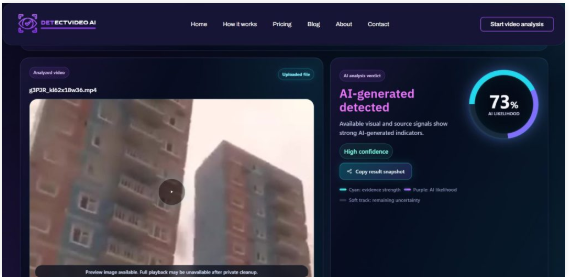
We first extracted several keyframes from the viral video and conducted reverse image searches using Google Lens. However, we found no credible news reports or evidence linking the footage to the recent earthquakes in Venezuela. A closer examination of the video revealed several anomalies. Despite the intense shaking and collision of the buildings, the windows and structural features remained unchanged throughout the footage. No visible deformation or damage appeared in the buildings before they collapsed, which is highly unrealistic and raised suspicions that the video had been generated using AI. To verify this, we analyzed the video using the AI detection tool detectvideo.ai. The results indicated a 73 percent probability that the footage was AI-generated.
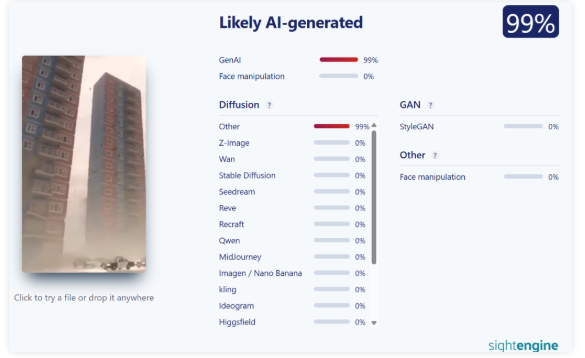
Similarly, analysis conducted using Sightengine found a 99 percent probability that the video had been created using artificial intelligence.
Conclusion
Our research found the viral claim to be false. The video showing two buildings colliding and collapsing is not related to the recent earthquakes in Venezuela. The footage was generated using artificial intelligence and is being misleadingly shared as real disaster footage.
.webp)
Overview:
WazirX is the platform for cryptocurrencies, based in India that has been hacked, and it made a loss of more than $230 million in cryptocurrency. This case concerned an unauthorized transaction with a multisignature or multisig, wallet controlled through Liminal’a digital asset management platform. These attacking incidents have thereafter raised more questions on the security of the Cryptocurrency exchanges and efficiency of the existing policies and laws.
Wallet Configuration and Security Measures
This wallet was breached and had a multisig setting meaning that more than one signature was needed to authorize a transaction. Specifically, it had six signatories: five are funded by WazirX and one is funded by Liminal. Every transaction needed the approval of at least three signatories of WazirX, all of whom had addressed security concerns by using Ledger’s hardware wallets; while the Liminal, too, had a signatory, for approval.
To further increase the level of security of the transactions, a whitelisting policy was introduced, only limited addresses were authorized to receive funds. This system was rather vulnerable, and the attackers managed to grasp the discrepancy between the information available through Liminal’s interface and the content of the transaction to seize unauthorized control over the wallet and implement the theft.
Modus Operandi: Attack Mechanics
The cyber attack appears to have been carefully carried out, with preliminary investigations suggesting the following tactics:
- Payload Manipulation: The attackers apparently substituted the transaction’s payload during signing; hence, they can reroute the collected funds into an unrelated wallet.
- Chain Hopping: To make it much harder to track their movements, the attackers split large amounts of money across multiple blockchains and broke tens of thousands of dollars into thousands of transactions involving different cryptocurrencies. This technique makes it difficult to trace people and things.
- Zero Balance Transactions: There were also some instances where it ended up with no Ethereum (ETH) in the balance and such wallets also in use for the purpose of further anonymization of the transactions.
- Analysis of the blockchain data suggested the enemy might have been making the preparations for this attack for several days prior to their attack and involved a high amount of planning.
Actions taken by WazirX:
Following the attack, WazirX implemented a series of immediate actions:
- User Notifications: The users were immediately notified of the occurrence of the breach and the possible risk it posed to them.
- Law Enforcement Engagement: The matters were reported to the National Cyber Crime Reporting Portal and specific authorities of which the Financial Intelligence Unit (FIU) and the Computer Emergency Response Team (CERT-In).
- Service Suspension: WazirX had suspended all its trading operations and user deposits’ and withdrawals’ to minimize further cases and investigate.
- Global Outreach: The exchange contacted more than 500 cryptocurrency exchanges and requested to blacklist the wallet’s addresses linked to the theft.
- Bounty Program: A bounty program was announced to encourage people to share information that can enable the authorities to retrieve the stolen money. A maximum of 23 million dollars was placed on the bounty.
Further Investigations
WazirX stated that it has contracted the services of cybersecurity professionals to help in the prosecution process of identifying and compensating for the losses. The exchange is still investigating the forensic data and working with the police for tracking the stolen assets. Nevertheless, the prospects of full recovery may be quite questionable primarily because of complexity of the attack and the methods used by the attackers.
Precautionary measures:
The WazirX cyber attack clearly implies that there is the necessity to improve the security and the regulation of the cryptocurrency industry. As exchanges become increasingly targeted by hackers, there is a pressing need for:
- Stricter Security Protocols: The commitment to technical innovations, such as integration of MFA, as well as constant monitoring of the users’ wallets’ activities.
- Regulatory Oversight: Formalization of the laws that require proper security for the cryptocurrency exchange platforms to safeguard their users as well as their investments.
- Community Awareness: To bypass such predicaments, there is a need to study on emergent techniques in spreading awareness, particularly in cases of scams or phishing attempts that are likely to follow such breaches.
Conclusion:
The cyber attack on WazirX in the field of cryptocurrency market, shows weaknesses and provides valuable lessons for enhancing the security. This attack highlights critical vulnerabilities in cryptocurrency exchanges, even though employing advanced security measures like multisignature wallets and whitelisting policies. The attack's complexity, involving payload manipulation, chain hopping, and zero balance transactions, underscores the attackers' meticulous planning and the challenges in tracing stolen assets. This case brings a strong message regarding the necessity of solid security measures, and constant attention to security in the rapidly growing world of digital assets. Furthermore, the incident highlights the importance of community awareness and education on emerging threats like scams and phishing attempts, which usually follow such breaches. By fostering a culture of vigilance and knowledge, the cryptocurrency community can better defend against future attacks.
Reference:
https://wazirx.com/blog/important-update-cyber-attack-incident-and-measures-to-protect-your-assets/
https://www.linkedin.com/pulse/wazirx-cyberattack-in-depth-analysis-jyqxf
