
Your Guide to Cyber Safe Mahakumbh 2025
Introduction
The Kumbh Mela is known worldwide as India's most significant pilgrimage and has earned a place on the UNESCO Intangible Cultural Heritage of Humanity list in 2017. This year, the Maha Kumbh will be held in Prayagraj, Uttar Pradesh, with 40 crore devotees from all over the world expected to attend this momentous event from January 13th to 26th February 2025. As the world embraces the blessings of digitalisation, people are increasingly relying on the Internet for arranging their travel, booking rooms, and securing accommodations for this grand spiritual journey.
However, amidst this digital age, where the conveniences offered are manifold, there also lurks the shadow of deceit. Cybercriminals are finding innovative ways to entrap innocent individuals. Fraudulent activities are on the rise, with wrongdoers operating fake websites that promise secure bookings for cottages, tents, and other accommodations for the Mahakumbh event. Like the deceptive mirage that the desert traveller may mistakenly believe to be an oasis, these malicious sites lure pilgrims with the false hope of easy arrangements, only to exploit their trust and commit malicious cyber fraudulent activities.
Policy and Preventive Measures Taken by Government
This year, the government has taken steps to utilise digitalisation services to enhance the experience of devotees, blending innovation with tradition. However, considering the rise in cyber scams, a dedicated cyber police station has also been established at Maha Kumbh 2025 to address threats such as the misuse of AI, the dark web, and social media platforms. This initiative aims to protect devotees from potential scams.
To strengthen safety measures, a special team of selected officers from across the state has been deployed in Mahakumbh Nagar, Prayagraj, to provide cybersecurity and ensure the safety of pilgrims. A dedicated cyber police station or digital police station will ensure round-the-clock monitoring of cyberspace.
The cybersecurity team has already identified 44 suspicious websites and initiated action against them. To further safeguard devotees attending Maha Kumbh 2025, a large-scale awareness campaign is being conducted to educate users about potential cyber threats.
The Role of Digital Discipline in Navigating the Uncharted Waters of the Internet
As the Yajurveda (ancient Vedic scriptures of Hinduism) reminds us ‘सत्यं चानृतं च सत्यं अभवत्, यदेतत् तपसा तप्यताम्।’. This learning translates into English as "Truth and falsehood are both present, yet truth is purified through intense discipline”. The Mahakumbh is a confluence not just of rivers but of faith and humanity's eternal quest for truth (Satyam). In the digital age, this vigilance extends to protecting ourselves from cyber frauds and scams that exploit the sanctity of occasions like the Mahakumbh. Just as devotees seek purity through holy rituals, we must also embrace Digital Discipline to navigate the confluence of tradition and technology safely.
Here are some Digital Discipline best practices you must follow:
- Be cautious of fake websites, fraudulent travel agencies, and scam bookings. Always verify legitimacy before engaging in any transactions.
- Stay alert for fake donation requests and only contribute to verified organizations.
- Be aware of any mis/disinformation and implausible claims surrounding the Mahakumbh event and verify it from authenticated sources. The official website of Mahakumbh is https://kumbh.gov.in.
- To report any cybercrime or issue, you can report it on the National Cyber Crime Reporting Portal at https://cybercrime.gov.in/, equipped with a 24x7 helpline 1930 that serves as a powerful resource available to the victims of cybercrimes to report their cases.
Conclusion
Netizens worldwide must prioritise Digital Discipline to ensure they are safeguarded from the snares of these cyber miscreants, so that they may safely and joyfully embark on their journey to the Maha Kumbh and receive divine blessings and purity of purpose through the experience.
References
- https://www.deccanherald.com/india/uttar-pradesh/up-police-gets-on-its-toes-to-ensure-cyber-safe-maha-kumbh-3335911
- https://www.hindustantimes.com/cities/others/four-cyber-crooks-held-for-operating-fake-booking-websites-101735326388201.html
- https://www.indiatvnews.com/uttar-pradesh/maha-kumbh-2025-cyber-police-station-set-up-in-prayagraj-to-safeguard-devotees-from-online-frauds-in-city-preparation-security-other-details-2024-12-11-965745
- https://organiser.org/2024/12/12/268915/bharat/mahakumbh-2025-cyber-police-station-set-up-to-protect-devotees-from-ai-and-social-media-scammers/
- https://www.ptinews.com/story/national/maha-kumbh-56-cyber-warriors-deployed-to-safeguard-devotees-against-online-scams/2135062

Related Blogs
Executive Summary
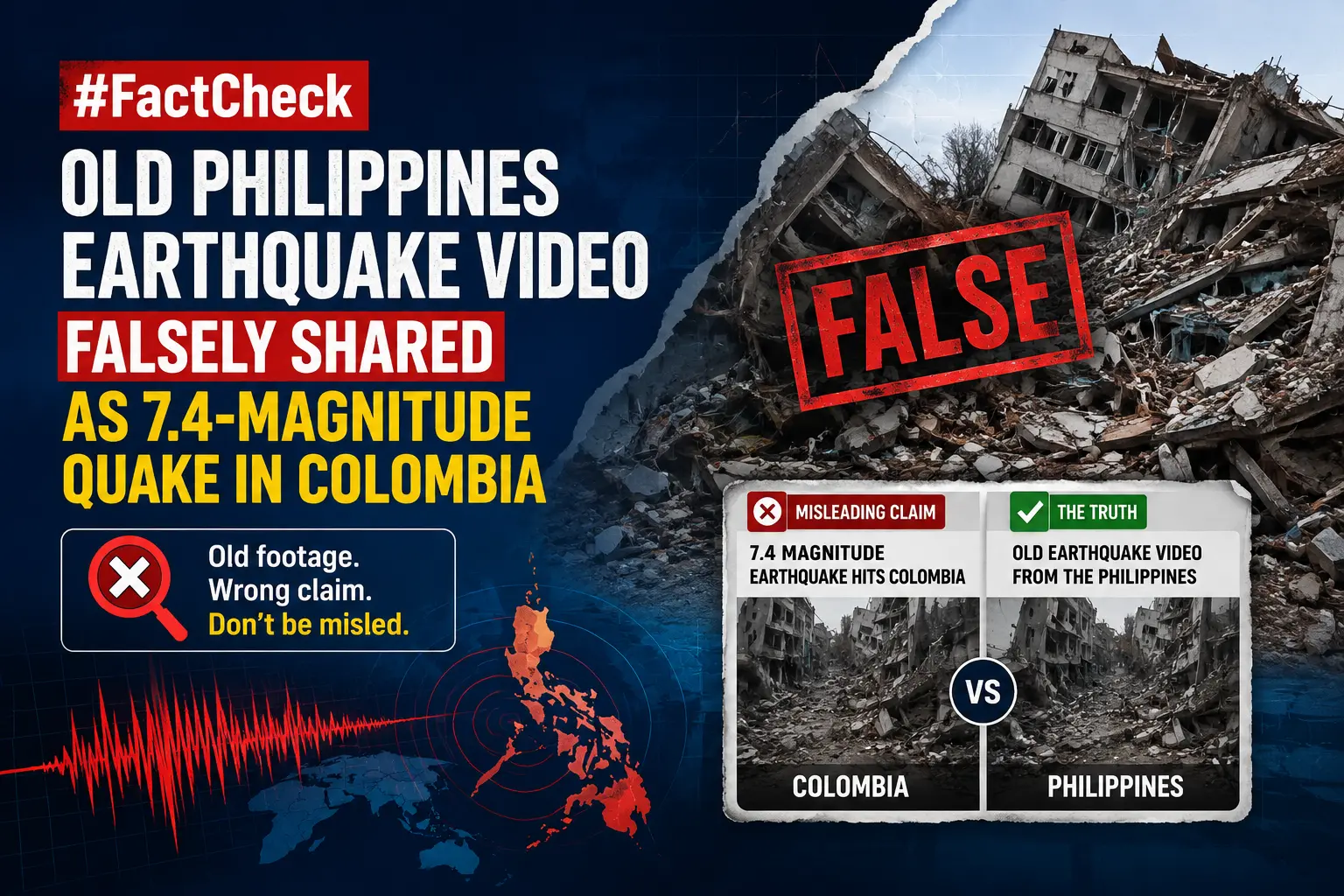
A video showing children crouching as the ground shakes violently is being widely shared on social media with the claim that it shows the aftermath of a devastating 7.4-magnitude earthquake that struck Colombia on August 10, 2026. However, the CyberPeace Research Wing found that the video is not from Colombia. The footage was recorded in the Philippines two months earlier during a more powerful earthquake.
Claim
An X user shared the video on August 10, 2026, claiming that it showed a massive 7.4-magnitude earthquake in Colombia that killed hundreds of people and destroyed thousands of homes. “Massive 7.4 magnitude earthquake in Colombia! Hundreds dead, thousands of homes destroyed,” the post claimed.
https://x.com/anandsh04294243/status/2086911617938362779

Fact Check
To verify the claim, the Desk conducted a reverse image search of keyframes from the viral video. The search led to the same footage being shared on social media on June 8, where it was linked to a powerful earthquake in the southern Philippines. The posts identified the footage as being related to a 7.8-magnitude earthquake that struck the region, causing buildings to collapse, triggering landslides and prompting tsunami warnings.
https://x.com/WeatherMonitors/status/2063855713223635055
Further research found that the video was recorded at Tubalan Elementary School in Malita, Davao Occidental province, Philippines.

According to the edit history of the Facebook post, the user initially stated that the footage showed the first day of school at Tubalan Elementary School. The user later updated the caption, urging viewers not to blame the teachers. The updated post stated that the students were outside near the school’s basketball court when the earthquake struck and were subsequently evacuated to safety without any injuries. The school also issued a separate post on Facebook to address what it described as a misconception arising from the video circulating on social media. The school clarified that the outdoor gymnasium was not being used as an evacuation area after the earthquake. It said the students were already inside the gymnasium for the scheduled flag ceremony when the earthquake occurred.
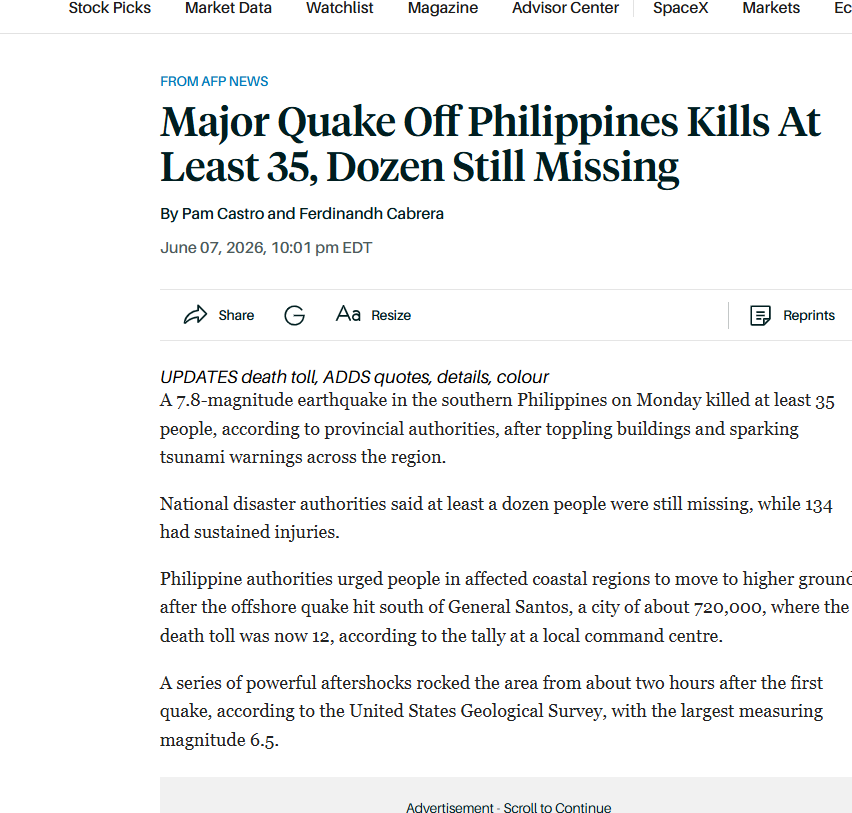
The Desk also searched for reports about the earthquake and found a detailed report published by Barron's, which confirmed the occurrence of a major earthquake off the southern Philippines. The report also mentioned casualties and tsunami warnings following the quake. https://www.barrons.com/news/major-quake-off-philippines-kills-one-triggers-tsunami-warnings-665c527c
Conclusion
The viral video does not show a 7.4-magnitude earthquake in Colombia. The footage was recorded at Tubalan Elementary School in the Philippines and was shared online in June 2026 in connection with a powerful earthquake that struck the southern Philippines. Therefore, the claim that the video shows the August 10, 2026 earthquake in Colombia is false.
Introduction
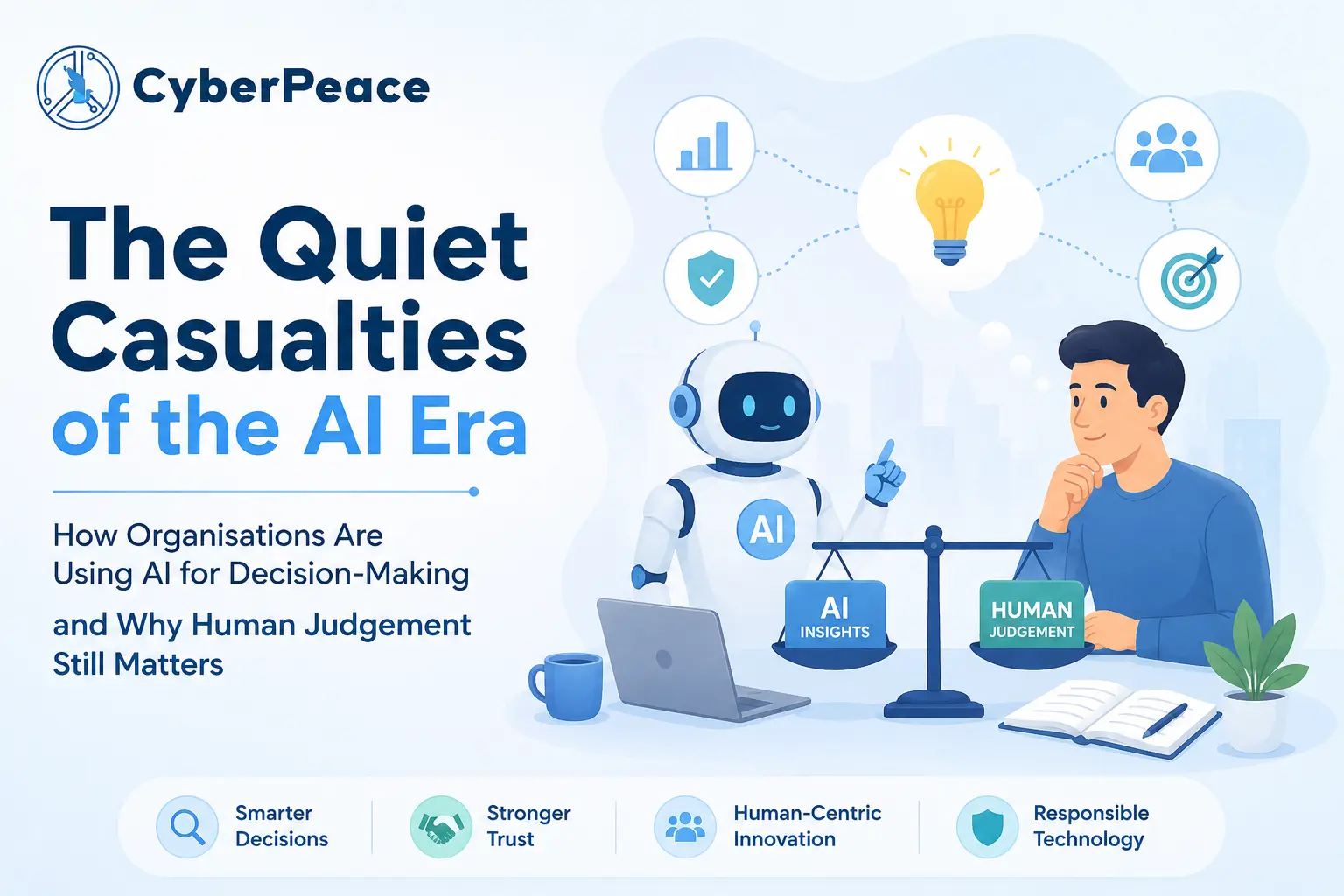
You ask an app for directions to a street you've driven down a hundred times. You let autocomplete finish your sentence before you've decided what you meant to say. You take a photo of a document instead of reading it, trusting the summary a model hands back. None of these moments feel like a loss. Each one is, on its own, a reasonable trade of effort for convenience. But add them up across a year, a career, an industry, and you start to wonder what exactly we've been trading away. Every technology wave produces its own founding myth. For AI, the myth is that intelligence can be manufactured at scale, bottled into a model, and dispensed on demand - cheaper, faster, and eventually better than the human original. It's a seductive story, and one we've been telling ourselves so uncritically that we've stopped noticing what it costs.
The casualties of this bet are rarely dramatic. Nobody announces that a skill has quietly atrophied, or that a habit of independent judgement has gone unused long enough to weaken. These losses don't show up as headlines; they show up later, as gaps, when the system that was supposed to think for us turns out not to have been thinking at all. Ford Motor Company's recent decision to rehire around 350 veteran engineers, after leaning heavily on AI-driven quality systems, is a small but telling data point.¹ The lesson isn't that automation failed outright — it's that a process can be automated without the judgement that made the process work ever being captured in the first place. That distinction between automating a task and actually preserving the human expertise behind it is the real subject of this AI moment.
How Organisations Are Using AI in Decision-Making
More organisations are now leaning on AI not just to execute tasks, but to help shape decisions. Deloitte's 2026 Global Human Capital Trends survey found that 60% of executives now regularly use AI to support their decisions, and the same report cites Gartner's projection that by 2027, half of all business decisions will be augmented or automated by AI agents. Companies like Netflix and Amazon are often pointed to as examples of this working well using AI to enhance recommendations and logistics while keeping people involved in the interpretation, generating significant value in the process. Elsewhere, results have been more mixed: MIT's "State of AI in Business 2025" study found that 95% of generative AI pilots showed no measurable P&L impact within six months, often because this initiative failed to integrate feedback or adapt to context rather than because the underlying model was flawed. Critics have noted the study used a narrow definition of success (six-month, bottom-line ROI), so the figure may understate the value AI creates in ways that aren't captured on the P&L. Notably, this is not an argument against using AI. It is an argument about how we use it and why the human-in-the-loop principle, keeping people actively involved in judgement rather than passively rubber-stamping outputs, is not a compliance checkbox but the thing that determines whether automation actually works. That distinction, between automating a task and preserving the human expertise behind it, is the point of contention.
Finding the Balance
The lesson isn't to use AI less, it's to be deliberate about where it sits in the process. The strongest results come from pairing AI's speed with human judgement, not swapping one for the other. That means keeping a clear owner for important decisions, checking that the model is optimising for the right goal, and treating its output as a strong first draft rather than a final answer. Used this way, AI doesn't replace thinking, it gives good judgement more room to work.
Two Framings We Should Retire
Conversations about AI adoption keep falling into two lazy framings. The first is AI versus humans, as if technology and workforce are locked in a zero-sum contest for relevance. The second is AI versus jobs, reducing every discussion to headcount and displacement. Both are legitimate concerns, but they crowd out a more urgent question: as AI gets embedded deeper into how decisions are made, what happens to the quality of the decisions themselves? This is not a question about whether AI is useful and it plainly is. It is a question about what gets quietly outsourced along with the task, and whether anyone notices before it matters.
Why “Wisdom of Crowds” Does Not Automatically Apply to AI
A comforting analogy often gets reached for: surely, with millions of people using the same models, errors will average out, the way independent forecasters tend to converge on accurate estimates.² That analogy breaks down where it matters most. The wisdom-of-crowds effect depends on independent thinking, genuinely diverse information, and an aggregation mechanism that does not distort the signal. When millions of people query the same underlying model, those conditions collapse. Everyone draws from the same statistical engine, trained on overlapping data, tuned toward similar “safe” answers. The apparent agreement is not corroboration, it is an echo. This creates a genuinely new risk: AI can be confidently, fluently, and uniformly wrong across an entire organisation at once, without the friction that would normally surface an error in a single person's judgement.
The Casualties, Named Plainly
Several things erode quietly when organisations are not deliberate about integrating AI into decisions. Independent judgement is the first casualty of the willingness to form a view before checking what the model says. Verification effort follows: generative AI collapses retrieval and generation into one fluent output, and people invest less effort checking something that already sounds complete and well-reasoned. Diversity of thought narrows as more decision-makers lean on the same handful of models for research and drafting, quietly reducing the range of framings available when it matters most. Accountability becomes harder to trace when a recommendation generated by a model and passed along with minimal scrutiny creates a strange vacuum where a decision was made but nobody quite owns it. And informational anchoring sets in, where a signal becomes a coordination point simply because everyone is looking at it, regardless of its accuracy.
Why Human-in-the-Loop Is a Design Requirement
“Human in the loop” often becomes a rubber-stamp step rather than genuine scrutiny. That is a mistake, because the functions humans provide are structural, not decorative. Context that a model cannot infer history, relationships, unstated constraints shapes whether a reasonable-sounding answer is right in a specific situation. Domain expertise built over years lets someone recognise when a fluent answer is subtly wrong. Ethical judgement decides trade-offs a model has no standing to make on an organisation's behalf. Accountability means someone can be asked why a decision was made and answer from reasoning, not from “the system recommended it.” And the rarest function of all is the willingness to challenge a convincing answer and resisting the very fluency that makes AI output persuasive.
What This Looks Like in Practice
For organisations, the goal is not slowing AI adoption but being deliberate about where human judgement stays load-bearing. AI output should default to draft status until a qualified person has actively tested its logic against context the model lacks. Teams using the same AI tools for analysis should build in a step that actively seeks disagreement, rather than assuming convergence means correctness. Ford's decision to bring engineers back to lead design reviews is instructive: expertise, once encoded into a system, is not safe to let atrophy in the people who built it.³ Verification should be visible and required for decisions with real financial, legal, safety, or reputational consequences. And organisations should track which decisions were AI-assisted and who owned the final call, so accountability stays traceable rather than quietly disappearing.
Conclusion
Decades ago, management thinkers warned that automating a broken process only helps an organisation fail faster. The AI era raises the stakes on that warning: judgement itself, the hard-won capacity to reason well under uncertainty, can be automated away without anyone deciding to give it up. Machines already process information faster than any team of people. What they cannot yet do is originate the wisdom that comes from human experience, accountability, and the willingness to be told one is wrong. That capacity erodes not because AI is powerful, but because organisations stop deliberately exercising it. The real task ahead is not resisting AI, but ensuring that as it takes on more of the work of deciding, humans deliberately keep hold of the responsibility of deciding.
References
- https://www.assemblymag.com/articles/100186-ford-rehires-veteran-engineers-to-improve-ai-vehicle-quality
- https://finance.yahoo.com/technology/ai/articles/ford-rehires-veteran-engineers-ai-144332497.html
- https://finance.yahoo.com/technology/ai/articles/ford-rehires-more-300-engineers-162210705.html
- https://www.msn.com/en-us/money/other/ford-rehires-hundreds-of-engineers-after-ai-struggles-to-improve-quality/ar-AA26P4QB?ocid=BingNewsSerp
- https://www.foxbusiness.com/technology/ford-rehires-experienced-engineers-after-ai-misses-mark
- https://www.livemint.com/opinion/online-views/artificial-wisdom-of-crowds-jobs-crisis-ai-technology-automation-openai-model-11785009289768.html
- https://www.deloitte.com/us/en/insights/topics/talent/human-capital-trends/2026/decision-making-with-ai.html
- https://www.hpcwire.com/aiwire/2026/03/04/deloittes-state-of-ai-2026-why-enterprise-execution-is-falling-behind-adoption/ and Legal.io summary: https://www.legal.io/blog/5719519/MIT-Report-Finds-95-of-AI-Pilots-Fail-to-Deliver-ROI-Exposing-GenAI-Divide
- https://www.marketingaiinstitute.com/blog/mit-study-ai-pilots
Executive Summary:
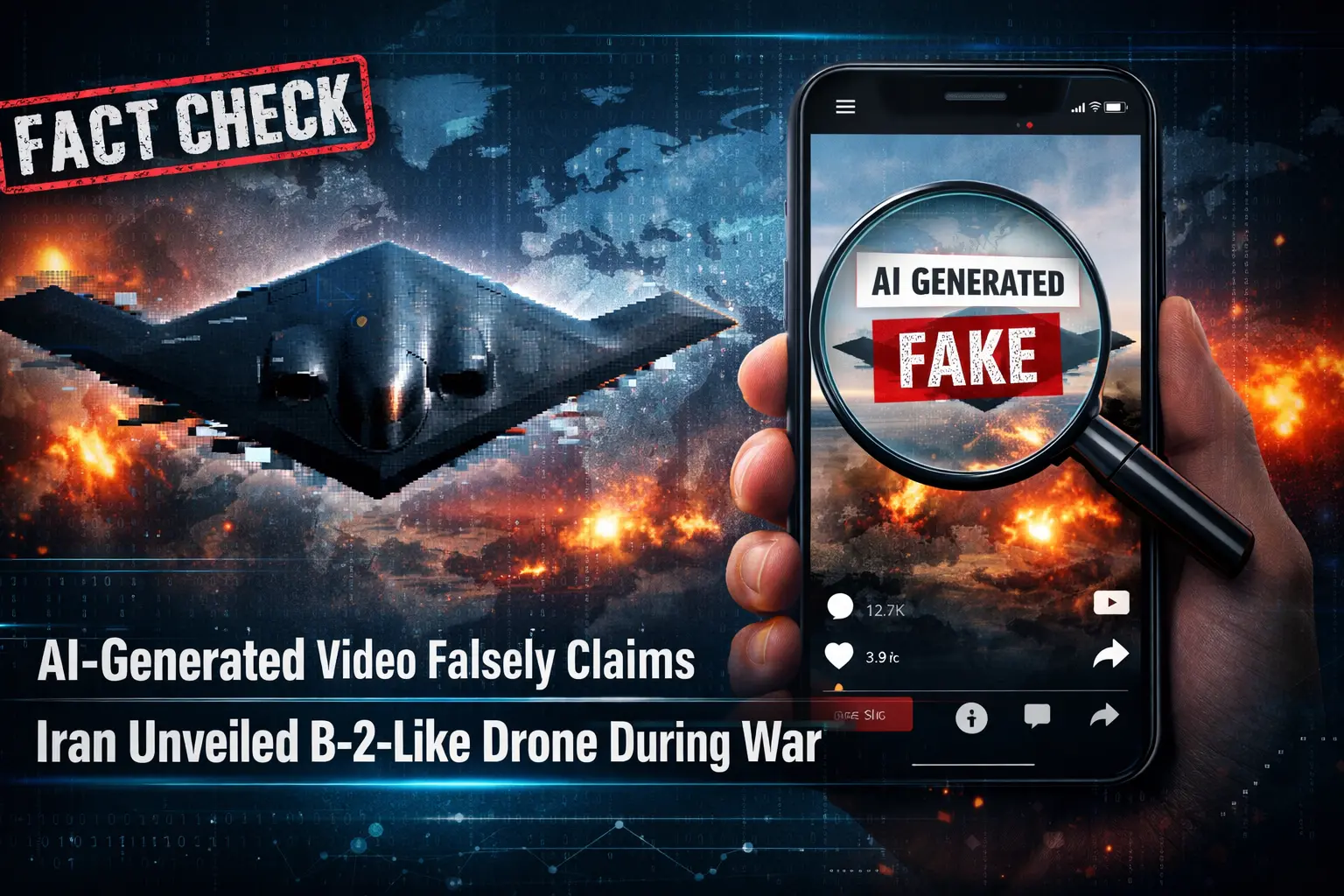
Amid the ongoing war involving the United States, Israel, and Iran, a video clip circulating on social media claims to show Iran unveiling a drone resembling the US B-2 stealth bomber. In the viral clip, an aircraft-like object can be seen emerging from a cave before taking off. Several users are sharing the video with the claim that Iran has deployed a B-2-style drone in the conflict.
However, research by the CyberPeace found that the viral video is not real and was generated using artificial intelligence. While the United States has reportedly used B-2 stealth bombers in strikes against Iran during the conflict, the viral clip does not show an actual Iranian drone.
Claim
X user “Muslim_Voice_Space” posted the video on March 3, 2026, claiming that Iran had rolled out a drone resembling the B-2 bomber for use in the war.

Fact Check
To verify the claim, we first closely examined the viral video. In the opening moments of the clip, the wing of the alleged drone appears to hit the side of the cave while exiting. Despite the apparent collision, the aircraft continues flying smoothly without any visible damage. This unusual detail raised doubts about the authenticity of the footage.
We then analyzed the video using the AI detection tool Hive Moderation, which flagged the clip as likely AI-generated.

Further analysis using the Sightengine AI detection tool also suggested that the video was artificially created. The tool estimated a 75% probability that the footage was generated using AI. It also indicated a 70% likelihood that the clip may have been created using Sora, an AI video-generation tool.

Conclusion
The viral video claiming to show an Iranian drone resembling the US B-2 stealth bomber emerging from a cave is not authentic. Analysis indicates that the clip was created using AI tools and is being misleadingly shared in the context of the ongoing conflict.
