
#FactCheck - Viral Video of ‘Hatha Yogi’ Meditating on Snowy Mountain Is AI-Generated
A video claiming to show a Hatha yogi performing extreme penance on a snow-covered mountain amid strong icy winds is going viral on social media. In the clip, the ascetic is seen balancing on one hand in a yoga posture, while users portray the visuals as a rare example of extraordinary spiritual endurance in harsh climatic conditions.
However, an investigation by the CyberPeace Foundation has found the claim to be false. Our analysis confirms that the viral video is AI-generated and does not depict a real person or an actual event.
Claim:
A Instagram user shared the video with the caption:
“Hatha yogi, what kind of soil are these people made of?” The post suggests that the visuals show a real yogi performing intense meditation on a frozen mountain.
- https://www.instagram.com/reels/DTK32TvDGIJ/
- (Archive link as provided) https://perma.cc/H84M-MGXZ

Fact Check:
To verify the claim, the CyberPeace Foundation conducted a detailed examination of the viral video.No credible or verifiable news reports were found to support the claim that such an incident ever occurred.
The viral video was analysed using the AI detection tool Deepfake-O-Meter.Its AVSRDD (2025) module flagged the video as AI-generated, confirming that the visuals were digitally created and not recorded in real life.
Multiple indicators within the footage,such as unnatural body balance, environmental inconsistencies, and visual artifacts are consistent with AI-generated content.

Conclusion
The viral video purportedly showing a yogi meditating on a frozen mountain is not real. It has been created using artificial intelligence and is being circulated on social media with a misleading narrative. Users are advised to exercise caution and verify content before sharing such sensational claims.

Related Blogs

Executive Summary:
An online claim alleging that U.S. bombers used Indian airspace to strike Iran has been widely circulated, particularly on Pakistani social media. However, official briefings from the U.S. Department of Defense and visuals shared by the Pentagon confirm that the bombers flew over Lebanon, Syria, and Iraq. Indian authorities have also refuted the claim, and the Press Information Bureau (PIB) has issued a fact-check dismissing it as false. The available evidence clearly indicates that Indian airspace was not involved in the operation.
Claim:
Various Pakistani social media users [archived here and here] have alleged that U.S. bombers used Indian airspace to carry out airstrikes on Iran. One widely circulated post claimed, “CONFIRMED: Indian airspace was used by U.S. forces to strike Iran. New Delhi’s quiet complicity now places it on the wrong side of history. Iran will not forget.”

Fact Check:
Contrary to viral social media claims, official details from U.S. authorities confirm that American B2 bombers used a Middle Eastern flight path specifically flying over Lebanon, Syria, and Iraq to reach Iran during Operation Midnight Hammer.

The Pentagon released visuals and unclassified briefings showing this route, with Joint Chiefs of Staff Chair Gen. Dan Caine explained that the bombers coordinated with support aircraft over the Middle East in a highly synchronized operation.

Additionally, Indian authorities have denied any involvement, and India’s Press Information Bureau (PIB) issued a fact-check debunking the false narrative that Indian airspace was used.

Conclusion:
In conclusion, official U.S. briefings and visuals confirm that B-2 bombers flew over the Middle East not India to strike Iran. Both the Pentagon and Indian authorities have denied any use of Indian airspace, and the Press Information Bureau has labeled the viral claims as false.
- Claim: Fake Claim that US has used Indian Airspace to attack Iran
- Claimed On: Social Media
- Fact Check: False and Misleading

Executive Summary
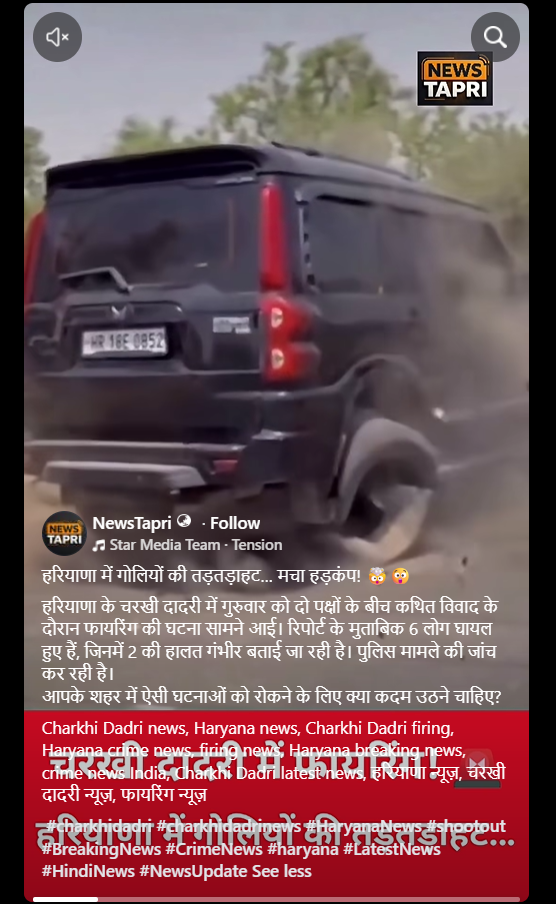
A video showing a black Scorpio being sprayed with bullets is being widely shared on social media.The video is being circulated with the claim that it shows the real footage of the firing incident in Haryana’s Charkhi Dadri on August 6, when around 30 rounds were allegedly fired at a Scorpio outside the City Police Station. The CyberPeace Research Wing found the claim to be false. The research established that the viral video is AI-generated and is being shared with a misleading claim.
Claim
A Facebook user shared the viral video with a caption stating, "Gunshots ring out in Haryana… panic grips the area! A firing incident reportedly took place in Charkhi Dadri, Haryana, during an alleged dispute between two groups on Thursday. According to reports, six people were injured, with two said to be in critical condition. Police are investigating the matter. What steps should be taken to prevent such incidents in your city?"
https://www.facebook.com/reel/991406893937983
FactCheck
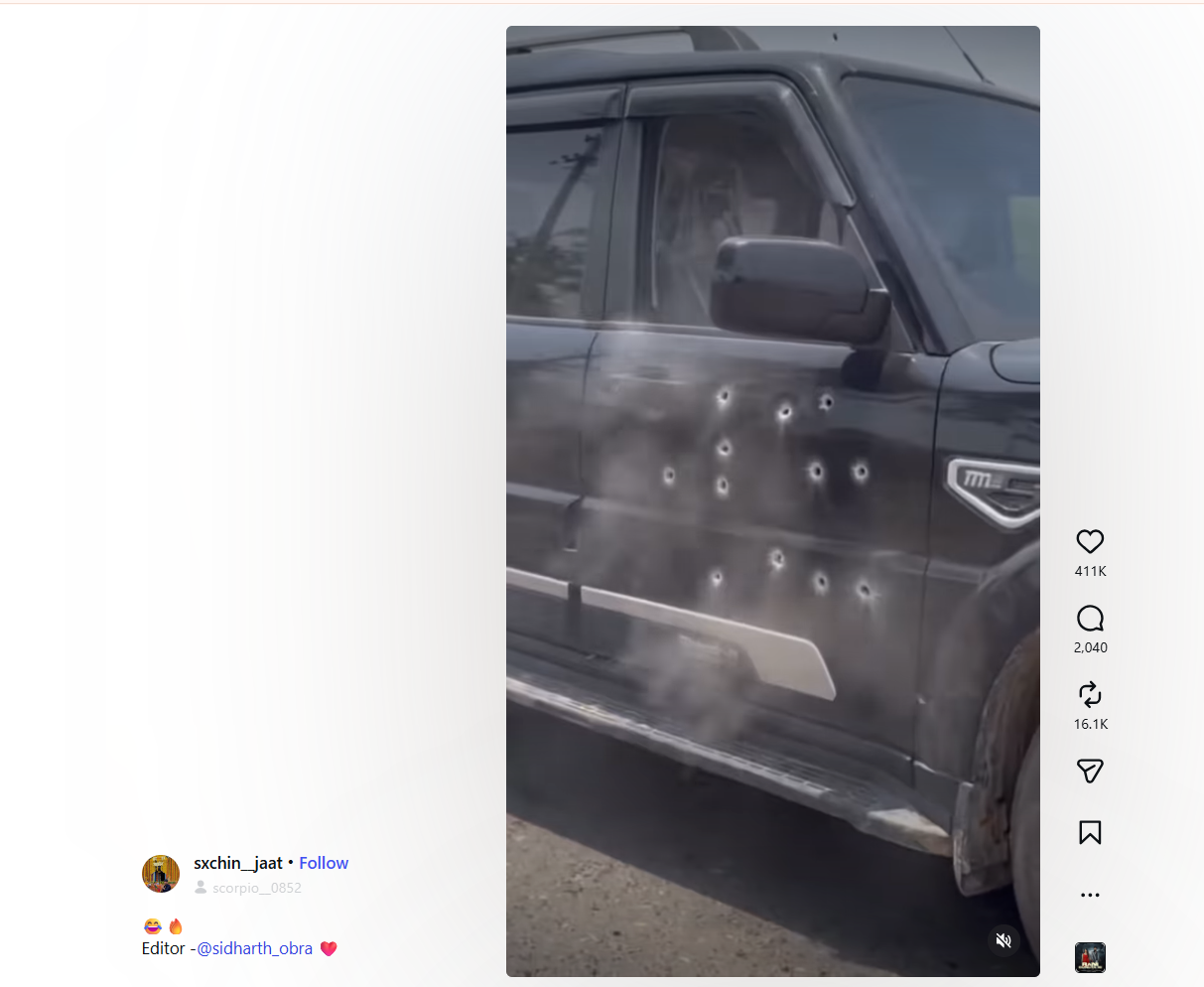
To verify the claim, we extracted keyframes from the viral clip and conducted a reverse image search. During the search, we found an older post containing the same video on an Instagram account named ‘sxchin_jaat’. The video was uploaded on May 12, well before the Charkhi Dadri firing incident of August 6.
The earlier upload establishes that the viral clip is unrelated to the firing incident in Charkhi Dadri.
https://www.instagram.com/reels/DYOOXiASH4h/
We then examined the viral video closely and noticed visual characteristics that raised suspicions that it could be AI-generated. The video was subsequently analysed using Hive Moderation, which indicated a 96 per cent probability of AI-generated content.
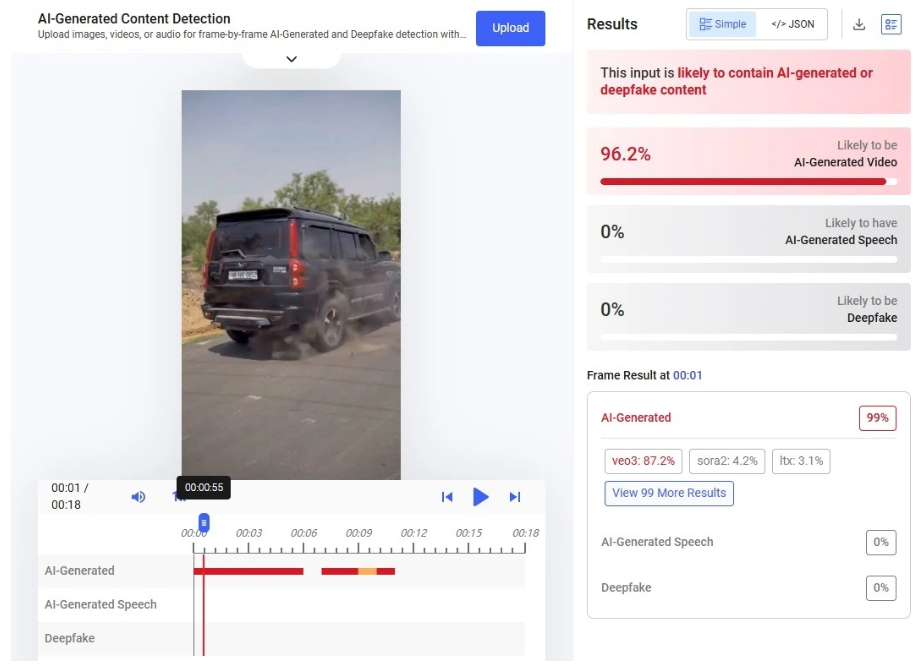
As part of the next stage of verification, we analysed the video using another AI detection tool, Undetectable AI. The tool also identified the viral video as AI-generated.

Conclusion
The viral claim is false. The video being shared as authentic footage of the August 6 firing incident in Charkhi Dadri is not genuine. The clip was posted online as early as May 12 and AI detection tools also identified it as AI-generated. The video is therefore being circulated with a misleading claim linking it to the Charkhi Dadri firing incident.

Executive Summary:
On 20th May, 2024, Iranian President Ebrahim Raisi and several others died in a helicopter crash that occurred northwest of Iran. The images circulated on social media claiming to show the crash site, are found to be false. CyberPeace Research Team’s investigation revealed that these images show the wreckage of a training plane crash in Iran's Mazandaran province in 2019 or 2020. Reverse image searches and confirmations from Tehran-based Rokna Press and Ten News verified that the viral images originated from an incident involving a police force's two-seater training plane, not the recent helicopter crash.
Claims:
The images circulating on social media claim to show the site of Iranian President Ebrahim Raisi's helicopter crash.


Fact Check:
After receiving the posts, we reverse-searched each of the images and found a link to the 2020 Air Crash incident, except for the blue plane that can be seen in the viral image. We found a website where they uploaded the viral plane crash images on April 22, 2020.

According to the website, a police training plane crashed in the forests of Mazandaran, Swan Motel. We also found the images on another Iran News media outlet named, ‘Ten News’.
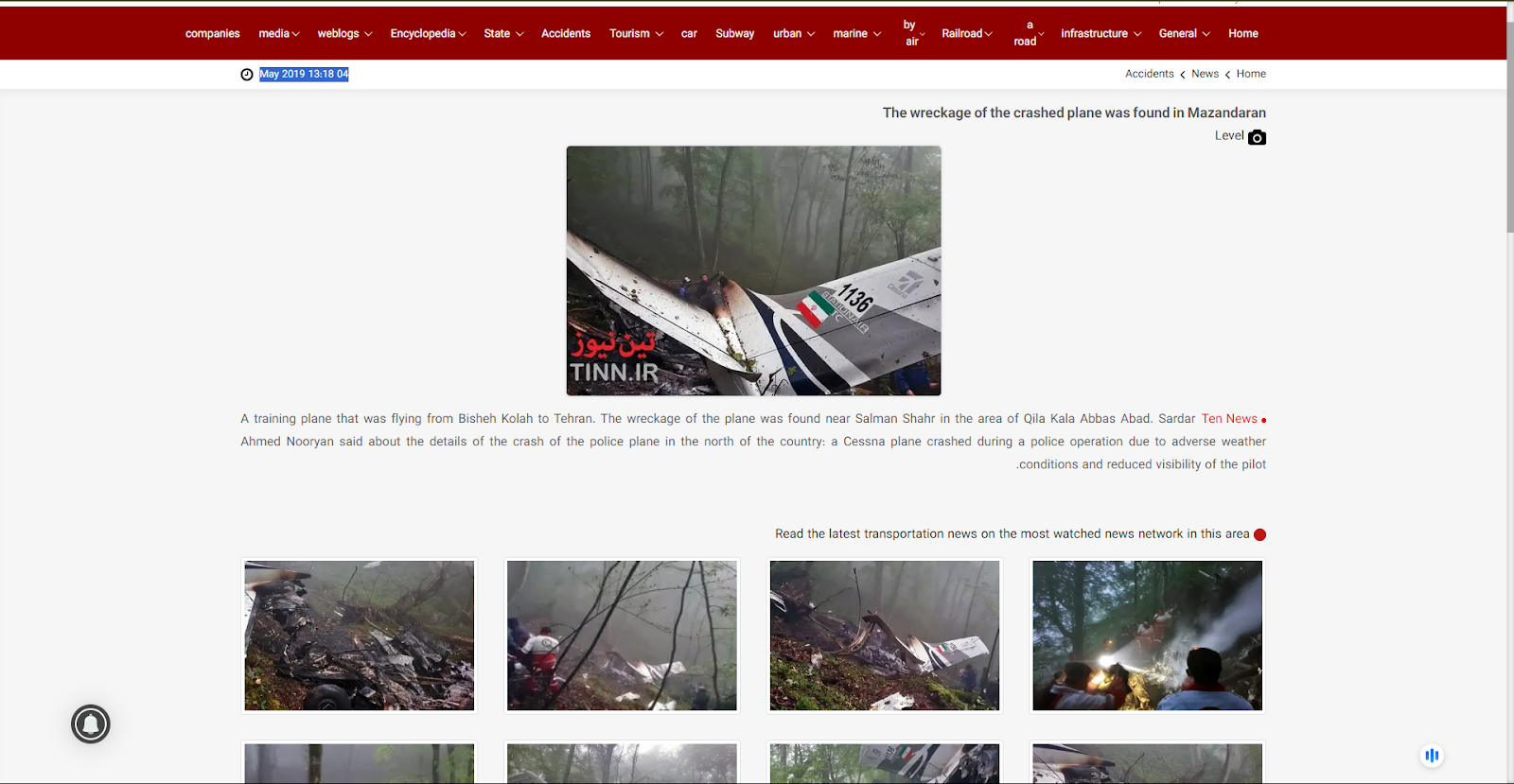
The Photos uploaded on to this website were posted in May 2019. The news reads, “A training plane that was flying from Bisheh Kolah to Tehran. The wreckage of the plane was found near Salman Shahr in the area of Qila Kala Abbas Abad.”
Hence, we concluded that the recent viral photos are not of Iranian President Ebrahim Raisi's Chopper Crash, It’s false and Misleading.
Conclusion:
The images being shared on social media as evidence of the helicopter crash involving Iranian President Ebrahim Raisi are incorrectly shown. They actually show the aftermath of a training plane crash that occurred in Mazandaran province in 2019 or 2020 which is uncertain. This has been confirmed through reverse image searches that traced the images back to their original publication by Rokna Press and Ten News. Consequently, the claim that these images are from the site of President Ebrahim Raisi's helicopter crash is false and Misleading.
- Claim: Viral images of Iranian President Raisi's fatal chopper crash.
- Claimed on: X (Formerly known as Twitter), YouTube, Instagram
- Fact Check: Fake & Misleading
