
Uber and GeM

Introduction
Established in the US, one of the world’s largest cab networks came into existence in 2010 and, since its inception, has expanded all over the globe with operations in 10,000 cities across 71 countries. It made a remarkable start in India in 2017 and, since then, has seen a rise in the customers and drivers for the company. India is among the largest markets for Uber, with 600,000 monthly drivers and 8.5 million monthly riders.
GeM
Government e-Marketplace (GeM) is a one-stop portal to facilitate online procurement of common-use Goods & Services required by various Government Departments / Organizations / PSUs. GeM aims to enhance transparency, efficiency and speed in public procurement. It provides the tools of e-bidding, reverses e-auction and demand aggregation to facilitate government users achieve the best value for their money. Government e-Marketplace owes its genesis to the recommendations of two Groups of Secretaries to the Prime Minister in January 2016. They recommended setting up a dedicated e-market for different goods & services procured or sold by Government/PSUs besides reforming DGS&D. Subsequently, the Finance Minister, in his Budget speech for FY 2016-17, announced setting up of a technology-driven platform to facilitate procurement of goods and services by various Ministries and agencies of the Government. The portal was launched on 9th August 2016 by the Commerce & Industry Minister.
Uber-GeM collaboration
The cab network giant has registered on the portal of the Government E-marketplace and has declared that it will offer its services to Government officials from Ministries and PSUs. The project is currently in its pilot phase and shall be executed systematically to cover all the ministries and PSUs in the nation. The officials can book cabs at a fixed price with no cancellation or surge fees on the rides. The authorised officials will be able to book a cab from the portal and select from the list of drivers available. It will be a cashless/cardless ride for the officials; additional vehicle categories for government riders have been added, namely, GeM Yatraa Hatch and GeM Yatraa Sedan, and there will be hourly rentals for multiple-stops, allowing the government officials to enjoy the flexible and easily accessible network of cabs in major cities.
Advantages
Such collaboration between Government institutions and corporates will go a long way to secure a stable equilibrium in the market. Uber, a US-based company, enjoys a vast user base in India and has created new job avenues. The advantages of the collaboration between GeM and Uber are as follows-
Easy accessibility
This will undoubtedly provide ease in accessibility in terms of being in a new place, and language barriers will no longer exist with such options for Government officials.
Increased jobs for drivers
With more cabs being engaged with ministries and PSUs, it is pertinent that the requirement for drivers will grow, thus increasing the employability rate in India and allowing the user to have an uninterrupted experience.
Ease of travel and commuting
This move will provide flexibility, thus leading to more ease in travel in cases of emergencies or places inaccessible by trains or other modes of transport.
Rise in travel and tourism
Coupled with the other factors, the opportunities for the users to visit different places will be an added advantage which will help boost the tourism industry, thus creating a balance in the market.
Sustainable Government corporate relationship

Such collaborations between the government and corporates will be substantial, signifying the ease of doing business in India. They will also act as a beacon of example for compliance with opportunities for the other companies and stakeholders.
Opportunities for collaboration with ingenious start-ups
With such major corporate joining hands with the government, the indigenous start-ups will have various opportunities to engage with companies and recreate similar businesses rooted in India, thus transforming the economy.
Conclusion
Transportation and communication play a vital role in our lives, thus, such collaboration will go a long way in creating a better and more uniform user experience in the country. This also goes a long way to showcase that the Governmental platforms also offer services of a global standard. Such portals exist in South Korea, Singapore, the US and Europe. The network of cabs can only be sustained using the locals as drivers, hence these collaborations are win-win for all as the market dynamics are improving, employability will increase, and improved user experience will be seen.

Related Blogs

Introduction
In a setback to the Centre, the Bombay High Court on Friday 20th September 2024, struck down the provisions under IT Amendment Rules 2023, which empowered the Central Government to establish Fact Check Units (FCUs) to identify ‘fake and misleading’ information about its business on social media platforms.
Chronological Overview
- On 6th April 2023, the Ministry of Electronics and Information Technology (MeitY) notified the Information Technology (Intermediary Guidelines and Digital Media Ethics Code) Amendment Rules, 2023 (IT Amendment Rules, 2023). These rules introduced new provisions to establish a fact-checking unit with respect to “any business of the central government”. This amendment was done In exercise of the powers conferred by section 87 of the Information Technology Act, 2000. (IT Act).
- On 20 March 2024, the Central Government notified the Press Information Bureau (PIB) as FCU under rule 3(1)(b)(v) of the Information Technology (Intermediary Guidelines and Digital Media Ethics Code) Amendment Rules 2023 (IT Amendment Rules 2023).
- The next day on 21st March 2024, the Supreme Court stayed the Centre's decision on notifying PIB -FCU, considering the pendency of the proceedings before the High Court of Judicature at Bombay. A detailed analysis covered by CyberPeace on the Supreme Court Stay decision can be accessed here.
- In the latest development, the Bombay High Court on 20th September 2024, struck down the provisions under IT Amendment Rules 2023, which empowered the Central Government to establish Fact Check Units (FCUs) to identify ‘fake and misleading’ information about its business on social media platforms.
Brief Overview of Bombay High Court decision dated 20th September 2024
Justice AS Chandurkar was appointed as the third judge after a split verdict in January 2023 by a division bench consisting of Justices Gautam Patel and Neela Gokhal. As a Tie-breaker judge' Justice AS Chandurkar delivered the decision striking down provisions for setting up a Fact Check Unit under IT amendment 2023 rules. Striking down the Centre's proposed fact check unit provision, Justice A S Chandurkar of Bombay High Court also opined that there was no rationale to undertake an exercise in determining whether information related to the business of the Central govt was fake or false or misleading when in digital form but not doing the same when such information was in print. It was also contended that there is no justification to introduce an FCU only in relation to the business of the Central Government. Rule 3(1)(b)(v) has a serious chilling effect on the exercise of the freedom of speech and expression under Article 19(1)(a) of the Constitution since the communication of the view of the FCU will result in the intermediary simply pulling down the content for fear of consequences or losing the safe harbour provision given under IT Act.
Justice Chandurkar held that the expressions ‘fake, false or misleading’ are ‘vague and overbroad’, and that the ‘test of proportionality’ is not satisfied. Rule 3(1)(b)(v), was violative of Articles 14 and 19 (1) (a) and 19 (1) (g) of the Constitution and it is “ultra vires”, or beyond the powers, of the IT Act.
Role of Expert Organisations in Curbing Mis/Disinformation and Fake News
In light of the recent developments, and the rising incidents of Mis/Disinformation and Fake News it becomes significantly important that we all stand together in the fight against these challenges. The actions against Mis/Disinformation and fake news should be strengthened by collective efforts, the expert organisations like CyberPeace Foundation plays an key role in enabling and encouraging netizens to exercise caution and rely on authenticated sources, rather than solely rely on govt FCU to block the content.
Mis/Disinformation and Fake News should be stopped, identified and countered by netizens at the very first stage of its spread. In light of the Bombay High Court's decision to stuck down the provision related to setting up the FCU by the Central Government, it entails that the government's intention to address misinformation related solely to its business/operations may not have been effectively communicated in the eyes of the judiciary.
It is high time to exercise collective efforts against Mis/Disinformation and Fake News and support expert organizations who are actively engaged in conducting proactive measures, and campaigns to target these challenges, specifically in the online information landscape. CyberPeace actively publishes fact-checking reports and insights on Prebunking and Debunking, conducts expert sessions and takes various key steps aimed at empowering netizens to build cognitive defences to recognise the susceptible information, disregard misleading claims and prevent further spreads to ensure the true online information landscape.
References:
- https://www.scconline.com/blog/post/2024/09/20/bombay-high-court-it-rules-amendment-2023-fact-check-units-article14-article19-legal-news/#:~:text=Bombay%20High%20Court%3A%20A%20case,grounds%20that%20it%20violated%20constitutional
- https://indianexpress.com/article/cities/mumbai/bombay-hc-strikes-down-it-act-amendment-fact-check-unit-9579044/
- https://www.cyberpeace.org/resources/blogs/supreme-court-stay-on-centres-notification-of-pibs-fact-check-unit-under-it-amendment-rules-2023

Executive Summary
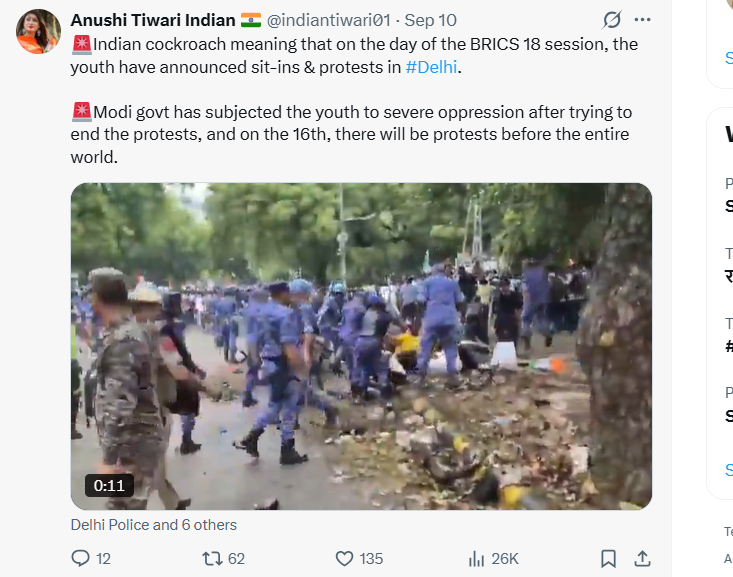
A video is being shared on social media with the claim that youths have announced sit-ins and protests in Delhi during the 18th BRICS Summit. The video is being shared with allegations that the Modi government attempted to suppress the protests and subjected the youth to severe oppression. It also claims that a large-scale protest would be held in Delhi on September 16. The video shows a large gathering of people, with police personnel seen taking action against them.
Research by CyberPeace found that the video is old and has been available online since at least July 20, 2026. According to earlier sources, the video shows police action against CJP protesters who were marching towards Parliament on July 20, 2026. Meanwhile, the 18th BRICS Summit is being held in New Delhi on September 12 and 13, 2026. Therefore, the old video is being misleadingly linked to police action during the BRICS Summit.
Claim:
A video is being shared on social media with the claim that youths have announced sit-ins and protests in Delhi during the 18th BRICS Summit and that the Modi government subjected them to severe oppression while attempting to suppress the protests.
https://x.com/indiantiwari01/status/2098058633825411110?s=20
FactCheck:
To verify the authenticity of the viral claim, we conducted a reverse image search of the keyframes from the video. During the search, we found the same video on the YouTube channel ANKIT'S PEACEFUL MIND, where it was published on July 20, 2026.
https://www.youtube.com/watch?v=uPsm9jueugY
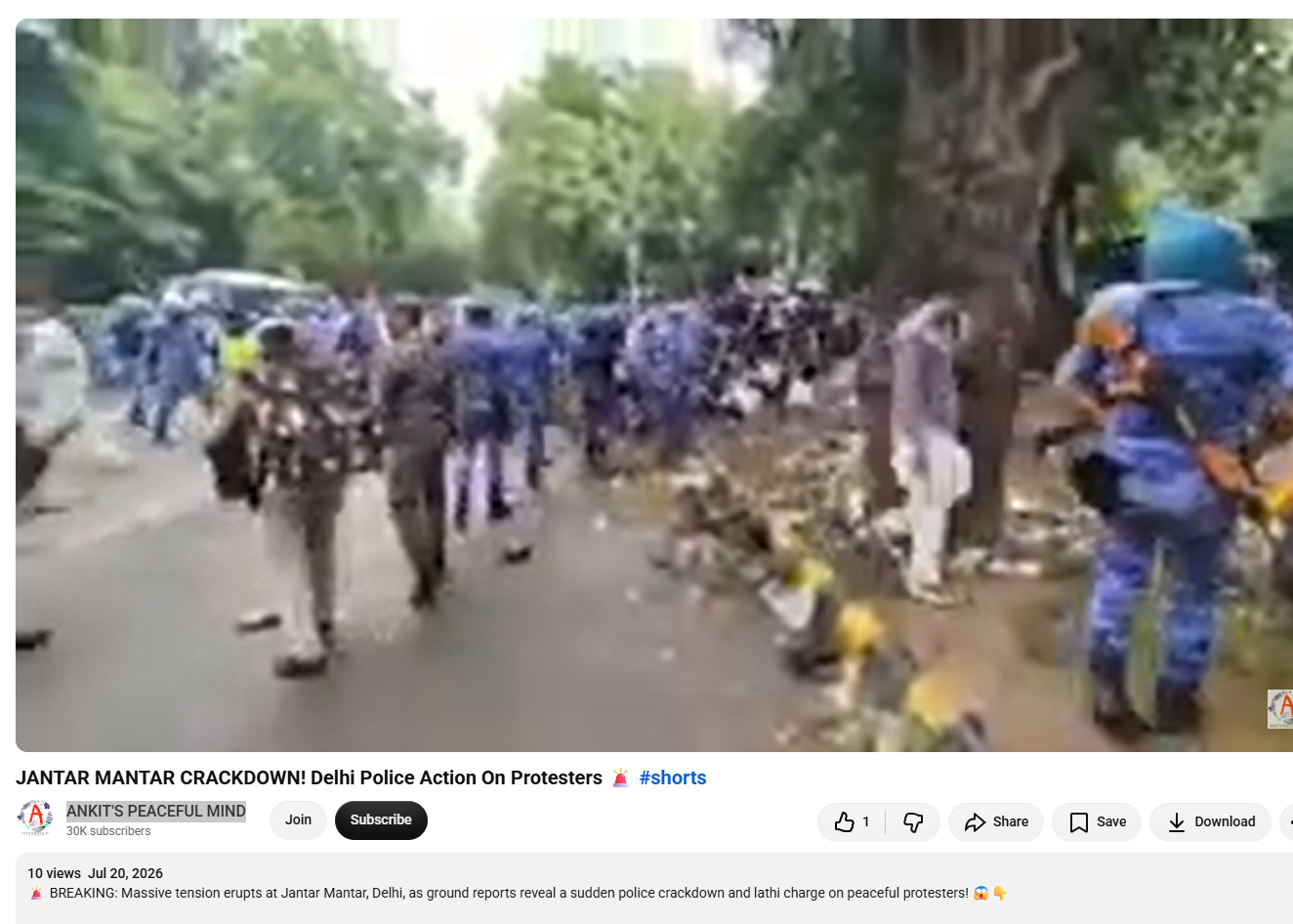
According to the video description, a tense situation unfolded at Jantar Mantar in Delhi, where police took action against people holding a peaceful protest and resorted to a lathi charge. The post claimed that thousands of youths, students and others had gathered in Delhi in support of environmental activist Sonam Wangchuk and the ongoing Ladakh movement. The situation reportedly escalated, leading to clashes between the protesters and the large number of security personnel deployed at the site.
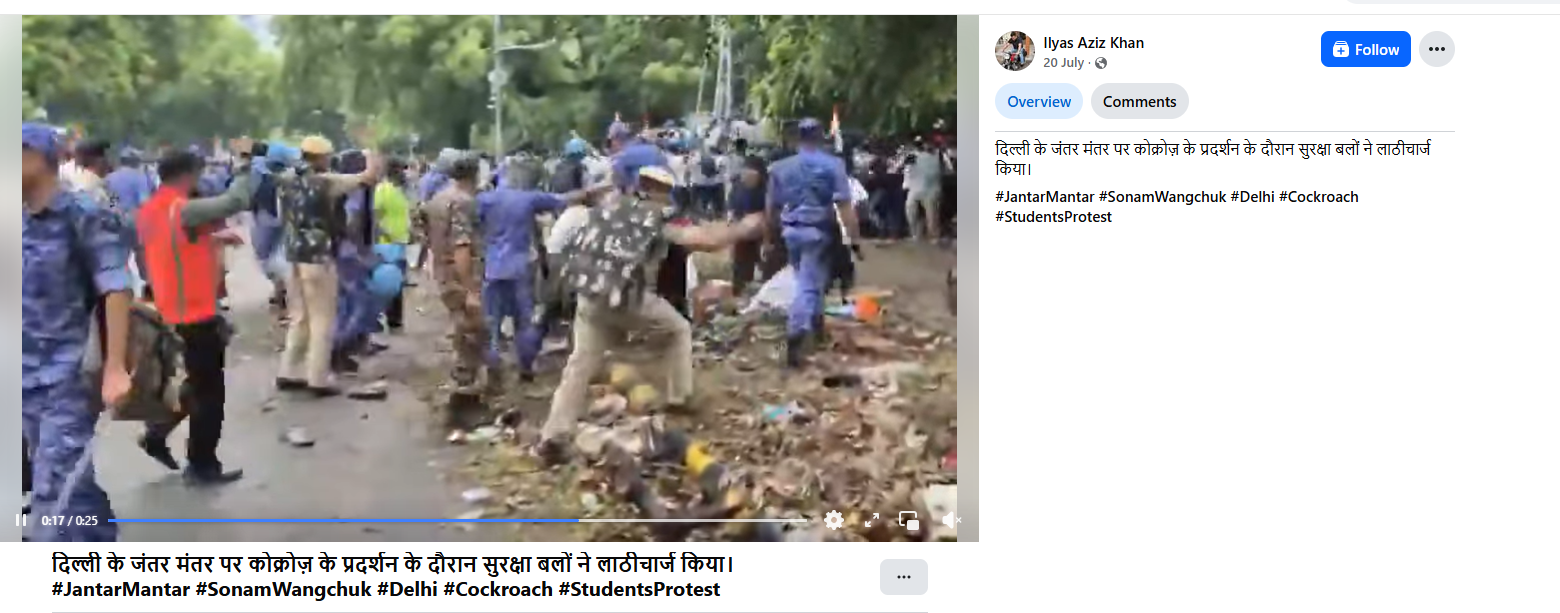
As part of the next step in our research, we found the same video on a Facebook page, where it was published on July 20. The video was also shared with the claim that security forces had resorted to a lathi charge against protesters during a CJP demonstration at Jantar Mantar in Delhi.
https://www.facebook.com/watch/?v=1583508539869113
Conclusion:
Our research found that the video being shared on social media is not related to any incident during the BRICS Summit. The video is old and has been available online since at least July 20, 2026. According to earlier sources, the video shows police action against CJP protesters who were marching towards Parliament on July 20. Meanwhile, the 18th BRICS Summit is being held in New Delhi on September 12 and 13, 2026. Therefore, sharing the old video as footage of police action against protesters during the BRICS Summit is misleading.

Introduction
In a business that historically operated in a landscape defined by probability and odds, India’s real-money gaming companies have taken their own legal bet, a gamble that may very well decide whether or not they survive. Play Games24x7, Junglee Games, Sachiko Gaming, and Head Digital Works were in front of India’s highest court on July 14, seeking review of an order that will ultimately decide the fate of these companies.
The Facts
The firms’ review petitions challenge the May 27 ruling in which the Supreme Court also upheld the constitutional legality of the 28% GST on online gaming, paving the way for over 1.5 trillion in back taxes. The petitions, prepared by the Lakshmikumaran & Sridharan law firm, “do not ask to set the entire case all over again” since a review is a technical process usually dealt with by the same bench of judges in their chambers when there’s an error on the record or genuinely fresh material before it before the case may potentially be referred for a new trial in open court if there is something significant in it.
The Genesis of the Legal Battle
To understand why gaming firms are pulling this lever, it helps to revisit what the Court actually decided in May. A bench of Justices J.B. Pardiwala and R. Mahadevan ruled that once a player stakes money on an uncertain outcome, the platform is supplying an "actionable claim" arising from betting and gambling under GST law. The long-cherished distinction between a "game of skill" and a "game of chance", which the industry had used for years to argue it wasn't really gambling, was declared irrelevant the moment cash entered the pot.
Just as consequentially, the Court rejected the industry's central financial argument: that GST should be calculated only on the platform's commission, or gross gaming revenue, rather than on the entire amount players deposit into a contest. The bench sided with tax authorities, ruling that the 28% levy applies to the full face value of every bet. It also found that 2023 amendments to GST law were merely "clarificatory", not the creation of a brand-new tax, a finding that opened the door to retrospective demands stretching back years, rather than only from October 2023 onwards, when the amendments took effect.
The practical fallout was severe. The ruling revived a ₹21,000 crore notice against Gameskraft that the Karnataka High Court had earlier quashed, and it validated roughly 91 show-cause notices issued industry-wide, with estimates of the total exposure ranging as high as ₹1.5–2.5 lakh crore, depending on the source. For context, that figure dwarfs the cumulative revenues several of these companies have ever earned.
The Arguments Now on the Table
The review petitions attack the judgement from several angles. Head Digital Works, the parent of gaming platform A23, argues the case raised substantial constitutional questions that should have gone to a larger Constitution Bench rather than a two-judge bench and that the ruling contains errors serious enough to warrant reconsideration. A recurring theme across the petitions is timing: the companies contend GST should be triggered only when winnings are actually paid out to players, not the moment an entry fee changes hands, and that treating the 2023 amendments as retrospective effectively taxes transactions under a legal framework that didn't yet exist when they occurred. They also argue the ruling creates an unfair mismatch, taxing online games more harshly than comparable offline activity, and in Head Digital Works' filing that the judgement glosses over the industry's long-standing constitutional protection for skill-based businesses under Article 19(1)(g).
A Sector Already on the Ropes
What makes this legal battle unusually high-stakes is that it isn't happening in isolation. In August 2025, Parliament passed the Promotion and Regulation of Online Gaming Act, banning all online real-money games nationwide regardless of whether they involve skill, chance, or a mix of both while carving out room for e-sports and social gaming. That law is itself under constitutional challenge, with hearings before a three-judge bench expected this year. So the same companies fighting a ₹1.5 trillion tax bill for games they used to run are simultaneously fighting for the right to run those games at all going forward. Add to this that GST on the relevant category of actionable claims was separately hiked to 40% in September 2025 as part of a broader rate overhaul, and it's clear the ground has shifted well beyond what the industry anticipated when this dispute began.
What Comes Next
The Supreme Court will first decide whether these petitions clear the threshold for review, a high bar by design, since courts are wary of turning review into a backdoor appeal. If the bench finds no fresh ground, the May 27 judgement becomes final, and companies will be left negotiating settlements, instalment plans, or insolvency proceedings against tax bills that, in several cases, exceed what they've ever earned. If the Court does find merit, it could reopen questions that reshape not just the gaming industry's tax liability but the constitutional line between what states can regulate as "betting and gambling" and what Parliament can tax as a national digital service.
Either way, the outcome will be watched well beyond the gaming world. Any digital business that collects money from users against an uncertain outcome from fantasy sports to prediction markets to certain fintech products has a stake in how the court defines "actionable claim" and how far a "clarificatory" amendment can legally reach into the past. Tax authorities, for their part, will be watching just as closely: a win here reinforces a template they've already begun applying to other sectors accused of restructuring around narrow tax definitions.
There's also an investor angle that tends to get lost in the legal jargon. Real-money gaming in India attracted billions of dollars in foreign investment over the past decade, built on the premise that skill-based games occupied a legitimate, constitutionally protected business category distinct from gambling. Between the May verdict and the PROGA ban, that premise has effectively collapsed within the space of a year. Whether or not the review petitions succeed, the episode is likely to be studied as a cautionary tale about regulatory and tax risk in India's digital economy, a reminder that a business model resting on a legal distinction is only as durable as a court's willingness to keep drawing that line.
Conclusion
The Supreme Court's decision will extend far beyond the gaming industry, shaping India's approach to digital taxation, regulatory certainty, and investor confidence. For now, the ball is back in the Supreme Court's hands, and the industry has staked its remaining legal capital on convincing the same bench that got it here to think again.
Sources
- Online gaming firms move Supreme Court seeking review of verdict upholding 28% GST levy — ANI News
- Promotion and Regulation of Online Gaming Act, 2025 — Wikipedia
- Anti-gambling act targets real-money gaming — Law.asia
- Behind the Ban: The Promotion and Regulation of Online Gaming Act, 2025 — Lexology
