
The DPDP Compliance Clock Is Running. Is Your Organisation Actually Ready?
Somewhere in a compliance meeting right now, someone is saying "we have eighteen months, we're fine." That sentence is doing the same thing a snooze button does at 6 a.m.: technically buying time, while quietly making the actual wake up call worse. India's data protection law just started its countdown, and the 18 months everyone keeps citing is not a grace period to procrastinate through. It is closer to a runway before takeoff. Runways exist for one purpose: building up speed until the plane has no choice but to leave the ground. Standing still on one is not a strategy.
What actually got notified, and when
On 13 November 2025, the Ministry of Electronics and Information Technology notified the Digital Personal Data Protection Rules, 2025, giving operational shape to the Digital Personal Data Protection Act that Parliament had passed back in August 2023. Alongside the Rules themselves, MeitY issued a separate Enforcement Notification setting out exactly when different provisions kick in, and a further notification establishing the Data Protection Board of India, headquartered in the National Capital Region with four members. The final Rules followed a genuinely deliberative process, MeitY had floated draft Rules in January 2025 for public consultation and received 6,915 individual inputs from startups, industry bodies, civil society groups, and citizens before finalising the version now in force. The headline structural decision, and the one causing the most confusion in boardrooms, is that the Rules do not commence all at once. They commence in three distinct phases spread across eighteen months, and different obligations become legally binding at each stage.
The phased timeline, laid out plainly
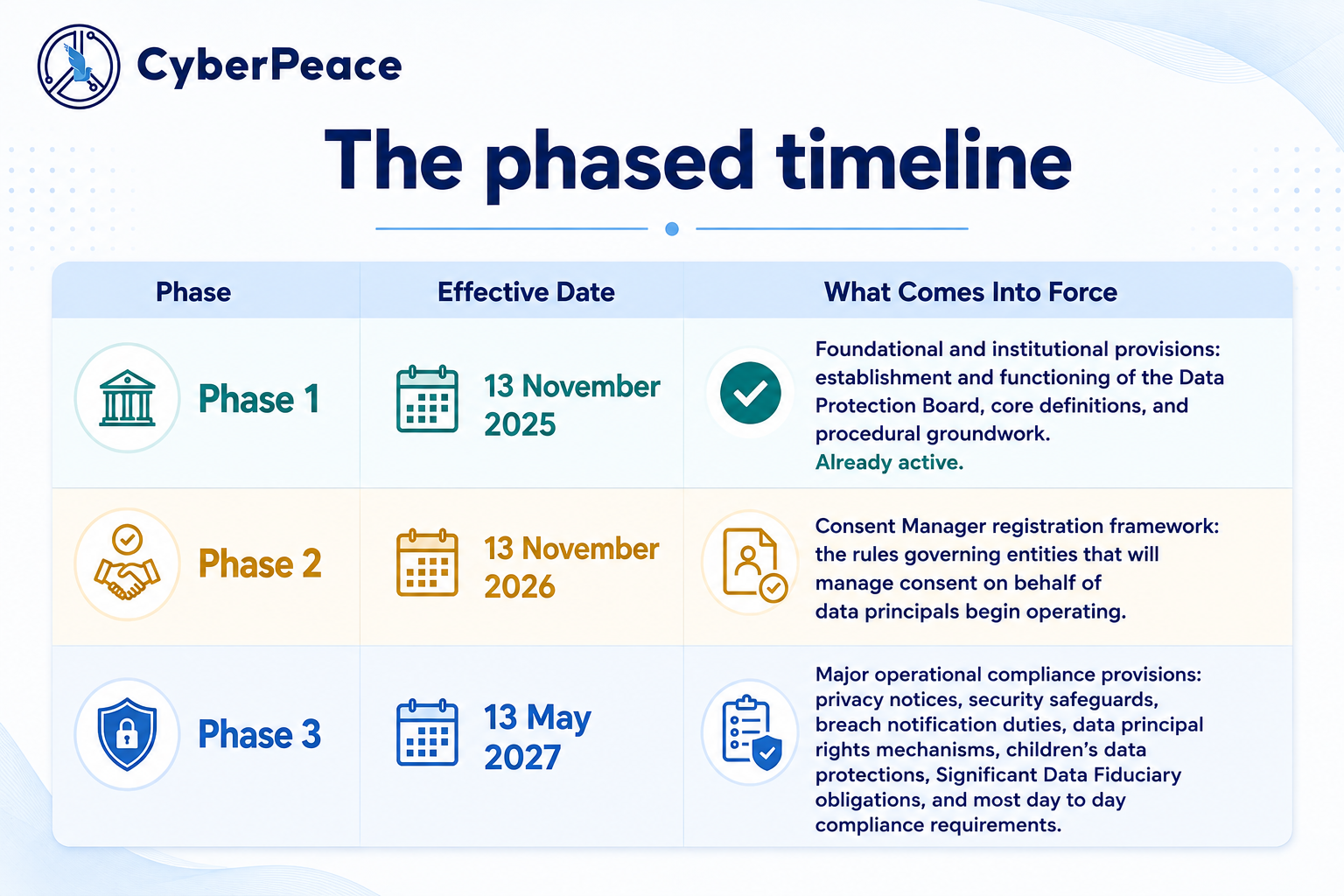
That third date, 13 May 2027, is the one that matters most for the vast majority of organisations, since it is where the bulk of actual operational obligations, the parts that touch product design, customer facing notices, and breach response, become enforceable. Legal commentary tracking the rollout has been consistent that this is described as a hard deadline with no grace period expected once it arrives, since the Data Protection Board is already operational and can begin receiving complaints well before Phase 3 obligations formally take effect.
Why "later" is a genuinely expensive plan
The financial stakes attached to Phase 3 non-compliance are not modest. The Schedule to the DPDP Act sets fixed penalty ceilings rather than turnover linked fines, which sounds gentler than Europe's GDPR model until you look at the actual numbers. Failure to implement reasonable security safeguards that results in a data breach can draw a penalty of up to 250 crore rupees per instance, the single highest tier in the Schedule. Failing to notify the Board or affected individuals after a breach occurs can draw up to 200 crore rupees, as can non-compliance with the Act's specific protections for children's data. Because these are assessed per instance rather than as a single capped exposure, a single incident that trips more than one obligation, say, inadequate safeguards that also delay breach notification, can compound into penalty exposure running into hundreds of crores from one event. All penalties collected go to the Consolidated Fund of India rather than to affected individuals directly, meaning the deterrent is aimed squarely at organisational behaviour, not compensation.
The part everyone keeps underestimating: this is not just a legal department problem
Perhaps the most consequential shift buried inside the DPDP framework is who actually has to own it. Reading the Rules as a checklist for the legal or privacy team alone misses how far the obligations actually reach. Building a compliant consent lifecycle touches product design. Security safeguards touch cybersecurity and IT infrastructure directly. Retention and deletion logic touches data governance and engineering. Third party risk review touches procurement. Breach preparedness touches internal audit and incident response. And increasingly, as organisations deploy AI systems that process personal data, AI governance enters the picture too, since a model trained or fine tuned on personal data inherits the same DPDP obligations as any other processing activity.
That cross functional reality is where most readiness programmes currently fall short. Treating DPDP compliance as a documentation exercise, updating a privacy policy PDF and calling it done, produces the appearance of compliance without the operational substance a Data Protection Board investigation would actually test. A breach response plan that exists only on paper and has never been rehearsed will not hold up against the 72 hour data principal notification window the Rules impose once Phase 3 lands. A consent mechanism bolted onto a website without corresponding backend logic to honour withdrawal requests will not satisfy an actual audit.
What a serious readiness posture looks like right now
Organisations that are ahead of this curve are already treating the eighteen month window as three overlapping workstreams rather than one deadline to hit at the end.
- The first is discovery: mapping what personal data exists, where it flows, who owns each system that touches it, and why it is collected in the first place, since compliance is structurally impossible without first knowing what you are protecting. This stage typically surfaces uncomfortable findings, shadow data sets nobody formally owns, vendor integrations nobody fully mapped, legacy systems still holding data well past any reasonable retention justification.
- The second is build: standing up the actual mechanisms, consent flows that can genuinely honour a withdrawal request end to end, rights request handling that does not depend on a single overworked employee checking an inbox, retention and deletion logic wired into the systems themselves rather than described only in a policy document, and security controls proportionate to the sensitivity of what is being protected.
- The third is proof: generating the internal evidence, audit trails, documented decisions, tested response procedures, that demonstrates governance was real rather than retrofitted after the fact. A Data Protection Board investigation, when it eventually happens, will not be satisfied by a well written policy; it will look for evidence that the policy was actually operational.
The actual question worth asking
The right question was never "when does DPDP become enforceable." Phase 1 already answered that; the law is live, and the Data Protection Board already exists and can act. The better question, the one worth taking into any leadership review between now and May 2027, is simpler and considerably less comfortable: will the organisation actually be ready when each phase's obligations become operational, or will readiness be assembled in a scramble once the deadline stops being theoretical. 18 months sounds long right up until the week it does not, and by the time Phase 3 lands, "we'll get to it" will no longer be a sentence any organisation gets to finish.
References
- Ministry of Electronics and Information Technology, Digital Personal Data Protection Rules, 2025, notified 13 November 2025. Press Information Bureau, "Digital Personal Data Protection Rules, 2025 Notified," 14 November 2025. https://static.pib.gov.in/WriteReadData/specificdocs/documents/2025/nov/doc20251117695301.pdf
- Shardul Amarchand Mangaldas & Co, "Enforcement of the DPDP Act and notification of the DPDP rules." https://www.amsshardul.com/insight/enforcement-of-the-dpdp-act-and-notification-of-the-dpdp-rules/
- S&R Associates, "India's Digital Personal Data Protection Regime Takes Effect." https://www.snrlaw.in/indias-digital-personal-data-protection-regime-takes-effect/
- Khurana & Khurana, "MeitY Notifies Rules Operationalising The DPDP Framework." https://www.khuranaandkhurana.com/update-meity-notifies-rules-operationalising-the-dpdp-framework-in-india
- Exchange4media, "DPDP Act 2025: Penalties for violations can reach Rs 250 crore." https://www.exchange4media.com/digital-news/dpdp-act-2025-penalties-for-confirmed-violations-can-reach-rs-250-crore-149360.html
- Seclore, "DPDP Rules 2025: India's Complete Compliance Guide." https://www.seclore.com/fundamentals/dpdp-rules-2025-compliance-guide/

Related Blogs

Introduction
THE DIGITAL PERSONAL DATA PROTECTION BILL, 2022 Released for Public Consultation on November 18, 2022THE DIGITAL PERSONAL DATA PROTECTION BILL, 2023Tabled at LokSabha on August 03. 2023Personal data may be processed only for a lawful purpose for which an individual has given consent. Consent may be deemed in certain cases.The 2023 bill imposes reasonable obligations on data fiduciaries and data processors to safeguard digital personal data.There is a Data Protection Board under the 2022 bill to deal with the non-compliance of the Act.Under the 2023 bill, there is the Establishment of a new Data Protection Board which will ensure compliance, remedies and penalties.
Under the new bill, the Board has been entrusted with the power of a civil court, such as the power to take cognisance in response to personal data breaches, investigate complaints, imposing penalties. Additionally, the Board can issue directions to ensure compliance with the act.The 2022 Bill grants certain rights to individuals, such as the right to obtain information, seek correction and erasure, and grievance redressal.The 2023 bill also grants More Rights to Individuals and establishes a balance between user protection and growing innovations. The bill creates a transparent and accountable data governance framework by giving more rights to individuals. In the 2023 bill, there is an Incorporation of Business-friendly provisions by removing criminal penalties for non-compliance and facilitating international data transfers.
The new 2023 bill balances out fundamental privacy rights and puts reasonable limitations on those rights.Under the 2022 bill, Personal data can be processed for a lawful purpose for which an individual has given his consent. And there was a concept of deemed consent.The new data protection board will carefully examine the instance of non-compliance by imposing penalties on non-compiler.The bill does not provide any express clarity in regards to compensation to be granted to the Data Principal in case of a Data Breach.Under 2023 Deemed consent is there in its new form as ‘Legitimate Users’.The 2022 bill allowed the transfer of personal data to locations notified by the government.There is an introduction of the negative list, which restricts cross-data transfer.

Introduction
Artificial intelligence is often hailed as a democratiser of knowledge, opportunity and skill. It is set to improve diagnostics, personalised learning, and productivity to boost the economy, which can assist millions of people to leave poverty. However, this may be an incomplete picture. A report of the United Nations Development Programme in 2025 tells a more complex tale. The Next Great Divergence: Why AI May Widen Inequality Between Countries cautions that, unless acts are taken to intervene, AI will not alleviate inequality between countries but will instead concentrate benefits in already advantaged economies and increase risks in more vulnerable ones.
Two Gaps, One Crisis
AI is not going to create a level playing field: it has been injected into a world where there is unprecedented inequality. The report outlines two structural asymmetries that will influence the ways in which its effects manifest: a capability gap and a vulnerability gap.
Those countries that have high connectivity, skills, compute and regulation will be in a position to reap a greater portion of the AI dividend. Others will be exposed to greater risks of job losses, information exclusion, misinformation, and the indirect consequences of increased energy and water demands.
The centre of this transition is the Asia-Pacific region, that harbors a population of more than 55 per cent of the world. More than half of the global AI users are now located in the region, but the initial positions are quite different. Nations such as Singapore and South Korea are already spending a lot of money on AI infrastructure, with others still striving to offer basic broadband services. Two out of three individuals already use AI tools in certain high-income economies. In most countries with low incomes, the utilisation is lower. Such figures are important as they depict not only a gap in technology but also a structural difference in terms of who controls AI and who is controlled by the latter.
When Inequality Becomes a Trust Problem
Any trusted technological system is based on three tenets: transparency, fairness and accountability. AI inequality negatively impacts all three.
If governments implement imported AI systems in areas with limited technical capability, with limited transparency on their operation, their construction, and their biases. Citizens do not really trust when decision-making systems are black boxes and domestic institutions lack the know-how to question them.
Data exclusion also interferes with fairness. The AI systems trained with the datasets not sufficiently representative of the rural population, linguistic minorities, and women will generate poorer results in those groups systematically. Since South Asian women are much less likely to own a smartphone, this impacts their representation in digital data, and consequently in any AI system trained on such data.
Safety Risks Are Not Evenly Distributed
The lack of trust has a direct safety aspect. For example, those countries that have less robust information ecosystems have a greater exposure to AI-generated misinformation that can bias the discourse of the populace, alter elections, and cause violence. They also have the weakest capability of screening, tagging, or combating such content.
The same can be said about labour markets. The very same technologies that can speed up marginalisation and destabilise governance increase human insecurity, especially among employees in the informal economy with weak social security. The UNDP report points out that the exposure of female employment to disruption by AI is disproportionate to that of male employment, which further presents a gendered dimension in an already unequal situation.
Risks of infrastructure are skewed as well. Large AI systems may create disproportionately high energy and water demands on countries that host the data infrastructure without there being an equivalent economic payback. The environmental cost is local while profits are outsourced. Dangers of AI spread downwards, and the advantages go upwards.
The Governance Gap and Regulatory Arbitrage
Governance is perhaps the most important aspect. There are only a few states that presently have extensive AI regulation systems. This gives rise to a patchy landscape, in which safety standards differ dramatically and where companies have an incentive to install systems in jurisdictions that have weaker regulation.
The main reason is the lack of capability, as expressed by Philip Schellekens, chief economist of the UNDP in Asia and the Pacific, who says that those countries that invest in skills, computing power and well-run governance structures will gain. The rest will be left far behind.
This departure has its ramifications outside the nations. When users in other areas are subjected to widely different rates of safety and equity by the same international platforms, the concept of uniform digital norms would no longer be sustainable. Confidence in AI systems is lost not only locally but also on a global scale.
Way Forward
The UNDP report makes it clear that there is no inevitability of divergence. To avert it, however, it is necessary to consider AI governance as a development, rather than a technology problem.
The capacity to govern should be constructed and not presumed. This implies assisting countries in establishing regulatory systems, institutional capacity, and facilitating cross-border collaboration on standards. It can also imply considering some AI features as a public good, with common models and open standards that do not allow a few firms or states to become too powerful.
The UNDP articulates the problem in a simple manner: in the end, the world's people and not machines must decide on what technologies should be given priority and how to utilise them optimally.
Conclusion
AI inequality is often framed as an economic divergence story. But its implications run deeper. It reshapes who is protected, who is visible in data, and who has the power to challenge harmful outcomes. The risk is not just that some countries fall behind economically. It is that the global digital ecosystem fragments into zones of high trust and low trust, high protection and low protection. The choices made now will determine which path prevails. AI can reinforce existing divides or help bridge them.
But that outcome will not be decided by the technology itself. It will be decided by how societies choose to distribute access, power, and responsibility in the systems they build.
References
- https://www.undp.org/sites/g/files/zskgke326/files/2025-12/undp-rbap-the-next-great-divergence_1.pdf
- https://www.undp.org/asia-pacific/press-releases/ai-risks-sparking-new-era-divergence-development-gaps-between-countries-widen-undp-report-finds
- https://www.undp.org/asia-pacific/blog/next-great-divergence-how-ai-could-split-world-again-if-we-dont-intervene
- https://www.aljazeera.com/news/2025/12/2/ai-threatens-to-widen-inequality-among-states-un
- https://www.undp.org/asia-pacific/next-great-divergence
- https://www.eco-business.com/press-releases/ai-risks-spark-new-era-of-divergence-as-development-gaps-widen-undp-report/

Introduction
The world has been witnessing various advancements in cyberspace, and one of the major changes is the speed with which we gain and share information. Cyberspace has been declared as the fifth dimension of warfare, and hence, the influence of technology will go a long way in safeguarding ourselves and our nation. Information plays a vital role in this scenario, and due to the easy access to information, the instances of misinformation and disinformation have been rampant across the globe. In the recent Russia-Ukraine crisis, it was clearly seen how instances of misinformation can lead to major loss and harm to a nation and its subjects. All nations and global leaders are deliberating upon this aspect and efficient sharing of information among friendly nations and inter-government organisations.
What is IW?
IW, also known as Information warfare, is a critical aspect of defending our cyberspace. Information Warfare, in its broadest sense, is a struggle over the information and communications process, a struggle that began with the advent of human communication and conflict. Over the past few decades, the rapid rise in information and communication technologies and their increasing prevalence in our society has revolutionised the communications process and, with it, the significance and implications of information warfare. Information warfare is the application of destructive force on a large scale against information assets and systems, against the computers and networks that support the four critical infrastructures (the power grid, communications, financial, and transportation). However, protecting against computer intrusion, even on a smaller scale, is in the national security interests of the country and is important in the current discussion about information warfare.
IW in India
The aspects of misinformation have been recently seen in India in the form of the violence in Manipur and Nuh, which resulted in a massive loss of property and even human lives. A lot of miscreants or anti-national elements often seed misinformation in our daily news feed, and this is often magnified by social media platforms such as Instagram or X (formerly known as Twitter) and OTT-based messaging applications like WhatsApp or Telegram during the pandemic. It was seen nearly every week that some or the other new ways to treat COVID-19 were shared on Social media, which were false and inaccurate, especially in regard to the vaccination drive. A lot of posts and messages highlighted that the Vaccine is not safe, but a lot of this was a part of misinformation propaganda. Most of the time, the speed of spread of such episodes of misinformation is rapid and is often spread by the use of social media platforms and OTT messaging applications.
IW and Indian Army
Former Meta employees have recently come up with allegations that the Chinar Corp of the Indian Army had approached the social media giant to suppress some pages and channels which propagated content that may be objectionable. It is alleged that the formation made such a request to propagate its counterintelligence operations against Pakistan. The Chinar Corps is one of the most prestigious formations of the Indian Army and has the operational area of Kashmir Valley. The instances of online grooming and brainwashing have been common from the anti-national elements of Pakistan, as a faction of youth has been engaged in terrorist activities directly or indirectly. Various messaging and social media apps are used by the bad actors to lure in innocent youth on the fake and fabricated pretext of religion or any other social issue. The Indian Army had launched an anti-misinformation campaign in Kashmir, which aimed to protect Kashmiris from the propaganda of fake news and misinformation, which often led to radicalisation or even riots or attacks on defence forces. The aspect of net neutrality is often misused by bad actors in areas which are sociological, critical or unstable. The Indian Army has created special offices focusing on IW at all levels of formations, and the same is also used to eradicate all or any fake news or fake propaganda against the Indian Army.
Conclusion
Information has always been a source of power since the days of the Roman Empire. Control, dissemination, moderation and mode of sharing of information plays a vital role for any nation both in term of safety from external threats and to maintain National Security. Information Warfare is part of the 5th dimension of warfare, i.e., Cyberwar and is a growing concern for developed as well as developing nations. Information warfare is a critical aspect which needs to be incorporated in terms of basic training for defence personnel and law enforcement agencies. The anti-misinformation operation in Kashmir was primarily focused towards eradicating the bad elements after repealing Article 377, from cyberspace and ensuring harmony, peace, stability and prosperity in the state.
References
- https://irp.fas.org/eprint/snyder/infowarfare.htm
- https://www.thehindu.com/news/national/metas-india-team-delayed-action-against-army-led-misinfo-op-in-kashmir-us-news-report/article67352470.ece
- https://www.indiatoday.in/india/story/facebook-instagram-block-handles-of-chinar-corps-no-response-from-company-over-a-week-says-officials-1910445-2022-02-08
