
The Boss Scam: How Fake CEOs Are Draining Corporate Accounts
Introduction
Imagine receiving a WhatsApp message from your CEO late on a Friday afternoon. The message is urgent: a confidential business deal requires an immediate wire transfer before markets close. The profile picture matches, the tone sounds familiar, and the account it came from has your CEO's name on it. Everything appears legitimate except it is not. This is the essence of the 'Boss Scam,' a sophisticated form of CEO impersonation fraud that has emerged as one of the most financially devastating cybercrime trends of 2025. India's Indian Cyber Crime Coordination Centre (I4C), under the Ministry of Home Affairs, issued an urgent national advisory on this threat in June 2025, warning that organisations across the country are falling victim to an evolved and technically advanced version of executive impersonation fraud that bypasses many traditional cybersecurity safeguards.
Understanding the Boss Scam
What Is CEO Impersonation Fraud?
CEO fraud, also known as Business Email Compromise (BEC) or executive impersonation fraud, is a targeted cyberattack in which criminals assume the digital identity of a high-ranking executive most commonly the Chief Executive Officer to deceive subordinate employees into authorising fraudulent financial transactions or divulging sensitive information. Unlike generic phishing campaigns that cast a wide net, CEO fraud is a precision attack. Cybercriminals invest significant time and resources researching their targets, studying organisational hierarchies, communication styles, and internal financial workflows before executing the scam. The attack is devastatingly effective because it weaponises one of the most powerful forces in any workplace: authority. An instruction that appears to originate from the CEO carries an implicit demand for immediate compliance, often bypassing normal checks and verification procedures. The FBI's Internet Crime Complaint Center (IC3) has consistently identified BEC as one of the most financially destructive categories of cybercrime, with adjusted losses of approximately USD 2.77 billion reported in 2024 alone across the United States.
The New and Evolved Variant: India's I4C Advisory
The variant identified by India's I4C represents a dangerous evolution of traditional CEO fraud. The earlier versions of this scam relied on spoofed email addresses or fake WhatsApp profiles that merely mimicked an executive's account. Employees were trained to spot tell-tale warning signs suspicious domains, unusual sender addresses, or spelling errors in email IDs. The latest
Boss Scam variant eliminates many of these red flags entirely by hijacking the executive's actual and legitimate WhatsApp account. This sophisticated attack begins not with the employee, but with the CEO. Cybercriminals approach senior executives through email or WhatsApp while posing as regulatory authorities in India's context, this includes impersonating officials from the Reserve Bank of India (RBI) or other government bodies. These messages claim an urgent compliance violation or regulatory breach requiring immediate remedial action. The communication contains a compressed ZIP archive, which the executive is prompted to open. Inside the archive are malicious executable (.exe) and Dynamic Link Library (.dll) files that, when run on a Windows system, deploy a Trojan dropper a form of malware capable of establishing persistent access on the device and hijacking active WhatsApp Web session tokens.
Once the session token is compromised, the attacker gains complete control over the executive's WhatsApp account without needing the phone, password, or any two-factor authentication code. The legitimate account is now in criminal hands, and any message sent from it appears entirely authentic to recipients.
How the Boss Scam Operates: A Step-by-Step Breakdown
Stage 1: Targeting the Executive: The operation begins with careful reconnaissance. Attackers study the target organisation's leadership, identify the CEO or a senior executive, and gather publicly available information about their communication patterns, business relationships, and company operations through LinkedIn, corporate websites, and news sources. They then contact the executive under a false regulatory identity, engineering a sense of crisis and urgency.
Stage 2: Malware Deployment:The fraudulent regulatory communication contains a ZIP file disguised as a compliance document, a security patch, or a mandatory software update. Upon execution on a Windows machine, the embedded malware installs itself and begins hijacking the WhatsApp Web session. Critically, in many documented cases, the CEO innocently forwards this regulatory message and the malicious attachment to their own finance officer or IT team, inadvertently widening the attack surface.
Stage 3: Account Takeover and Impersonation:With the CEO's legitimate WhatsApp account now under their control, cybercriminals send highly convincing messages to subordinate staff, particularly those in finance, accounts payable, or treasury functions. These messages carry the full weight of genuine executive authority correct name, profile photo, and account history making them extraordinarily difficult to distinguish from authentic communications.
Stage 4: The Financial Strike:The fraudulent instruction typically requests an urgent, confidential wire transfer to an unfamiliar account, often accompanied by requests for complete secrecy. The employee, believing the instruction to be genuine and fearing the consequences of non-compliance with a directive from their CEO, processes the transaction. By the time the fraud is discovered, the funds have been routed through multiple mule accounts, making recovery extremely difficult.
The Broader Landscape: Scale and Impact
The Boss Scam is not an isolated Indian phenomenon it represents the cutting edge of a global epidemic of executive impersonation fraud. According to the FBI's data, BEC has been the costliest category of cybercrime for several years running, with cumulative global losses that officials have described as exceeding USD 50 billion over the past decade. A 2025 fraud survey found that 90 per cent of U.S. companies experienced attempted cyber-fraud in 2024, with business email compromise and impersonation scams surging by 103 per cent year-on-year. The technological sophistication of these attacks has grown in lockstep with the availability of AI tools. In early 2024, a finance worker at a multinational firm in Hong Kong was tricked into authorising a payment of USD 25 million after attending a video conference in which the CFO and other senior executives were entirely fabricated using deepfake technology. In March 2025, a similar attack unfolded in Singapore, where a finance director authorised nearly USD 499,000 after joining a Zoom call populated entirely by AI-generated deepfakes of company executives. Deepfake attacks against businesses reportedly surged by 3,000 per cent in 2023, and voice cloning fraud rose by 680 per cent the following year. In India, the Telangana Cyber Security Bureau reported over 300 complaints related to the Boss Scam variant alone within a twenty-day period in June 2025. In one prominent case, formerPrime Minister I.K. Gujral's son, Naresh Gujral, reportedly lost approximately Rs 7.8 crorethrough a messaging-app impersonation scheme targeting his company's Chief Financial Officer.
Warning Signs Every Employee Must Recognise
Identifying a Boss Scam attempt requires situational awareness and healthy scepticism. The following red flags should prompt immediate caution:
● Any request for urgent or secret financial transfers received via WhatsApp or email, without prior discussion or formal documentation.
● Instructions to bypass standard approval procedures or to maintain secrecy from colleagues or senior management.
● Compressed files (.zip, .rar) or executable attachments received from any source, including apparently known contacts, claiming to be compliance documents or regulatory updates.
● Messages from executives at unusual hours, particularly those emphasising that a transaction must be completed immediately.
● Claims that a request comes from a government regulator, such as the RBI, delivered through informal channels like WhatsApp.
● Any communication that creates extreme urgency, invokes authority, and simultaneously demands confidentiality the classic triangle of social engineering manipulation. Protective Measures: Defending Against the Boss Scam
For Employees and Finance Teams
The I4C advisory and global cybersecurity authorities recommend several concrete steps that employees can take. The most important is to independently verify any urgent financial instruction through a direct voice call or in-person confirmation before taking action, regardless of how convincing the digital message appears. No financial transaction of significance should be authorised on the basis of a WhatsApp message or email alone.
For Organisations and Leadership
Organisations must implement multi-layered verification protocols for all wire transfers above a defined threshold, making dual authorisation and out-of-band verification mandatory. IT teams should deploy updated malware detection tools, enforce software restriction policies that block unauthorised executable files, and regularly audit devices for signs of compromise. WhatsApp linked devices should be reviewed periodically. Leadership must also commit to regular, mandatory cybersecurity awareness training for all staff, with particular attention to social engineering tactics. The I4C has also emphasised that legitimate regulatory bodies including the RBI , do not distribute software, compliance tools, or security patches via WhatsApp or email attachments. Any such communication must be treated as a potential attack vector and reported immediately.
Conclusion
The Boss Scam exploits organisational trust and human psychology rather than technical vulnerabilities and with deepfake technology now capable of replicating familiar voices and faces, traditional verification instincts are no longer reliable. The strongest defence is a culture of verification without embarrassment, where questioning an unusual instruction is seen as diligence, not insubordination. Awareness, clear protocols, and scepticism towards urgency remain our most powerful tools. If you've encountered such a scam, contact India's National Cybercrime Helpline at 1930 or report at cybercrime.gov.in.
References
- https://www.cybercrime.gov.in
- https://www.business-standard.com/india-news/boss-scam-ceo-impersonation-fraudgovt- advisory-i4c-126062300353_1.html
- https://www.indiatvnews.com/news/india/boss-scam-all-about-the-new-cyber-fraudtargeting- corporates-and-precautions-listed-by-mha-2026-06-23-1045827
- https://www.freepressjournal.in/business/boss-scam-on-whatsapp-new-ceo-fraudbypasses- traditional-cybersecurity-checks
- https://hyderabadmail.com/tgcsb-warns-boss-scam-ceo-impersonation-fraud-malwarealert/
- https://www.newkerala.com/news/a/rising-boss-scam-threat-targets-senior-executiveswarns- 242.html
- https://www.ic3.gov
- https://www.mcafee.com/learn/is-that-really-your-boss/
- https://abnormal.ai/glossary/ceo-fraud
- https://www.brside.com/blog/deepfake-ceo-fraud-50m-voice-cloning-threat-cfos
- https://www.eftsure.com/blog/cyber-crime/these-7-deepfake-ceo-scams-prove-that-nobusiness- is-safe/
- https://www.knowbe4.com/ceo-fraud
- https://trustpair.com/blog/ceo-fraud-how-to-protect-your-organization-from-fraudsters/
- https://hacked.com/services/executive-impersonation-and-ceo-fraud-protecting-high-networth- individuals/
- https://www.certifid.com/article/ceo-fraud

Related Blogs

Executive Summary
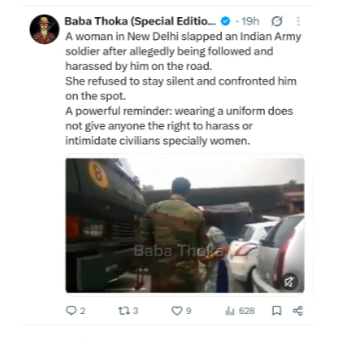
A video is being shared on social media with the claim that a woman in New Delhi slapped an Indian Army soldier who allegedly followed and harassed her on the road. The post claims that the woman confronted the soldier on the spot, linking the incident to harassment of women. CyberPeace Research found the viral claim to be misleading. Our research found that the video is not recent but dates back to an incident in Delhi in September 2017. The video is from a road rage incident that took place in the Vasant Kunj-Rajokari Flyover area of South Delhi in September 2017. According to available reports, the woman allegedly assaulted two Army personnel. The claim that the video shows an incident in which a woman slapped an Army soldier in response to being followed or harassed by him is misleading.
Claim:
A social media user shared the viral video claiming that a woman in New Delhi slapped an Indian Army soldier who allegedly followed and harassed her on the road. The post claimed that instead of remaining silent, the woman confronted the soldier on the spot. The post further stated that the incident sends a strong message that wearing a uniform does not give anyone the right to harass or intimidate civilians, especially women.
https://x.com/OfficialThoka/status/2101989813071307032
Fact Check
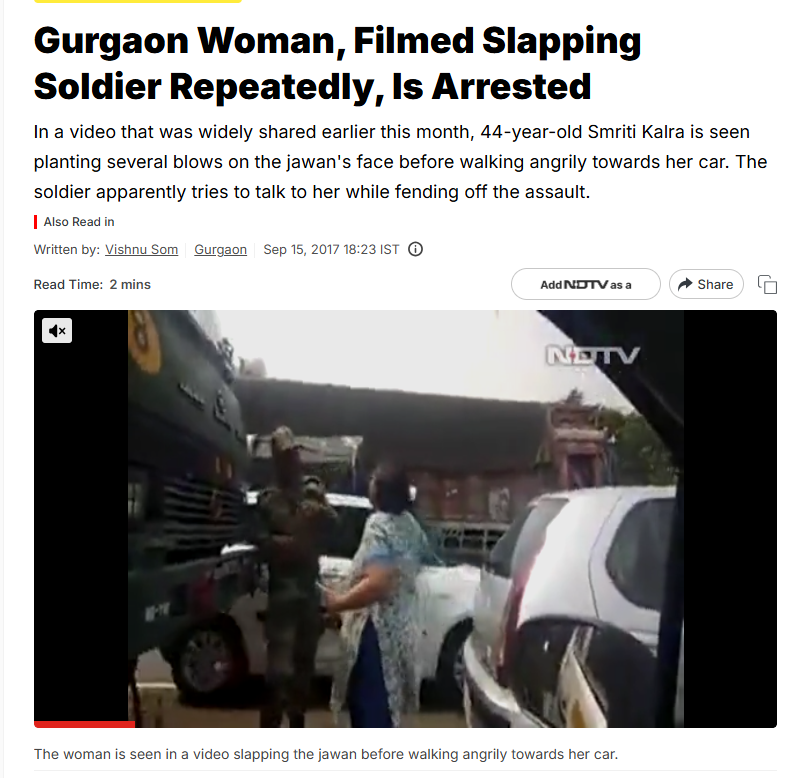
To verify the viral claim, we conducted a Google search using relevant keywords. However, we did not find any credible media reports related to the claim.To further verify the authenticity of the viral claim, we conducted a reverse image search of the keyframes of the video. During the search, we found the same video on the NDTV website, which was published on September 15, 2017. According to the NDTV report, a woman in New Delhi was caught on camera repeatedly slapping an Army personnel. The soldier did not appear to retaliate during the incident. Following a complaint by the Army to the Delhi Police, the woman was arrested. However, she was released within a few hours after a judge granted her bail. The report stated that in a video recorded by a witness on a mobile phone in South Delhi’s Vasant Kunj the previous Saturday, 44-year-old Smriti Kalra was seen repeatedly slapping the soldier on the face before walking angrily towards her car. The soldier appeared to be trying to reason with her while attempting to defend himself against the assault.Smriti Kalra, a resident of Gurgaon, had stopped her Tata Indica car in front of an Army truck carrying soldiers. At first glance, the incident appeared to be a case of road rage, although there was no reported collision or any obvious provocation for the attack.Smriti Kalra, who was divorced, was charged with causing hurt to deter a public servant from performing his duty. She was also accused of obstructing and assaulting a public servant on duty and wrongfully restraining him. Police seized her car.
In the next stage of our research, we found a report on the Aaj Tak website related to the incident, which also featured the viral video. The report included an exclusive interview with the Army personnel involved in the incident. He was identified as Mahavir Singh, who was serving as a Junior Commissioned Officer (JCO) in the Army at the time.
In an exclusive interview with Aaj Tak, Mahavir Singh said that he was deeply saddened by the incident. He questioned how anyone could behave in such a manner with Indian Army personnel, abuse them, or slap them. He said that the Army vehicle was moving slowly when a car suddenly came in front of it and started driving ahead of them. A woman was the only person in the car, and she was allegedly driving in a zigzag manner in front of the Army vehicle.
Conclusion
Our research found that the viral video is being shared with a misleading context. The video is not from a recent incident but from a road rage incident that took place in the Vasant Kunj-Rajokari Flyover area of South Delhi in September 2017. According to available media reports, the woman had allegedly misbehaved with Army personnel and slapped one of the soldiers during the incident. Mahavir Singh, who was serving as a JCO in the Army at the time, also spoke to the media about the incident. Our research found no credible information confirming that the Army personnel had followed or harassed the woman. Therefore, the claim that the video from the 2017 incident shows a woman slapping a soldier in response to being allegedly followed or harassed by him is misleading.

Introduction
On May 21st, 2025, the Department of Telecommunications (DoT) launched the Financial Risk Indicator (FRI) feature, marking an important step towards safeguarding mobile phone users from the risks of financial fraud. This was developed as a part of the Digital Intelligence Platform (DIP), which facilitates coordination between stakeholders to curb the misuse of telecom services for conducting cyber crimes.
What is the Financial Risk Indicator (FRI)?
The FRI is a risk-based metric feature that categorises phone numbers into risk, medium risk, and high risk based on their association with financial fraud in the past. The data pool enabling this intelligence sharing includes the Digital Intelligence Unit (DIU) of the DoT, which engages and sends a list of Mobile Numbers that were disconnected (Mobile Number Revocation List - MNRL) to the following stakeholders, creating a network of checks and balances. They are:
- Intelligence from Non-Banking Finance Companies, and UPI (Unified Payment Interface) gateways.
- The Chakshu facility- a feature on the Sanchar Saathi portal that enables users to report suspected fraudulent communication (Calls, SMS, WhatsApp messages), which has also been roped in.
- Complaints from the National Cybercrime Reporting Portal (NCRP) through the I4C (Indian Cyber Coordination Center).
Some other initiatives taken up concerning securing against digital financial fraud are the Citizen Financial Cyber Fraud Reporting and Management System, the International Incoming Spoofed Calls Prevention System, among others.
A United Stance
The ease of payment and increasing digitisation might have enabled the increasing usage of UPI platforms. However, post-adoption, the responsibility of securing the digital payments infrastructure becomes essential. As per a report by CNBC TV18, UPI fraud cases surged by 85% in FY24. The number of incidents have increased from 7.25 lakh in FY23 to 13.42 lakh in FY24. These cases involved a total value of ₹1,087 crore, compared to ₹573 crore in the previous year, and the number continues to increase.
Nevertheless, UPI platforms are taking their own initiative to combat such crimes. PhonePe, one of the most used digital payment interface as of January 2025 (Statista) has already incorporated the FRI into its PhonePe Protect feature; this blocks transactions with high-risk numbers and issues a warning prior to engaging with numbers that are categorised to be of medium risk.
CyberPeace Insights
The launch of a feature addressing the growing threat of financial fraud is crucial for creating a network of stakeholders to coordinate with law enforcement to better track and prevent crimes. Publicity of these measures will raise public awareness and keep end-users informed. A secure infrastructure for digital payments is necessary in this age, with a robust base mechanism that can adapt to both current and future threats.
References
- https://www.thehawk.in/news/economy-and-business/centre-launches-financial-fraud-risk-indicator-to-safeguard-mobile-users
- https://telanganatoday.com/government-launches-financial-fraud-risk-indicator-to-safeguard-mobile-users
- https://www.pib.gov.in/PressReleasePage.aspx?PRID=2130249#:~:text=What%20is%20the%20%E2%80%9CFinancial%20Fraud,High%20risk%20of%20financial%20fraud
- https://www.business-standard.com/industry/news/dot-launches-financial-fraud-risk-indicator-to-aid-cybercrime-detection-125052101912_1.html
- https://www.cnbctv18.com/business/finance/upi-fraud-cases-rise-85-pc-in-fy24-increase-parliament-reply-data-19514295.htm
- https://www.statista.com/statistics/1034443/india-upi-usage-by-platform/#:~:text=In%20January%202025%2C%20PhonePe%20held%20the%20highest,key%20drivers%20of%20UPI%20adoption%20in%20India
- https://telecom.economictimes.indiatimes.com/amp/news/policy/centre-notifies-draft-rules-for-delicensing-lower-6-ghz-band/121260887?nt

Introduction
The Ministry of Electronics and Information Technology (MeitY) recently issued the “Email Policy of Government of India, 2024.” It is an updated email policy for central government employees, requiring the exclusive use of official government emails managed by the National Informatics Centre (NIC) for public duties. The policy replaces 2015 guidelines and prohibits government employees, contractors, and consultants from using their official email addresses on social media or other websites unless authorised for official functions. The policy aims to reinforce cybersecurity measures and protocols, maintain secure communications, and ensure compliance across departments. It is not legally binding, but its gazette notification ensures compliance and maintains cyber resilience in communications. The updated policy is also aligned with the newly enacted Digital Personal Data Protection Act, 2023.
Brief Highlights of Email Policy of Government of India, 2024
- The Email Policy of the Government of India, 2024 is divided into three parts namely, Part I: Introduction, Part II: Terms of Use, Part III: Functions, duties and Responsibilities, and with an annexe attached to it defining the meaning of certain organisation types in relation to this policy.
- The policy direct to not use NICeMail address for registering on any social media or other websites or mobile applications, save for the performance of official duties or with due authorisation from the authority competent.
- Under this new policy, “core use organisations” (central government departments and other government-controlled entities that do not provide goods or services on commercial terms) and its users shall use only NICeMail for official purposes.
- However, where the Core Use Organisation has an office or establishment outside India, to ensure availability of local communication channels under exigent circumstances may use alternative email services hosted outside India with all due approval.
- Core Use Organisations, including those dealing with national security, have their own independent email servers and can continue operating their independent email servers provided the servers are hosted in India. They should also consider migrating their email services to NICeMail Services for security and uniform policy enforcement.
- The policy also requires departments that currently use @gov.in or @nic.in to instead migrate to @departmentname.gov.in mail domains so that information sanctity and integrity can be maintained when officials are transferred from one department/ministry to another, and so that the ministry/department doesn’t lose access to the official communication. For this, the department or ministry in question must register the domain name with NIC. For instance, MeitY has registered the mail domain @meity.gov.in. The policy gives government departments six months time period complete this migration.
- The policy also makes distinction between (1) Organisation-linked email addresses and (2) Service-linked email addresses. The policy in respect of “organisation-linked email addresses” is laid down in paragraphs 5.3.2(a) and 5.4 to 5.6.3. And the policy in respect of “service-linked email addresses” is laid down in paragraphs 5.3.2(b) and 5.7 to 5.7.2 under the official document of said policy.
- Further, the new policy includes specific directives on separating the email addresses of regular government employees from those of contractors or consultants to improve operational clarity.
CyberPeace Policy Outlook
The revised Email Policy of the Government of India reflects the government’s proactive response to countering the evolving cybersecurity challenges and aims to maintain cyber resilience across the government department’s email communications. The policy represents a significant step towards securing inter government and intra-government communications. We as a cybersecurity expert organisation emphasise the importance of protecting sensitive data against cyber threats, particularly in a world increasingly targeted by sophisticated phishing and malware attacks, and we advocate for safe and secure online communication and information exchange. Email communications hold sensitive information and therefore require robust policies and mechanisms in place to safeguard the communications and ensure that sensitive data is shielded through regulated and secure email usage with technical capabilities for safe use. The proactive step taken by MeitY is commendable and aligned with securing governmental communication channels.
References:
- https://www.meity.gov.in/writereaddata/files/Email-policy-30-10-2024.pdf-(Official document for Email Policy of Government of India, 2024.
- https://www.hindustantimes.com/india-news/dont-use-govt-email-ids-for-social-media-central-govt-policy-for-employees-101730312997936.html#:~:text=Government%20employees%20must%20not%20use,email%20policy%20issued%20on%20Wednesday
- https://bwpeople.in/article/new-email-policy-issued-for-central-govt-employees-to-strengthen-cybersecurity-measures-537805
- https://www.thehindu.com/news/national/centre-notifies-email-policy-for-ministries-central-departments/article68815537.ece
