
Operation Mule Hunt 2.0: How Ordinary Bank Accounts Became India's Biggest Cybercrime Weapon
Introduction
The recent investigation of Patan Cyber Crime Police as part of Operation Mule Hunt 2.0 reveals the sheer scale and intricacy of India's burgeoning cyber fraud economy. Police found that a total of 13 current accounts were being operated at a cooperative bank in the Patan district of Gujarat and used for siphoning 398.43 crore of cyber fraud transaction data on 228 cybercrime cases across states. Further investigations against 14 current account holders and intermediaries show the indispensability of mule accounts in laundering criminal money. The recent incident cannot be taken as isolated; the story points at a formalised and industrialised fraud economy with a robust banking infrastructure, a growing payment gateway, and complex networks.
What Is a Mule Account and Why Should You Care?
The term "mule account" is benign but plays a critical role in modern cybercrime networks. The Reserve Bank of India defines a mule account as a bank account that serves as a vehicle to transfer money proceeds from unlawful transactions and can be operated by people coerced by the prospect of high earnings or by way of inducement.
This mechanism can be witnessed through the investigation of the Patan cybercrime incident, where an investor can be defrauded by a fake investment website, employment fraud, or a digital arrest scheme. After transactions from the victim account, funds would quickly flow into the mule account, which would be held by a legitimate KYC customer. These transactions would then be passed on, between 1 lakh and 5 lakh transactions within hours, to multiple accounts as alleged by the Indian Cyber Crime Coordination Centre (I4C) before they get difficult to trace by being passed through informal channels or converted to cryptocurrency.
In the Patan case, it is alleged that the middlemen enticed locals and offered commissions to open firms and current accounts at Harij Nagrik Sahakari Bank and subsequently gave up their ATM cards, checkbooks, SIMs, and net banking facilities to the operators of the account. It is estimated that such accounts channeled an amount of 398.43 crore to 228 Indian cybercrime cases.
The Scale of India's Mule Account Crisis
The scale of the mule account ecosystem is reflected in India's rapidly worsening cybercrime statistics. As of data from the National Cyber Crime Reporting Portal (NCCRP), a total of 22.68 lakh complaints were registered in 2024, a jump by 42% from 2023. This was not even half the rate of financial loss, which jumped by 206% in 2023 (22,845 crore) and stood at 22,495 crore in 2025 (complaints jumped to 28.15 lakh). The increase in fraudulent transactions therefore outweighs the stability in financial losses significantly.
Mule accounts are the backbone of this crime network. To curb this phenomenon, the Indian Cyber Crime Coordination Centre (I4C) launched a Suspect Registry along with Indian banks and financial institutions in September 2024. 24.67 lakh accounts of suspected mules were identified in this, preventing over 8,031 crore in fraudulent transactions. Despite these efforts, a recent statement from the ED found over 12,000 crore being routed via mule accounts, shell firms, and cryptocurrency.
This isn't isolated to certain banks. 2024 alone saw over 65,000 mule accounts detected in Karnataka. By analyzing the Citizen Financial Cyber Frauds Reporting and Management System, about 40,000 such accounts were detected in SBI branches, and thousands more were detected across the PNB, Canara Bank, Kotak Mahindra Bank, and Airtel Payments Bank. The Patan case also clearly highlights that cooperative banks' lack of compliance and lower levels of transaction-monitoring systems contribute to easily creating and using mule accounts.
Operation Mule Hunt: Gujarat's Coordinated Offensive
This bust in Patan is just one manifestation of a much wider coordinated effort by the state government. Operation Mule Hunt 1.0, which ran from November to December 2025 across the state of Gujarat, was a month-long campaign by Gujarat Police's Cyber Centre of Excellence (CCOE) that unearthed 2,289 crore of fraudulent transactions, led to the registration of 565 FIRs, arrest of 638 accused, and impounding of 913 mule accounts with connections to over 4,000 cases of cybercrime nationwide.
This was followed up with the second installment of the operation, which was kicked off in all districts of Gujarat in 2026. The two-week campaign, which began across the state on January 8 this year, resulted in the Surat City Police alone arresting 77 people and uncovering close to 23.85 crore in fraudulent transactions. In what looks like one of the single largest single-district bust-ups in the operation, the Patan incident itself, with a staggering 398.43 crore routed through only 13 accounts, is remarkable.
The extraordinary nature of the operation is seen in the intelligence capabilities that drove it. It wasn't that police accidentally stumbled upon the Patan network; they worked back on it. After using data from the union government’s inter-agency platform, SAMANVAYA, a coordination platform for data on cybercrimes and the NCCRP, they traced suspicious clusters of transactions in the Harij Nagrik Sahakari Bank accounts to build a chain of evidence connecting the accountholders to the middlemen and, from the middlemen, to the whole ring of fraud. Twenty accused have been chargesheeted under the Bharatiya Nyaya Sanhita (BNS), and fourteen have been arrested, while six are still absconding.
The Human Cost Nobody Talks About
Behind every crore of scam money lies a real person who actually lost the real money. Of the 75%+ fraud losses incurred in 2025, 75% are from investment scams alone. Victims of stock trading scams lost ₹4,636 crore, spread across 2.28 lakh complaints filed in 2024. "Digital arrest" scams, in which fraudsters posing as law enforcement officials psychologically blackmail the victims to transfer money, claimed ₹2,576 crore between 2022 and the first quarter of 2025.
For the victims it's never about the money: it's the retired teacher's lifetime savings from Chhattisgarh, the small trader's capital from Rajkot, the emergency money of the Bhopal family, or just savings from an ordinary person. And the mule accounts' networks are why most of it is never retrieved. Once the money is thrown into the layering chain, it's exponentially more difficult to trace it after every jump.
Then there's another category of victims that often gets overlooked, and they are the mule account holders themselves, many being semi-literate people from semi-urban or rural backgrounds approached with ₹10,000 in commission and with no awareness about the legalities of lending their bank details. With the BNS now they stand to get convicted for grave crimes, but the awareness of this trap is very low.
Recommendations and Suggestions
This isn't something India is facing passively. I4C, along with RBI, has developed Mule Account Hunter software. This software can be used by banks for the detection of suspect accounts through the use of behavioral analysis, device intel, and transaction pattern recognition. The Union Home Minister has directly asked all cooperative banks across the country to adopt this software at the earliest. Failure to do so, he warned, would make consumer safety from cyber fraud incomplete.
Apart from technology, three other areas need to go hand in hand: stringent KYC enforcement for cooperative and small finance banks; the prime locations of the mule recruitment network; greater awareness for the masses regarding the criminal liability one takes up when lending their accounts; and efficient inter-agency coordination so that the intelligence gathered on platforms like SAMANVAYA is converted into arrests before the accounts are dumped and the network reforms in another location.
Operation Mule Hunt 2.0 proves that this is feasible. 13 accounts in a small district of Gujarat. 398 crore. 228 victims. 14 arrested. The pipeline did exist, and it has been broken.
Yet, even as one network is broken, another is forming, somewhere right now. The accounts will appear legitimate. The holders of these accounts may not even realize what they have got into. That is the true danger of the mule accounts and work that cannot stop.
Conclusion
The Patan investigation has clearly shown that mule accounts have now moved from being a subsidiary tool of financial crime to becoming the infrastructure that underpins the economy of cyber-fraud in India. Every financial fraud, including investment fraud, digital arrest fraud, and phishing scams, is backed by a string of real bank accounts where the proceeds of crime are transferred and the trail is obscured. Though attempts such as the I4C Suspect Registry have made attempts to break down this network, it remains an overwhelming task. Robust KYC norms, real-time monitoring of transactions, and coordination between banks, police, and regulators are the key in preventing further industrialisation of cyber financial fraud in India.
References
- https://timesofindia.indiatimes.com/city/ahmedabad/operation-mule-hunt-2-0-gujarat-
- police-bust-rs-398-43-crore-cyber-fraud-14-held/articleshow/131594240.cms?utm_source=contentofinterest&utm_medium=text&utm_campaign=cppst
- https://the420.in/india-cybercrime-2024-42-percent-spike-sims-imei-mule-accounts/
- https://www.thehansindia.com/news/national/ed-explains-how-mule-accounts-and-crypto-networks-enabled-12000-crore-cyber-fraud-1047606
- https://www.zigram.tech/article/mule-accounts-tier-1-tier-2-cities-india/
- https://risk.lexisnexis.com/global/en/insights-resources/article/stopping-money-mules-in-india
- https://timesofindia.indiatimes.com/city/ahmedabad/operation-mule-hunt-2-0-gujarat-police-bust-rs-398-43-crore-cyber-fraud-14-held/articleshow/131594240.cms

Related Blogs

Executive Summary
A video showing flames and thick smoke rising over a densely populated city at night is being widely circulated on social media. The video is being shared with the claim that it shows the actual visuals of explosions and destruction caused by an attack on Iran. CyberPeace Research Wing ’s research found the viral claim to be false. Our research revealed that the video is not real footage but an AI-generated video, which is being circulated with a false claim.
Claim
A user on social media platform Instagram shared the viral video on July 17, 2026, claiming that it shows the real visuals of an attack on Iran and the massive explosions caused by it.
https://www.instagram.com/reel/Da1_gaXyyoP/?utm_source=ig_web_copy_link&igsh=NTc4MTIwNjQ2YQ==

Fact Check
To verify the authenticity of the viral claim, we extracted multiple keyframes from the video and conducted a reverse image search using Google Lens. During the research, we did not find any credible news report, verified video, or authentic source confirming that the footage was related to any attack on Iran. To further examine the authenticity of the video, we analysed it using multiple AI detection tools. First, we scanned the video using Hive Moderation. The tool’s analysis indicated that the video had a 94.9% probability of being AI-generated, suggesting that the footage may have been created using Artificial Intelligence.
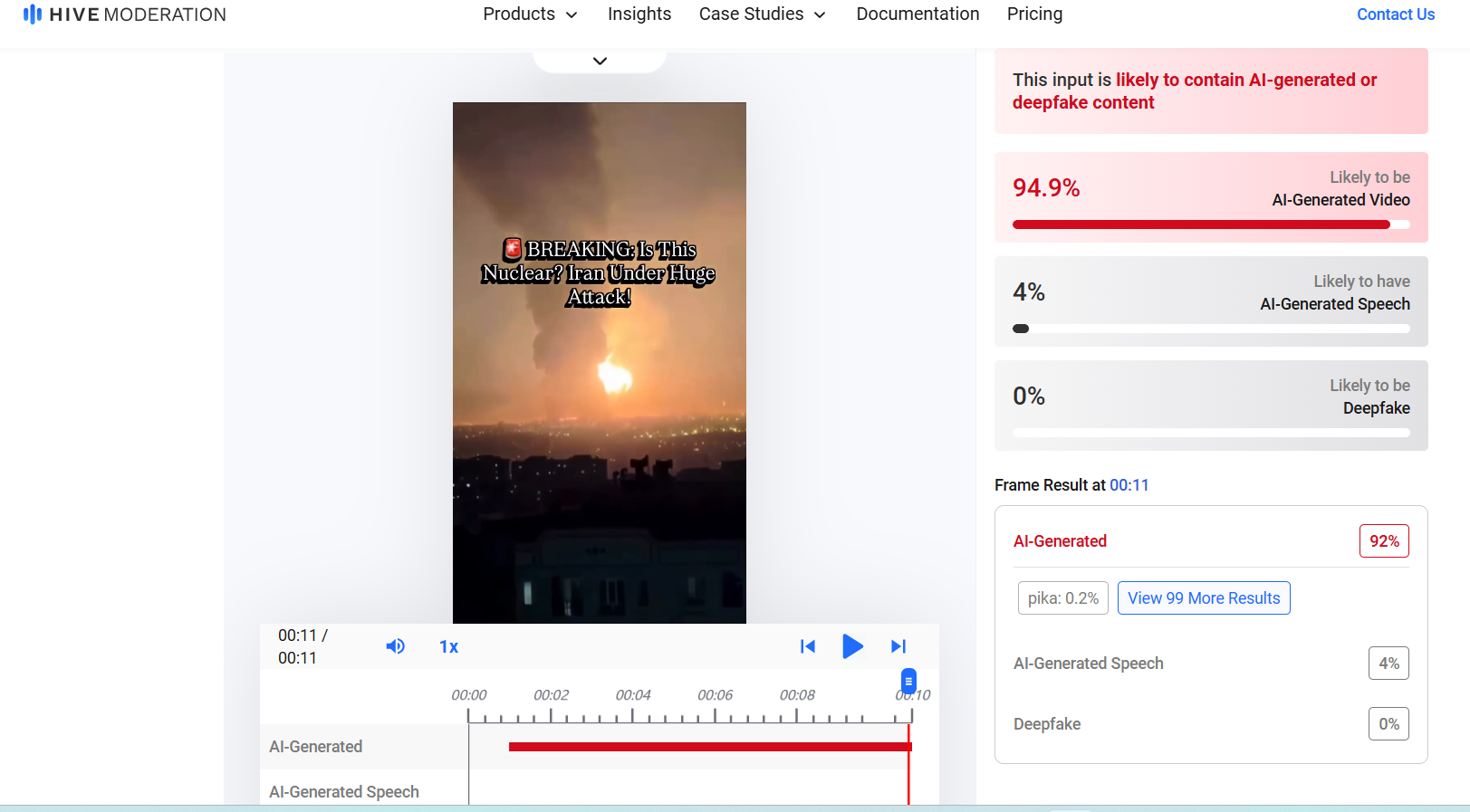
For additional verification, we analysed the video using DetectVideo AI. The tool also indicated that the video was likely AI-generated, with an estimated 80% probability.

We further checked the video using another AI detection tool, AI or Not, which suggested that the footage had a 64% probability of being AI-generated.

At the final stage of verification, we used WasIt.AI, which also indicated that the video was likely AI-generated, with an 88% probability.

Conclusion
CyberPeace Research Wing ’s research found that the viral video does not show real footage of an attack on Iran.The video was created using Artificial Intelligence (AI) and is being falsely shared as authentic visuals of explosions and destruction caused by an attack on Iran. Users are advised to verify such sensational claims before sharing them online.

Disclaimer:
This report is the collaborative outcome of insights derived from the CyberPeace Helpline’s operational statistics and the CyberPeace Research Team, covering the monthly helpline case trends of May 2025, the report identifies recurring trends, operational challenges, and strategic opportunities. The objective is to foster research-driven solutions that enhance the overall efficacy of the helpline.
Executive Summary:
This report summarizes the cybercrime cases reported in May, offering insights into case types, gender distribution, resolution status, and geographic trends.
As per our analysis, out of various Cyber Frauds Financial Fraud was the most reported issue, making up 43% of cases, followed by Cyberbullying (26%) and Impersonation (14%). Less frequent but serious issues included Sexual Harassment, Sextortion, Hacking, Data Tampering, and Cyber Defamation, each accounting for 3–6%, highlighting a mix of financial and behavioral threats.The gender distribution was fairly balanced, with 51% male and 49% female respondents. While both genders were affected by major crimes like financial fraud and cyber bullying, some categories—such as sexual harassment—reflected more gender-specific risks, indicating the need for gender-responsive policies and support.
Regarding case status, 60% remain under follow-up while 40% have been resolved, reflecting strong case-handling efforts by the team.
The location-wise data shows higher case concentrations in Uttar Pradesh, Andhra Pradesh, Karnataka, and West Bengal, with significant reports also from Delhi, Telangana, Maharashtra, and Odisha. Reports from the northeastern and eastern states confirm the nationwide spread of cyber incidents.In conclusion, the findings point to a growing need for enhanced cybersecurity awareness, preventive strategies, and robust digital safeguards to address the evolving cyber threat landscape across India.
Cases Received in May:
As per the given dataset, the following types of cases were reported to our team during the month of May:
- 💰 Financial Fraud – 43%
- 💬 Cyber Bullying – 26%
- 🕵️♂️ Impersonation – 14%
- 🚫 Sexual Harassment – 6%
- 📸 Sextortion – 3%
- 💻 Hacking – 3%
- 📝 Data Tampering – 3%
- 🗣️ Cyber Defamation – 3%

The chart illustrates various cybercrime categories and their occurrence rates. Financial Fraud emerges as the most common, accounting for 43% of cases, highlighting the critical need for stronger digital financial security. This is followed by Cyber Bullying at 26%, reflecting growing concerns around online harassment, especially among youth. Impersonation ranks third with 14%, involving identity misuse for deceitful purposes. Less frequent but still serious crimes such as Sexual Harassment (6%), Sextortion, Hacking, Data Tampering, and Cyber Defamation (each 3%) also pose significant risks to users’ privacy and safety. Overall, the data underscores the need for improved cybersecurity awareness, legal safeguards, and preventive measures to address both financial and behavioral threats in the digital space.
Gender-Wise Distribution:
- 👨 Male – 51%
- 👩 Female – 49%

The chart illustrates the distribution of respondents by gender. The data shows that Male participants make up 51% of the total, while Female participants account for 49%. This indicates a fairly balanced representation of both genders, with a slight majority of male respondents.
Gender-Wise Case Distribution:

- The chart presents a gender-wise distribution of various cybercrime cases, offering a comparative view of how different types of cyber incidents affect males and females.
- It highlights that both genders are significantly impacted by cybercrimes such as financial fraud and cyber bullying, indicating a widespread risk across the board.
- Certain categories, including sexual harassment, cyber defamation, and hacking, show more gender-specific patterns of victimization, pointing to differing vulnerabilities.
- The data suggests the need for gender-sensitive policies and preventive measures to effectively address the unique risks faced by males and females in the digital space.
- These insights can inform the design of tailored awareness programs, support services, and intervention strategies aimed at improving cybersecurity for all individuals.
Major Location Wise Distribution:
The map visualization displays location-wise distribution of reported cases across India. The cases reflect the cyber-related incidents or cases mapped geographically.

The map highlights the regional distribution of cybercrime cases across Indian states, with a higher concentration in Uttar Pradesh, Andhra Pradesh, Karnataka, and West Bengal. States like Delhi, Telangana, Maharashtra, and Odisha also show notable activity, indicating widespread cyber threats. Regions including Assam, Tripura, Bihar, Jharkhand, and Jammu & Kashmir further reflect the pan-India spread of such incidents. This distribution stresses the need for targeted cybersecurity awareness and stronger digital safeguards nationwide
CyberPeace Advisory:
- Use Strong and Unique Passwords: Create complex passwords using a mix of letters, numbers, and symbols. Avoid reusing the same password across multiple platforms.
- Enable Multi-Factor Authentication (MFA): Add an extra layer of security by using a second verification step like an OTP or authentication app.
- Keep Software Updated: Regularly update your operating system, apps, and security tools to protect against known vulnerabilities.
- Install Trusted Security Software: Use reliable antivirus and anti-malware programs to detect and block threats.
- Limit Information Sharing: Be cautious about sharing personal or sensitive details, especially on social media or public platforms.
- Secure Your Network: Protect your Wi-Fi with a strong password and encryption. Avoid accessing confidential information on public networks.
- Back Up Important Data: Regularly save copies of important files in secure storage to prevent data loss in case of an attack.
- Stay Informed with Cybersecurity Training: Learn how to identify scams, phishing attempts, and other online threats through regular awareness sessions.
- Control Access to Data: Give access to sensitive information only to those who need it, based on their job roles.
- Monitor and Respond to Threats: Continuously monitor systems for unusual activity and have a clear response plan for handling security incidents.
- CyberPeace Helpline mail ID: helpline@cyberpeace.net
- CyberPeace Helpline Number: 9570000066
- Central Government Helpline: https://cybercrime.gov.in/
- Central Government Helpline Number: 1930
Conclusion
The cybercrime cases reported in May highlight a diverse and evolving threat landscape across India. Financial fraud, cyber bullying, and impersonation are the most prevalent, affecting both genders almost equally, though some crimes like sexual harassment call for targeted gender-sensitive measures. With 60% of cases still under follow-up, the team’s efforts in investigation and resolution remain strong. Geographically, cyber incidents are widespread, with higher concentrations in several key states, demonstrating that no region is immune. These findings underscore the urgent need to enhance cybersecurity awareness, strengthen preventive strategies, and build robust digital safeguards. Proactive and inclusive approaches are essential to protect individuals and communities and to address the growing challenges posed by cybercrime nationwide.
Introduction
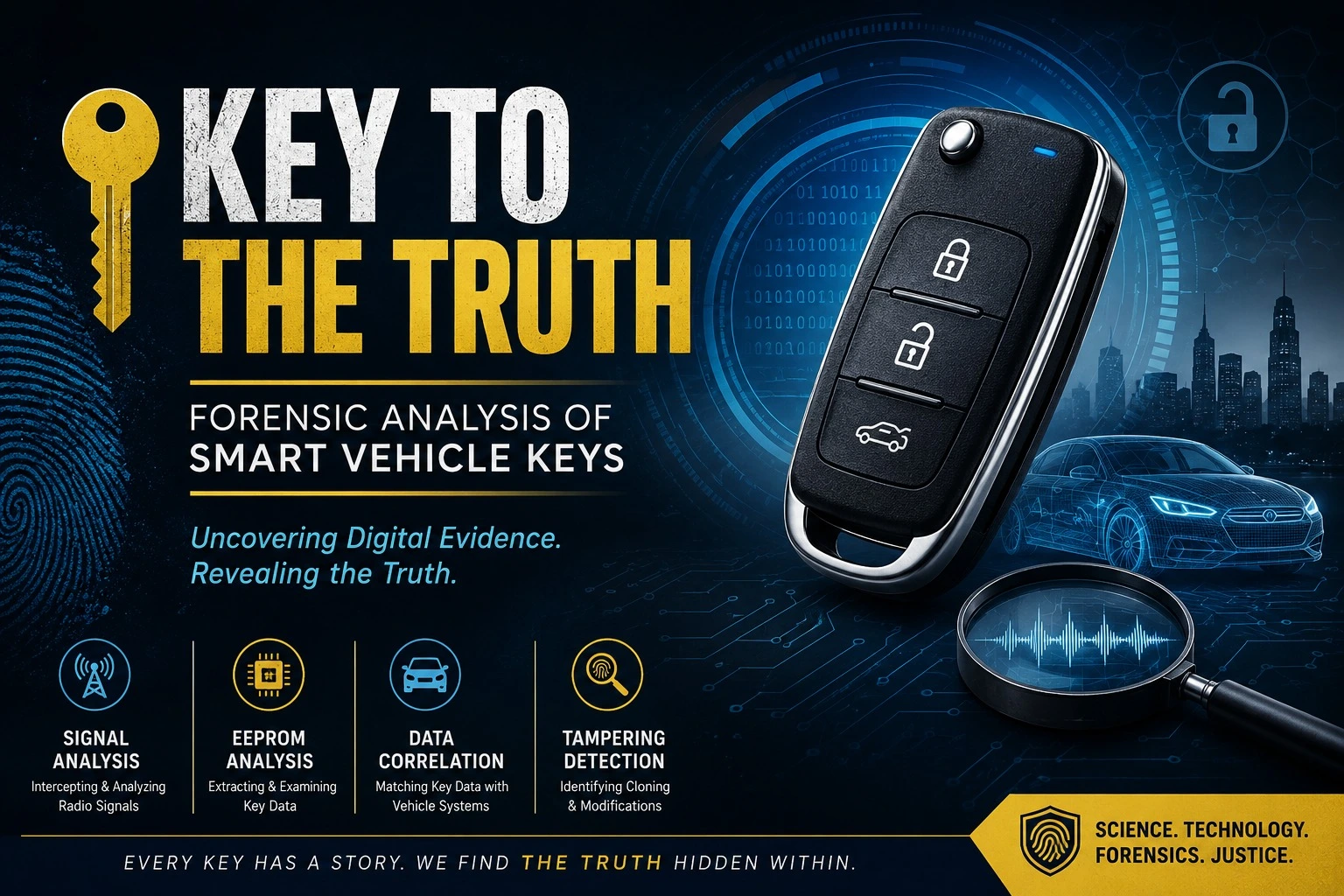
With the modernization of automobiles, so have the methods employed by criminals who seek to commit thefts. The old method of smashing a car window or bypassing an engine lock is no longer prevalent. Modern car thieves employ cloning techniques for keys and digital signals, and sophisticated methods to commit crimes without any traces left behind. In an era where intelligence is crucial, the forensic examination of car keys has become an indispensable tool for investigations, providing clues buried within ordinary car keys.
The Need for Car Key Forensics Today
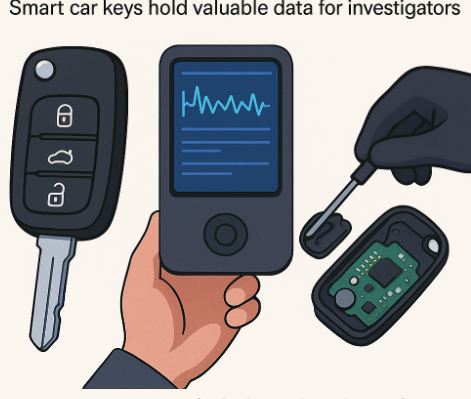
Daily, thousands of cars worth millions are being hacked or stolen around the globe. The shocking thing is that most of these hacks do not have any sign of breakage or forced entry. It is because the thieves use vulnerabilities in the wireless key systems to unlock the vehicles without leaving any trace behind. Therefore, car-key forensics has now become more important than ever before.
Forensic Value of Smart Key
The smart key is not just comprised of locking and unlocking features for vehicles. Actually, it operates as a miniature computer within the key itself. Information such as pairing records, frequency of use, or the last instance that the key was used to unlock something could be contained in smart keys, thus offering evidence of any criminal activity conducted using these items.
Patterns of Vehicle Theft
Through the examination of the chip in a key, one will be able to establish whether the key was legally programmed or had been tampered with by some other means. Such forensics become more important when trying to detect and monitor any car theft rings, which employ cloning machines or software.
Confirming Ownership and Authenticity
In cases involving insurance claims or fraud, smart key data can help confirm whether the person making a claim actually owned or used the car during the incident. It’s digital proof that goes beyond what paperwork or statements can show.
Strengthening Legal Cases
When brought to court, data doesn’t lie. A properly handled forensic examination of a car key can provide hard evidence — the kind that holds up under questioning and supports or disproves claims with complete accuracy. In many cases, this small device becomes the most reliable witness in the investigation.
A Real-Life Example
Consider the following scenario: An expensive SUV is stolen from a parking lot secured with security surveillance. No one is captured on camera and there is no sign of forced entry. After days of investigation, the police end up arresting a suspect with a smart key.
During forensic analysis of the smart key, it is revealed that:
- The transponder has an ID number which can be matched against the immobilizer installed in the vehicle.
- The rolling code counter has been incremented in such a way that the date corresponds with the report of theft of the vehicle.
- The extracted information helps match the pair timestamp of the key with the particular make and model of the vehicle.
All this from a single piece of evidence – the smart key.
Inside a Smart Key: Where the Data Lives
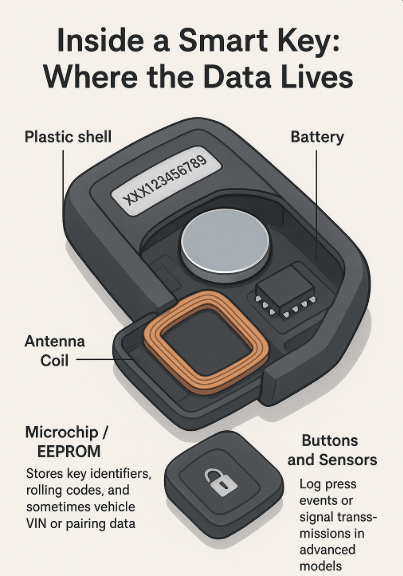
An average smart key is not only a remote but also a multi-level set of data carriers:
- Plastic Shell– could include serial numbers and information on the manufacture.
- Battery – helps calculate the time of using the key or detect any modifications.
- Antenna Coil – sends encrypted information to the immobilizer of a car. Draw the picture of this element.
- Microchip / EEPROM – holds key identification code, rolling code, VIN number, and/or other information of the vehicle.
- Buttons / sensors – could record any pressing or transmission actions in some cases.
All the little devices above, once properly studied via forensics software, provide valuable information.
How the Investigator Uncovers the Truth
In relation to investigating the true story about a vehicle, it is no different than handling other forms of digital evidence, as forensic analysts treat the car key in the same way. It is nothing more than an encrypted device in your hands, and using special techniques, they are able to reveal the information contained within the device.
Some of the methods used by modern forensic laboratories include:
1. Intercepting Radio Signals
Any intelligent key transmits radio signals to communicate with a car. Specialists employ advanced antennas and radio frequency (RF) analysers to catch and analyse them. This way, it is possible to understand the interaction between the key and the car – how often was it used, what kind of authentication procedure takes place, and if the signal matches the car’s one or has been forged somehow.
2. Checking Out the Key’s Brain (Analysis of EEPROM)
There is always a special chip on the key that is responsible for its activity. The chip contains an important memory module (EEPROM – Electrically Erasable Programmable Read-Only Memory), which holds various data, including key IDs and rolling codes. It can be carefully retrieved via advanced tools. Thus, it is possible to determine whether somebody tried to tamper with the key.
3. The Correlation between the Key and Car’s Information
The information stored inside the key will not be used separately since investigators will correlate the key's data with that of the vehicle itself (ECU and immobilizer). If the two kinds of information coincide, the investigation may conclude that the key belongs to the vehicle. Otherwise, this may mean either cloning or tampering.
4. Identifying the Tampering and Cloning Evidence
As was mentioned above, thieves sometimes resort to using unlawful programming devices for duplicating smart car keys. In order to detect possible cloning, experts examine the key using various diagnostic devices to find out whether the keys were modified by changing the encryption code, frequencies, and hardware itself.
At the end of the process, some kind of miracle occurs because of the following: all actions committed with this particular key become documented, recorded inside the device itself. Even if someone tries to hide anything or remove any information concerning this particular incident, there will always remain some data.
Car Key Forensics in the Future
The evolution of cars to connect with other devices and adopt self-driving technologies requires new investigative methods to be used for vehicle-related crimes. Advanced car keys or smartphone apps that replace physical keys will likely incorporate biometric authentication, cloud integration, or blockchain records of key activity in the near future.
Such improvements will pose several threats and offer many benefits:
- Artificial intelligence tools can determine if the car key is cloned based on its behaviour pattern.
- Blockchain validation ensures all key-related activities are recorded and cannot be altered.
- Cyber-forensic protocols will become increasingly necessary for investigating criminal activity related to vehicles.
Car key forensics technology will not only allow solving crimes but may become instrumental in crime prevention.
Conclusion
A car key in this era is more than just an unlocking mechanism; it is a miniature data storage facility, which can yield information about the user, intentions, and access rights. The more cars become technologically advanced, the more the examination of smart keys becomes necessary as part of correlating physical evidence with digital investigation. It clearly indicates how small objects such as keys can play pivotal roles in cracking cases.
