
IW: Weaponising Information

Introduction
The world has been witnessing various advancements in cyberspace, and one of the major changes is the speed with which we gain and share information. Cyberspace has been declared as the fifth dimension of warfare, and hence, the influence of technology will go a long way in safeguarding ourselves and our nation. Information plays a vital role in this scenario, and due to the easy access to information, the instances of misinformation and disinformation have been rampant across the globe. In the recent Russia-Ukraine crisis, it was clearly seen how instances of misinformation can lead to major loss and harm to a nation and its subjects. All nations and global leaders are deliberating upon this aspect and efficient sharing of information among friendly nations and inter-government organisations.
What is IW?
IW, also known as Information warfare, is a critical aspect of defending our cyberspace. Information Warfare, in its broadest sense, is a struggle over the information and communications process, a struggle that began with the advent of human communication and conflict. Over the past few decades, the rapid rise in information and communication technologies and their increasing prevalence in our society has revolutionised the communications process and, with it, the significance and implications of information warfare. Information warfare is the application of destructive force on a large scale against information assets and systems, against the computers and networks that support the four critical infrastructures (the power grid, communications, financial, and transportation). However, protecting against computer intrusion, even on a smaller scale, is in the national security interests of the country and is important in the current discussion about information warfare.
IW in India
The aspects of misinformation have been recently seen in India in the form of the violence in Manipur and Nuh, which resulted in a massive loss of property and even human lives. A lot of miscreants or anti-national elements often seed misinformation in our daily news feed, and this is often magnified by social media platforms such as Instagram or X (formerly known as Twitter) and OTT-based messaging applications like WhatsApp or Telegram during the pandemic. It was seen nearly every week that some or the other new ways to treat COVID-19 were shared on Social media, which were false and inaccurate, especially in regard to the vaccination drive. A lot of posts and messages highlighted that the Vaccine is not safe, but a lot of this was a part of misinformation propaganda. Most of the time, the speed of spread of such episodes of misinformation is rapid and is often spread by the use of social media platforms and OTT messaging applications.
IW and Indian Army
Former Meta employees have recently come up with allegations that the Chinar Corp of the Indian Army had approached the social media giant to suppress some pages and channels which propagated content that may be objectionable. It is alleged that the formation made such a request to propagate its counterintelligence operations against Pakistan. The Chinar Corps is one of the most prestigious formations of the Indian Army and has the operational area of Kashmir Valley. The instances of online grooming and brainwashing have been common from the anti-national elements of Pakistan, as a faction of youth has been engaged in terrorist activities directly or indirectly. Various messaging and social media apps are used by the bad actors to lure in innocent youth on the fake and fabricated pretext of religion or any other social issue. The Indian Army had launched an anti-misinformation campaign in Kashmir, which aimed to protect Kashmiris from the propaganda of fake news and misinformation, which often led to radicalisation or even riots or attacks on defence forces. The aspect of net neutrality is often misused by bad actors in areas which are sociological, critical or unstable. The Indian Army has created special offices focusing on IW at all levels of formations, and the same is also used to eradicate all or any fake news or fake propaganda against the Indian Army.
Conclusion
Information has always been a source of power since the days of the Roman Empire. Control, dissemination, moderation and mode of sharing of information plays a vital role for any nation both in term of safety from external threats and to maintain National Security. Information Warfare is part of the 5th dimension of warfare, i.e., Cyberwar and is a growing concern for developed as well as developing nations. Information warfare is a critical aspect which needs to be incorporated in terms of basic training for defence personnel and law enforcement agencies. The anti-misinformation operation in Kashmir was primarily focused towards eradicating the bad elements after repealing Article 377, from cyberspace and ensuring harmony, peace, stability and prosperity in the state.
References
- https://irp.fas.org/eprint/snyder/infowarfare.htm
- https://www.thehindu.com/news/national/metas-india-team-delayed-action-against-army-led-misinfo-op-in-kashmir-us-news-report/article67352470.ece
- https://www.indiatoday.in/india/story/facebook-instagram-block-handles-of-chinar-corps-no-response-from-company-over-a-week-says-officials-1910445-2022-02-08

Related Blogs

Introduction
Phishing as a Service (PhaaS) platform 'LabHost' has been a significant player in cybercrime targeting North American banks, particularly financial institutes in Canada. LabHost offers turnkey phishing kits, infrastructure for hosting pages, email content generation, and campaign overview services to cybercriminals in exchange for a monthly subscription. The platform's popularity surged after introducing custom phishing kits for Canadian banks in the first half of 2023.Fortra reports that LabHost has overtaken Frappo, cybercriminals' previous favorite PhaaS platform, and is now the primary driving force behind most phishing attacks targeting Canadian bank customers.
In the digital realm, where the barriers to entry for nefarious activities are crumbling, and the tools of the trade are being packaged and sold with the same customer service one might expect from a legitimate software company. This is the world of Phishing-as-a-Service (PhaaS), and at the forefront of this ominous trend is LabHost, a platform that has been instrumental in escalating attacks on North American banks, with a particular focus on Canadian financial institutions.
LabHost is not a newcomer to the cybercrime scene, but its ascent to infamy was catalyzed by the introduction of custom phishing kits tailored for Canadian banks in the first half of 2023. The platform operates on a subscription model, offering turnkey solutions that include phishing kits, infrastructure for hosting malicious pages, email content generation, and campaign overview services. For a monthly fee, cybercriminals are handed the keys to a kingdom of deception and theft.
Emergence of Labhost
The rise of LabHost has been meticulously chronicled by various cyber security firms which reports that LabHost has dethroned the previously favored PhaaS platform, Frappo. LabHost has become the primary driving force behind the majority of phishing attacks targeting customers of Canadian banks. Despite suffering a disruptive outage in early October 2023, LabHost has rebounded with vigor, orchestrating several hundreds of attacks per month.
Their investigation into LabHost's operations reveals a tiered membership system: Standard, Premium, and World, with monthly fees of $179, $249, and $300, respectively. Each tier offers an escalating scope of targets, from Canadian banks to 70 institutions worldwide, excluding North America. The phishing templates provided by LabHost are not limited to financial entities; they also encompass online services like Spotify, postal delivery services like DHL, and regional telecommunication service providers.
LabRat
The true ingenuity of LabHost lies in its integration with 'LabRat,' a real-time phishing management tool that enables cybercriminals to monitor and control an active phishing attack. This tool is a linchpin in man-in-the-middle style attacks, designed to capture two-factor authentication codes, validate credentials, and bypass additional security measures. In essence, LabRat is the puppeteer's strings, allowing the phisher to manipulate the attack with precision and evade the safeguards that are the bulwarks of our digital fortresses.
LabSend
In the aftermath of its October disruption, LabHost unveiled 'LabSend,' an SMS spamming tool that embeds links to LabHost phishing pages in text messages. This tool orchestrates a symphony of automated smishing campaigns, randomizing portions of text messages to slip past the vigilant eyes of spam detection systems. Once the SMS lure is cast, LabSend responds to victims with customizable message templates, a Machiavellian touch to an already insidious scheme.
The Proliferation of PhaaS
The proliferation of PhaaS platforms like LabHost, 'Greatness,' and 'RobinBanks' has democratized cybercrime, lowering the threshold for entry and enabling even the most unskilled hackers to launch sophisticated attacks. These platforms are the catalysts for an exponential increase in the pool of threat actors, thereby magnifying the impact of cybersecurity on a global scale.
The ease with which these services can be accessed and utilized belies the complexity and skill traditionally required to execute successful phishing campaigns. Stephanie Carruthers, who leads an IBM X-Force phishing research project, notes that crafting a single phishing email can consume upwards of 16 hours, not accounting for the time and resources needed to establish the infrastructure for sending the email and harvesting credentials.
PhaaS platforms like LabHost have commoditized this process, offering a buffet of malevolent tools that can be customized and deployed with a few clicks. The implications are stark: the security measures that businesses and individuals have come to rely on, such as multi-factor authentication (MFA), are no longer impenetrable. PhaaS platforms have engineered ways to circumvent these defenses, rendering them vulnerable to exploitation.
Emerging Cyber Defense
In the face of this escalating threat, a multi-faceted defense strategy is imperative. Cybersecurity solutions like SpamTitan employ advanced AI and machine learning to identify and block phishing threats, while end-user training platforms like SafeTitan provide ongoing education to help individuals recognize and respond to phishing attempts. However, with phishing kits now capable of bypassing MFA,it is clear that more robust solutions, such as phishing-resistant MFA based on FIDO/WebAuthn authentication or Public Key Infrastructure (PKI), are necessary to thwart these advanced attacks.
Conclusion
The emergence of PhaaS platforms represents a significant shift in the landscape of cybercrime, one that requires a vigilant and sophisticated response. As we navigate this treacherous terrain, it is incumbent upon us to fortify our defenses, educate our users, and remain ever-watchful of the evolving tactics of cyber adversaries.
References
- https://www-bleepingcomputer-com.cdn.ampproject.org/c/s/www.bleepingcomputer.com/news/security/labhost-cybercrime-service-lets-anyone-phish-canadian-bank-users/amp/
- https://www.techtimes.com/articles/302130/20240228/phishing-platform-labhost-allows-cybercriminals-target-banks-canada.htm
- https://www.spamtitan.com/blog/phishing-as-a-service-threat/
- https://timesofindia.indiatimes.com/gadgets-news/five-government-provided-botnet-and-malware-cleaning-tools/articleshow/107951686.cms
Executive Summary
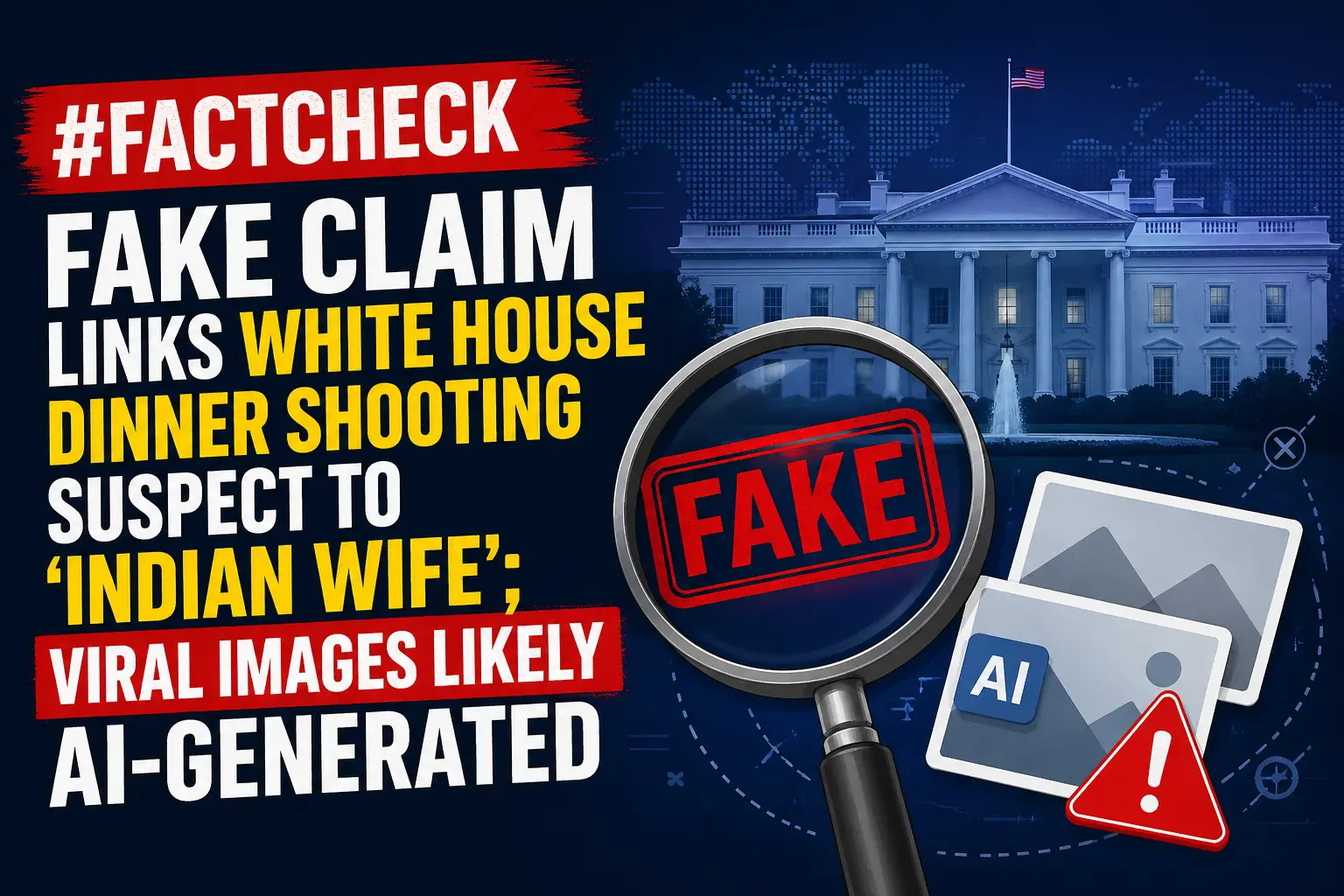
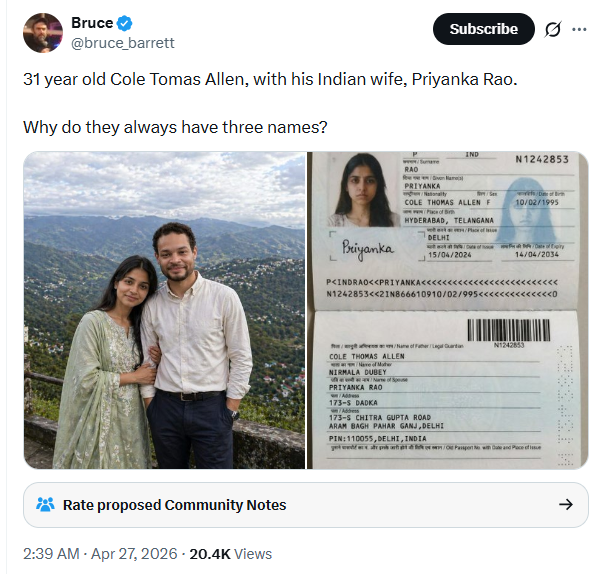
After reports identifying Cole Thomas Allen as the accused in the shooting incident at the White House Correspondents’ Association (WHCA) dinner, several Pakistani propaganda-linked social media accounts began circulating a new claim alleging that the suspect’s wife is an Indian woman named Priyanka Rao. Users shared a photo purportedly showing Cole Thomas Allen with Priyanka Rao, along with an alleged Indian passport in her name. One user posted the image with the caption: “31-year-old Cole Thomas Allen with his Indian wife Priyanka Rao. Why do they always have three names?”
However, research by the CyberPeace Research Wing found the claim to be fake. The viral passport and accompanying image appear to be AI-generated.
Claim:
Social media users claimed that Cole Thomas Allen, accused in the WHCA dinner shooting, is married to an Indian woman named Priyanka Rao.
Fact Check:
During the research, multiple inconsistencies were found in the viral passport image, strongly indicating it is fabricated. A close review of the document revealed several obvious errors commonly seen in AI-generated content. For instance, in the “Nationality” field, the name “Cole Thomas Allen” was written instead of a country name. Such a basic mistake would not appear in any genuine government-issued passport.
The Hindi text on the document was also highly inaccurate and unnatural. Examples included:
- “राष्ट्रीयता” misspelled as “राष्ट्रीयाय”
- “जन्मतिथि” replaced with meaningless text
- “जन्म स्थान” incorrectly written
- “Issue” mistranslated as unrelated wording
- “Date of Expiry” left untranslated in Hindi format
Further analysis using an AI detection tool indicated that the viral passport image had a 69 percent probability of being AI-generated.

Conclusion:
The claim that WHCA dinner shooting accused Cole Thomas Allen has an Indian wife named Priyanka Rao is fake. The viral passport and image being shared online are likely AI-generated and part of a misinformation campaign.
With AI touching new milestones everyday an increasing need for making it secure is also arising. As these AI companies increase their operations and position in the market as providers of powerful tools in the market. A recent concern due to Anthropic's recent privacy policy update which will be effective from July 8, 2026 shows how companies have begun expanding the amount of personal information they collect in the name of safety, compliance, and trust. While they are being demonstrated as measures to improve safety of users and prevent abuse, it raises important questions about privacy, biometric data, surveillance, data retention, and user autonomy, some of which we will be addressing in this article.
Identity Verification of consumers
One of the most notable update to Anthropic's privacy policy is the category of "Verification Data." According to the policy, users may be asked to verify their age or identity in certain circumstances. Depending on the verification method, Anthropic may collect:
- Images of government-issued identity documents;
- Information appearing on those documents, including identification numbers and date of birth for age verification;
- Photographs or videos of the user;
- Facial geometry templates, which may constitute biometric data under certain legal frameworks; and
- The outcome of the verification process.
At first, this may appear similar to the Know Your Customer (KYC) procedures employed by banks or financial institutions but Claude is not a banking service. It is a consumer AI platform. The issue is not that verification exists, but that the circumstances under which it may be required remain undefined.
THE PROBLEM WITH “CERTAIN CIRCUMSTANCES”
The policy refers to verification being required in "certain circumstances." The public notification from Anthropic mentions that these circumstances may include access to particular features, routine platform integrity checks, abuse prevention mechanisms, policy enforcement activities, or legal compliance obligations. The ambiguity of this phrase raises important concerns. From a user perspective, it is difficult to determine, When verification may be triggered ? Whether verification applies only to suspicious accounts ? Whether access to future features may depend upon verification ? Whether users in particular regions will face more frequent verification requirements ? Whether verification requests may increase as AI regulation expands ? This broad language and discretionary power that the company has along with flexibility in the hands of the company creates uncertainty for users who may have initially joined a platform expecting only an email address and payment information to be required.
Government IDs collection: A new risk category
Almost all AI services have operated without collecting government-issued identity documents. Once a company begins processing such information, the privacy implications change dramatically. Because government issued IDs contain: Full legal names, Dates of birth, Identification numbers, Addresses, Photographs and information regarding nationality. When companies collect these documents, they will have an important database of highly sensitive personal information. Even if the company itself does not retain the documents indefinitely, the existence of a verification process introduces additional privacy and security risks. As per Anthropic has stated that identity verification is conducted through third-party providers such as Persona. According to article on the official site titled ‘Identity verification on Claude’, Persona stores the identity documents and selfie data, while Anthropic retains access to verification records when necessary. From the user's perspective, several important realities remain: First, the data still exists somewhere. Second, another third party organization is now involved in processing highly sensitive personal information. Third, Anthropic retains the ability to access verification records under certain circumstances. Therefore, although Anthropic may not directly maintain copies of every uploaded identity document, the practical result remains that sensitive information enters a broader ecosystem of entities and systems. Identity documents today are among the most valuable forms of personal information from the perspective of fraudsters, cybercriminals, and malicious actors. Therefore, any system that handles such documents becomes an attractive target for attack.
More information on persona’s government ID verification- https://withpersona.com/blog/what-is-government-id-verification
The Biometric Dimension
Another significant aspect of the update is the reference to facial geometry templates. Unlike passwords, biometric identifiers cannot easily be changed if compromised. A person can replace a password or even obtain a new identification card, but they cannot simply obtain a new face. Facial geometry templates are sensitive because they enable automated identity matching. Although these templates, as claimed, are not equivalent to photographs, they are nevertheless derived from unique physical characteristics of a person. In many jurisdictions, including parts of the European Union and several U.S. states, biometric data receives enhanced legal protection because of its permanence and sensitivity, let us see how it unfolds in these jurisdictions.
The Unanswered Retention Question
It is unclear in the policy as to how long the data will be retained because retention limits serve as one of the most important safeguards in modern privacy law, they have given another vague answer that “They're bound to protect it with industry-standard security controls and delete it in line with the retention limits we've set and applicable law.” The longer sensitive information remains stored, the greater the likelihood of unauthorized access, misuse, accidental disclosure, or legal compulsion.
Court Orders and Government Access
Anthropic may be required to disclose information pursuant to valid legal processes such as subpoenas, court orders, warrants, or regulatory directives. The existence of identity verification records means that future requests could potentially be linked to verified identities rather than pseudonymous accounts. This does not mean governments receive unrestricted access to user data. However, it does mean that once identity verification information exists within a company's ecosystem, it may become subject to lawful disclosure requirements. The privacy implications are therefore materially different from those associated with anonymous or pseudonymous AI usage.
Shifting Responsibility onto Users
Another concern is that the privacy policy states that users are responsible for ensuring they possess the necessary rights, permissions, or authority when uploading files, connecting third-party services, or instructing Claude to retrieve information. Anthropic is effectively informing users that they bear responsibility for ensuring that uploaded or connected data is lawfully accessible. As AI assistants gain greater capabilities, this transfer of responsibility from platform to user is likely to become increasingly common. Beyond individual privacy, Anthropic's verification policy also raises larger questions about data sovereignty and the cross-border movement of sensitive personal information. In India, the Justice K.S. Puttaswamy (Retd.) v. Union of India judgment recognized privacy as a fundamental right under Article 21 of the Constitution, affirming that individuals have the right to informational self-determination and control over their personal data. Yet, under Anthropic's verification framework, an Indian user may be required to upload a government-issued identity document and biometric information, which are processed by Persona, a U.S.-based identity verification company acting on behalf of Anthropic. Although users voluntarily consent to this process, it nevertheless results in highly sensitive identity information crossing national borders and entering the control of foreign private entities governed primarily by foreign contractual arrangements and multiple legal regimes. While governments issue identity documents as sovereign instruments of citizenship, their verification and processing are increasingly outsourced to multinational technology companies. Questions arise not only about how securely such information is handled, but also about which country's laws ultimately govern access, retention, disclosure, and accountability when personal data leaves the jurisdiction in which it originated. Under the Digital Personal Data Protection Act, 2023, cross-border transfer of personal data is generally permitted unless the Central Government specifically restricts transfers to certain jurisdictions. Therefore, a foreign company processing identity documents is not, by itself, unlawful but this legality does not eliminate legitimate concerns. Users realistically have limited bargaining power and little practical understanding of how long their identity documents, biometric templates, or verification records will be retained, who within the corporate ecosystem may access them, or how they may be disclosed pursuant to foreign legal processes.
Conclusion
The policy is commendable in some respects because it openly identifies the categories of information that may be collected rather than obscuring them behind vague terminology. However, important concerns remain regarding the extent of verification triggers, the handling of biometric information, the absence of clearly disclosed retention periods, and the long-term implications of linking AI accounts to government-issued identities. As AI systems become more integrated into daily life, these questions will likely become central issues in debates about digital privacy, surveillance, autonomy, and the future governance of artificial intelligence.
