
Inside the CBSE OSM Cyberattack │A Technical Breakdown of the June 2026 Incident
Introduction
On June 2nd, 2026, even as thousands of Class 12 students across the nation flocked to submit re-evaluation and verification applications on the CBSE’s newly rolled-out On-Screen Marking (OSM) portal, a decidedly different kind of visitor had logged in an attacker carrying automation scripts, botnet traffic, and malicious intentions to either shut the system down or steal its contents. The attack, which CBSE then openly reported on its official X account, flooded the portal with 1.5 million hits in two minutes and sent over a lakh unauthorized file access attempts.
Understanding the Attack Architecture: The Two-Pronged Operation
The CBSE cyberattack was actually not a single exploit but rather a layered, orchestrated attack. The attack can be understood in two prongs:
- The DoS Attack:Firstly, attackers initiated a large-scale DoS (Denial of Service) attack, producing approximately 1.5 million requests in 120 seconds, or approximately 12,500 per second, in order to saturate the server. By overloading the systems with bogus requests, the attackers sought not just to disable the site but also to throw off security personnel from their primary task of stabilizing the portal during its launch period.
The File Probing: These attacks usually include the following methods:
- Path Traversal Attacks - Attackers will attempt to navigate outside of the current directory by supplying inputs such as "../../etc/passwd" in URL parameters or in a file upload.
- Forced Browsing / Directory Enumeration - An attacker may have used tools to attempt to find vulnerable files and directories like answer sheets, exam scans, student identification documents, and admin-related files by systematically guessing names.
- API Endpoint Fuzzing: If any REST or GraphQL API was present for the portal, the attacker may have tried sending a various number of inputs to parameters to attempt to retrieve records, find IDORs, or escalate privileges.
- Session Token Harvesting - For high-load environments, some systems may use insecure session management. Attackers would attempt to predict or guess the token to hijack another student's or administrator's session.
Why Are Educational Portals High-Value Targets?
Here's why the Indian education sector is an attractive target for cyber-attacks:
- Concentrated PII: Millions of students are present on these education portals, and their data (names, birth dates, Aadhaar linkage information, parents' details, address, education profiles, etc.) is of the highest value on the dark web and can be used for identity theft, financial fraud, credential reuse, and targeting.
- Low Investment Relative to the Data Value: The education system is chronically under-invested in cybersecurity. Many of these systems were built for a function/scale, rather than security by design, and are highly vulnerable.
- High-Pressure Launches: Launching a massive, public-facing system like the CBSE OSM verification site that needs to service millions of students on day 1 often requires time constraints that preclude proper penetration testing, stress testing, security auditing, or staged deployment; these launches often launch with numerous known security flaws.
- Large Attack Surface: The education ecosystem is comprised of many integrated systems, APIs, cloud instances, third-party systems, and authentication infrastructure. Each dependency increases the overall attack surface and provides multiple potential avenues to compromise these systems, such as IDOR, API abuse, or credential-based attacks.
- Geopolitical Motivation: Following the Op Sindoor attack in 2025, there was a significant increase in public institutions targeted by cyber-attacks with prolonged DDoS against critical systems. Highly visible, public-facing student portals catering to more than 35 million students make a tantalizing target for both nation-state attackers and hacktivist groups to cause disruption or gather intelligence.
The CBSE's Response
A balanced perspective on CBSE's public response is necessary:
- The portal did not go down and served about 14000 users at any point during the attack and had over 28000 successful submissions by 10pm June 2nd.
- In real-time, sessions are continuously being optimized for the students, and session timeouts are being extended.
- Management was on top of the situation and maintained good communication through social media.
To withstand a sustained attack volume of roughly 12,500 requests per second, CBSE would surely need more than one security control implemented on its infrastructure. In all probability, rate limiting was the primary reason it could sustain this attack volume by limiting the requests from an IP or client over a certain period of time and automatically aborting requests from systems sending automated data. This, coupled with perhaps load balancing, will distribute the attack across several systems, none of which will have become bottlenecks. Finally, it is possible that traffic could have also been routed via a Content Delivery System (CDN) or dedicated DDoS mitigation service capable of detecting and cleaning requests of malicious code before they even reach the origin servers.
Technical Recommendations
It is not sustainable for India's exam infrastructure to continue operating in a post-breach, patching-in mode forever. The systems need to embrace Privacy By Design (PBD) as an integral part of their DNA. Here are suggestions for short-term hardening and long-term resilience:
- Deploy a zero-trust file access architecture: Each request to access any file should be authenticated, authorized using role-based access control (RBAC), and logged in an immutable audit trail. Direct access to file paths should not be permissible; rather, pre-signed, time-limited tokens are recommended to control file access.
- Implement a multi-layered DDoS mitigation architecture: A combination of network edge traffic scrubbing (CDNs & DDoS mitigation services) along with rate limiting at the application layer via WAF is necessary. An Anycast-based multi-PoP architecture and pre-provisioning scrubbing capacity may further increase resiliency
- Conduct pre-launch penetration testing and red teaming exercises: Penetration testing with OWASP Top 10 audits, API security reviews, and load-based penetration testing should be conducted by CERT-In empanelled auditors prior to the launch of the examination. The red team exercise should simulate blended DoS and file-probing attacks.
- Secure Payments: The secure payment surface should support PCI-DSS Level 1 certified payments and tokenisation and employ velocity checks against automated abuse and support 3D Secure 2.0 (3DS2) on card payments.
- Implement SOC: Security operations centers (SOCs) should have real-time access to CERT-In threat feeds and ISAC intelligence, allowing them to act quickly on emerging attack vectors before anything malicious can be exploited.
- Encryption: Students' data should be encrypted with AES-256; keys should be stored separately in a Hardware Security Module (HSM) system and not co-located with the data storage system. Student data must also support the data minimisation principle, while storing it should be encrypted with AES-256 and keys should be stored securely in HSM.
- Monitoring: 24/7 SOC monitoring, ongoing vulnerability scanning on all pipelines, anomalous detection baselining, and frequent tabletop exercises for cyber resilience at 24x7 and post-examination activities.
Beyond the Breach: Governance, Accountability, and the Growing Cyber Threat to India's Education Sector
The CBSE attack is merely one example of a wider truth, a truth that extends beyond an isolated security event and highlights security as not only an issue of governance but of national security. Although it was during a period in which there was considerable change in leadership within the CBSE (some officials had been removed from their positions), and although it may be impossible to prevent administrative change, security vulnerability is an inherent risk when it cannot be ensured that the new incumbents have had knowledge transferred from the previous administration in terms of system design, vendor management, configuration, and incident response procedures. It has become apparent that a requirement for digital system governance must be considered to be just as serious a requirement as an academic and administrative governance requirement.
The attack is also indicative of a wider problem, and in 2025 there were in excess of 265 million cyber-attacks, and increasingly, critical infrastructure is being attacked by all manner of actors, including criminals, hacktivists, and state-sponsored groups. Educational institutions offer a prime target due to the amount of personal data held within their systems and the historically low security investment they tend to have. Worldwide trends that support the similar narrative of "data of immense value protected by under-resourced programs" (universities hit by ransomware and mass student data breaches included) are being constantly illustrated. For an examining body of tens of millions of students, cybersecurity cannot be an afterthought and needs to be clearly addressed within the governance and risk-management framework of the institution and, therefore, become a fundamental pillar of public trust.
Conclusion
The June 2026 cyberattack on the CBSE's OSM portal both illustrated the advancing capabilities of today's threat actors and highlighted the critical role cyber resilience must play in India's education sector. A high-volume DoS attack combined with over 100,000 file access attempts indicates a concerted and strategic operation both for disruption and the opportunity for data theft. Though the CBSE's infrastructure did hold, the attack should not offer comfort. Educational institutions are responsible for a significant amount of sensitive personal data, and they are major targets to state-sponsored and financially motivated attackers. Attacks are bound to continue. It is essential that cybersecurity become a fundamental pillar of the governance and trustworthiness of education and not a technical afterthought.
References
- CBSE Official Statement on Cyberattack, X (formerly Twitter), @cbseindia29, June 2, 2026.
- Indian Express, "CBSE OSM Row: Portal attack was a 'coordinated, two-pronged operation' says cybersecurity expert," June 3, 2026.
- Srinivas L, Joint MD & Joint CEO, 63SATS Cybertech (subsidiary of 63 moons technologies limited), was quoted in Indian Express, June 3, 2026.
- The Federal, "CBSE re-evaluation portal faces cyberattack, records 1.5 million hits in two minutes," June 2, 2026. https://thefederal.com
- CERT-In (Indian Computer Emergency Response Team), Empanelled Security Auditor Framework. https://www.cert-in.org.in
- OWASP Top 10 Web Application Security Risks, 2021 edition. https://owasp.org/www-project-top-ten/
- National Institute of Standards and Technology (NIST), Zero Trust Architecture (SP 800-207), August 2020. https://doi.org/10.6028/NIST.SP.800-207
- Indian Express, "What CBSE ignored: Its own panel found glitches in dry run, said delay OSM by a year," June 3, 2026.
- Asianet Newsable, "CBSE Class 12 re-evaluation portal withstands major DoS cyberattack," June 2, 2026. https://newsable.asianetnews.com

Related Blogs

Introduction
India’s digital growth journey has been moving at a tremendous pace. According to MeitY’s report, India’s digital economy is expected to rise to US$ 500 billion by 2025, up from US$ 200 billion in 2019. The digitisation drive that we are experiencing is likely to foster and boost a favourable business environment that will attract rapid investment and augment economic growth across sectors. This will, in turn, compel businesses to adopt digital platforms as solutions to meet customer expectations. Due to accelerated digitisation, cyber risks often deter business growth. Cybercrimes are becoming more rampant and complex and the costs associated with such breaches are not only increasing but also becoming more systemic.
Development of the Cyber Insurance Landscape
Digitization of businesses started in the 1980s with the use of mainframes. Personal computers entered the game and further modified the landscape from the 2000s along with LANs, the internet and the dot-com boom of the 2000s. In the late 1990s, cyber-insurance was developed as a risk management tool to ensure information security. Coverage was limited, and clients included SMEs in need of insurance to qualify for tenders, or community banks too small to hedge the risks of their online banking operations. The first cyber insurance policy was written in 1997 through AIG, against hacking as a third-party liability policy.
The current trends in the cyber insurance space are focused on the prevention of cyber risks, which by nature are hard to outline and constantly evolving. The result is that the buyers have limited clarity on the types of cyber risks covered under cyber insurance, and even lesser visibility on the scope and amount of optimum coverage. Unfamiliarity with the claim procedure and resolutions, ambiguous claim thresholds during settlements, and confusion around exclusions and coverage of regulatory fines and penalties under a purchased scheme further discourage potential buyers from seriously investing in cyber insurance products.
Key Factors in Cyber Insurance Evolution and Its Role in Risk Management
The cyber insurance market in India has three key influencing factors, namely the speed of achieving digital maturity, government initiatives to digitise and enforce stringent cyber laws, and the evolving landscape with technology giants and MNCs entering the cyber insurance domain. The latter are the catalyst for intensifying competition in this market.
Advancements in technology in terms of AI, machine learning, big data, robotics, blockchain, augmented and virtual reality, and IoT are expected to reshape the insurance industry and help reach untapped audiences in a more digital-forward manner. With the absence of a standard cyber insurance policy, regulators need to take the following variables into consideration while developing cyber insurance policies: the risk insured against, the scope of the loss covered and the limits/ sub-limits.
Challenges
With the complexity of cyber risks increasing exponentially the challenges to counter the same are growing too which is leading to gaps in the coverage offered for cyber threats. Resultantly, the compliance regulations are dependent on the risks which exist and cyber threat actors adopt new technologies faster and exploit them to their benefit. A lack of historical data and predictability in future cyber risks, the possibility of large overwhelming loss events, uncertainties among market participants about what is specifically covered under such policies, and legal battles over fundamental issues are some of the challenges identified.
Future Outlook/ Recommendations
India's cyber infrastructure requires a multi-faceted approach that involves collaboration between government, industry, and academia should be developed. Some recommendations are:
- Risk assessments should be a general practice and the cyber insurance policies should be simplified, clearing the mismatch between the premium paid and insurance coverage and there should be standard verbosity across cyber policy language.
- Promoting R&D tailored to India focused on education programs that have public-private partnerships and global collaborations to share threat intelligence, best practices, and expertise in critical infrastructure protection.
- Cyber insurance can also be promoted as compliance with the DPDP Act, which would lead to better development of cyber infrastructure and cyber hygiene practices.
- Regular updates to cyber insurance policies to ensure relevance and effectiveness. Insurers could create and offer holistic cyber insurance risk management plans.
Conclusion
According to a report by Deloitte in 2023, the cyber insurance market in India is expected to grow by 27-30 per cent in the coming years and it is currently valued at USD 50-60 million, while maintaining a steady 27-30 per cent CAGR in the past three years. The Indian cyber infrastructure’s nature is challenging, however, it offers opportunities for growth, innovation, and collaboration. A proactive approach, supported by robust policies, advanced technologies, and skilled professionals, will be essential to building a resilient cyber infrastructure capable of withstanding evolving threats.
Reference
- https://www2.deloitte.com/content/dam/Deloitte/nl/Documents/financial-services/deloitte-nl-fsi-demystifying-cyber-insurance-coverage-report.pdf
- https://www.dnaindia.com/business/report-what-s-cyber-liablity-insurance-and-why-you-may-need-it-2136556
- https://economictimes.indiatimes.com/industry/banking/finance/insure/cyber-insurance-gains-momentum-in-india-set-to-witness-exponential-growth-deloitte/articleshow/104189297.cms?from=mdr
Introduction
In recent years, the online gaming sector has seen tremendous growth and is one of the fastest-growing components of the creative economy, contributing significantly to innovation, employment generation and export earnings. India possesses a large pool of skilled young professionals, strong technological capabilities and a rapidly growing domestic market, which together provide an opportunity for the country to assume a leadership role in the global value chain of online gaming. With this, the online gaming industry has also faced an environment of exploitation, abuse, with notable cases of fraud, money laundering, and other emerging cybercrimes. In order to protect the interests of players, ensure fair play and competition, safe and secure online gaming environment, the need for introducing and establishing dedicated gaming regulation was a need of the hour.
On 20 August 2025, the Union government introduced a new bill, ‘Promotion and Regulation of Online Gaming Bill, 2025’ in Lok Sabha that seeks to prohibit online money gaming, including advertisements and financial transactions related to such platforms. From the introduction, the said bill was passed at 5 PM on the same date. Further, the upper house of parliament (Rajya Sabha) passed the bill on 21st August 2025. The bill can be seen as a progressive step towards building safer online gaming spaces for everyone, especially for our youth and combating the emerging cybercrime threats present in the online gaming landscape.
Key Highlights of the Bill
The Bill extends to the whole of India. It also applies to any online money gaming service offered within India or operated from outside the country but accessible in India.
- Definition of E-sports:
Section 2(1)(c) of the Bill defines e-sports as:-
(i) is played as part of multi-sports events;
(ii) involves organised competitive events between individuals or teams, conducted in multiplayer formats governed by predefined rules;
(iii) is duly recognised under the National Sports Governance Act, 2025, and registered with the Authority or agency under section 3;
(iv) has outcome determined solely by factors such as physical dexterity, mental agility, strategic thinking or other similar skills of users as players;
(v) may include payment of registration or participation fees solely for the purpose of entering the competition or covering administrative costs and may include performance-based prize money by the player; and
(vi)shall not involve the placing of bets, wagers or any other stakes by any person, whether or not such person is a participant, including any winning out of such bets, wagers or any other stakes;
- Prohibition of Online Money Gaming and Advertisement thereof
The Bill prohibits the offering of online money games and online money gaming services. It also bans all forms of advertisements or promotions connected to online money games. This includes endorsements by individuals or entities. - Financial Transactions
Banks, financial institutions, and other intermediaries are barred from facilitating transactions related to online money gaming services. - Criminal Liability
Violation of the provisions on online money gaming can result in imprisonment for up to three years, or a fine of up to ₹1 crore, or both. Repeat offenders face stricter punishment with higher fines and longer jail terms. - Cognizable and Non-Bailable Offences
Offences relating to offering online money gaming services and facilitating financial transactions for such games are categorised as cognizable and non-bailable. This gives law enforcement agencies greater power to act without requiring prior approval.
In conversation with CyberPeace ~
Shailendra Vikram Singh, Former Deputy Secretary (Cyber & Information Security), Ministry of Home Affairs, GOI . He highlighted that
"The passage of the Promotion and Regulation of Online Gaming Bill, 2025 in the Lok Sabha highlights the government’s growing priority on national security, public safety, and health in digital regulation. Unfortunately, the real money gaming industry, despite its growth and promise, did not take proactive steps to address these concerns. The absence of safeguards and engagement left the government with no choice but to adopt a blanket ban."Having worked on this issue from both the government and industry side, the clear lesson is that in sensitive digital sectors, early regulatory alignment and constructive dialogue are not optional but essential. Going forward, collaboration is the only way to achieve a balance between innovation and responsibility.”
CyberPeace Outlook
The Promotion and Regulation of Online Gaming Bill, 2025, marks a decisive policy shift by simultaneously fostering the growth of e-sports, educational and social gaming, and imposing an absolute prohibition on online money games. By recognising e-sports as legitimate, skill-based competitive sports under the National Sports Governance Act, 2025, and establishing a central Authority for oversight, registration, and regulation, the Bill creates an institutional framework for safe and responsible development of the sector. The Bill completely bans real money games (RMGs), regardless of whether they are skill-based or chance-based or both, hence it poses significant questions on RMG companies' legal standing, upon which the gaming industry has raised its conundrum. Further, it addresses urgent threats such as cybercrime, gaming addiction, online betting, money laundering, and the misuse of gaming platforms for illicit activities. The move reflects a balanced approach, encouraging innovation and digital skill-building, while safeguarding public order, consumer interests, and financial integrity.
References
- https://prsindia.org/files/bills_acts/bills_parliament/2025/Bill_Text-Online_Gaming_Bill_2025.pdf
- https://prsindia.org/billtrack/the-promotion-and-regulation-of-online-gaming-bill-2025
- https://www.hindustantimes.com/india-news/rajya-sabha-clears-online-gaming-bill-a-day-after-lok-sabha-approval-101755766847840.html
A video purportedly showing Prime Minister Narendra Modi delivering a politically charged warning during a public address has been widely circulated on social media. The clip is being shared with claims that the Prime Minister spoke about the “saffronisation” of the Indian Army and issued a stern message to Bangladesh by invoking India’s role in the 1971 war.
A detailed verification by the CyberPeace Foundation found these claims to be misleading. The investigation revealed that the viral video has been digitally altered, and the statements attributed to the Prime Minister do not appear in the original speech. The misleading narrative appears to have been created by inserting manipulated audio into authentic video footage.
Claim
An X user, “@Pakpulse247,” shared a video on December 26 claiming that Prime Minister Narendra Modi, while addressing a public gathering, made remarks about the “saffronisation” of the Indian Army and issued a warning to Bangladesh by invoking India’s role in the 1971 war.
The post’s caption alleged that the Prime Minister made these statements during the inauguration of the Rashtra Prerna Sthal in Lucknow, suggesting that Bangladesh should not expect support from Pakistan in the event of an Indian offensive and should remember India’s contribution during the 1971 conflict.
The link to the post is provided below, along with a screenshot of the viral claim.

Fact Check:
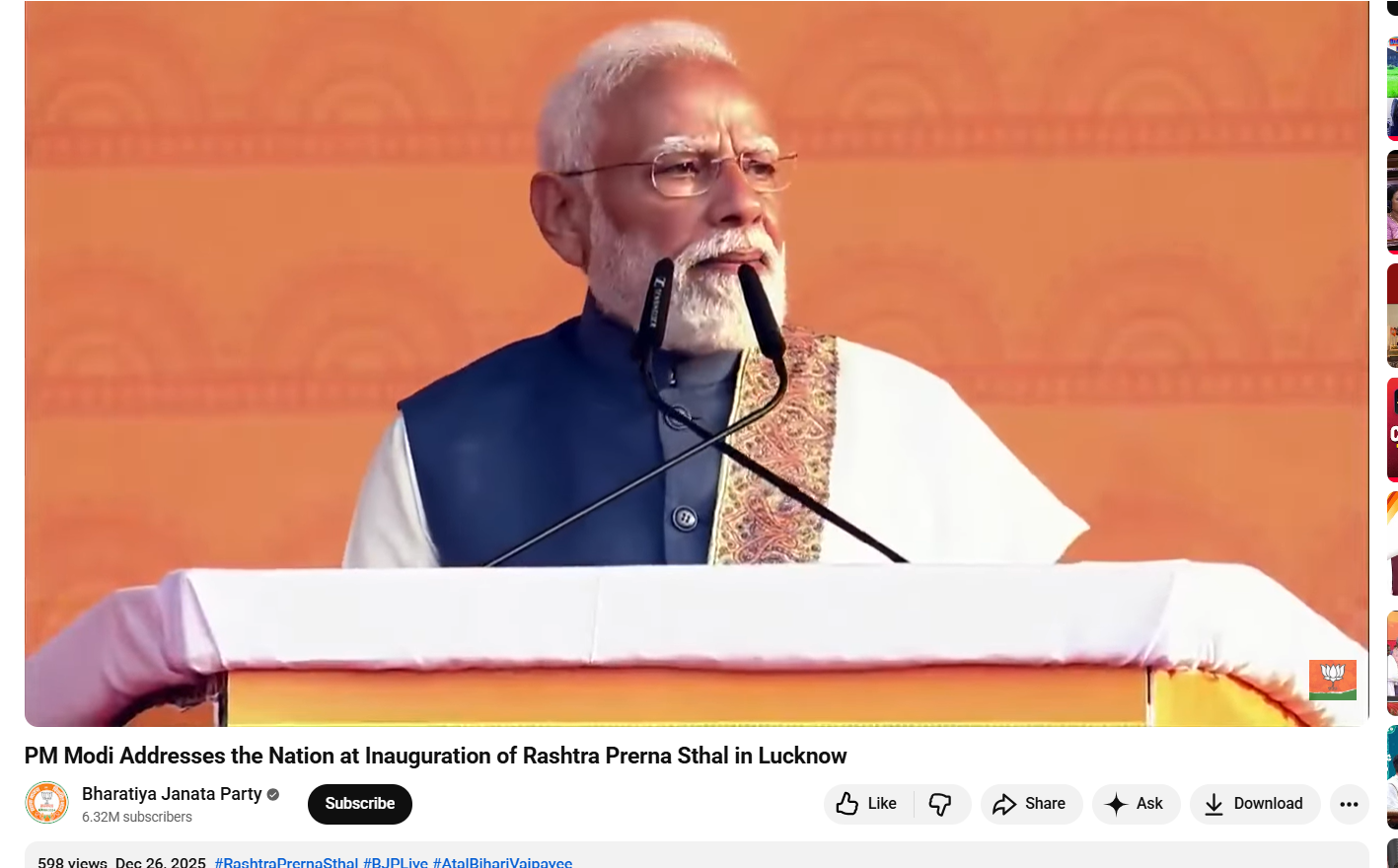
During the verification process, the Desk carried out a targeted keyword search and located the complete, original version of the video on the official YouTube channel of the Bharatiya Janata Party, uploaded on December 26, 2025. The video description confirmed that Prime Minister Narendra Modi was addressing the gathering at the inauguration of the Rashtra Prerna Sthal in Lucknow.
A comparison of the visuals showed that the venue, backdrop, and the Prime Minister’s attire were identical to those seen in the viral clip circulating on social media. However, after carefully reviewing the full speech, the Desk found no reference to Pakistan, Bangladesh, or the claims being attributed to him in the viral post.
The link to the original video is provided below, along with a relevant screenshot.
https://www.youtube.com/watch?v=L9rbzU0m30o
Upon further examination of the search results, the Desk located the official English transcript of Prime Minister Narendra Modi’s speech on the PM India website. A thorough review of the complete transcript revealed no mention of the statements attributed to him in the viral social media post.
The link to the official transcription is provided below.
On further examination of the search results, the Desk accessed the official English transcript of Prime Minister Narendra Modi’s speech published on the PM India website. A careful review of the complete transcript confirmed that none of the claims made in the viral social media post appear in the official record.
The link to the transcription is provided below.
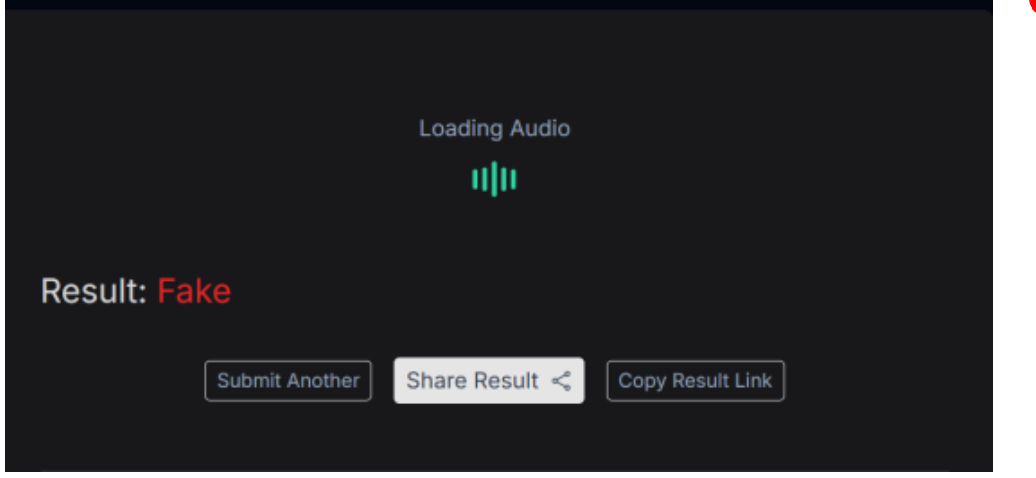
Building on these findings, the Desk extracted the audio track from the viral video and analysed it using Resemble AI, an audio-detection tool. The analysis flagged the audio as fake, indicating that it had been digitally manipulated.
Conclusion
The CyberPeace Foundation’s research clearly establishes that the viral video claiming Prime Minister Narendra Modi made remarks about the saffronisation of the Indian Army and issued warnings to Bangladesh is false and misleading. The full original video and official transcript of the speech contain no such references to Pakistan, Bangladesh, or the 1971 war. Furthermore, audio analysis using AI-detection tools confirms that the voice in the viral clip has been digitally manipulated.
