
Gold, Temples, and a Manufactured Panic - How Rumours Outran Official Clarifications
Introduction
By the morning of May 19, 2026, many Indians woke up to see a worrying message being circulated on WhatsApp and X (formerly Twitter) stating that the government proposed to appropriate all gold stored in the temples, convert it to cash by some new scheme, and further, regard temple towers, doors, etc., gilded with gold as the "Strategic Gold Reserves of India." The panic spread immediately; religious communities were enraged, and online arguments broke out. By afternoon, the rumour was out of control. The catch was that this whole thing was false.
The Rise of Misinformation: An Old Problem with a New Engine
Misinformation is an ancient phenomenon. Folk scholars have observed for centuries that fabrications, rumours, and hoaxes move through the same channels and follow the same patterns as reliable news, deriving their credibility from repetition rather than proof and relying on social networks for believability.
A seminal 2017 study published in the Journal of Economic Perspectives by Allcott and Gentzkow discovered that fake news articles were far more widely shared than the most popular legitimate news articles in the run-up to the 2016 United States presidential election. The study additionally discovered that nearly 62% of all American adults get at least a fraction of their news through social media, a reality the researchers posited would allow fake news to spread wide and far through unvetted channels.
India is an even more extreme case; on a platform such as WhatsApp, where researcher Kiran Garimella, working for MIT, estimates that 50 billion messages are transmitted every single day in India alone, misinformation is less something that spreads and more something that simply exists.
The Science of Viral Misinformation
The temple gold rumour took a course typical of conspiracy theories. A dramatic, provocative rumour that simultaneously appealed to religious, state, and financial safety was received by an audience already conditioned to mistrust its leaders. In Science, 2018, MIT researchers Vosoughi, Roy, and Aral mapped the very mechanism at scale: it revealed false information to propagate about six times more than true information, reaching about three times as many people. The study further concluded that falsehoods were 70% more likely to be shared than true stories and that the 'engine' of false information spread was not bots and algorithms but humans. The simple reason was that humans prefer something that is novel, surprising, and alarming.
Pariser further elaborated this process within his book Filter Bubble; as algorithms mainly show users what conforms with their existing beliefs, people are put in individual echo chambers, and their tendency to share emotional or falsified content results in corrections often failing to keep up.
The Importance of Fact-Checking and Official Sources
The government reacted to this with a swift and concise response, and an official statement released by the Ministry of Finance on 19 May 2026 cautioned citizens that all legal government policies are declared only through official press releases, government websites, and appropriate agencies and not via social media forwards.
India has a dedicated institutional resource for exactly this purpose. The PIB Fact Check Unit (FCU), established in November 2019 under the Press Information Bureau, has now published over 2,900 fact-checks covering false claims about government policies, schemes, deepfakes, AI-generated content, fabricated notifications, and fraudulent websites. Citizens can submit suspicious content directly to the FCU via WhatsApp (+91 8799711259) or through factcheck.pib.gov.in: The service is free, confidential, and designed to be accessible.
The Risks of Sharing Unverified Information
Beyond confusion and unnecessary anxiety, the spread of unverified information carries concrete risks. Allcott and Gentzkow's research found that individuals who consumed more ideologically homogeneous information were substantially more likely to believe false headlines, a pattern that holds regardless of education or political affiliation.
In India, where WhatsApp research has documented that approximately 13% of images shared in politically active groups constitute known misinformation, the consequences have at times extended well beyond digital confusion.
Advisory for Citizens: Verify, Inoculate, and Share Responsibly
Becoming responsible digital citizens is more than just exercising passive vigilance. An important concept every digital citizen ought to know was formulated by John Cook, Stephan Lewandowsky, and Ullrich Ecker in a 2017 PLOS ONE paper: it is called "prebunking."
Debunking seeks to counter a falsehood once it is believed, while prebunking builds resilience in advance of the exposure, similar to how a vaccine inoculates the body to protect against a disease. Prebunking is implemented through an inoculation technique wherein individuals are warned about the presence of likely future misinformation, about the subject and the typical manipulative tactics that the misinformation may use. Exposure, even in an attenuated form, arms individuals with the wherewithal to recognise and disregard the actual misinformation once it appears. What this means in practice is that informed, aware citizens, capable of analysing how misinformation is crafted, are unlikely to fall for a new rumour of this nature.
What should be kept in mind?
- Wait before sharing: A prompt sense of fear, anger, or desire to share a post is not a call to immediate dissemination but an exercise in caution.
- Prebunk yourself and others: Be mindful of subjects that persistently generate falsehoods like government schemes, religious matters, economic policy, and national security.
- Refer to official sources only: The authenticity of claims related to any government scheme can be cross-checked on PIB.gov.in, relevant ministries, or the PIB Fact Check WhatsApp number, 8799711259.
- Identify filter bubbles: Repeated confirmation of your own beliefs and concerns indicates an algorithmic bubble.
- Do not amplify ambiguity: Circulating information merely as a matter of cautious verification has damaging repercussions.
- Rectify what has been shared: Issue the correction to the same recipients as the false information.
Conclusion
The swift clarifications issued by the government in May 2026 and fact-check systems by PIB have helped contain the panic, but the role of the government cannot be seen as the sole bulwark against misinformation. An informed citizenry, digitally and information literate to such an extent that they know how misinformation is created and circulated, is our strongest defence against fake news. It is not only the ability to fact-check but also to detect manipulative attempts before misinformation goes viral. Check before you share. Stop before you panic. When in doubt, check the PIB Fact Check.
References
[3] https://www.pib.gov.in/PressReleasePage.aspx?PRID=2247720
[4] Allcott, Hunt and Matthew Gentzkow. (2017). "Social Media and Fake News in the 2016 Election." Journal of Economic Perspectives 31(2): 211–23
[5] Vosoughi, Soroush, Deb Roy, and Sinan Aral. (2018). "The Spread of True and False News Online." Science 359(6380): 1146–1151
[6] Cook, John, Stephan Lewandowsky, and Ullrich K. H. Ecker. (2017). "Neutralizing misinformation through inoculation: Exposing misleading argumentation techniques reduces their influence." PLOS ONE 12(5): e0175799.
[7] Garimella, Kiran and Dean Eckles. (2020/2023). "Images and Misinformation in Political Groups: Evidence from WhatsApp in India.
[8] Christakis, Nicholas A. and James H. Fowler. (2011). Connected: The Surprising Power of Our Social Networks and How They Shape Our Lives.
[9] Pariser, Eli. (2011/2012). The Filter Bubble: What the Internet Is Hiding from You.

Related Blogs
The Digital Personal Data Protection (DPDP) Act, 2023, operationalises data privacy largely through a consent management framework. It aims to give data principles, ie, individuals, control over their personal data by giving them the power to track, change, and withdraw their consent from its processing. However, in practice, consent management is often not straightforward. For example, people may be frequently bombarded with requests, which can lead to fatigue and eventual overlooking of consent requests. This article discusses the way consent management is handled by the DPDP Act, and looks at how India can design the system to genuinely empower users while holding organisations accountable.
Consent Management in the DPDP Act
According to the DPDP Act, consent must be unambiguous, free, specific, and informed. It must also be easy for people to revoke their consent (DPO India, 2023). To this end, the Act creates Consent Managers- registered middlemen- who serve as a link between users and data custodians.
The purpose of consent managers is to streamline and centralise the consent procedure. Users can view, grant, update, or revoke consent across various platforms using the dashboards they offer. They hope to improve transparency and lessen the strain on people to keep track of permissions across different services by standardising the way consent is presented (IAPP, 2024).
The Act draws inspiration from international frameworks such as the GDPR (General Data Protection Regulation), mandating that Indian users be provided with a single platform to manage permissions rather than having to deal with dispersed consent prompts from every service.
The Challenges
Despite the mandate for an interoperable platform for consent management, several key challenges emerge. There is a lack of clarity on how consent management will be operationalised. This creates challenges of accountability and implementation. Thus, :
- If the interface is poorly designed, users could be bombarded with content permissions from apps/platforms/ services that are not fully compliant with the platform.
- If consent notices are vague, frequent, lengthy, or complex, users may continue to grant permissions without meaningful engagement.
- It leaves scope for data fiduciaries to use dark patterns to coerce customers into granting consent through poor UI/UX design.
- The lack of clear, standardised interoperability protocols across sectors could lead to a fragmented system, undermining the goal of a single, easy-to-use platform.
- Consent fatigue could easily appear in India's digital ecosystem, where apps, e-commerce websites, and government services all ask for permissions from over 950 million internet subscribers. Experiences from GDPR countries show that users who are repeatedly prompted eventually become banner blind, which causes them to ignore notices entirely.
- Low levels of literacy (including digital literacy) and unequal access to digital devices among women and marginalised communities create complexities in the substantive coverage of privacy rights.
- Placing the burden of verification of legal guardianship for children and persons with disabilities (PwDs) on data fiduciaries might be ineffective, as SMEs may lack the resources to undertake this activity. This could create new forms of vulnerability for the two groups.
Legal experts claim that this results in what they refer to as a legal fiction, wherein consent is treated as valid by the law despite the fact that it does not represent true understanding or choice (Lawvs, 2023). Additionally, research indicates that users hardly ever read privacy policies in their entirety. People are very likely to tick boxes without fully understanding what they are agreeing to. By drastically limiting user control, this has a bearing on the privacy rights of Indian citizens and residents. (IJLLR, 2023).
Impacts of Weak Consent Management:
According to the Indian Journal of Law and Technology, in an era of asymmetry and information overload, privacy cannot be sufficiently protected by relying only on consent (IJLT, 2023). Almost every individual will be impacted by inadequate consent management.
- For Users: True autonomy is replaced by the appearance of control. Individuals may unintentionally disclose private information, which undermines confidence in digital services.
- For Businesses: Compliance could become a mere formality. Further, if acquired consent is found to be manipulated or invalid, it creates space for legal risks and reputational damage.
- For Regulators: It becomes difficult to oversee a system where consent is frequently disregarded or misinterpreted. When consent is merely formal, the law's promise to protect personal information is undermined.
Way Forward
- Layered and Simplified Notices: Simple language and layers of visual cues should be used in consent requests. Important details like the type of data being gathered, its intended use, and its duration should be made clear up front. Additional explanations are available for users who would like more information. This method enhances comprehension and lessens cognitive overload (Lawvs, 2023).
- Effective Dashboards: Dashboards from consent managers should be user-friendly, cross-platform, and multilingual. Management is made simple by features like alerts, one-click withdrawal or modification, and summaries of active permissions. The system is more predictable and dependable when all services use the same format, which also reduces confusion (IAPP, 2024).
- Dynamic and Contextual Consent: Instead of appearing as generic pop-ups, consent requests should show up when they are pertinent to a user's actions. Users can make well-informed decisions without feeling overburdened by subtle cues, such as emphasising risks when sensitive data is requested (IJLLR, 2023).
- Accountability of Consent Managers: Organisations that offer consent management services must be accountable and independent, through clear certification, auditing, and specific legal accountability frameworks. Even when formal consent is given, strong trustee accountability guarantees that data is not misused (IJLT, 2023).
- Complementary Protections Beyond Consent: Consent continues to be crucial, but some high-risk data processing might call for extra protections. These may consist of increased responsibilities for fiduciaries or proportionality checks. These steps improve people's general protection and lessen the need for frequent consent requests (IJLLR, 2023).
Conclusion
The core of the DPDP Act is to empower users to have control over their data through measures such as consent management. But requesting consent is insufficient; the system must make it simple for people to manage, monitor, and change it. Effectively designed, managed, and executed consent management has the potential to revolutionise user experience and trust in India's digital ecosystem if it is implemented carefully.To make consent management genuinely meaningful, it is imperative to standardise procedures, hold fiduciaries accountable, simplify interfaces, and investigate supplementary protections.
References
Building Trust with Technology: Consent Management Under India’s DPDP Act, 2023
Consent Fatigue and Data Protection Laws: Is ‘Informed Consent’ a Legal Fiction
Beyond Consent: Enhancing India's Digital Personal Data Protection Framework
Top 10 operational impacts of India’s DPDPA – Consent management
Executive Summary
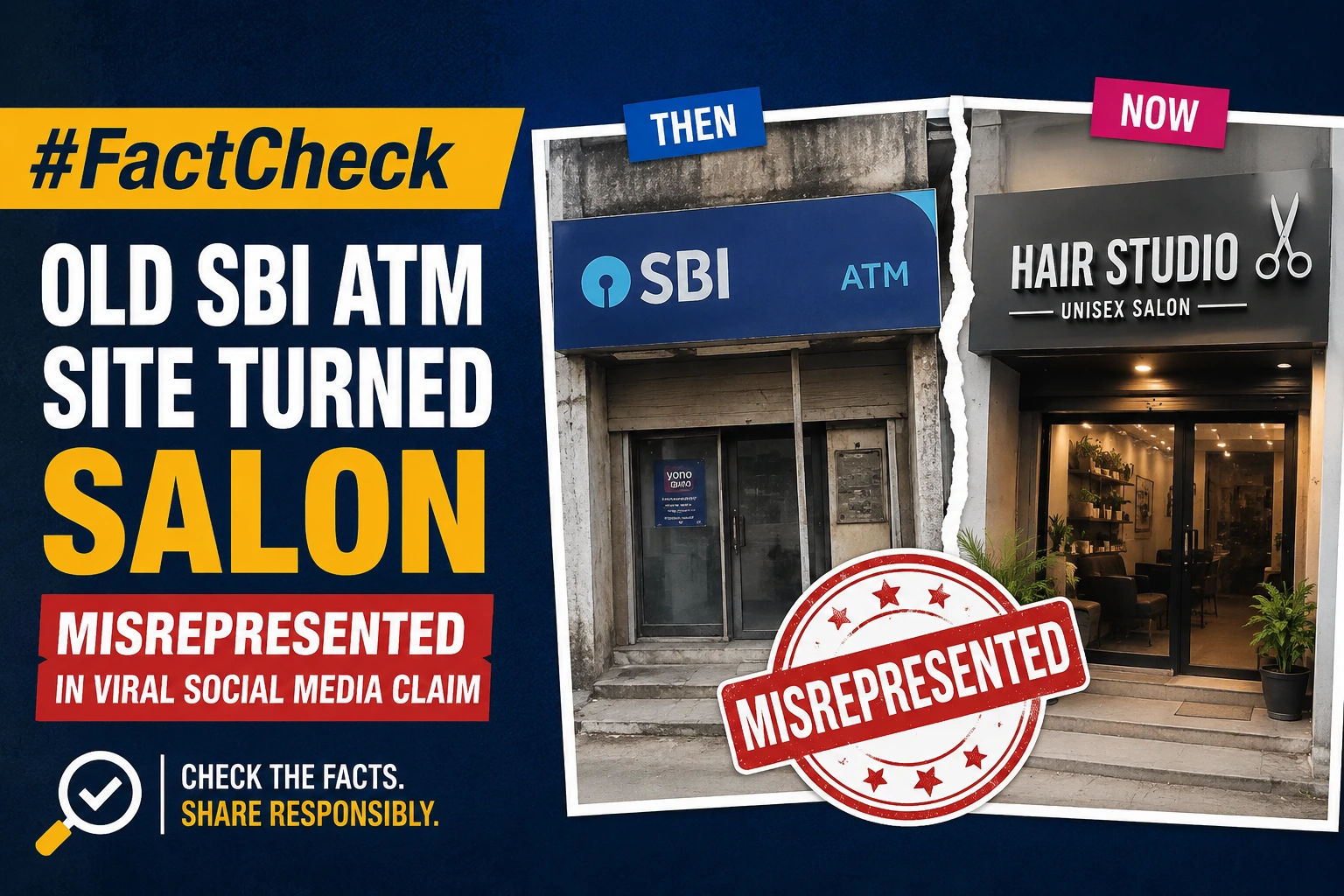
A video is going viral on social media claiming that a salon has been opened inside a State Bank of India (SBI) ATM in Bihar. The video is also being used by some users to take political jibes at the central and state governments led by the Bharatiya Janata Party (BJP). However, the CyberPeace Research Wing’s research has found that this claim is misleading. The location shown in the viral video was earlier an SBI ATM, which had been shut down around six months ago. After the bank discontinued its operations at the site, the ATM machine and other equipment were removed. However, the external structure of the ATM cabin and the SBI signage were not removed at that time. After the premises were vacated, the property owner rented out the space to a salon operator. Since the SBI board and branding were still visible on the structure, the video created confusion and went viral with misleading claims.
Following the circulation of the video, the bank later removed its signage from the location and also cleared all remaining SBI branding from the structure. Our research also found that the bank had removed the ATM machine and equipment months earlier, but the cabin structure and SBI board were left behind. After that, the space was rented out for commercial use as a salon. In this context, it would be incorrect to claim that a salon was opened inside an active SBI ATM.
Claim
A Facebook user ‘Soumitra Roy’ shared a video on 11 May 2026 claiming:
“Someone has opened a barber shop inside an SBI ATM in Bihar. The BJP’s double-engine government has developed Bihar so much that loan EMIs can now be deducted directly inside ATMs. This is Modi’s masterstroke.”
- https://www.facebook.com/reel/980962511535926
- https://perma.cc/WTY2-WEQQ

Fact Check
To verify the viral claim, a keyword search based on the video was conducted. Several media reports were found, which clarified the full context of the incident. A report uploaded on the YouTube channel ‘Live Cities’ on 12 May 2026 stated that a salon was running at a former ATM location in Danapur, Bihar. The bank had already vacated the premises about six months earlier, but its signage had not been removed. The report also includes an interview with the property owner, who confirmed that the bank had removed its ATM machine and equipment six months ago and later the space was rented out to a salon operator.

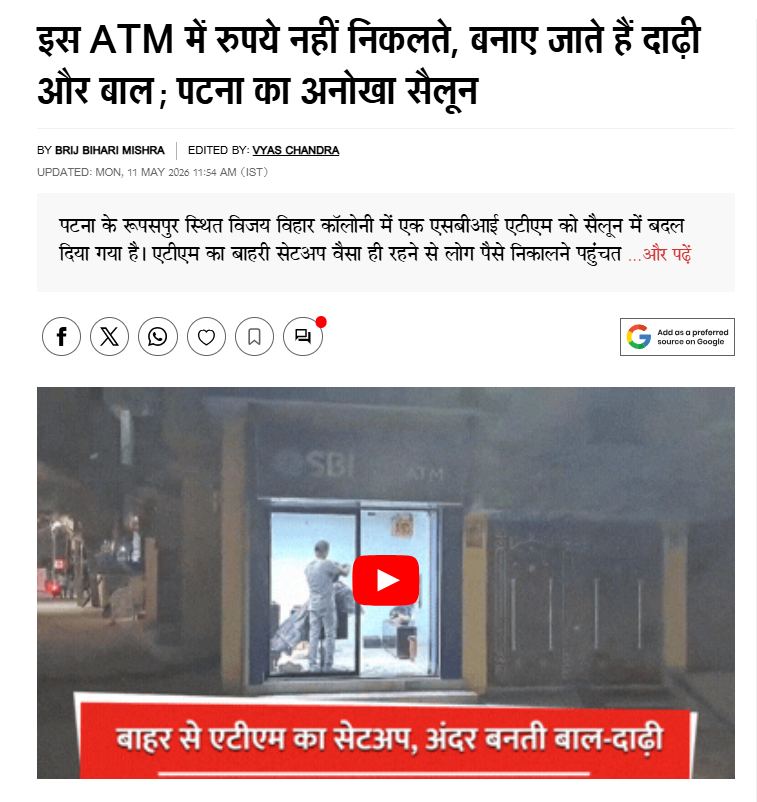
The viral video was also found on the Jagran website in a news report dated 11 May 2026. The report states that an SBI ATM previously existed at the location. The bank had removed the ATM machine due to operational reasons but left behind the external structure and signage. Later, the space was rented out to a salon operator, who began running his business from the same setup.
Conclusion
Our research found that the viral post is misleading. It is incorrect to claim that a salon was opened inside an SBI ATM. The truth is that the bank had shut down the ATM at this location around six months ago and removed all machines and equipment. After that, the premises were rented out to a salon operator, which led to confusion due to the presence of old SBI signage.

Executive Summary:
A circulating picture which is said to be of United States President Joe Biden wearing military uniform during a meeting with military officials has been found out to be AI-generated. This viral image however falsely claims to show President Biden authorizing US military action in the Middle East. The Cyberpeace Research Team has identified that the photo is generated by generative AI and not real. Multiple visual discrepancies in the picture mark it as a product of AI.
Claims:
A viral image claiming to be US President Joe Biden wearing a military outfit during a meeting with military officials has been created using artificial intelligence. This picture is being shared on social media with the false claim that it is of President Biden convening to authorize the use of the US military in the Middle East.

Similar Post:

Fact Check:
CyberPeace Research Team discovered that the photo of US President Joe Biden in a military uniform at a meeting with military officials was made using generative-AI and is not authentic. There are some obvious visual differences that plainly suggest this is an AI-generated shot.

Firstly, the eyes of US President Joe Biden are full black, secondly the military officials face is blended, thirdly the phone is standing without any support.
We then put the image in Image AI Detection tool

The tool predicted 4% human and 96% AI, Which tells that it’s a deep fake content.
Let’s do it with another tool named Hive Detector.

Hive Detector predicted to be as 100% AI Detected, Which likely to be a Deep Fake Content.
Conclusion:
Thus, the growth of AI-produced content is a challenge in determining fact from fiction, particularly in the sphere of social media. In the case of the fake photo supposedly showing President Joe Biden, the need for critical thinking and verification of information online is emphasized. With technology constantly evolving, it is of great importance that people be watchful and use verified sources to fight the spread of disinformation. Furthermore, initiatives to make people aware of the existence and impact of AI-produced content should be undertaken in order to promote a more aware and digitally literate society.
- Claim: A circulating picture which is said to be of United States President Joe Biden wearing military uniform during a meeting with military officials
- Claimed on: X
- Fact Check: Fake
