
EU rules mandate for USB-C
Introduction:
Apple is known for its unique innovations and designs. Apple, with the introduction of the iPhone 15 series, now will come up with the USB-C by complying with European Union(EU) regulations. The standard has been set by the European Union’s rule for all mobile devices. The new iPhone will now come up with USB-C. However there is a little caveat here, you will be able to use any USB-C cable to charge or transfer from your iPhone. European Union approved new rules to make it compulsory for tech companies to ensure a universal charging port is introduced for electronic gadgets like mobile phones, tablets, cameras, e-readers, earbuds and other devices by the end of next year.
The new iPhone will now come up with USB-C. However, Apple being Apple, will limit third-party USB-C cables. This means Apple-owned MFI-certified cable will have an optimised charging speed and a faster data transfer speed. MFI stands for 'Made for iPhone/iPad' and is a quality mark or testing program from Apple for Lightning cables and other products. The MFI-certified product ensures safety and improved performance.
European Union's regulations on common charging port:
The new iPhone will have a type-c USB port. EU rules have made it mandatory that all phones and laptops need to have one USB-C charging port. IPhone will be switching to USB-C from the lightning port. European Union's mandate for all mobile device makers to adopt this technology. EU has set a deadline for all new phones to use USB-C for wired charging by the end of 2024. These EU rules will be applicable to all devices, such as tablets, digital cameras, headphones, handheld video game consoles, etc. And will apply to devices that offer wired charging. The EU rules require that phone manufacturers adopt a common charging connection. The mobile manufacturer or relevant industry has to comply with these rules by the end of 2024. The rules are enacted with the intent to save consumers money and cut waste. EU stated that these rules will save consumers from unnecessary charger purchases and tonnes of cut waste per year. With the implementation of these rules, the phone manufacturers have to comply with it, and customers will be able to use a single charger for their different devices. It will strengthen the speed of data transfer in new iPhone models. The iPhone will also be compatible with chargers used by non-apple users, i.e. USB-C.
Indian Standards on USB-C Type Charging Ports in India
The Bureau of Indian Standards (BIS) has also issued standards for USB-C-type chargers. The standards aim to provide a solution of a common charger for all different charging devices. Consumers will not need to purchase multiple chargers for their different devices, ultimately leading to a reduction in the number of chargers per consumer. This would contribute to the Government of India's goal of reducing e-waste and moving toward sustainable development.
Conclusion:
New EU rules require all mobile phone devices, including iPhones, to have a USB-C connector for their charging ports. Notably, now you can see the USB-C port on the upcoming iPhone 15. These rules will enable the customers to use a single charger for their different Apple devices, such as iPads, Macs and iPhones. Talking about the applicability of these rules, the EU common-charger rule will cover small and medium-sized portable electronics, which will include mobile phones, tablets, e-readers, mice and keyboards, digital cameras, handheld videogame consoles, portable speakers, etc. Such devices are mandated to have USB-C charging ports if they offer the wired charging option. Laptops will also be covered under these rules, but they are given more time to adopt the changes and abide by these rules. Overall, this step will help in reducing e-waste and moving toward sustainable development.
References:
https://www.bbc.com/news/technology-66708571

Related Blogs
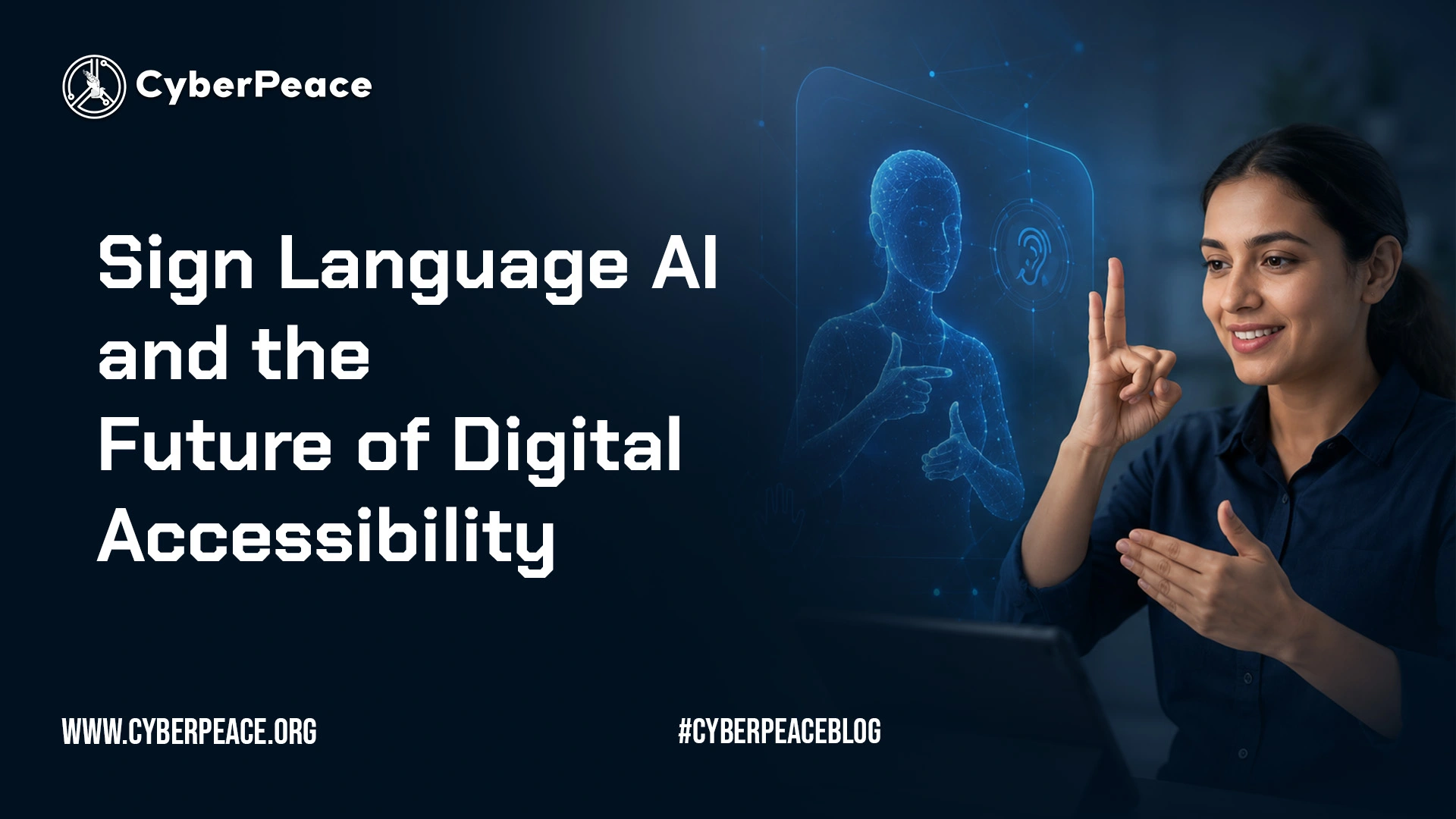
The Emerging Landscape of AI-Enabled Sign Language Technologies
Consumer technology has been moving in a single, steady direction for decades: machines are getting increasingly sensitive to human speech. The phone transcribes what we say into it. An algorithm responds to a question we ask. With just one tap, we can translate across languages. However, sign language, one of the most essential forms of human expression, has largely escaped this change for millions of Deaf and hard-of-hearing people. At last, that omission may finally be narrowing.
For the first time, sign language recognition is now widely available in consumer goods thanks to Google DeepMind’s massively multilingual sign language-to-text model. Starting with American Sign Language to English, the technology currently powers sign-to-text dictation within Gboard and Live Transcribe on Pixel 11. Additional devices and languages are promised. In addition to using Live Transcribe to sign during live conversations, users can sign anywhere they would normally type, such as while conducting a web search, writing a message or interacting with an AI assistant. However, this development’s importance goes far beyond a single accessibility function.
Reimagining How We connect with Technology
The most noteworthy is a conceptual change, sign language is starting to be recognised as a valid interface for human-computer interaction in and of itself , rather than as a modality that technology can accept. Because sign languages are not spoken languages that are represented by hand, this distinction is important. The hands, arms, torso, head and facial expressions all simultaneously convey meaning in these independent natural languages, which have their own grammar, vocabulary and syntax. Compared to traditional voice recognition, this presents a far more complex computing task.
In terms of architecture, the model does not keep raw video instead, it processes pose landmark sequences. The original footage may be destroyed while an on-device mechanism tracks locations on the signer’s body and transmits only geometric coordinates for translation. Instead than using intermediate “gloss” representations, which sometimes lose the spatial and non-manual components crucial to meaning, translation happens directly. Accessibility and privacy meet at this point, a technology designed to grant independence shouldn’t require the surrender of personal biometric information in return.
The Indian question is larger than ASL
A more significant concern for India is raised by this development, whose sign language will artificial intelligence eventually comprehend? It is not possible to import an ASL-to-English model and claim it to be a solution. The linguistic architecture, communities and regional variations of Indian Sign Language are unique. ISL recognition and its translation into Hindi, Telugu and Bengali are the subject of an expanding amount of study yet this same research openly highlights the shortcomings of existing systems including limited vocabularies, isolated word recognition and noticeable sensitivity to individual signing style.
This is not a coincidental distinction. Benchmark accuracy alone cannot be used to gauge inclusive AI; instead, it must be effective under typical circumstances for a variety of individuals, geographical locations and sign languages. It is clear from research on low resource sign languages that over three hundred sign languages are still woefully under-resourced and under-documented. A growing body of research supports signer-adaptive modelling, privacy preserving representations, community co-design and dialectical variety preservation. Therefore, making data collecting, engagement and design more truly inclusive may be the next real advancement rather than further scaling models.
A Legal Architecture already in place
India’s statutory framework offers a firm foundation for this trajectory. The Rights of Persons with Disabilities Act, 2016 defines universal design broadly enough to include cutting edge technologies and assistive devices. It is based on the ideals of equality, dignity, participation and accessibility. Information and communication technology access is specifically covered by Section 42, which requires captioning, sign language interpretation, accessible electronic content and universal design in common electronic products. In this context, accessible AI is an issue of statutory rights rather than technological generosity. This stance is supported by the UN Convention on the Rights of Persons with Disabilities, which addresses accessibility in Article 9 and information access and freedom of speech in Article 21. As a result, the central policy topic is changing from whether technology should be made accessible to how accessibility should be incorporated from the start.
Beyond sign-to-text
Beyond Transcription, Google has expressed aspirations for more sign languages, sign language production and expanded AI capabilities. Future architecture could be imagined as running along a continuous circuit that connects sign, text, speech and AI in both directions rather than just from sign to text. A consumer could deal with a bank without completely relying on an interpreter; a student could learn in her favourite language; or someone could sign a question to an assistant and could get an answer in generated sign language. However , there are still important unanswered questions about this future, such as who owns the data used to train these systems, how signers’ meaningful consent is obtained, how systematic misrecognition of specific communities is prevented and who is responsible when translation fails in an emergency, legal or medical setting.
The Real Measure of Inclusion
The mere fact that a machine has discovered something humans have long understood makes it easy to characterise innovations like these as breakthroughs. The most accurate way to put it is that technology becomes inclusive when individuals can use it without changing who they are or how they interact, not when it acknowledges more human behaviours. This means that India must continue to invest not only in models but also in Indian Sign Language databases, community-led research, accessibility standards and the meaningful involvement of the Deaf and hard-of-hearing populations in both design and evaluation. The ability of a system to detect a hand gesture will not define the future of accessible AI.
References
- https://aclanthology.org/2025.wslp-main.5/
- The Rights of Persons with Disabilities Act 2016 (Act No 49 of 2016), s 42.
- Convention on the Rights of Persons with Disabilities (adopted 13 December 2006, entered into force 3 May 2008) 2515 UNTS 3, art 9.
.webp)
Executive Summary:
A video showing a car catching fire is rapidly going viral on social media. In the clip, a family can be seen bursting firecrackers in front of a newly purchased car. Moments later, the vehicle also appears to catch fire. The video is being shared with the claim that the family was celebrating the purchase of a new car with fireworks, which accidentally led to the vehicle going up in flames. Many users are circulating the clip as footage of a real incident. However, an research by the CyberPeace found that the video is not from a real-life event but has been created using Artificial Intelligence (AI).
Claim
On February 25, 2026, an X user named “Mamta Rajgarh” shared the viral video with the caption:“This was supposed to be a grand celebration for buying a new car, but it turned into a ceremony of burning the car. What do you say? Comment below.”
- Post link: https://x.com/rajgarh_mamta1/status/2026696175311786408?s=20
- Archived link: https://perma.cc/22AA-KBS4

Fact Check:
To verify the claim, we conducted a keyword search on Google but found no credible news reports supporting the alleged incident. Upon closely examining the video, we noticed several technical inconsistencies. The car’s number plate is unclear, a common flaw often seen in AI-generated content. Additionally, the sequence of events appears unnatural — the firecrackers seem to extinguish first, and only after a delay does the car suddenly catch fire. These irregularities raised suspicion that the video may have been artificially generated. To further verify, we analyzed the clip using AI detection tools. Hive Moderation indicated a 98.7 percent likelihood that the video was generated using Artificial Intelligence.
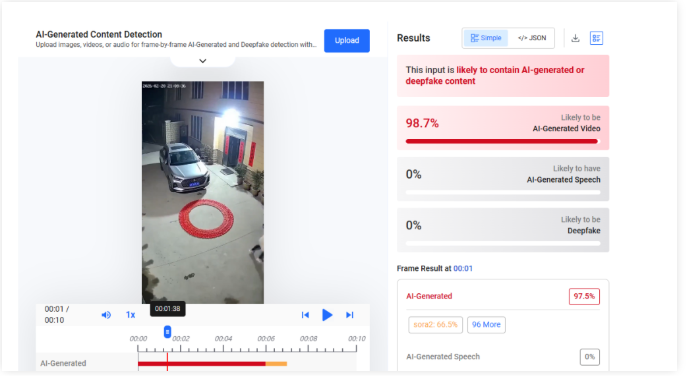
Another AI detection tool, Undetectable.ai, suggested a 77 percent probability that the video was AI-generated.
Conclusion
Our research confirms that the viral video does not depict a real incident. It has been created using Artificial Intelligence and is being misleadingly shared as genuine footage.

Introduction
Attacks by cybercriminals targeting national critical infrastructure are increasing at an unsettling rate. Such attacks have the potential to do severe damage by upsetting transportation networks, utilities, financial services, and other vital infrastructure. The physical and digital systems that underpin a nation's economy are known as critical infrastructure thus if they were to be disrupted, there would be serious risks to the economy and public health and safety. Establishing proper cybersecurity measures and protecting those digital systems from possible threats or cyberattacks is necessary. Both public and private sector assets are included in these essential infrastructure categories.
Nationwide alert:
Recently one of the biggest hacker organizations has warned of an upcoming cyberattack on the critical infrastructure and websites in India, causing a countrywide alert. A gang of hackers from Indonesia and Pakistan, celebrating 4,000 members, announced a planned “Cyber Party” on 11 December 2023. The event’s claimed goal is to compromise and disrupt India's digital infrastructure. They disclosed this information on their Telegram channel.
This hacker organization holds a record of launching extensive cyberattacks; in the past, it sent out a "red notice" that was intended to target 12,000 websites run by the Indian government. They have previously attacked other nations, such as Israel, Sweden, and the United States. Their reasons are varied and might include anything from assaults on certain groups to religious disagreements.
The gang has also been acclaimed for hacking into a New York City police agency, obtaining health and social media data from Israel, and exposing information from Swedish social media users. These alarming events show how urgently strong and all-encompassing cybersecurity measures are needed, not only in India but throughout the world.
Effect(s) on India
1. Central Agencies Are Alert, Expect Health Sector Attacks: The cyberinfrastructure of the health sector has been a common target of assaults, particularly in the aftermath of the COVID-19 epidemic, which has authorities particularly concerned. Relevant ministries have received notifications from central authorities advising them to take precautions against unwanted access. The security of digital infrastructure is seriously challenged by the constantly changing panorama of cyber-attacks, according to those who are aware of the warning and threat.
2. National security concerns: Because of the interconnectedness of critical national infrastructure, a cyberattack may have an impact on national security. Attacks against defense networks, intelligence organizations health infrastructure, or military systems, for instance, might make it more difficult for the nation to respond to threats from outside.
3. Concerns for Public Safety and Health: Cyberattacks on healthcare systems run the risk of compromising patient data, stopping medical procedures, and even endangering the general public's health. This might have potentially fatal results in urgent circumstances.
4. Data Breach and Privacy Issues: Stealing confidential data is a common component of cybersecurity assaults. A breach of critical infrastructure systems might result in sensitive data, including personal information, being misused and accessed without authorization, raising privacy issues.
Preventive and protective measures
1. The plan for responding to incidents: Make sure a clear incident response strategy is in place, with a focus on healthcare systems, and that it is especially designed to handle cyber-attacks on critical infrastructure.
2. Better Tracking: Observing vital networks, systems, and data flows more closely, especially in the healthcare industry. Using cutting-edge threat detection technologies to spot odd or questionable activity.
3. Critical System Isolation: Cutting off vital healthcare systems from the wider network to reduce the chance of attackers moving laterally.
4. Continual Backups: Make sure that backup copies of important data and systems are kept in a safe, isolated location by regularly backing them up. In the event of a ransomware attack or data breach, this makes recovery easier.
5. Update and patch systems: Make sure that all operating systems and apps utilized in the infrastructure of the healthcare industry are updated with the most recent security updates.
6. Protocols for Communication: In the case of a cyber-incident, establishing explicit communication mechanisms to guarantee that pertinent parties are notified as soon as possible. This covers correspondence with law enforcement, the public, and other members of the healthcare industry as needed.
Conclusion
Urgent preventative actions are essential in response to an impending cyber threat revealed by a large hacker organization that is targeting India's key infrastructure, specifically the healthcare sector. The interconnectedness of this infrastructure puts public safety, privacy, and national security in danger. A crucial defensive approach is formed by the proactive measures mentioned, which include communication protocols, system isolation, improved monitoring, incident response preparation, and frequent backups. The dangers underline the necessity of international collaboration in tackling cybersecurity issues and the requirement for shared responsibility of everyone to safeguard digital networks. To reduce risks and guarantee the resilience of vital national infrastructure in the face of changing cyber threats, authorities must continue to develop and adapt their cybersecurity tactics.
References:
- https://www.cnbctv18.com/technology/exclusive--nationwide-alert-sounded-as-hacker-group-plans-cyber-party-to-attack-indias-critical-digital-infra-18520021.htm
- https://www.the420.in/ndian-authorities-high-alert-hacker-groups-threaten-cyber-assault/
- https://www.cnbctv18.com/technology/exclusive--nationwide-alert-sounded-as-hacker-group-plans-cyber-party-to-attack-indias-critical-digital-infra-18520021.htm#:~:text=By%20News18.com%20Dec%208,%3A58%20AM%20IST%20(Published)&text=A%20nationwide%20alert%20has%20been,Indian%20websites%20and%20critical%20infrastructure
- https://verveindustrial.com/resources/blog/critical-infrastructure-cyber-security/
