
Doctrine of ‘Lifting the AI Veil’ | Borrowing an Old Company Law Trick to Solve a New Accountability Problem
Introduction
Company law solved a version of this problem more than a century ago, and artificial intelligence regulation is now quietly borrowing the solution. When something goes wrong inside a company, the law generally cannot reach past the corporate entity to punish the people who ran it, because the company is treated as a legal person entirely separate from its shareholders and directors. Courts developed an exception for exactly the cases where that separation becomes a shield for wrongdoing, and lawyers now call it lifting, or piercing, the corporate veil. A growing body of legal scholarship argues that AI systems present a strikingly similar problem, and needs a strikingly similar fix. That emerging idea has come to be called lifting the AI veil.
Where the original doctrine comes from
The doctrine of lifting the corporate veil traces directly to the House of Lords decision in Salomon v. Salomon & Co. Ltd. in 1897. Aron Salomon, a leather and boot manufacturer, incorporated his existing business, sold it to the new company, and structured share ownership so that he and his family held nearly all the shares. When the company later failed, creditors argued Salomon should be held personally liable, since the company was effectively just him operating under a different name. The House of Lords disagreed, holding decisively that once validly incorporated, a company is a person in law entirely distinct from its subscribers, with its own rights and liabilities. That ruling established what remains company law's foundational principle: separate legal personality.
Separate personality is not, however, unconditional. Courts across common law jurisdictions, including India, carved out an exception for cases where the corporate form is used as a facade for fraud, to evade a statutory obligation, or to circumvent a legal duty that would otherwise apply to the individuals behind it. In such cases, a court will "lift the veil," looking past the company's separate legal identity to attribute liability directly to the directors or shareholders actually in control. India's Supreme Court, in Life Insurance Corporation of India v. Escorts Ltd., reaffirmed that this remains an exception applied only in narrow, exceptional circumstances, generally where a statute contemplates it, or fraud or improper conduct needs to be prevented. The doctrine has since found application well beyond fraud alone, including in tax matters, as seen in cases like State of U.P. v. Renusagar Power Co., where courts treated closely related corporate entities as one for the purpose of a specific statutory benefit.
Why AI creates the same structural problem
Scholarship examining AI liability has increasingly pointed to a near identical structural gap. As AI systems take on functions once reserved for human decision makers, board level analytics, automated lending decisions, algorithmic hiring, even proposed "robo-director" advisory roles, a familiar question resurfaces: who answers for the outcome when the AI system, rather than a named individual, produced the decision. A 2025 academic paper titled Lifting the AI Veil in Company Law argues explicitly that AI liability should be approached through an extension of existing doctrines, including directors' duty of care and precisely the piercing of the veil doctrine traditionally reserved for shareholders, rather than inventing an entirely new liability regime from scratch.
The concern driving this argument is not abstract. Commentary in outlets like MIT Technology Review has warned that granting AI systems anything resembling legal personhood risks handing companies a genuinely dangerous new shield, allowing a company to argue that a harmful outcome was the AI's autonomous decision, disconnected from any human actor's intent or negligence, much as a company might once have argued a harmful outcome was simply "the company's" doing and not any individual's. Critics of AI personhood proposals, writing in journals examining AI as legal persons, make the parallel explicit: while corporate veil piercing exists precisely to stop the corporate form being misused as a liability shield, the justification for extending similar legal personhood to AI is considerably weaker, since corporate personhood serves a clear economic purpose, enabling investment and risk pooling, that AI personhood does not obviously replicate.
How regulators have actually responded
The European Union's experience is instructive precisely because it shows the doctrine's underlying logic being adopted through legislation rather than judicial precedent. The European Commission originally proposed a dedicated AI Liability Directive in September 2022, intended to ease the burden of proof on claimants harmed by AI systems, including a rebuttable presumption of causality where a claimant could show an AI system breached EU AI Act obligations. That proposal was formally withdrawn in 2025, with the withdrawal notice published in the Official Journal on 6 October 2025, after member states failed to reach agreement. In its place, the revised EU Product Liability Directive now does much of the same underlying work through a different legal mechanism, explicitly treating AI software as a "product" for the purposes of manufacturer liability, meaning AI providers face strict liability for defective AI products without claimants needing to prove fault, applicable to AI products placed on the EU market from 9 December 2026 onward. Functionally, this achieves something close to piercing the AI veil by statute: instead of allowing a company to attribute harm to an autonomous algorithmic process and stop the inquiry there, liability is anchored back to the entity that built, trained, or deployed the system.
The Indian angle, and why it matters here
India has no AI specific liability statute at present, and no reported judicial decision has yet applied the corporate veil piercing doctrine by analogy to an AI system. But the underlying legal architecture is already familiar territory for Indian courts. India's jurisprudence on lifting the corporate veil, built through Escorts, Renusagar, and subsequent cases, already establishes the judicial comfort with looking past a formal legal structure to find the real, controlling actor when justice demands it. Indian courts have been consistently clear that this remains an exceptional remedy rather than a routine one, generally invoked where a statute contemplates it, where fraud or improper conduct needs to be prevented, or where a taxing or beneficial statute would otherwise be defeated by rigid adherence to corporate form. That same cautious, fact specific posture is likely to shape how any future Indian AI liability doctrine develops, applied sparingly rather than as a blanket rule.
As AI systems increasingly mediate lending decisions, insurance claims processing, and algorithmic hiring in Indian companies, the same reasoning that let Indian courts see through a corporate facade could plausibly extend to seeing through an "AI made the decision" defence, attributing responsibility to whichever human actor, developer, deployer, or governing board, exercised actual control over how that system was built and used. Given how central technology sector employment and AI deployment already are to India's economy, the absence of a clear domestic answer to this question is unlikely to remain untested for long.
The larger point
The doctrine of lifting the AI veil is less a wholly new legal invention and more a recognition that AI systems and corporations create the same essential problem: a formally separate entity that can, if left unchecked, absorb blame that properly belongs to the humans directing it. Company law solved this by refusing to let the corporate form become an alibi. AI law, whether through judicial doctrine, statute, or a hybrid of both as the EU's experience suggests, will likely need to reach the same conclusion, because the alternative is allowing genuine harm to disappear into a system nobody can be made to answer for.
References
- Bird & Bird, "Proposed EU AI liability rules withdrawn." https://www.twobirds.com/en/insights/2025/proposed-eu-ai-liability-rules-withdrawn
- LegalClarity, "AI Liability Directive: What It Was and Why It Was Withdrawn." https://legalclarity.org/ai-liability-directive-what-it-was-and-why-it-was-withdrawn/
- WCR Legal, "EU AI Liability Directive: Withdrawn, What Now Applies?" https://wcr.legal/eu-ai-liability-directive-withdrawn-pld/
- Verfassungsblog, "Anatomy of a Fall: On the Anticipated Withdrawal of the AI Liability Directive Proposal." https://verfassungsblog.de/anatomy-of-a-fall-aiact-aild-pld/
- MIT Technology Review, "Debates over AI consciousness are a trap." https://www.technologyreview.com/2026/08/20/1142571/ai-consciousness-debate-trap/
- ResearchGate, "Lifting the AI Veil in Company Law." https://www.researchgate.net/publication/393305638_Lifting_the_AI_veil_in_company_law
- Review of Law and Regulation, "Lifting the AI Veil in Company Law." https://rlr.iup.rs/wp-content/uploads/2025/07/04.pdf
- Bhatt & Joshi Associates, "Decoding the Jurisprudence on Lifting the Corporate Veil in Indian Court. https://bhattandjoshiassociates.com/decoding-the-jurisprudence-on-lifting-the-corporate-veil-in-indian-court/
- Mondaq, "Analysis Of Standard Of Proof For Lifting Of The Corporate Veil In Cases Of Fraud." https://www.mondaq.com/india/corporate-and-company-law/1259382/analysis-of-standard-of-proof-for-lifting-of-the-corporate-veil-in-cases-of-fraud
- Record Of Law, "Analysis of the theory of corporate veil lifting." https://recordoflaw.in/analysis-of-the-theory-of-corporate-veil-lifting/
- Suren Uppal Offices, "Lifting of Corporate Veil: Navigating Judicial Precedents." https://www.suolaw.com/lifting-of-corporate-veil-navigating-judicial-precedents/

Related Blogs

The World Wide Web was created as a portal for communication, to connect people from far away, and while it started with electronic mail, mail moved to instant messaging, which let people have conversations and interact with each other from afar in real-time. But now, the new paradigm is the Internet of Things and how machines can communicate with one another. Now one can use a wearable gadget that can unlock the front door upon arrival at home and can message the air conditioner so that it switches on. This is IoT.
WHAT EXACTLY IS IoT?
The term ‘Internet of Things’ was coined in 1999 by Kevin Ashton, a computer scientist who put Radio Frequency Identification (RFID) chips on products in order to track them in the supply chain, while he worked at Proctor & Gamble (P&G). And after the launch of the iPhone in 2007, there were already more connected devices than people on the planet.
Fast forward to today and we live in a more connected world than ever. So much so that even our handheld devices and household appliances can now connect and communicate through a vast network that has been built so that data can be transferred and received between devices. There are currently more IoT devices than users in the world and according to the WEF’s report on State of the Connected World, by 2025 there will be more than 40 billion such devices that will record data so it can be analyzed.
IoT finds use in many parts of our lives. It has helped businesses streamline their operations, reduce costs, and improve productivity. IoT also helped during the Covid-19 pandemic, with devices that could help with contact tracing and wearables that could be used for health monitoring. All of these devices are able to gather, store and share data so that it can be analyzed. The information is gathered according to rules set by the people who build these systems.
APPLICATION OF IoT
IoT is used by both consumers and the industry.
Some of the widely used examples of CIoT (Consumer IoT) are wearables like health and fitness trackers, smart rings with near-field communication (NFC), and smartwatches. Smartwatches gather a lot of personal data. Smart clothing, with sensors on it, can monitor the wearer’s vital signs. There are even smart jewelry, which can monitor sleeping patterns and also stress levels.
With the advent of virtual and augmented reality, the gaming industry can now make the experience even more immersive and engrossing. Smart glasses and headsets are used, along with armbands fitted with sensors that can detect the movement of arms and replicate the movement in the game.
At home, there are smart TVs, security cameras, smart bulbs, home control devices, and other IoT-enabled ‘smart’ appliances like coffee makers, that can be turned on through an app, or at a particular time in the morning so that it acts as an alarm. There are also voice-command assistants like Alexa and Siri, and these work with software written by manufacturers that can understand simple instructions.
Industrial IoT (IIoT) mainly uses connected machines for the purposes of synchronization, efficiency, and cost-cutting. For example, smart factories gather and analyze data as the work is being done. Sensors are also used in agriculture to check soil moisture levels, and these then automatically run the irrigation system without the need for human intervention.
Statistics
- The IoT device market is poised to reach $1.4 trillion by 2027, according to Fortune Business Insight.
- The number of cellular IoT connections is expected to reach 3.5 billion by 2023. (Forbes)
- The amount of data generated by IoT devices is expected to reach 73.1 ZB (zettabytes) by 2025.
- 94% of retailers agree that the benefits of implementing IoT outweigh the risk.
- 55% of companies believe that 3rd party IoT providers should have to comply with IoT security and privacy regulations.
- 53% of all users acknowledge that wearable devices will be vulnerable to data breaches, viruses,
- Companies could invest up to 15 trillion dollars in IoT by 2025 (Gigabit)
CONCERNS AND SOLUTIONS
- Two of the biggest concerns with IoT devices are the privacy of users and the devices being secure in order to prevent attacks by bad actors. This makes knowledge of how these things work absolutely imperative.
- It is worth noting that these devices all work with a central hub, like a smartphone. This means that it pairs with the smartphone through an app and acts as a gateway, which could compromise the smartphone as well if a hacker were to target that IoT device.
- With technology like smart television sets that have cameras and microphones, the major concern is that hackers could hack and take over the functioning of the television as these are not adequately secured by the manufacturer.
- A hacker could control the camera and cyberstalk the victim, and therefore it is very important to become familiar with the features of a device and ensure that it is well protected from any unauthorized usage. Even simple things, like keeping the camera covered when it is not being used.
- There is also the concern that since IoT devices gather and share data without human intervention, they could be transmitting data that the user does not want to share. This is true of health trackers. Users who wear heart and blood pressure monitors have their data sent to the insurance company, who may then decide to raise the premium on their life insurance based on the data they get.
- IoT devices often keep functioning as normal even if they have been compromised. Most devices do not log an attack or alert the user, and changes like higher power or bandwidth usage go unnoticed after the attack. It is therefore very important to make sure the device is properly protected.
- It is also important to keep the software of the device updated as vulnerabilities are found in the code and fixes are provided by the manufacturer. Some IoT devices, however, lack the capability to be patched and are therefore permanently ‘at risk’.
CONCLUSION
Humanity inhabits this world that is made up of all these nodes that talk to each other and get things done. Users can harmonize their devices so that everything runs like a tandem bike – completely in sync with all other parts. But while we make use of all the benefits, it is also very important that one understands what they are using, how it is functioning, and how one can tackle issues should they come up. This is also important to understand because once people get used to IoT, it will be that much more difficult to give up the comfort and ease that these systems provide, and therefore it would make more sense to be prepared for any eventuality. A lot of times, good and sensible usage alone can keep devices safe and services intact. But users should be aware of any issues because forewarned is forearmed.

Executive Summary
An image is being widely circulated on social media with the claim that it shows the destruction caused by an explosion at a mall in Japan following a 7.1-magnitude earthquake in July 2026. The viral image shows a shopping complex in a severely damaged condition, allegedly after the incident. CyberPeace Research Wing’s research found that the viral image does not show damage caused by an explosion or earthquake at any mall in Japan. The visuals in the image do not match authentic photographs of the affected shopping complex. The research further revealed that the viral image was created using Artificial Intelligence (AI).
Claim
A social media post claims that the AEON Mall in Japan exploded after the Kumamoto earthquake and a gas leak was suspected. The post, published in Burmese language on Facebook on July 29, 2026, shared an image claiming to show the aftermath of the incident at the mall.

FactCheck
To verify the authenticity of the viral claim, we conducted a Google search using relevant keywords. During the search, we found a report published by France24, which stated that the Kumamoto disaster management office released updated figures following the earthquake. According to the report, seven bodies were recovered from the debris, steel and wires of the Aeon shopping mall after a suspected gas blast. The report further stated that eight people were confirmed dead at the Nippon Paper Industries factory in Yatsushiro city, where part of a red-and-white smokestack collapsed. Following the 7.1-magnitude earthquake, five others were reported to be in critical condition, while around 9,500 residents were staying in evacuation centres in Kyushu, southwestern Japan.
http://france24.com/en/live-news/20260730-up-to-23-feared-dead-in-japan-quake
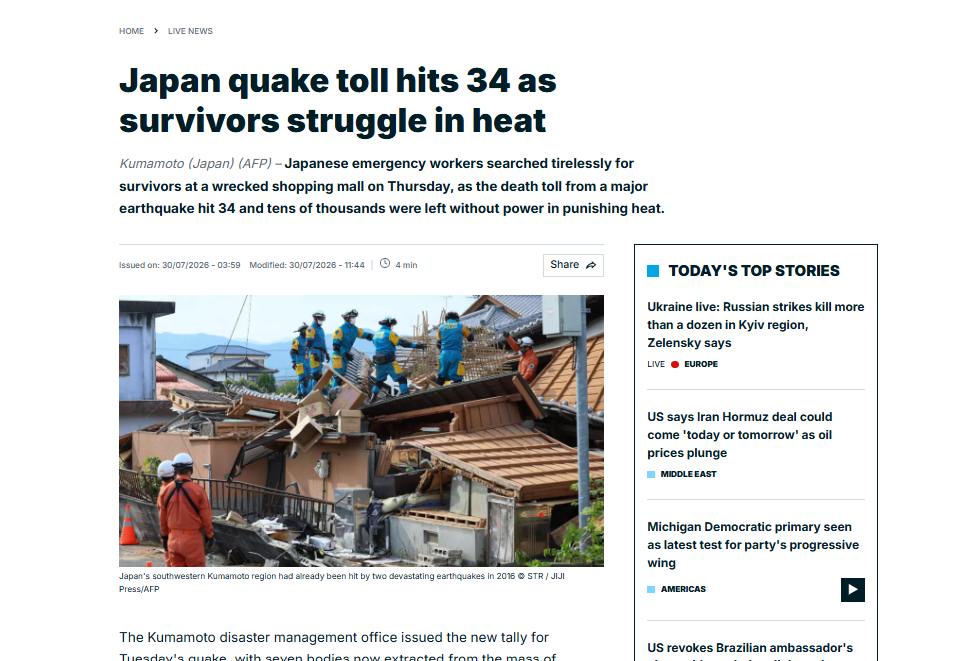
However, the viral image showed several visual inconsistencies and was flagged as AI-generated.
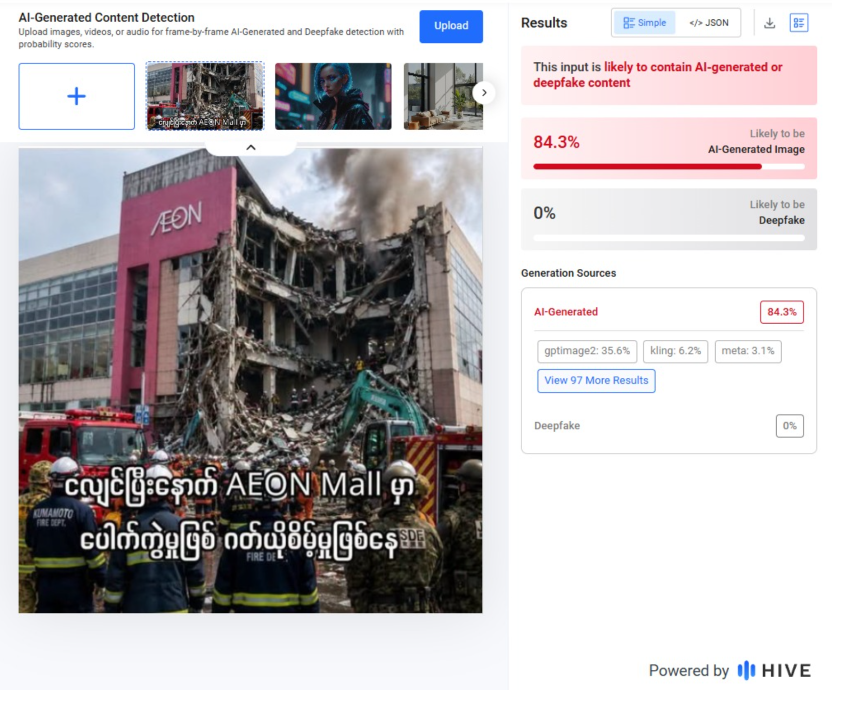
To further examine the authenticity of the image, we scanned it using the AI detection tool Hive Moderation. The results indicated that the image had an 84 percent probability of being AI-generated.
We also analysed the image using Human Meter, where the results showed a 75 percent probability that the image was AI-generated.

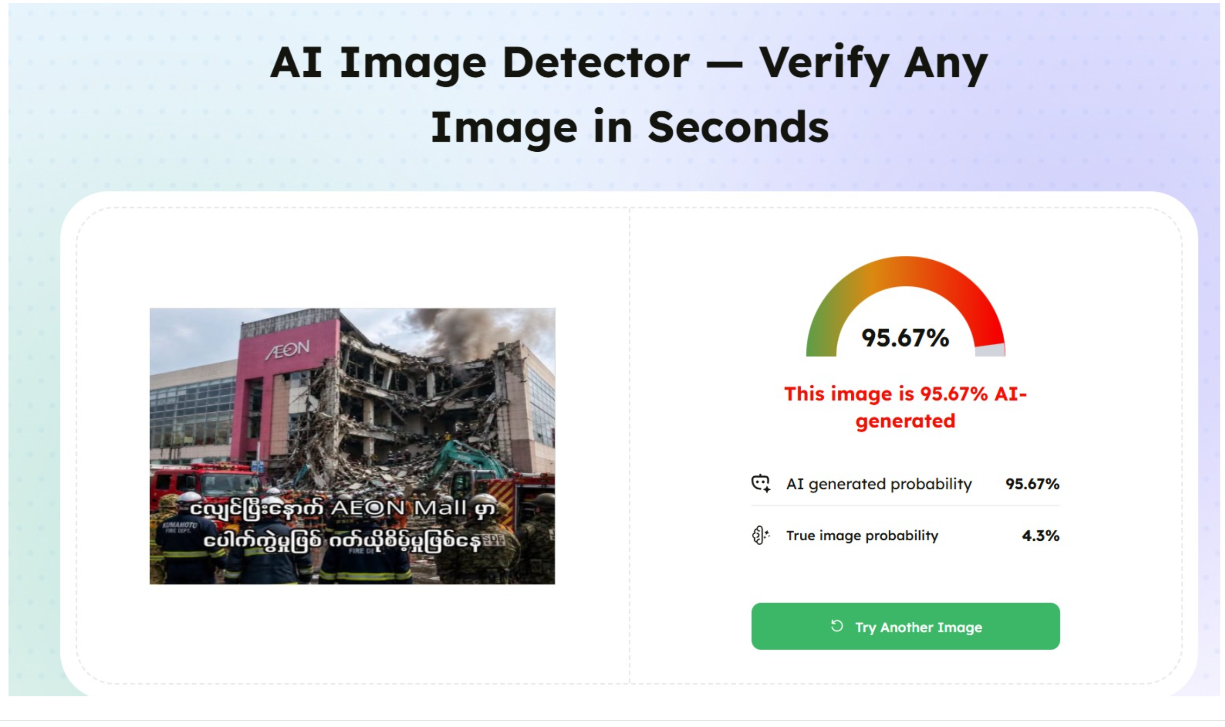
In the final stage of the research, we scanned the image using another AI detection tool, AI Image Detector. The tool indicated that the image had a 95 percent probability of being AI-generated.
Conclusion:
The research established that the viral image is not an authentic photograph of the damage caused by the Kumamoto earthquake or any explosion at an Aeon Mall in Japan. The image contains multiple inconsistencies and was found to be AI-generated. Therefore, the claim linking the image to the Japan earthquake incident is false.
Executive Summary
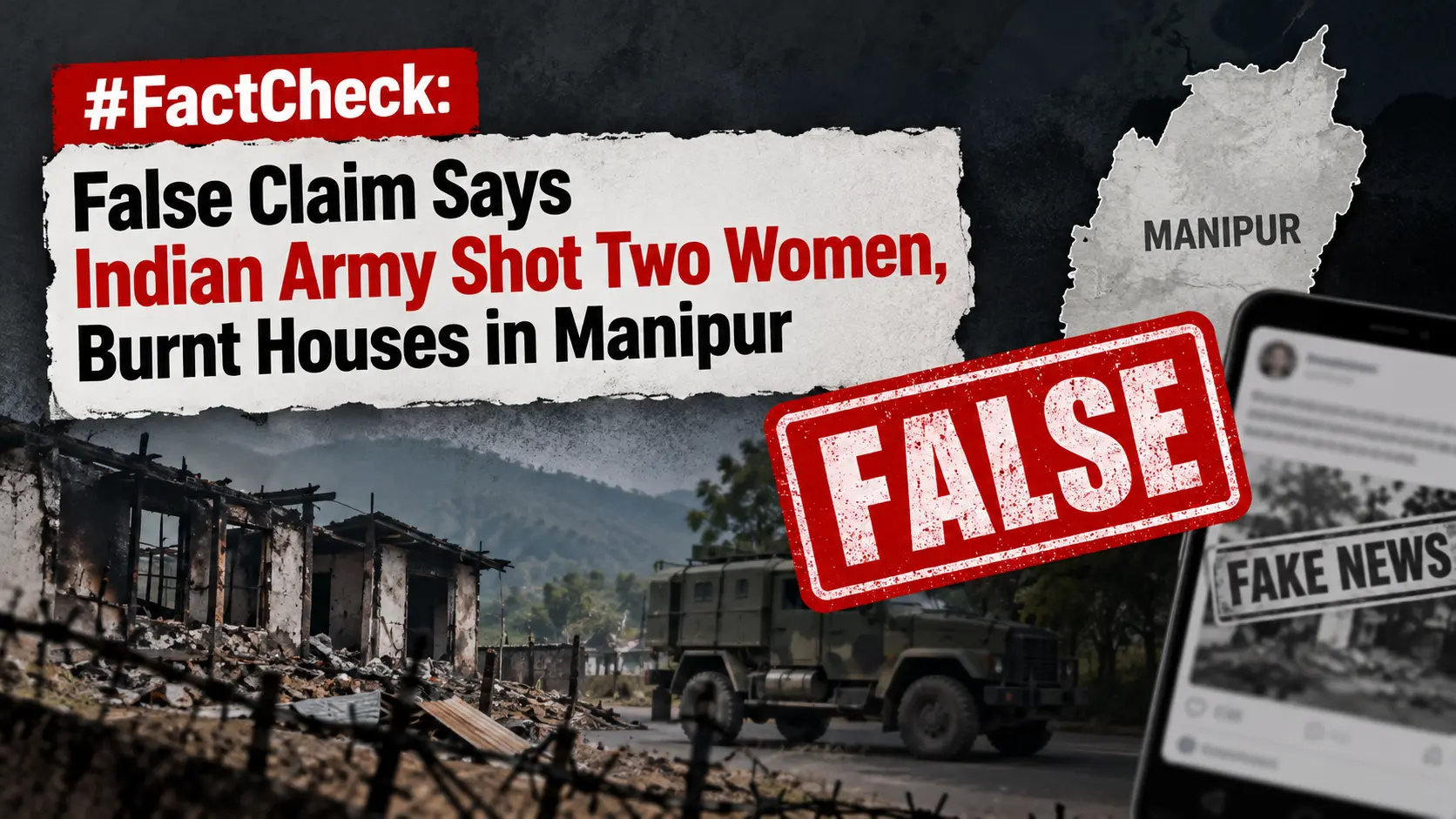
A claim is being shared on social media alleging that two women were shot dead and their homes were set on fire in Manipur. The post alleges that the Indian Army carried out the attack on the orders of Lieutenant General V. M. Bhuvana Krishnan, Commander of the Eastern Command. CyberPeace Research found the claim to be false. According to available reports, suspected militants attacked a hill village in Manipur’s Kangpokpi district. During an exchange of fire with security forces, the attackers set at least two houses on fire.
Claim:
The Indian Army, on the orders of Eastern Command Commander Lieutenant General V. M. Bhuvana Krishnan, shot two women in Manipur and set their homes on fire, following which the situation in the state deteriorated severely.
https://x.com/indiantiwari01/status/2100204995425743103?s=20
https://archive.ph/SOm7I

Fact Check
To verify the viral claim, we conducted a Google search using relevant keywords. During the search, we found a report published on The Times of India website on September 16, 2026. According to the report, suspected militants attacked a hill village in Manipur’s Kangpokpi district on Tuesday night and set at least two houses on fire. Security forces engaged the attackers in an exchange of fire during the incident.According to officials, a large number of militants armed with sophisticated weapons attacked Chawangkining Naga village at around 10:30 p.m. on Tuesday. The attack took place hours after two Kuki women were shot dead at Leisangphai village in neighbouring Tamenglong district.CRPF personnel deployed in the nearby area returned fire, triggering intermittent firing that continued for nearly six hours until around 4:30 a.m. on Wednesday.An official said, “Intermittent firing was reported for nearly six hours till 4:30 a.m. on Wednesday. The CRPF returned fire, preventing the militants from entering the village.” He added that two wooden houses on the outskirts of the village were nevertheless set ablaze.

As part of our further investigation, we conducted a reverse image search of keyframes from the video. During the search, we found the visuals from the viral video on the YouTube channel of @ukhrultimes. According to the accompanying information, intermittent firing continued for nearly six hours in Chawangkining Naga village in Manipur’s Kangpokpi district on the night of September 15, 2026. During the incident, two houses on the outskirts of the village were completely burnt down, while several others were damaged.According to local reports, suspected militants targeted the village despite the deployment of CRPF personnel in the area and engaged in an exchange of fire with security forces. Meanwhile, the Liangmai Naga Council, Manipur (LNC-M), condemned the attack and alleged that suspected Kuki militants operating from the Songtung Suspension of Operations (SoO) camp were behind the firing. However, these allegations regarding the identity of the attackers should be reported as allegations and should not be presented as independently verified facts.
https://www.youtube.com/shorts/QuZ2FoLyA5A

At the end of our investigation, we found a report published on The Hindu website on September 16, 2026. According to the report, officials said that suspected militants had attacked Chawangkining Naga village in Manipur’s Kangpokpi district. During the attack, they engaged in an exchange of fire with security forces and set at least two houses on the outskirts of the village on fire. The report quoted an official as saying that a large number of militants armed with sophisticated weapons attacked the village at around 10:30 p.m. on September 15. The incident took place hours after two Kuki women were shot dead in Leisangphai village in neighbouring Tamenglong district.

Conclusion
Our investigation revealed that separate incidents of the killing of two women and the burning of their houses in Manipur are being falsely shared on social media, claiming them to be actions taken by the Indian Army. According to available reports, on September 15, 2026, two Kuki women were shot dead by unidentified armed assailants in Leisangphai village, Tamenglong district. On the same night, suspected militants attacked Chawangkining Naga village, Kangpokpi district. Security forces exchanged fire, and two houses on the outskirts of the village were set on fire. No credible report has confirmed the links between these incidents and the orders of the Indian Army or Eastern Command Commander Lieutenant General V.M. Bhuvana Krishnan. Therefore, the claim that the Indian Army shot two women and set their houses on fire by linking the two incidents is false and misleading.
