
AI as a Global Good: Guarding Innovation Against Misuse
Introduction
Artificial Intelligence (AI) has transcended its role as a futuristic tool; it is already an integral part of the decision-making process in various sectors, including governance, the medical field, education, security, and the economy, worldwide. On the one hand, there are concerns about the nature of AI, its advantages and disadvantages, and the risks it may pose to the world. There are also doubts about the technology’s capacity to provide effective solutions, especially when threats such as misinformation, cybercrime, and deepfakes are becoming more common.
Recently, global leaders have reiterated that the use of AI should continue to be human-centric, transparent, and governed responsibly. The issue of offering unbridled access to innovators, while also preventing harm, is a dilemma that must be resolved.
AI as a Global Public Good
In earlier times only the most influential states and large corporations controlled the supply and use of advanced technologies, and they guarded them as national strategic assets. In contrast, AI has emerged as a digital innovation that exists and evolves within a deeply interconnected environment, which makes access far more distributed than before. Usage of AI in a specific country will not only bring its pros and cons to that particular place, but the rest of the world as well. For instance, deepfake scams and biased algorithms will not only affect the people in the country where they are created but also in all other countries where such people might be doing business or communicating.
The Growing Threat of AI Misuse
- Deepfakes, Crime, and Digital Terrorism
The application of artificial intelligence in the wrong way is quickly becoming one of the main security problems. Deepfake technology is being used to carry out electoral misinformation spread, communicate lies, and create false narratives. Cybercriminals are now making use of AI to make phishing attacks faster and more efficient, hack into security systems, and come up with elaborate social engineering tactics. In the case of extremist groups, AI has the power to give a better quality of propaganda, recruitment, and coordination.
- Solution - Human Oversight and Safety-by-Design
To overcome these dangers, a global AI system must be developed based on the principles of safety-by-design. This means incorporating moral safeguards right from the development phase rather than reacting after the damage is done. Moreover, human control is just as vital. Artificial intelligence (AI) systems that influence public confidence, security, or human rights should always be under the control of human decision-makers. Automated decision-making where there is no openness or the possibility of auditing could lead to black-box systems being developed, where the assignment of responsibility is unclear.
Three Pillars of a Responsible AI Framework
- Equitable Access to AI Technologies
One of the major hindrances to global AI development is the non-uniformity of access. The provision of high-end computing capability, data infrastructure, and AI research resources is still highly localised in some areas. A sustainable framework needs to be set up so that smaller countries, rural areas, and people speaking different languages will also be able to share the benefits of AI. The distribution of access fairly will be a gradual process, but at the same time, it will lead to the creation of new ideas and improvements in the different places where the local markets are. Thus, there would be no digital divide, and the AI future would not be exclusively determined by the wealthy economies. - Population-Level Skilling and Talent Readiness
AI will have an impact on worldwide working areas. Thus, societies must not only equip their people with the existing job skills but also with the future technology-based skills. Massive AI literacy programs, digital competencies enhancement, and cross-disciplinary education are very important. Forecasting human resources for roles in AI governance, data ethics, cyber security, and modern technologies will help prevent large scale displacement while also promoting growth that is genuinely inclusive. - Responsible and Human-Centric Deployment
Adoption of Responsible AI makes sure that technology is used for social good and not just for making profits. The human-centred AI directs its applications to the sectors like healthcare, agriculture, education, disaster management, and public services, especially the underserved regions in the world that are most in need of these innovations. This strategy guarantees that progress in technology will improve human life instead of making the situation worse for the poor or taking away the responsibility from humans.
Need for a Global AI Governance Framework
- Why International Cooperation Matters
AI governance cannot be fragmented. Different national regulations lead to the creation of loopholes that allow bad actors to operate in different countries. Hence, global coordination and harmonisation of safety frameworks is of utmost importance. A single AI governance framework should stipulate:
- Clear responsible prohibition on AI misuse in terrorism, deepfakes, and cybercrime .
- Transparency and algorithm audits as a compulsory requirement.
- Independent global oversight bodies.
- Ethical codes of conduct in harmony with humanitarian laws.
Framework like this makes it clear that AI will be shaped by common values rather than being subject to the influence of different interest groups.
- Talent Mobility and Open Innovation
If AI is to be universally accepted, then global mobility of talent must be made easier. The flow of innovation takes place when the interaction between researchers, engineers, and policymakers is not limited by borders.
- AI, Equity, and Global Development
The rapid concentration of technology in a few hands poses the risk of widening the gap in equality among countries. Most developing countries are facing the problems of poor infrastructure, lack of education and digital resources. By regarding them only as technology markets and not as partners in innovation, they become even more isolated from the mainstream of development. An AI development mix of human-centred and technology-driven must consider that the global stillness is broken only by the inclusion of the participation of the whole world. For example, the COVID-19 pandemic has already demonstrated how technology can be a major factor in the building of healthcare and crisis resilience. As a matter of fact, when fairly used, AI has a significant role to play in the realisation of the Sustainable Development Goals.
Conclusion
AI is located at a crucial junction. It can either enhance human progress or increase the digital risks. Making sure that AI is a global good goes beyond mere sophisticated technology; it requires moral leadership, inclusion in governance, and collaboration between countries. Preventing misuse by means of openness, supervision by humans, and policies that are responsible will be vital in keeping public trust. Properly guided, AI can make society more resilient, speed up development, and empower future generations. The future we choose is determined by how responsibly we act today.
As PM Modi stated ‘AI should serve as a global good, and at the same time nations must stay vigilant against its misuse’. CyberPeace reinforces this vision by advocating responsible innovation and a secure digital future for all.
References
- https://www.hindustantimes.com/india-news/ai-a-global-good-but-must-guard-against-misuse-pm-101763922179359.html
- https://www.deccanherald.com/india/g20-summit-pm-modi-goes-against-donald-trumps-stand-seeks-global-governance-for-ai-3807928
- https://timesofindia.indiatimes.com/india/need-global-compact-to-prevent-ai-misuse-pm-modi/articleshow/125525379.cms

Related Blogs
Executive Summary
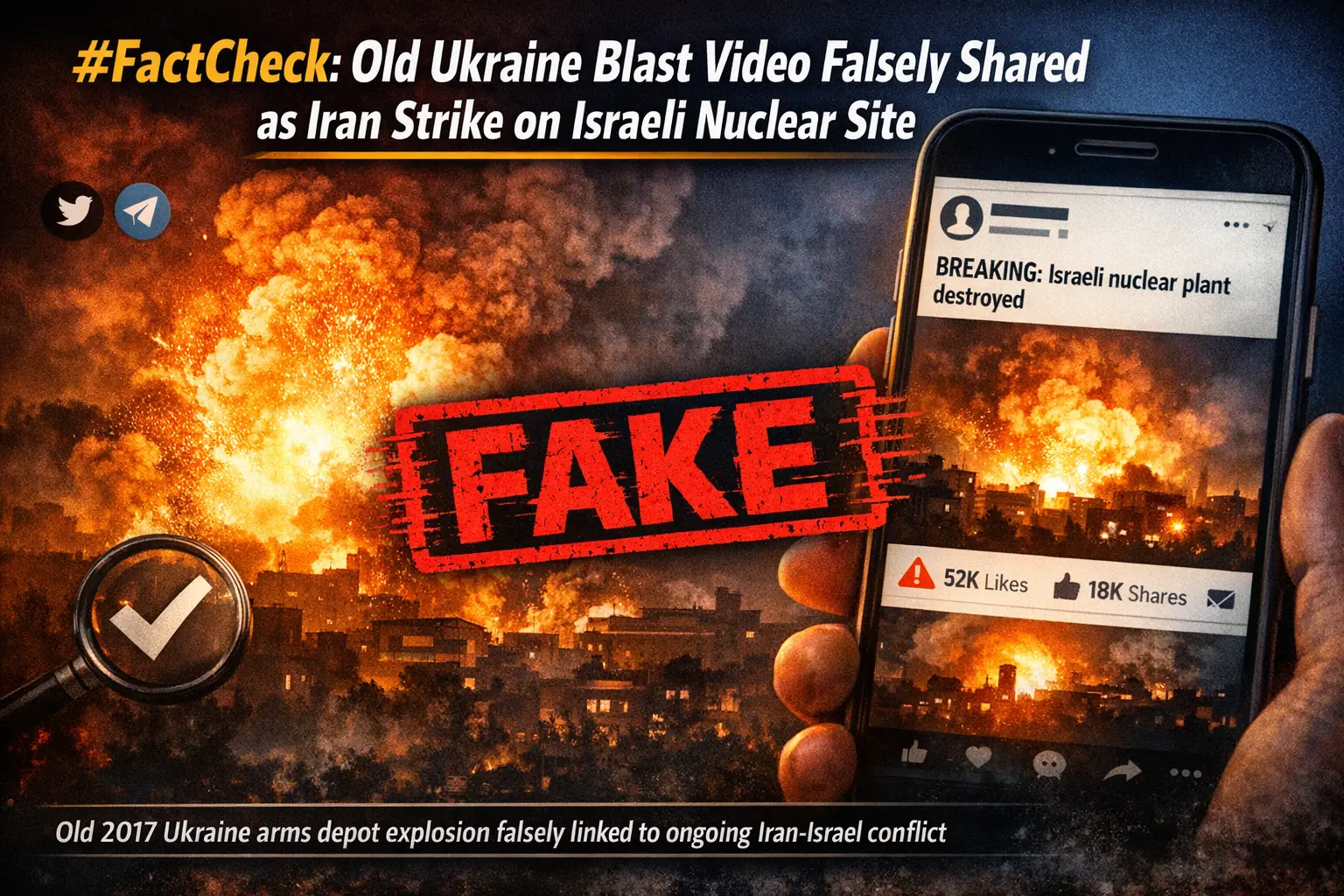
A video showing a massive fire and explosion is going viral on social media. The clip shows a large plume of smoke followed by a sudden blast. It is being shared with the claim that it depicts Iran attacking a nuclear reactor in Israel amid the ongoing Iran-Israel conflict. However, research by CyberPeace found that the claim is misleading. The viral video is actually from 2017 and shows a massive explosion at an ammunition depot in Ukraine.
Claim:
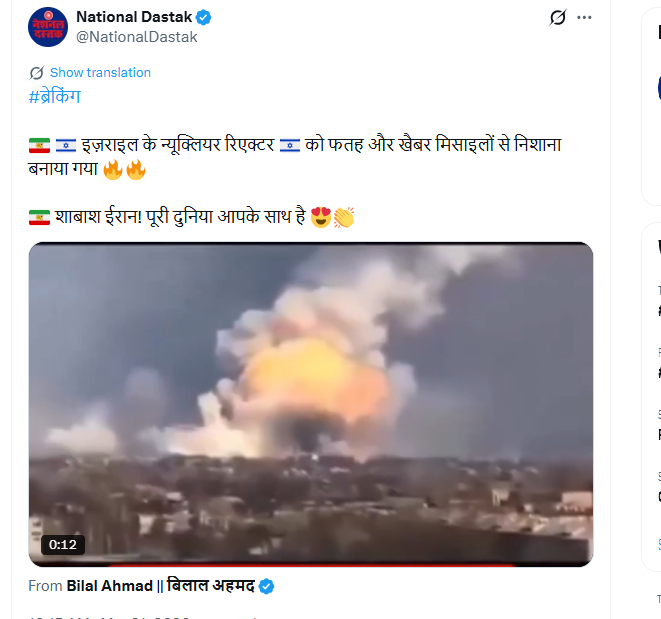
On social media platform X (formerly Twitter), a user shared the video on March 21, 2026, with the caption:“Israel’s nuclear reactor was targeted with Fateh and Khyber missiles. Well done Iran! The whole world is with you.”
Fact Check:
To verify the viral claim, we extracted keyframes from the video and conducted a reverse image search. During this process, we found the same video uploaded on March 23, 2017, on a YouTube channel named “null.” According to the upload, the video shows a massive explosion at an ammunition depot in Balakliya, Ukraine. Using these clues, we performed a keyword search and found a report published on March 24, 2017, by Global News.
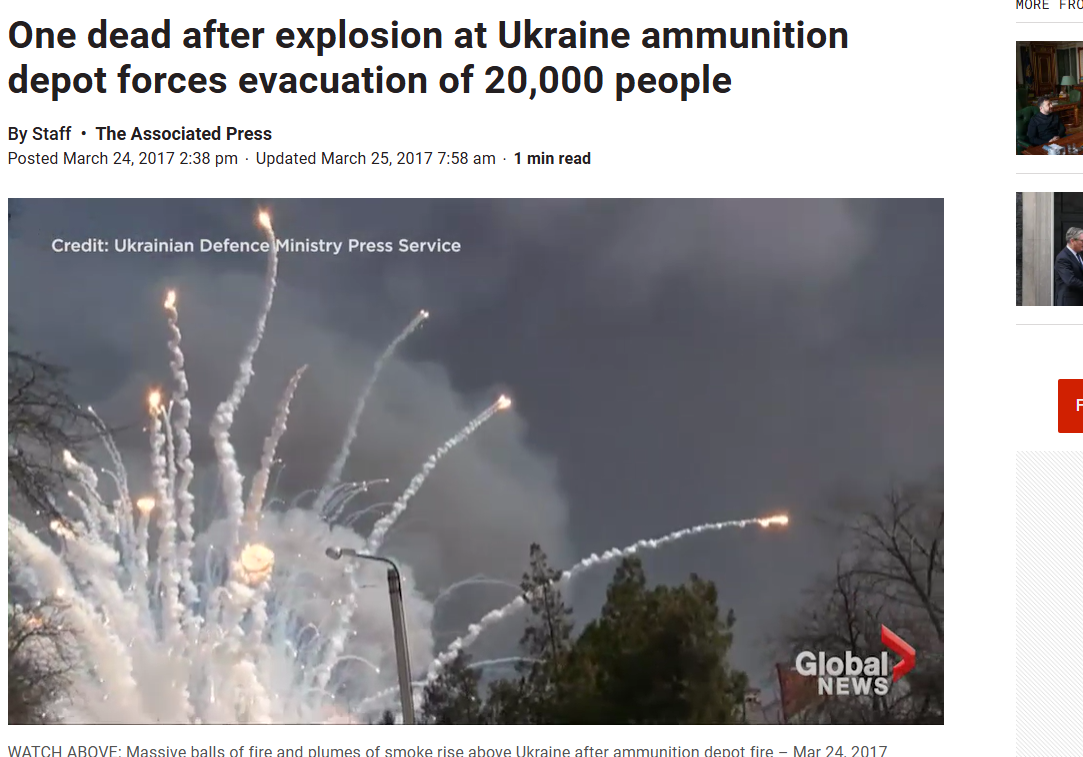
According to the report, a major fire and explosion broke out at a large military ammunition depot in Balakliya, located in Ukraine’s Kharkiv region. The incident resulted in one death, while nearly 20,000 people from surrounding areas were evacuated to safer locations.
Conclusion:
The claim that the video shows Iran attacking a nuclear reactor in Israel is misleading. The viral footage is actually from 2017 and depicts an explosion at an ammunition depot in Ukraine.
.webp)
Introduction
Digitalisation presents both opportunities and challenges for micro, small, and medium enterprises (MSMEs) in emerging markets. Digital tools can increase business efficiency and reach but also increase exposure to misinformation, fraud, and cyber attacks. Such cyber threats can lead to financial losses, reputational damage, loss of customer trust, and other challenges hindering MSMEs' ability and desire to participate in the digital economy.
The current information dump is a major component of misinformation. Misinformation spreads or emerges from online sources, causing controversy and confusion in various fields including politics, science, medicine, and business. One obvious adverse effect of misinformation is that MSMEs might lose trust in the digital market. Misinformation can even result in the devaluation of a product, sow mistrust among customers, and negatively impact the companies’ revenue. The reach of and speed with which misinformation can spread and ruin companies’ brands, as well as the overall difficulty businesses face in seeking recourse, may discourage MSMEs from fully embracing the digital ecosystem.
MSMEs are essential for innovation, job development, and economic growth. They contribute considerably to the GDP and account for a sizable share of enterprises. They serve as engines of economic resilience in many nations, including India. Hence, a developing economy’s prosperity and sustainability depend on the MSMEs' growth and such digital threats might hinder this process of growth.
There are widespread incidents of misinformation on social media, and these affect brand and product promotion. MSMEs also rely on online platforms for business activities, and threats such as misinformation and other digital risks can result in reputational damage and financial losses. A company's reputation being tarnished due to inaccurate information or a product or service being incorrectly represented are just some examples and these incidents can cause MSMSs to lose clients and revenue.
In the digital era, MSMEs need to be vigilant against false information in order to preserve their brand name, clientele, and financial standing. In the interconnected world of today, these organisations must develop digital literacy and resistance against misinformation in order to succeed in the long run. Information resilience is crucial for protecting and preserving their reputation in the online market.
The Impact of Misinformation on MSMEs
Misinformation can have serious financial repercussions, such as lost sales, higher expenses, legal fees, harm to the company's reputation, diminished consumer trust, bad press, and a long-lasting unfavourable impact on image. A company's products may lose value as a result of rumours, which might affect both sales and client loyalty.
Inaccurate information can also result in operational mistakes, which can interrupt regular corporate operations and cost the enterprise a lot of money. When inaccurate information on a product's safety causes demand to decline and stockpiling problems to rise, supply chain disruptions may occur. Misinformation can also lead to operational and reputational issues, which can cause psychological stress and anxiety at work. The peace of the workplace and general productivity may suffer as a result. For MSMEs, false information has serious repercussions that impact their capacity to operate profitably, retain employees, and maintain a sustainable business. Companies need to make investments in cybersecurity defence, legal costs, and restoring consumer confidence and brand image in order to lessen the effects of false information and ensure smooth operations.
When we refer to the financial implications caused by misinformation spread in the market, be it about the product or the enterprise, the cost is two-fold in all scenarios: there is loss of revenue and then the organisation has to contend with the costs of countering the impact of the misinformation. Stock Price Volatility is one financial consequence for publicly-traded MSMEs, as misinformation can cause stock price fluctuations. Potential investors might be discouraged due to false negative information.
Further, the reputational damage consequences of misinformation on MSMEs is also a serious concern as a loss of their reputation can have long-term damages for a carefully-cultivated brand image.
There are also operational disruptions caused by misinformation: for instance, false product recalls can take place and supplier mistrust or false claims about supplier reliability can disrupt procurement leading to disruptions in the operations of MSMEs.
Misinformation can negatively impact employee morale and productivity due to its physiological effects. This leads to psychological stress and workplace tensions. Staff confidence is also affected due to the misinformation about the brand. Internal operational stability is a core component of any organisation’s success.
Misinformation: Key Risk Areas for MSMEs
- Product and Service Misinformation
For MSMEs, misinformation about products and services poses a serious danger since it undermines their credibility and the confidence clients place in the enterprise and its products or services. Because this misleading material might mix in with everyday activities and newsfeeds, viewers may find it challenging to identify fraudulent content. For example, falsehoods and rumours about a company or its goods may travel quickly through social media, impacting the confidence and attitude of customers. Algorithms that favour sensational material have the potential to magnify disinformation, resulting in the broad distribution of erroneous information that can harm a company's brand.
- False Customer Reviews and Testimonials
False testimonies and evaluations pose a serious risk to MSMEs. These might be abused to damage a company's brand or lead to unfair competition. False testimonials, for instance, might mislead prospective customers about the calibre or quality of a company’s offerings, while phony reviews can cause consumers to mistrust a company's goods or services. These actions frequently form a part of larger plans by rival companies or bad individuals to weaken a company's position in the market.
- Misleading Information about Business Practices
False statements or distortions regarding a company's operations constitute misleading information about business practices. This might involve dishonest marketing, fabrications regarding the efficacy or legitimacy of goods, and inaccurate claims on a company's compliance with laws or moral principles. Such incorrect information can result in a decline in consumer confidence, harm to one's reputation, and even legal issues if consumers or rival businesses act upon it. Even before the truth is confirmed, for example, allegations of wrongdoing or criminal activity pertaining can inflict a great deal of harm, even if they are disproven later.
- Fake News Related to Industry and Market Conditions
By skewing consumer views and company actions, fake news about market and industry circumstances can have a significant effect on MSMEs. For instance, false information about market trends, regulations, or economic situations might make consumers lose faith in particular industries or force corporations to make poor strategic decisions. The rapid dissemination of misinformation on online platforms intensifies its effects on enterprises that significantly depend on digital engagement for their operations.
Factors Contributing to the Vulnerability of MSMEs
- Limited Resources for Verification
MSMEs have a small resource pool. Information verification is typically not a top priority for most. MSMEs usually lack the resources needed to verify the information and given their limited resources, they usually tend to deploy the same towards other, more seemingly-critical functions. They are more susceptible to misleading information because they lack the capacity to do thorough fact-checking or validate the authenticity of digital content. Technology tools, human capital, and financial resources are all in low supply but they are essential requirements for effective verification processes.
- Inadequate Digital Literacy
Digital literacy is required for effective day-to-day operations. Fake reviews, rumours, or fake images commonly used by malicious actors can result in increased scrutiny or backlash against the targeted business. The lack of awareness combined with limited resources usually spells out a pale redressal plan on part of the affected MSME. Due to their low digital literacy in this domain, a large number of MSMEs are more susceptible to false information and other online threats. Inadequate knowledge and abilities to use digital platforms securely and effectively can result in making bad decisions and raising one's vulnerability to fraud, deception, and online scams.
- Lack of Crisis Management Plans
MSMEs frequently function without clear-cut procedures for handling crises. They lack the strategic preparation necessary to deal with the fallout from disinformation and cyberattacks. Proactive crisis management plans usually incorporate procedures for detecting, addressing, and lessening the impact of digital harms, which are frequently absent from MSMEs.
- High Dependence on Social Media and Online Platforms
The marketing strategy for most MSMEs is heavily reliant on social media and online platforms. While the digital-first nature of operations reduces the need for a large capital to set up in the form of stores or outlets, it also gives them a higher need to stay relevant to the trends of the online community and make their products attractive to the customer base. However, MSMEs are depending more and more on social media and other online channels for marketing, customer interaction, and company operations. These platforms are really beneficial, but they also put organisations at a higher risk of false information and online fraud. Heavy reliance on these platforms coupled with the absence of proper security measures and awareness can result in serious interruptions to operations and monetary losses.
CyberPeace Policy Recommendations to Enhance Information Resilience for MSMEs
CyberPeace advocates for establishing stronger legal frameworks to protect MSMEs from misinformation. Governments should establish regulations to build trust in online business activities and mitigate fraud and misinformation risks. Mandatory training programs should be implemented to cover online safety and misinformation awareness for MSME businesses. Enhanced reporting mechanisms should be developed to address digital harm incidents promptly. Governments should establish strict penalties for deliberate inaccurate misinformation spreaders, similar to those for copyright or intellectual property violations. Community-based approaches should be encouraged to help MSMEs navigate digital challenges effectively. Donor communities and development agencies should invest in digital literacy and cybersecurity training for MSMEs, focusing on misinformation mitigation and safe online practices. Platform accountability should be increased, with social media and online platforms playing a more active role in removing content from known scam networks and responding to fraudulent activity reports. There should be investment in comprehensive digital literacy solutions for MSMEs that incorporate cyber hygiene and discernment skills to combat misinformation.
Conclusion
Misinformation poses a serious risk to MSME’s digital resilience, operational effectiveness, and financial stability. MSMEs are susceptible to false information because of limited technical resources, lack of crisis management strategies, and insufficient digital literacy. They are also more vulnerable to false information and online fraud because of their heavy reliance on social media and other online platforms. To address these challenges it is significant to strengthen their cyber hygiene and information resilience. Robust policy and regulatory frameworks are encouraged, promoting and mandating online safety training programmes, and improved reporting procedures, are required to overall enhance the information landscape.
References:
- https://www.dai.com/uploads/digital-downsides.pdf
- https://www.indiacode.nic.in/bitstream/123456789/2013/3/A2006-27.pdf
- https://pib.gov.in/PressReleaseIframePage.aspx?PRID=1946375
- https://dai-global-digital.com/digital-downsides-the-economic-impact-of-misinformation-and-other-digital-harms-on-msmes-in-kenya-india-and-cambodia.html
- https://www.dai.com/uploads/digital-downsides.pdf

Introduction
Cyber-attacks are another threat in this digital world, not exclusive to a single country, that could significantly disrupt global movements, commerce, and international relations all of which experienced first-hand when a cyber-attack occurred at Heathrow, the busiest airport in Europe, which threw their electronic check-in and baggage systems into a state of chaos. Not only were there chaos and delays at Heathrow, airports across Europe including Brussels, Berlin, and Dublin experienced delay and had to conduct manual check-ins for some flights further indicating just how interconnected the world of aviation is in today's world. Though Heathrow assured passengers that the "vast majority of flights" would operate, hundreds were delayed or postponed for hours as those passengers stood in a queue while nearly every European airport's flying schedule was also negatively impacted.
The Anatomy of the Attack
The attack specifically targeted Muse software by Collins Aerospace, a software built to allow various airlines to share check-in desks and boarding gates. The disruption initially perceived to be technical issues soon turned into a logistical nightmare, with airlines relying on Muse having to engage in horror-movie-worthy manual steps hand-tagging luggage, verifying boarding passes over the phone, and manually boarding passengers. While British Airways managed to revert to a backup system, most other carriers across Heathrow and partner airports elsewhere in Europe had to resort to improvised manual solutions.
The trauma was largely borne by the passengers. Stories emerged about travelers stranded on the tarmac, old folks left barely able to walk without assistance, and even families missing important connections. It served to remind everyone that the aviation world, with its schedules interlocked tightly across borders, can see even a localized system failure snowball into a continental-level crisis.
Cybersecurity Meets Aviation Infrastructure
In the last two decades, aviation has become one of the more digitally dependent industries in the world. From booking systems and baggage handling issues to navigation and air traffic control, digital systems are the invisible scaffold on which flight operations are supported. Though this digitalization has increased the scale of operations and enhanced efficiency, it must have also created many avenues for cyber threats. Cyber attackers increasingly realize that to target aviation is not just about money but about leverage. Just interfering with the check-in system of a major hub like Heathrow is more than just financial disruption; it causes panic and hits the headlines, making it much more attractive for criminal gangs and state-sponsored threat actors.
The Heathrow incident is like the worldwide IT crash in July 2024-thwarting activities of flights caused by a botched Crowdstrike update. Both prove the brittleness of digital dependencies in aviation, where one failure point triggering uncontrollable ripple effects spanning multiple countries. Unlike conventional cyber incidents contained within corporate networks, cyber-attacks in aviation spill on to the public sphere in real time, disturbing millions of lives.
Response and Coordination
Heathrow Airport first added extra employees to assist with manual check-in and told passengers to check flight statuses before traveling. The UK's National Cyber Security Centre (NCSC) collaborated with Collins Aerospace, the Department for Transport, and law enforcement agencies to investigate the extent and source of the breach. Meanwhile, the European Commission published a statement that they are "closely following the development" of the cyber incident while assuring passengers that no evidence of a "widespread or serious" breach has been observed.
According to passengers, the reality was quite different. Massive passenger queues, bewildering announcements, and departure time confirmations cultivated an atmosphere of chaos. The wrenching dissonance between the reassurances from official channel and Kirby needs to be resolved about what really happens in passenger experiences. During such incidents, technical restoration and communication flow are strategies for retaining public trust in incidents.
Attribution and the Shadow of Ransomware
As with many cyber-attacks, questions on its attribution arose quite promptly. Rumours of hackers allegedly working for the Kremlin escaped into the air quite possibly inside seconds of the realization, Cybersecurity experts justifiably advise against making conclusions hastily. Extortion ransomware gangs stand the last chance to hold the culprits, whereas state actors cannot be ruled out, especially considering Russian military activity under European airspace. Meanwhile, Collins Aerospace has refused to comment on the attack, its precise nature, or where it originated, emphasizing an inherent difficulty in cyberattribution.
What is clear is the way these attacks bestow criminal leverage and dollars. In previous ransomware attacks against critical infrastructure, cybercriminal gangs have extorted millions of dollars from their victims. In aviation terms, the stakes grow exponentially, not only in terms of money but national security and diplomatic relations as well as human safety.
Broader Implications for Aviation Cybersecurity
This incident brings to consideration several core resilience issues within aviation systems. Traditionally, the airports and airlines had placed premium on physical security, but today, the equally important concept of digital resilience has come into being. Systems such as Muse, which bind multiple airlines into shared infrastructure, offer efficiency but, at the same time, also concentrate that risk. A cyber disruption in one place will cascade across dozens of carriers and multiple airports, thereby amplifying the scale of that disruption.
The case also brings forth redundancy and contingency planning as an urgent concern. While BA systems were able to stand on backups, most other airlines could not claim that advantage. It is about time that digital redundancies, be it in the form of parallel systems or isolated backups or even AI-driven incident response frameworks, are built into aviation as standard practice and soon.
On the policy plane, this incident draws attention to the necessity for international collaboration. Aviation is therefore transnational, and cyber incidents standing on this domain cannot possibly be handled by national agencies only. Eurocontrol, the European Commission, and cross-border cybersecurity task forces must spearhead this initiative to ensure aviation-wide resilience.
Human Stories Amid a Digital Crisis
Beyond technical jargon and policy response, the human stories had perhaps the greatest impact coming from Heathrow. Passengers spoke of hours spent queuing, heading to funerals, and being hungry and exhausted as they waited for their flights. For many, the cyber-attack was no mere headline; instead, it was ¬ a living reality of disruption.
These stories reflect the fact that cybersecurity is no hunger strike; it touches people's lives. In critical sectors such as aviation, one hour of disruption means missed connections for passengers, lost revenue for airlines, and inculcates immense emotional stress. Crisis management must therefore entail technical recovery and passenger care, communication, and support on the ground.
Conclusion
The cybersecurity crisis of Heathrow and other European airports emphasizes the threat of cyber disruption on the modern legitimacy of aviation. The use of increased connectivity for airport processes means that any cyber disruption present, no matter how small, can affect scheduling issues regionally or on other continents, even threatening lives. The occurrences confirm a few things: a resilient solution should provide redundancy not efficiency; international networking and collaboration is paramount; and communicating with the traveling public is just as important (if not more) as the technical recovery process.
As governments, airlines, and technology providers analyse the disruption, the question is longer if aviation can withstand cyber threats, but to what extent it will be prepared to defend itself against those attacks. The Heathrow crisis is a reminder that the stake of cybersecurity is not just about a data breach or outright stealing of money but also about stealing the very systems that keep global mobility in motion. Now, the aviation industry is tested to make this disruption an opportunity to fortify the digital defences and start preparing for the next inevitable production.
References
- https://www.bbc.com/news/articles/c3drpgv33pxo
- https://www.theguardian.com/business/2025/sep/21/delays-continue-at-heathrow-brussels-and-berlin-airports-after-alleged-cyber-attack
- https://www.reuters.com/business/aerospace-defense/eu-agency-says-third-party-ransomware-behind-airport-disruptions-2025-09-22/
