
CyberPeace First Responder Program | Kendriya Vidyalaya Sangathan (KVS) June 2026
00
00
00
00


1. Event Overview
The Webinar on Cyber Security and How to Be Safe Online was conducted for students, teachers, and school leadership under the Kendriya Vidyalaya Sangathan (KVS) network with the objective of strengthening cyber awareness and promoting safe, responsible, and secure digital practices among school communities.
The webinar series focused on creating awareness about the rapidly evolving cyber threat landscape and the increasing risks faced by students and educators in their day-to-day digital interactions. The sessions highlighted common forms of cybercrime, online fraud, social media risks, digital safety practices, and the importance of responsible online behaviour.
The programme witnessed 127,117 total participants from 297 schools across six KVS regions, demonstrating significant interest and engagement in cyber safety and digital awareness.
2. Objectives of the Programme
The key objectives of the webinar were to:
- Create awareness about common cybersecurity threats and online frauds.
- Educate students about safe and responsible internet usage.
- Help participants identify technology-enabled scams and fraudulent activities.
- Promote awareness regarding financial and payment frauds.
- Highlight risks associated with social media and digital platforms.
- Sensitize students about phishing, suspicious links, fake profiles, and malicious communications.
- Provide practical guidance on dealing with fraudulent phone calls and messaging scams.
- Encourage students and teachers to adopt stronger digital security and privacy practices.
- Build a culture of cyber hygiene, responsible digital citizenship, and online resilience.
3. Programme Coverage
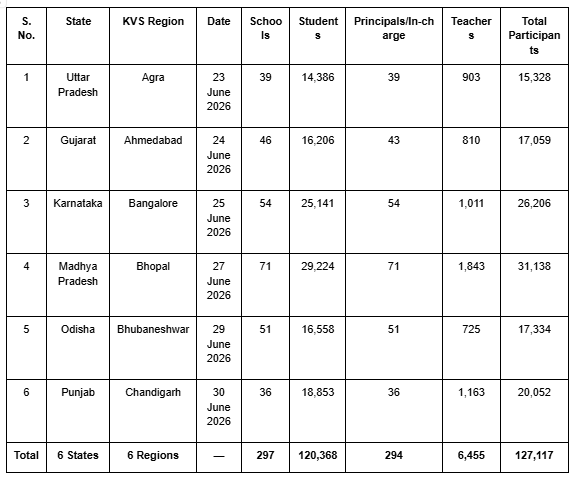
The webinar series covered six KVS regions during June 2026:
4. Participation at a Glance
The programme achieved extensive participation across the six KVS regions.
Key Highlights
- 297 schools participated.
- 120,368 students participated in the webinar sessions.
- 6,455 teachers participated.
- 294 Principals/In-charge participated.
- 127,117 total participants were recorded.
- The programme was conducted across 6 KVS regions in 6 states.
- The sessions were conducted between 23 June and 30 June 2026.
The Bhopal Region recorded the highest overall participation with 31,138 participants, followed by Bangalore with 26,206 participants and Chandigarh with 20,052 participants.
5. Key Areas Covered During the Webinar
The sessions focused on practical cybersecurity awareness and addressed several important areas relevant to school students and educators.
Cybercrime Awareness
Participants were introduced to common forms of cybercrime and how criminals exploit technology, social engineering, and human behaviour to target individuals.
Technology-Based Scams
The webinar highlighted emerging technology-enabled scams and encouraged participants to verify digital information before responding, clicking links, downloading files, or sharing personal information.
Financial and Payment Fraud
Participants were sensitized to risks involving:
- UPI and digital payment fraud
- Fake payment requests
- Phishing links
- OTP-related fraud
- Impersonation scams
- Fake customer-care numbers
- Fraudulent investment and reward schemes
The importance of never sharing OTPs, PINs, passwords, or banking credentials was emphasized.
Social Media and Digital Fraud
The programme addressed risks associated with excessive and unsafe social media usage, including:
- Fake social media profiles
- Account takeover
- Online impersonation
- Social engineering
- Cyberbullying
- Malicious links
- Privacy violations
- Unverified information and misinformation
Messaging and Phone-Call Scams
Participants were made aware of scam calls and messages that attempt to create urgency or fear to manipulate victims into revealing sensitive information or transferring money.
The importance of pausing, verifying, and reporting suspicious communications was emphasized.
6. Cyber Safety Practices Promoted
The webinar encouraged participants to adopt simple but effective cybersecurity practices, including:
- Use strong and unique passwords for different accounts.
- Enable Multi-Factor Authentication (MFA) wherever available.
- Never share OTP, PIN, password, or other authentication credentials.
- Avoid clicking on suspicious or unknown links.
- Verify the identity of individuals contacting you online.
- Keep operating systems, applications, and security software updated.
- Avoid downloading applications from untrusted sources.
- Review privacy and security settings on social media platforms.
- Think before posting or sharing personal information online.
- Report suspicious activities and cyber incidents through appropriate channels.
7. Student Engagement and Awareness
The webinar placed particular emphasis on students as active participants in the digital ecosystem. Students were encouraged to become more vigilant and responsible digital citizens rather than passive users of technology.
The sessions emphasized that cybersecurity is not limited to technical controls and that individual awareness and responsible behaviour are equally important components of digital security.
Participants were encouraged to:
- Question suspicious online requests.
- Verify information before sharing it.
- Recognize common social-engineering techniques.
- Protect their digital identity.
- Maintain privacy on social media.
- Seek assistance from parents, teachers, or trusted authorities when encountering suspicious online activities.
8. Regional Participation and Outreach
The programme demonstrated extensive geographical outreach across the KVS network.
The Bhopal Region recorded the highest participation with 31,138 participants, while Bangalore Region recorded 26,206 participants. Chandigarh, Ahmedabad, Odisha, and Agra also demonstrated strong participation.
The large-scale participation indicates a significant demand for cybersecurity awareness programmes among students, teachers, and school administrators.
9. Impact of the Programme
The webinar contributed to strengthening cybersecurity awareness among a large and diverse school community.
The programme helped:
- Increase awareness of emerging cyber threats.
- Improve understanding of online scams and fraud.
- Promote safer digital behaviour among students.
- Strengthen cybersecurity awareness among teachers and school leadership.
- Encourage responsible social media usage.
- Improve recognition of phishing and social-engineering attempts.
- Promote the importance of protecting personal and financial information.
- Reinforce the concept of cyber hygiene and digital responsibility.
With more than 1.27 lakh participants, the initiative represents a significant effort towards mainstreaming cybersecurity education among young digital users.
10. Key Outcome
The webinar successfully established cybersecurity awareness as an important component of digital education. By bringing together students, teachers, and school leadership, the programme created a broader ecosystem of informed and responsible digital users.
The scale of participation across 297 schools and six KVS regions demonstrates the effectiveness of collaborative awareness initiatives in reaching large student communities and strengthening India's culture of cyber safety.
11. Conclusion
The Webinar on Cyber Security and How to Be Safe Online conducted across Kendriya Vidyalaya Sangathan regions successfully achieved its objective of enhancing cybersecurity awareness among students, teachers, and school leadership.
The programme provided participants with practical knowledge to identify and respond to technology-based scams, financial fraud, social media threats, phishing attempts, and suspicious calls and messages. The strong participation of 127,117 individuals from 297 schools reflects the growing importance of cybersecurity education in the school ecosystem.
The initiative reinforces the need for continuous cyber awareness programmes that empower young users with the knowledge, skills, and confidence required to navigate the digital world safely and responsibly.
You're invited! Join hands with the cyber peace movement and register for our upcoming event.


InMobi Group
eRaksha Winners
CyberPeace Corps Volunteers
• Mitigating the Risk of AI

